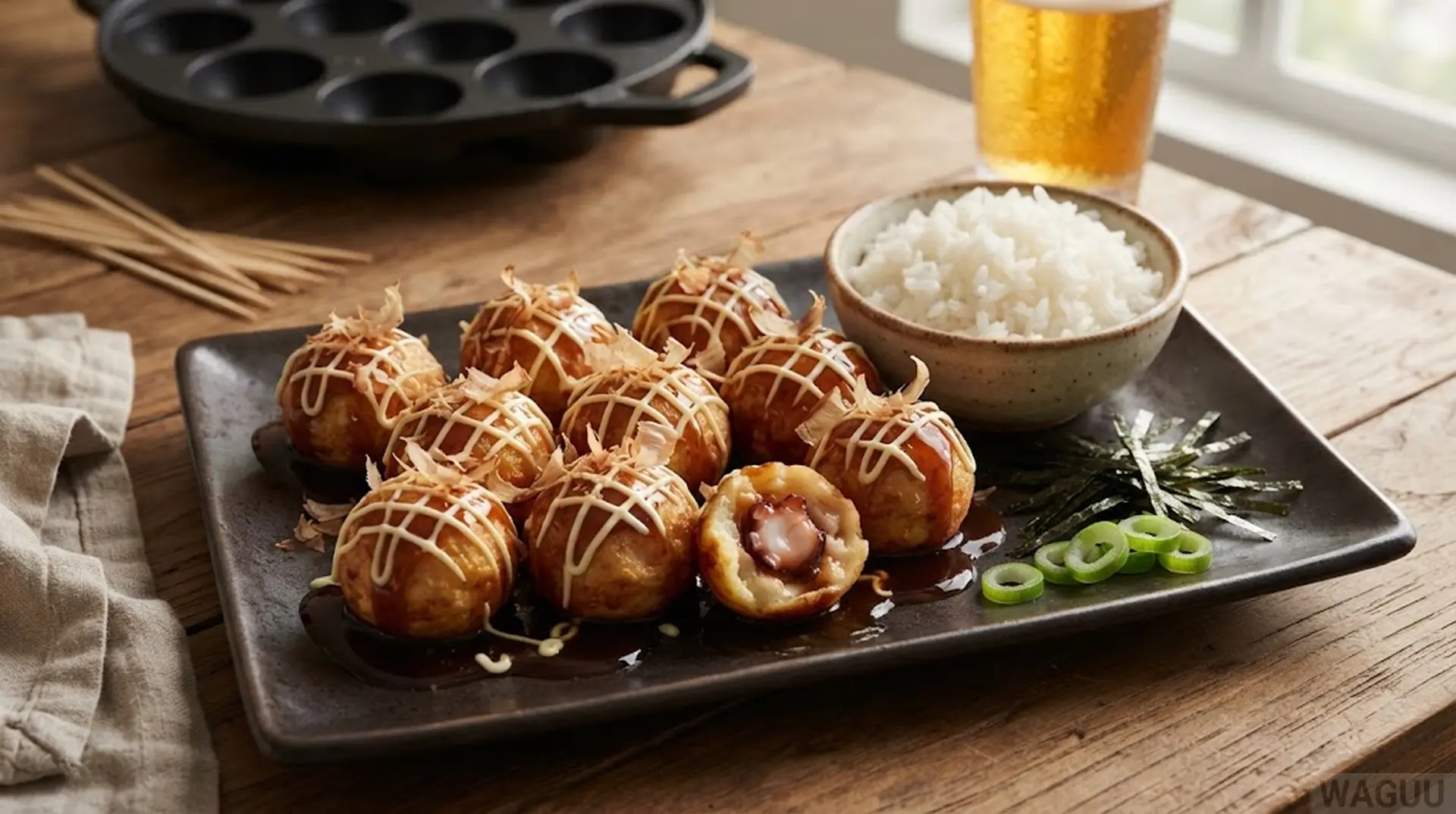
Summary: Takoyaki made from a thin batter of plain flour, dashi stock and egg, filled with diced cooked octopus and pickled ginger. The batter is poured into a hot cast-iron pan with half-spherical hollows and turned with skewers until it closes into a ball. The finished balls are brushed with sauce, mayonnaise and sprinkled with bonito flakes. Total time 75 minutes, makes 6 servings.
Have you cooked this recipe? Share your result with the community.
Category: fish-and-seafood, japanese-cuisine
Success rate: not rated yet % of users managed this recipe
Quick overview
- Dish: Takoyaki – round fried batter balls filled with octopus, typical of Osaka
- Category: fish-and-seafood, japanese-cuisine
- Cuisine: Japanese
- Main ingredient: Cooked octopus, 300 g (diced) (quality specification)
- Guide: 12 most famous Japanese dishes: traditional recipes from Japanese cuisine
- Total time: 75 minutes (35 min preparation + 40 min cooking)
- Difficulty: Challenging
- Servings: 6 (Serving weight: 250 g)
- Key technique: Frying in a cast-iron pan with half-spherical hollows and turning the batter with skewers by ninety degrees
- Cooking methods: Pan-frying
- Dietary info & allergens: gluten (plain flour, soy sauce), egg (egg, mayonnaise), molluscs (octopus), soy (soy sauce), fish (bonito flakes)
- Suitable for: A party for six to eight people, an evening with friends at a Japanese table, a family gathering, a celebration with a hot pan in the middle of the table, a home version of Osaka street food.
- Nutrition (per 1 serving): 410, Protein: 21.0 g, Fat: 14.0 g, Carbohydrates: 41.0 g
- Storage: 2 days in the fridge, 1 month in the freezer
- Pairing: Japanese light lager, dry white wine, cold mugi barley tea
- In short: Takoyaki made from a thin batter of plain flour, dashi stock and egg, filled with diced cooked octopus and pickled ginger. Total time 75 minutes, serves 6.
WAGUU says: “”The batter for takoyaki is deliberately thin. If it were thick, the ball would not close and raw flour would remain inside.””
Key facts
| Preparation time: | 35 |
| Cooking time: | 40 |
| Temperature: | Pan heated to 190–200 °C, frying at 180 °C |
| Servings: | 6 |
In a nutshell
Takoyaki looks like play, but the pan temperature and the thinness of the batter decide everything. The batter must be runnier than for pancakes so that it wraps itself around the filling in the hollow. The pan heats for a long time and evenly, because a cold spot means a ball that will not release and tears. Turning with skewers is not decoration: each quarter turn adds a layer of batter to the ball and seals it. If you turn too late, the batter leaks out; if too early, the ball falls apart.
Ingredients
Base servings: 6 servings • Serving weight: 250 g
| Ingredient | Amount | Quality |
|---|---|---|
| plain flour | 200 g | wheat, finely milled, sifted |
| dashi stock | 500 ml | from seaweed and dried fish |
| egg | 3 pcs | fresh, room temperature, size M |
| cooked octopus | 300 g | cooked, tender, cut into 8 mm dice |
| spring onion | 4 pcs | fresh, cut into thin rings |
| pickled ginger | 60 g | sweet-and-sour brine, finely chopped |
| tenkasu | 40 g | crispy pieces of fried batter |
| rapeseed oil | 60 ml | for greasing the pan, high smoke point |
| fine sea salt | 4 g | for the batter |
| soy sauce | 20 ml | naturally fermented, for the batter |
| okonomiyaki sauce | 80 ml | thick, sweet-and-sour, with a fruity note |
| mayonnaise | 60 ml | Japanese, unsweetened |
| bonito flakes | 12 g | thin shavings of dried fish |
| nori sheets | 2 pcs | toasted, cut into fine strips |
Why you’ll love this recipe
- A hot pan in the middle of the table: The balls are made right at the table and eaten immediately. No one waits, everyone takes what is just ready.
- Thin batter that closes itself: The batter is runnier than for pancakes. In the hot hollow it wraps around the filling without shaping by hand.
- Precise ratios for 6 servings: Fifty grams of octopus per serving, one and a half eggs per batch and a pan that holds the heat. Everything recalculates according to the number of diners.
Guaranteed success: Thin batter behaves differently in a hot hollow than thick batter. The water in the batter at the boundary with the metal turns to steam, which lifts the batter and forces it up the walls of the hollow. That is why the ball closes itself, without shaping by hand. The gluten from the plain flour holds the batter together, but it must be mixed briefly. If the batter is mixed for a long time or left to rest, the gluten tightens, the batter thickens and it will not wrap around the filling in the hollow. The octopus is added cooked, because raw would not heat through during the short frying and would remain tough. Turning with skewers has two effects: it turns the unclosed side to the hot metal and at the same time picks up batter from around the hollow, so the ball grows into a full shape.
Recipe overview
Preparation: 35 min min | Cooking: 40 min min | Difficulty: Challenging | Servings: 6 | Type: Main course | Origin: Japanese
Detailed method
Total progress: 6 % done
Phase 1: Prepare the filling – 15 min
Equipment: fridge, sharp knife
1. Pat the cooked octopus dry with kitchen paper and cut it into evenly sized dice. Put the dice in a bowl and place in the fridge.
2. Cut the spring onion into thin rings, finely chop the pickled ginger and cut the nori into fine strips. Keep everything in separate bowls next to the pan.
VKB: The octopus dice are the same size, dry to the touch and hold their shape. The onion and ginger are finely chopped and there is no liquid in the bowls.
Before you move to the next step:
Do not cook the octopus again or rinse it. Cooked octopus shrinks to rubber with further heat; cut it and keep it cold.
Phase 2: Batter – 8 min
Equipment: bowl, whisk
1. Sift the plain flour into a bowl and add the salt. Whisk the egg with the dashi stock and soy sauce and pour the liquid into the flour.
2. Whisk just until small lumps of flour remain in the batter. Cover the batter and leave it to rest, then give it a quick stir again before pouring.
VKB: The batter is thin like cream, runs off the whisk in a thin stream and has tiny bubbles on the surface. There is no settled flour at the bottom of the bowl.
Before you move to the next step:
Do not mix the batter for long and do not leave it standing overnight. The gluten will tighten, the batter will thicken and it will not wrap around the filling in the hollow.
Phase 3: Heating the pan – 12 min
Equipment: cast iron takoyaki pan, kitchen thermometer, pastry brush
1. Place the pan over a medium flame and let it heat slowly and evenly. Brush each hollow with a thin layer of oil and let the oil heat through.
2. Check the temperature with a drop of batter in one hollow. The batter should immediately catch on the edges, puff up and not turn black. Then wipe the pan and brush with oil again.
VKB: The thermometer reads 190–200°C. A drop of batter in a hollow sets immediately at the edges and turns golden. The pan is dry, the oil does not pool.
Before you move to the next step:
Do not put the pan over the highest flame. Cast iron heats unevenly, one side will burn the balls and the other will leave them raw.
Phase 4: Frying and turning – 18 min
Equipment: takoyaki pan, skewers or two chopsticks
1. Place a piece of octopus, a slice of spring onion and some ginger with tenkasu into each hollow. Pour the batter so that the hollows overflow and the batter joins the neighbouring hollows.
2. After a moment, run a skewer over the surface of the pan and push the excess batter into the hollows. Once the edge of a hollow sets, turn each ball a quarter turn with the skewer. Repeat turning until the batter closes into a full ball and the surface is golden brown.
VKB: The balls release from the metal on their own and hold their shape when turned. The surface is golden brown all over and sounds hollow when tapped with a skewer. No liquid batter is visible inside.
Before you move to the next step:
Do not turn the balls before the edge sets. Soft batter will break apart and leak into the hollow, where it will burn.
Phase 5: Finishing and topping – 7 min
Equipment: pastry brush, tongs, plate
1. Lift the cooked balls with tongs onto a warmed plate and brush them with okonomiyaki sauce. Apply the mayonnaise with a spoon in thin lines over the sauce.
2. Sprinkle the balls with bonito flakes, strips of nori and rings of spring onion. Serve immediately, while the surface is crisp.
VKB: The sauce glistens and clings to the surface of the balls, the mayonnaise lattice is distinct. The bonito flakes curl in the heat. The balls on the plate hold their shape and do not flatten.
Required equipment
| Utensil | Ideal size | Alternative | Risk |
|---|---|---|---|
| cast iron takoyaki pan | 18 hollows, hollow diameter 4 cm | two smaller pans and frying in two batches | a thin pan without mass will not hold heat and the balls will not close |
| turning skewers | wooden or metal, 15 cm long | two thick chopsticks | a thick spoon will crush the batter and the ball will break apart |
| oil brush | silicone, narrow | paper towel soaked in oil | a thick layer of oil will overheat in the hollow and the ball will taste bitter |
| kitchen thermometer | up to 250°C, fast response | check with a drop of batter | without measuring temperature the balls will burn outside and stay raw inside |
| tongs | long narrow jaws | two forks | short tongs bring your hand close to the hot pan |
Shopping list
Nutritional profile
Values per 1 portion (without side dish). Calculated from average nutritional values of ingredients.
| Nutrient | Per 100 g | Per 1 portion | Per 6 portions |
|---|---|---|---|
| Energy | 686 kJ / 164 kcal | 1715 kJ / 410 kcal | 10293 kJ / 2460 kcal |
| Fat | 5.6 g | 14.0 g | 84.0 g |
| of which saturates | 1.2 g | 2.9 g | 17.4 g |
| Carbohydrate | 16.4 g | 41.0 g | 246.0 g |
| of which sugars | 2.2 g | 5.6 g | 33.6 g |
| Protein | 8.4 g | 21.0 g | 126.0 g |
| Salt | 0.5 g | 1.3 g | 7.8 g |
Reference intake of an average adult (8400 kJ / 2000 kcal).
WAGUU Professional level
- Professional standard: Tested recipe with precise ratios and visual checkpoints.
- Tip 1: Tested recipe with precise ratios and visual checkpoints.
- Tip 2: Mix the batter only until the ingredients come together and leave it to rest, but stir it briefly again before pouring. Settled flour at the bottom would otherwise clog the hollows.
- Tip 3: Heat the pan long and slowly, ideally ten minutes over a medium flame. A cold spot in the cast iron means a ball that will not release and tears.
- Tip 4: Try the first ball and cut it open. If there is raw flour inside, lower the temperature and extend the frying time, not the other way round.
Scientific background
Thin batter behaves differently in a hot hollow than thick batter. Water in the batter turns to steam at the metal boundary, which lifts the batter and forces it up the sides of the hollow, so the ball closes by itself. Gluten from plain flour holds the batter together, but it must be mixed briefly. When the batter is mixed for long or left to rest, the gluten tightens and the batter will not wrap around the filling in the hollow. Octopus is added cooked, because raw would not heat through during the short frying.
Fine Dining – Professional techniques
- Plate composition: Stack the balls on a plate in a pyramid, then pour over the sauce and mayonnaise in a circular motion. Add the bonito flakes at the table.
- Texture contrasts: Crisp bonito flakes and crisp spring onion provide contrast against the soft centre. One piece should have both.
- Temperature contrast: Serve the balls immediately after lifting from the pan, when the surface is crispest and the centre hottest. Cold takoyaki loses both shape and flavour.
- Aromatic additions: Stir a teaspoon of rice vinegar and a pinch of wasabi into the mayonnaise. The acid cuts through the sweet sauce and the wasabi aroma underlines the octopus flavour.
Sensory radar
- Appearance: The balls are golden brown all over and hold a round shape. The surface is decorated with dark sauce, a white mayonnaise lattice, green nori strips and brown bonito flakes that curl in the heat.
- Aroma: Aroma of fried batter and seafood, followed by the sweet aroma of the sauce and a fresh note of spring onion.
- Taste: Sweet and salty taste of the sauce, followed by the taste of octopus and seaweed. Mayonnaise rounds and softens the flavour.
- Texture:The surface of each ball is crisp, the inside soft and moist. Pieces of octopus offer a slight resistance, and tenkasu adds crunch.
Pairings
- Japanese pale lager: The carbonation and gentle bitterness cut through the oil from the fried batter. Serve chilled at 6–8 °C.
- Dry white wine: Muscadet or Pinot Blanc with higher acidity. The wine’s acidity cleanses the palate after the sweet sauce and mayonnaise.
- Sencha green tea: Warm, but not boiling. The tea’s bitterness balances the combination of sauce and bonito flakes.
Variations
- Cheese takoyaki:: Add a cube of gouda cheese to the hollow along with the octopus. The cheese melts and the ball gets a creamy centre.
- Meat-free version:: Replace the octopus with pieces of pickled radish and sweetcorn. The flavour is fresh and the balls close just as easily.
Allergens and dietary information
Contains: gluten (plain flour, soy sauce), egg (egg, mayonnaise), molluscs (octopus), soy (soy sauce), fish (bonito flakes) • Gluten: yes, in plain flour and soy sauce • Not suitable for: people with coeliac disease, mollusc allergy, egg allergy, and soy allergy
Suitable for
A party for six to eight people, an evening with friends at a Japanese table, a family gathering, a celebration with a hot pan in the middle of the table, a home version of Osaka street food.
Substitution catalogue
- Tenkasu:: crushed unsweetened cornflakes or chopped roasted nuts. They add a crunchy element to the ball.
FAQ
Why is takoyaki batter so thin?
The water in the batter turns to steam in the hot hollow, lifting the batter and forcing it up the sides. That’s why the ball closes by itself. A thick batter would stay raw inside.
How do I know the pan is at the right temperature?
A thermometer should read 190 to 200 °C. Without a thermometer, test with a drop of batter: it should immediately firm at the edges and turn golden, not black.
Can I use tinned octopus?
Yes, but drain it and pat dry with kitchen paper. Cut it into cubes the same size as cooked octopus and use it at the same point.
What can I use instead of tenkasu?
Crispy pieces of fried batter from a previous batch, crushed unsweetened cornflakes, or chopped roasted nuts. They add a crunchy element to the ball.
What should I do if the ball won’t release from the pan?
The pan was cold or the ball hasn’t firmed on the surface yet. Leave it for a moment, add a little oil around the hollow, and only then try to turn it.
Can I make takoyaki ahead of time?
Cooked balls keep in the fridge for two days and in the freezer for a month. Reheat in the oven at 180 °C or in an air fryer. Add the toppings only after reheating.
WAGUU Petr advises: Cooking for 6 or more?
6–8 people: Heat the pan on the table on a portable stove and fry the balls in two batches. Always mix fresh batter and keep the filling in bowls in the cold. • 10+ people: Divide the work: one person turns the balls, another adds the filling and dresses the cooked balls with sauce. This way the pan doesn’t stop and the balls don’t burn.
Sides and serving
Serving: Serve the balls immediately after taking them out of the pan on a warmed plate with sauce, mayonnaise, and bonito flakes. Takoyaki is served with cold beer or green tea.
Storage and reheating
Fridge: 2 days • Freezer: 1 month • Reheating: Fridge: 2 days • Freezer: 1 month • Reheating: Reheat the balls in the oven at 180 °C for 7 minutes or in an air fryer. Add the toppings only after reheating.
Author: WAGUU Petr & Team • Published: 7 Oct 2026 • Updated: 10 Oct 2026
More recipes from the article
Guide: 12 most famous Japanese dishes: traditional recipes from Japanese cuisine
Ramen – noodle soup with a rich broth, meat, egg, vegetables and other typical toppings
Tempura – lightly battered and fried seafood or vegetables in a thin crisp batter
Tonkatsu – breaded and fried pork cutlet served with finely shredded cabbage and tonkatsu sauce
Katsudon – bowl of rice with breaded pork cutlet tonkatsu, egg and onion in a seasoned broth
Gyudon – bowl of rice topped with thin slices of beef and onion simmered in a sweet-savoury sauce
More recipes you might like
Why WAGUU?
Recipes on WAGUU are checked for accuracy of ingredients, methods and nutritional values.
Photo gallery from the process
Community photos: Cook, take a photo and share the result.
You can upload photos in the comments below or send them by email.
Did you film a video of our recipe? Paste the link to YouTube, YouTube Shorts, TikTok, Instagram Reels, Facebook Reels, Pinterest, Vimeo or X (Twitter) in the comments – we’ll be happy to publish it and help you and your content get noticed.
Most common mistakes
- Thick batter – the batter doesn’t wrap around the filling in the hollow and raw flour remains inside. The batter should be thinner than pancake batter.
- Cold pan – the ball won’t release from the bottom and tears when turned. Heat the pan slowly for ten minutes and check the temperature with a drop of batter.
- Too much filling – the ball won’t close and the batter spills into the hollow. The filling should fill only a third of the hollow; the rest is taken care of by the batter.
- Turning too late or too early – too late and the batter spills, too early and the ball falls apart. Turn when the edge of the hollow firms and releases from the metal.