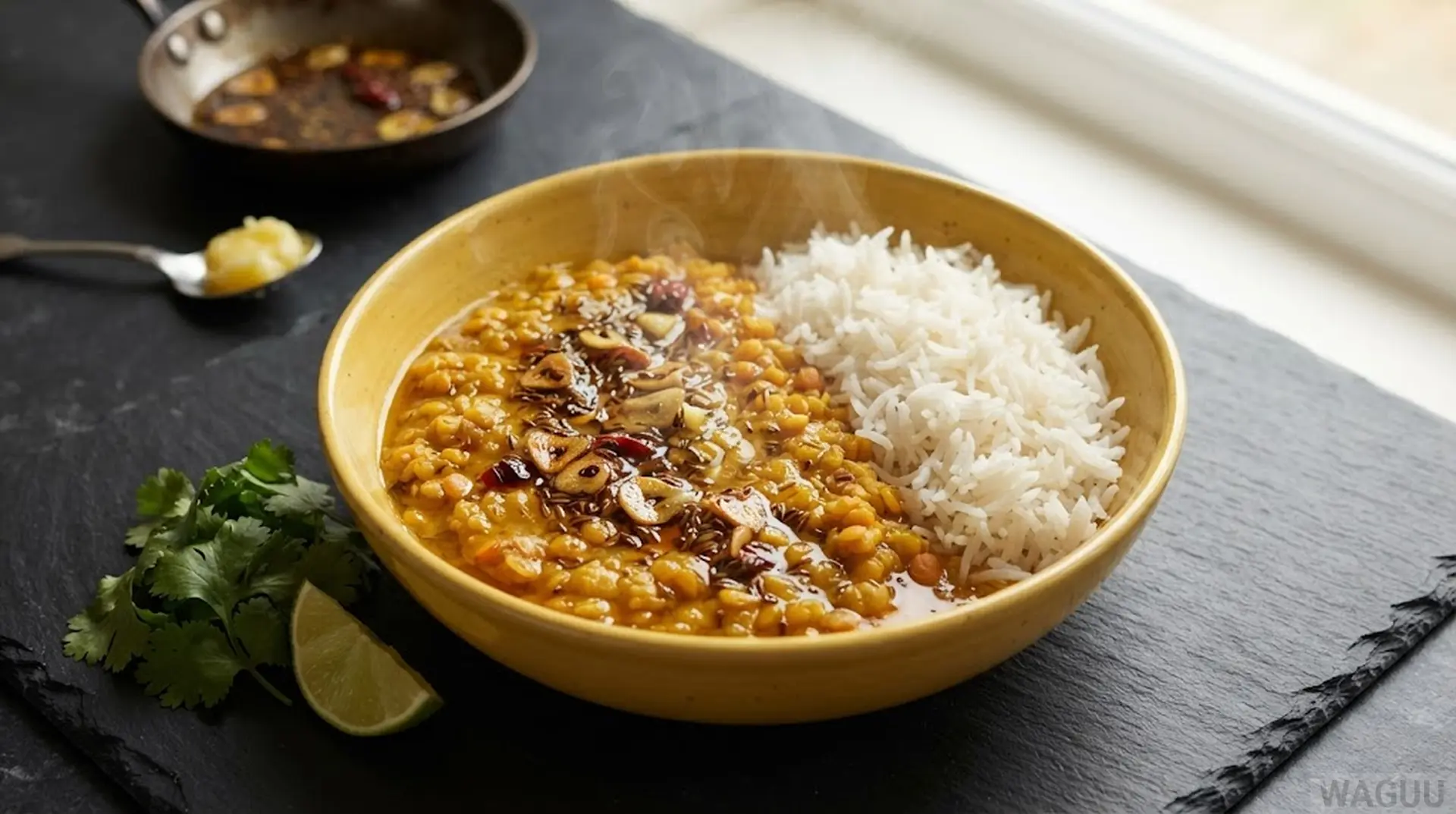
Summary: Red lentils simmer with tomatoes, ginger and turmeric into a thick porridge. At the end, a tadka is poured in – hot oil with cumin, garlic, onion and chilli that sizzles and releases its aroma. Total time 60 minutes, makes 6 servings.
Have you cooked this recipe? Share your result with the community.
Category: Gluten-Free · Indian Cuisine
Success rate: not rated yet % of users have mastered this recipe
Quick overview
- Dish: Dal Tadka – lentils flavoured with fried spices, garlic, onion and chilli
- Category: meat-free dishes, Indian cuisine
- Cuisine: Indian
- Main ingredient: Red lentils, 400 g (rinsed) (quality specification)
- Guide: 12 most famous Indian dishes: traditional recipes from Indian cuisine
- Total time: 60 minutes (10 min preparation + 50 min cooking)
- Difficulty: Easy
- Servings: 6 (Serving size: 190 g)
- Key technique: Simmering lentils until soft and flavouring with fried spices (tadka) at the end
- Preparation types: Boiling, tempering spices
- Dietary info & allergens: milk (ghee)
- Suitable for: Family dinner, dinner with friends, a festive multi-course table, or batch cooking for several days ahead.
- Nutritional values (per 1 serving): 352, Protein: 17.8 g, Fat: 11.5 g, Carbohydrates: 44.4 g
- Storage: 3 days in the fridge, 1 month in the freezer
- Pairing: Indian light lager, dry Riesling, salted lassi
- In short: Red lentils simmer with tomatoes, ginger and turmeric into a thick porridge. Total time 60 minutes, 6 servings.
WAGUU says: “Dal without tadka is just boiled lentils. Tadka makes it a meal.”
Key facts
| Preparation time: | 10 |
| Cooking time: | 50 |
| Temperature: | Lentils 95 °C, tadka 150–170 °C (oil shimmers but does not smoke) |
| Number of servings: | 6 |
At a glance
Dal tadka is a two-step dish and the second step is decisive: hot fat with spices poured into the cooked lentils at the table. The oil temperature is crucial – hot enough for the spices to crackle, but not so hot that the garlic burns. If you add the tadka to the pot at the beginning, you get lentils with a flat flavour.
Ingredients
Base servings: 6 servings • Serving size: 190 g
| Ingredient | Amount | Quality |
|---|---|---|
| red lentils | 400 g | split and skinned, rinsed |
| onion | 2 pcs | medium, one for the lentils, one for the tadka |
| chopped tomatoes | 300 g | tinned, no added salt |
| ginger | 25 g | fresh, finely grated |
| garlic | 8 cloves | fresh, thinly sliced for the tadka |
| ghee | 60 g | clarified butter, for the tadka |
| ground cumin | 2 tsp | whole, to crackle in the fat |
| turmeric | 1 tsp | ground |
| garam masala | 1 tsp | freshly ground blend |
| chilli flakes | 1 tsp | coarse flakes, for the tadka |
| bay leaf | 2 pcs | whole, for the simmering lentils |
| salt | 1 tsp | fine, added at the end of cooking |
| fresh coriander | 25 g | fresh, for garnish |
| lime | 1 pcs | juicy, for the juice |
Why you’ll love this recipe
- Tadka as a second dish: Hot fat with spices is poured over the lentils at the end. The aroma is released in front of your guests and stays on the surface.
- Fastest pulse: Red lentils need no soaking and cook in half an hour. The dish is ready before the rice.
- Meat-free and filling: Lentils provide protein and fibre and thicken with their own starch. The dish satisfies without meat and is inexpensive.
Guaranteed success: Red lentils are split and skinned, so they cook without soaking and don’t need to be soaked overnight. Tadka is a blend of spices dissolved in hot fat – aromatic compounds are fat-soluble, not water-soluble, so this is the only way they get into the lentils. Salt is added at the end because lentils take longer to soften in salted water.
Recipe overview
Preparation: 10 min | Cooking: 50 min | Difficulty: Easy | Servings: 6 | Type: Main course | Origin: Indian
Detailed method
Overall progress: 0 % done
Phase 1: Rinsing and preparing the lentils – 8 min
Equipment: sieve, saucepan
1. Rinse the lentils under cold water until the water runs clear. Surface starch would otherwise foam during cooking and make the lentils stick together.
2. Prepare the ginger finely grated and one onion finely chopped. Have everything to hand, as there’s no time for chopping once the pot is on.
VKB: The rinsing water is clear, the lentils are loose and no slimy layer remains on the bottom of the sieve.
Before you move to the next step:
Unrinsed lentils foam and boil over. If foam appears, skim it off with a spoon and cook over a lower heat.
Phase 2: Cooking the lentils – 25 min
Equipment: heavy-based saucepan, wooden spoon
1. Put the lentils, bay leaf, turmeric and grated ginger in the saucepan. Pour in water so the lentils are covered by two fingers of water.
2.Bring to the boil, then reduce the heat. Simmer uncovered until the lentils are soft and starting to break down. Stir along the base to stop them catching.
Visual check:The lentils are soft and hold together only by their starch. What’s in the pan is a thick purée, not a thin soup.
Before you move on:
Salt added at the start of cooking toughens lentils. Season only at the end, once they are soft.
Stage 3: Tomato base for the lentils – 10 min
Equipment: frying pan, wooden spoon
1.Heat some of the ghee in a frying pan and fry the chopped onion until golden brown. Add half the garlic and cook until fragrant.
2.Add the peeled tomatoes and crush them with the spoon. Cook until the liquid has evaporated and the base has thickened, then stir it into the lentils.
Visual check:The base is thick and deep red, with the oil separated on the surface. Once stirred in, the lentils darken and take on a fuller flavour.
Before you move on:
Underripe tomatoes leave the lentils sour. If your tomatoes are too sharp, cook them five minutes longer – heat softens the acidity.
Stage 4: Making the tadka – 8 min
Equipment: small pan, spoon
1.Melt the remaining ghee in a small pan over a medium-high heat. Tip in the cumin and let it sizzle until it smells nutty.
2.Add the garlic slices and chopped onion and fry until golden brown. Stir in the chilli flakes at the end and take the pan off the heat straight away.
Visual check:The cumin is popping, the garlic is golden and the chilli flakes have released their aroma. The oil is clear and glossy, not cloudy or smoking.
Before you move on:
Overheated ghee turns garlic bitter, and you can’t hide that in the lentils. As soon as the garlic turns gold, take the pan off the heat – it will finish cooking in its own warmth.
Stage 5: Pouring the tadka into the lentils – 5 min
Equipment: saucepan, spoon
1.Stir the lentils until smooth and adjust the salt. Then pour the hot tadka into the centre and let it sizzle – the oil will spit and the aroma will rise.
2.Stir the tadka through just two or three times so it stays on the surface. Add the garam masala and the lime juice.
Visual check:Golden slices of garlic and onion sit on top of the lentils and the oil gleams. The aroma is strong and spicy, not boiled.
Before you move on:
Don’t cook the tadka with the lentils. Added at the start, the aromatic compounds disappear and only a greasy taste is left.
Stage 6: Finishing and serving – 4 min
Equipment: serving bowl, spoon
1.Taste again and adjust the salt, lime and garam masala. The flavour should be gentle, with the warmth of the spices coming through at the end.
2.Tip the dal tadka into a warm bowl, spoon coriander over the top and add a wedge of lime. Serve rice or naan alongside.
Visual check:The lentils are thick and smooth, with golden garlic slices floating on the surface. They don’t spread across the plate.
Equipment needed
| Kit | Ideal size | Alternative | Risk |
|---|---|---|---|
| heavy-based saucepan | 3 l capacity | thick-walled casserole | a thin pan catches the lentils at the base, because a thick purée is hard to stir |
| small pan for the tadka | 16 cm diameter | metal ladle held over the flame | a large pan heats the fat unevenly and the spices burn at the edges |
| sieve | fine mesh, 20 cm diameter | colander lined with muslin | a coarse sieve leaves surface starch on the lentils and they stick together |
| flat-edged spoon | 30 cm long | wooden spoon | a narrow spoon won’t reach the base and the lentils catch in the middle |
Shopping list
Nutrition
Values per 1 portion (without sides). Calculated from average nutritional values of the ingredients.
| Nutrient | Per 100 g | Per 1 portion | For 6 portions |
|---|---|---|---|
| Energy | 774 kJ / 185 kcal | 1473 kJ / 352 kcal | 8837 kJ / 2112 kcal |
| Fat | 6.1 g | 11.5 g | 69.0 g |
| of which saturates | 3.3 g | 6.3 g | 37.9 g |
| Carbohydrate | 23.4 g | 44.4 g | 266.4 g |
| of which sugars | 2.9 g | 5.5 g | 33.0 g |
| Protein | 9.4 g | 17.8 g | 106.8 g |
| Salt | 0.5 g | 0.9 g | 5.2 g |
Reference intake of an average adult (8400 kJ / 2000 kcal).
WAGUU Pro level
- Pro standard: A tested recipe with exact ratios and visual checkpoints.
- Tip 1: A tested recipe with exact ratios and visual checkpoints.
- Tip 2: The water runs clear after rinsing, the lentils are loose and no slimy layer is left at the bottom of the sieve. Unrinsed lentils foam and boil over. If foam appears, skim it off with a spoon and lower the heat.
- Tip 3: The lentils are soft and hold together only by their starch. What’s in the pan is a thick
- Tip 4: Set out the ingredients in small bowls before you start. Indian cooking runs on spices added in a precise order, and there’s no time to weigh things out mid-cook.
The science behind it
The aromatic compounds in cumin and garlic are fat-soluble, which is why they are released above 130 °C. In water they would stay locked inside the plant cells. The acid in tomatoes slows the softening of lentils, which is why the tomatoes go in during the second half of cooking. Turmeric gives colour as well as a faint bitterness, so it is measured precisely.
Fine Dining – Professional techniques
- Plating: Pour the lentils into the base of a deep bowl in a smooth layer. Spoon the tadka on top so it stays in one place and your guest can see it.
- Texture contrast: Add something crisp – a thin slice of naan dried in the oven or toasted sesame seeds. Smooth lentils need a contrast.
- Temperature contrast: Put a coriander leaf and a few drops of ghee on the tadka. The fat on the surface releases the cumin aroma at the table.
- Aromatic extras: Serve pickled lemon peel and yogurt on the side. The acidity cleans the palate between mouthfuls of rich lentils.
Sensory radar
- Appearance: The dal is golden yellow and thick, with golden garlic slices, red chilli and green coriander floating on top.
- Aroma: Crackling cumin and fried garlic, then gentle lentils and a hint of lime at the end.
- Taste: Mild lentil flavour with the warmth of spices that arrives at the end. The lime acidity keeps it fresh.
- Texture: Lentils smooth and thick like cream, with crunchy garlic and onion slices on top.
Pairing
- Indian light lager: A lager with higher carbonation cleanses the palate from the thick dal. Serve at 5–7 °C.
- Dry Riesling: Riesling with acidity keeps up with cumin and garlic and doesn’t succumb to the spice heat.
- Salted lassi: Salted lassi made from yogurt and cumin. The milky flavour suits the lentils and softens the dish.
Variations
- Dal tadka with butter and cream:: At the end, stir a tablespoon of butter and a little cream into the dal. The dish is milder and suitable for children, but loses its lightness.
- Dal tadka with coconut milk:: Replace the cream with coconut milk and the dish is dairy-free. The taste is sweeter and the tadka is added only on the plate.
Allergens and dietary information
Contains: milk (ghee) • Gluten: no, the recipe is gluten-free (lentils, vegetables, spices) • Not suitable for: people with sensitivity to pulses and strong spices
Suitable for
Family dinner, dinner with friends, a festive table with multiple courses, or making ahead for several days.
Substitution guide
- red lentil: beluga or brown lentils (cook for ten minutes longer)
FAQ
Which lentils should I use for dal tadka?
Red split lentils. They cook down without soaking and create a thick purée. Green or beluga lentils hold their shape and the dish is thinner.
Why won’t my lentils soften?
You added salt or acid at the beginning. Salt and tomatoes slow down softening, so they should go into the pot only in the second half of cooking.
What is tadka?
A mixture of spices bloomed in hot fat. It is poured into the finished dish at the end to release the aroma and keep it on the surface.
What can I use instead of ghee?
Clarified butter or vegetable oil with a tablespoon of butter. However, ghee withstands higher temperatures and doesn’t give the tadka a milky aftertaste.
Is dal tadka gluten-free?
Yes, if served with rice and not with naan or roti made from wheat flour. Lentils, vegetables and spices do not contain gluten.
What to serve with dal tadka?
Basmati rice, naan or roti, and pickled lemon rind. Yogurt is also good to soften the spice heat.
WAGUU Petr advises: Cooking for 6 or more?
6–8 people: Prepare the masala (fried spice base) in double quantity and store half in the fridge. When cooking for more people, use two pots rather than one large one – spices don’t fry evenly in too thick a layer. • 10+ people: A tandoor can be replaced by a grill or a cast-iron pan heated in the oven to maximum. Prepare the naan dough and chicken marinade the day before and keep them in the fridge – both flavour and texture will be better.
Sides and serving
Serving: Serve dal tadka in a deep bowl with basmati rice or naan, top with a spoonful of tadka and coriander. Pickled lemon rind and yogurt go well with it.
Storage and reheating
Fridge: 3 days • Freezer: 1 month • Reheating: Fridge: 3 days • Freezer: 1 month • Reheating: on low heat up to 80 °C, with a tablespoon of water, add the tadka only after reheating
Author: WAGUU Petr & Team • Published: 9 Oct 2026 • Updated: 10 Oct 2026
More recipes from the article
Guide: 12 most famous Indian dishes: traditional recipes from Indian cuisine
Butter Chicken – chicken in a mild creamy tomato sauce with butter and aromatic spices
Chicken Tikka Masala – pieces of marinated chicken in a spiced tomato and cream sauce
Tandoori Chicken – chicken marinated in yogurt and spices and cooked at high temperature
Biryani – aromatic layered rice with meat, saffron and a blend of spices
Palak Paneer – Indian paneer cheese in a mildly spiced spinach base
Palak Paneer – Indian paneer cheese in a mildly spiced spinach base
Chana Masala – chickpeas simmered in a spicy sauce of tomatoes, onions and aromatic spices
Masala Dosa – thin crispy fermented rice and lentil pancake with spiced potatoes
Samosa – fried triangular parcels filled with potatoes, peas and spices
Chole Bhature – spiced chickpeas with large fried leavened bhature breads
Naan – traditional Indian flatbread baked at high temperature in a tandoor
More recipes you might like
Why WAGUU?
WAGUU recipes are checked for accuracy of ingredients, methods and nutritional values.
Photo gallery from the process
Photos from the community: Cook, take a photo and share the result.
You can upload photos in the comments below or send them by email.
Did you film a video of our recipe? Paste a link to YouTube, YouTube Shorts, TikTok, Instagram Reels, Facebook Reels, Pinterest, Vimeo or X (Twitter) in the comments – we’ll be happy to publish it and help you and your content get noticed.
Common mistakes
- Rinsing and preparing lentils – Unrinsed lentils foam and boil over. When foam appears, skim it off with a spoon and cook on a lower heat.
- Cooking lentils – Salt added at the start of cooking toughens lentils. Add salt only at the final stage, when the lentils are soft.
- Tomato base for lentils – Unripe tomatoes make the lentils sour. If the tomatoes are too acidic, cook them for five minutes longer – the acid mellows with heat.
- Preparing tadka – Overheated ghee makes garlic bitter, and that bitterness can’t be hidden in the lentils. As soon as the garlic turns golden, take the pan off the heat – it will finish cooking in its own heat.