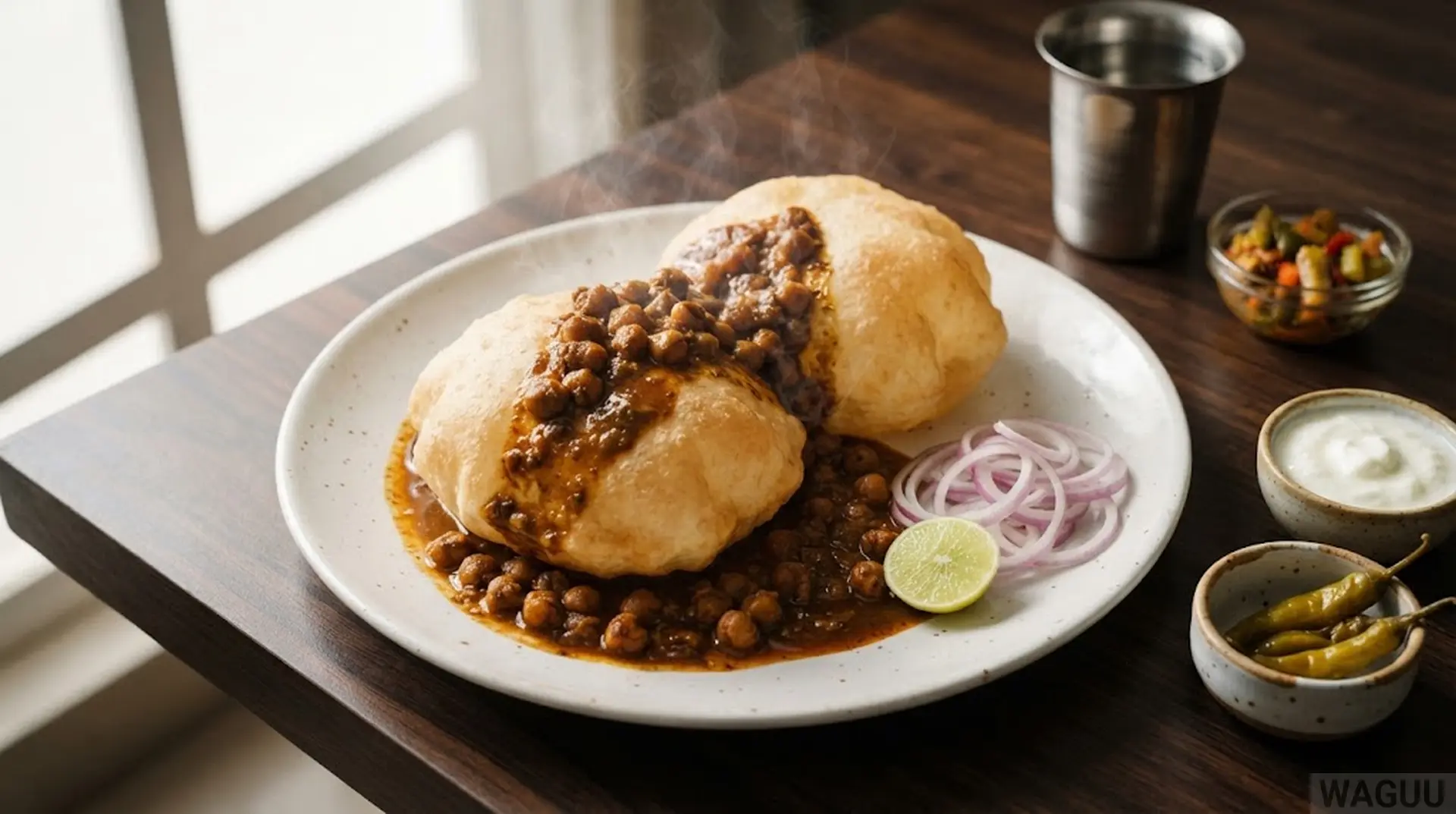
Summary: Chickpeas are simmered in a dark base of onion, tomato and spices with a tea infusion that gives them their colour. They are served with fluffy deep-fried bhature, which are best eaten straight away. Total time 100 minutes, serves 6.
Have you cooked this recipe? Share your result with the community.
Category: Vegetarian · Indian Cuisine
Success rate: not rated yet % of users have mastered this recipe
Quick overview
- Dish: Chole Bhature – spiced chickpeas with large deep-fried bhature
- Category: vegetarian, indian
- Cuisine: Indian
- Main ingredient: Chickpeas, 900 g (canned, drained) (quality specification)
- Guide: 12 most famous Indian dishes: traditional recipes from Indian cuisine
- Total time: 100 minutes (30 min preparation + 70 min cooking)
- Difficulty: Medium
- Servings: 6 (portion weight: 453 g)
- Key technique: Simmering chickpeas in a dark spiced base and deep-frying bhature
- Cooking methods: Simmering, deep-frying
- Dietary info & allergens: gluten (plain flour); milk (whole-milk yogurt, ghee)
- Suitable for: Family dinner, dinner with friends, a festive multi-course table, or batch cooking for several days ahead.
- Nutrition (per serving): 939 kcal, protein: 22.6 g, fat: 50.8 g, carbohydrates: 98.1 g
- Storage: 3 days in the fridge, 1 month in the freezer
- Pairing: Indian pale lager, dry Riesling, salted lassi
- In brief: Chickpeas are simmered in a dark base of onion, tomato and spices with a tea infusion that gives them their colour. Total time 100 minutes, serves 6.
WAGUU says: “Bhature don’t puff up by the strength of the dough. They puff up from steam that has nowhere to escape.”
Key facts
| Preparation time: | 30 |
| Cooking time: | 70 |
| Temperature: | Deep-frying bhature at 170–180 °C, simmering chickpeas at 90–95 °C, proving dough at 28–30 °C |
| Servings: | 6 |
At a glance
Chole bhature has two halves that must be ready at the same time: dark, thick chickpeas and a puffed-up deep-fried bread. The oil temperature for the bhature is crucial – oil that is too cool lets them absorb fat, while oil that is too hot burns the surface and the bread won’t puff. Fry them in oil that’s too hot and you’ll get hard, airless discs.
Ingredients
Base servings: 6 servings • Portion weight: 453 g
| Ingredient | Amount | Quality |
|---|---|---|
| canned chickpeas | 900 g | drained, no added salt |
| plain flour | 500 g | wheat, for the dough |
| whole-milk yogurt | 150 g | full-fat, for the dough |
| dried yeast | 1 tsp | instant dried |
| onion | 3 pcs | medium, finely chopped |
| chopped tomatoes | 400 g | peeled, no added salt |
| ginger | 25 g | fresh, finely grated |
| garlic | 6 cloves | fresh, finely chopped |
| vegetable oil | 250 ml | for deep-frying, stable up to 180 °C (only a small amount is absorbed) |
| ghee | 40 g | for the base and the dough |
| garam masala | 2 tsp | freshly ground blend |
| ground cumin | 2 tsp | whole and ground |
| ground coriander | 2 tsp | ground, roasted |
| ground red chilli | 1 tsp | sweet paprika with a little heat |
| turmeric | 1 tsp | ground |
| salt | 1 tsp | fine, for the dough |
| lime | 1 pcs | juicy, for the juice |
| fresh coriander | 25 g | fresh, to garnish |
Why you’ll love this recipe
- Two textures in one dish: Thick dark chickpeas and a fluffy, crisp bread. The contrast of textures keeps the dish interesting from the first bite to the last.
- Colour without colouring: The dark colour comes from long-cooked onions and spices. Nothing is artificially coloured and the flavour stays clean.
- Filling without meat: Chickpeas bring protein and fibre, and the bread completes it. It’s satisfying and inexpensive.
Success guaranteed: The dark colour of the chickpeas comes from a tea infusion and long-cooked onions, not artificial colouring. The bhature dough is fried at a lower temperature: water on the surface turns to steam, which puffs the dough, and the surface stays dry. Salt comes from the canned chickpeas and the dough, so the sauce is only salted at the end. The acid from tamarind or lime keeps the flavour fresh against the sweetness of the onion.
Recipe overview
Preparation: 30 min | Cooking: 70 min (including proving) | Difficulty: Medium | Servings: 6 | Type: Main course | Origin: Indian
Detailed method
Total progress: 0 % done
Phase 1: Bhature dough – 30 min
Equipment: bowl, cloth, rolling pin
1. Stir the yeast into the yogurt with a little warm water and leave it to work for five minutes. Then pour it into the flour with the salt and ghee and knead until smooth.
2.Cover the dough with a tea towel and leave it to rise in a warm place until it doubles in volume. Then divide it into equal pieces and roll each into an oval.
Visual check:The dough is smooth, springy and springs back when pressed. The oval is about two millimetres thick and doesn’t tear at the edges.
Before you move on:
Cold yogurt slows the yeast and the dough won’t rise. Leave all ingredients at room temperature for an hour beforehand.
Phase 2: Dark base for chole – 20 min
Equipment: heavy-based saucepan, wooden spoon
1.Fry the onion in the ghee over a medium heat until dark golden brown. The dark onion gives half the colour of the finished sauce, so don’t rush it.
2.Add the ginger, garlic and all the ground spices. Fry until the spices smell fragrant, then add the chopped tomatoes and crush them with the wooden spoon.
Visual check:The base is dark reddish-brown and thick, with oil separated on the surface. It tastes sweet from the onion, not sour from the tomatoes.
Before you move on:
Pale onion leaves the sauce orange and sweet. Fry it over a medium heat until it turns the colour of dark wood.
Phase 3: Simmering the chickpeas – 25 min
Equipment: saucepan with lid, wooden spoon
1.Drain the chickpeas, rinse them and add to the base. Pour in enough water to cover them and stir.
2.Cover and simmer over a low heat until the chickpeas absorb the flavour of the sauce. Mash a few spoonfuls of chickpeas with a fork so the sauce thickens with their own starch.
Visual check:The chickpeas are soft and coated in the dark sauce. The sauce clings to a spoon and doesn’t run off. The colour is dark brown, not orange.
Before you move on:
A sauce that’s too thin means it hasn’t cooked down enough. Let it evaporate uncovered, but keep stirring the bottom.
Phase 4: Frying the breads – 15 min
Equipment: deep saucepan, thermometer, slotted spoon
1.Heat the oil to the right temperature. Lower a bread into the oil and press it gently under the surface with the slotted spoon – the pressure helps the steam puff up the dough.
2.When the bread floats and puffs up, turn it over and fry the other side until golden brown. Put the finished bread on a wire rack to drain.
Visual check:The bread is golden brown, puffed into a bubble and dry to the touch. No greasy mark is left on the rack.
Before you move on:
Oil that’s too hot burns the surface before the bread puffs up. Keep the temperature below 180°C and fry the breads one at a time.
Phase 5: Balancing the flavour – 6 min
Equipment: saucepan, spoon
1.Stir the garam masala and the juice of half a lime into the chickpeas. The acid at the end keeps the flavour fresh against the sweetness of the onion.
2.Taste the sauce and adjust the salt and heat. The chickpeas and tomato purée already contain salt, so add it a pinch at a time.
Visual check:The flavour is balanced – sweet from the onion, sour from the lime and warm from the spices. The sauce is thick and dark.
Before you move on:
Neither lime nor garam masala belongs at the start of cooking. Their aroma disappears with heat and leaves only a flat taste.
Phase 6: Serving – 4 min
Equipment: serving bowl, plate
1.Tip the chickpeas into a warm bowl and top with coriander, a lime wedge and sliced onion rinsed under cold water.
2.Serve the breads in a single layer on a warm plate, straight from the oil. Take yogurt and pickled vegetables to the table.
Visual check:The chickpeas are dark and thick, the breads puffed and golden brown. No oily mark is left on the plate.
Equipment needed
| Kitchenware | Ideal size | Alternative | Risk |
|---|---|---|---|
| deep frying pan | 4 l capacity | wok or deep-fat fryer | shallow oil cools sharply when the bread goes in and the bread soaks up fat |
| kitchen oil thermometer | up to 200°C | test with a piece of dough | overheated oil burns the surface and the bread won’t puff up |
| heavy-based saucepan | 3 l capacity | thick-walled casserole | a thin pan catches the dark base at the bottom because it’s hard to stir |
| slotted spoon | 10 cm diameter | frying tongs | without pressing the bread under the surface the dough won’t puff into a bubble |
Shopping list
Nutritional profile
Values per 1 portion (without side dish). Calculated from average nutritional values of the ingredients.
| Nutrient | Per 100 g | Per 1 portion | Per 6 portions |
|---|---|---|---|
| Energy | 866 kJ / 207 kcal | 3929 kJ / 939 kcal | 23573 kJ / 5634 kcal |
| Fat | 11.2 g | 50.8 g | 304.8 g |
| of which saturates | 2.4 g | 10.7 g | 64.1 g |
| Carbohydrate | 21.7 g | 98.1 g | 588.6 g |
| of which sugars | 2.0 g | 9.1 g | 54.6 g |
| Protein | 5.0 g | 22.6 g | 135.6 g |
| Salt | 0.3 g | 1.5 g | 8.8 g |
Reference intake of an average adult (8400 kJ / 2000 kcal).
WAGUU Pro level
- Pro standard: Tested recipe with precise ratios and visual checkpoints.
- Tip 1: Tested recipe with precise ratios and visual checkpoints.
- Tip 2: The dough is smooth, springy and springs back when pressed. The oval is about two millimetres thick and doesn’t tear at the edges. Cold yogurt slows the yeast and the dough won’t rise. Leave all ingredients at room temperature for an hour beforehand.
- Tip 3: The base should be dark reddish-brown and thick, with oil separated on the surface. The flavour is sweet from the onions, not sour from the tomatoes. Pale onions will leave the sauce orange and sweet. Fry them over a medium heat until they take on the colour of dark wood.
- Tip 4: Prepare the ingredients on the table in small bowls beforehand. Indian cooking relies on spices added in a precise order, and there is no time to portion things out mid-cook.
The science behind it
Yeast dough contains carbon dioxide from the yeast. When fried, the gas expands and the dough puffs up into a bubble. The surface dries out quickly in the hot oil, so the fat does not soak in and the bread is not greasy. Tea leaves contain tannins that are released during cooking and darken the sauce; they also slightly tighten the flavour and keep it balanced.
Fine Dining – Professional Techniques
- Plate composition: Pour the chickpeas into the base of the bowl in a smooth layer. Stand the bread upright alongside so it stays puffed and crisp.
- Texture contrasts: Add contrast – pickled onion and yogurt chilled to 6 °C. Fried dough needs an acidic, cold counterpart.
- Temperature contrast: Spoon a tablespoon of yogurt over the chickpeas and top with a coriander leaf. The white makes the dark sauce stand out.
- Aromatic garnishes: Serve on a warmed stoneware plate. The bread cools quickly, and its airiness goes with it.
Sensory radar
- Appearance: The chickpeas are dark brown and thick, the bread golden-brown and puffed into a bubble, with coriander and onion on top of the chickpeas.
- Aroma: Fried dough, then sweet fried onion, and finally warm garam masala and lime.
- Flavour: Sweet onion, sour lime, warm spice, and the taste of fried dough at the end.
- Texture: The chickpeas soft and thick, the bread crisp on the surface and airy inside.
Pairings
- Indian pale lager: A lager with higher carbonation lifts the fat from the fried bread off the palate. Serve at 5–7 °C.
- Dry Riesling: A Riesling with acidity keeps pace with the dark spiced chickpeas and does not give way to the fried flavour.
- Salted lassi: A salted lassi made with yogurt and cumin. It cools and softens the dish, and suits chickpeas better than water.
Variations
- Chole with rice:: Instead of fried bread, the chickpeas are served with basmati rice. The dish is lighter and ready without proving dough.
- Bhature with yogurt:: The breads are served with yogurt and pickled vegetables instead of chickpeas. A quick breakfast, ready within half an hour.
Allergens and dietary information
Contains: gluten (plain flour); milk (plain yogurt, ghee) • Gluten: no, the recipe contains gluten (wheat flour in the breads) • Not suitable for: people with coeliac disease and gluten allergy
Suitable for
A family dinner, dinner with friends, a festive table with several courses, or cooking ahead for several days.
Substitution catalogue
- tinned chickpeas: dried chickpeas soaked overnight and boiled until soft
FAQ
Why won’t my bhature puff up?
The dough was under-proved or the oil is too hot. Let the dough rise until doubled and keep the oil between 170 and 180 °C.
How do I get the chole dark?
By frying the onions long and slow with the spices, or with a tea-leaf infusion. No artificial colouring is needed, and it would spoil the flavour.
Can I bake bhature in the oven?
Yes, at 220 °C for about ten minutes, but they will not puff into a bubble. The flavour stays similar, the texture will be drier.
Is chole bhature suitable for vegans?
The chickpeas are, the dough is not – it contains yogurt. You can swap in plant-based yogurt, but the dough will then prove more slowly.
How do I make it milder for children?
Leave out the hot paprika and chilli. Add a tablespoon of yogurt on the plate and serve the bread with plain chickpeas, no spices.
What should I serve with chole bhature?
Pickled onion, a lime wedge, yogurt and a green cucumber salad. The acidity and the chill balance the fried bread.
WAGUU Petr advises: Cooking for 6 or more?
6–8 people: Make the masala (the fried spice base) in double quantity and refrigerate half. When cooking for more people, use two pans rather than one large one – in too deep a layer the spices do not fry evenly. • 10+ people: A grill or a cast-iron pan heated to maximum in the oven will stand in for a tandoor. Make the naan dough and the chicken marinade the day before and keep them in the fridge – both flavour and texture will be better.
Sides and serving
Serving: Serve chole bhature by tearing the bread with your hand and scooping up the chickpeas. Pickled onion, a lime wedge and yogurt belong with it. Never stack the breads on top of each other.
Storage and reheating
Fridge: 3 days • Freezer: 1 month • Reheating: Fridge: 3 days • Freezer: 1 month • Reheating: chickpeas over a low heat to 80 °C, breads in the oven at 160 °C for five minutes
Author: WAGUU Petr & Team • Published: 9 Oct 2026 • Updated: 10 Oct 2026
More recipes from the article
Guide: 12 of the most famous Indian dishes: traditional recipes from Indian cuisine
Butter Chicken – chicken in a mild creamy tomato sauce with butter and aromatic spices
Chicken Tikka Masala – pieces of marinated chicken in a spiced tomato and cream sauce
Tandoori Chicken – chicken marinated in yogurt and spices and cooked at high heat
Biryani – aromatic layered rice with meat, saffron and a blend of spices
Palak Paneer – Indian paneer cheese in a gently spiced spinach base
Palak Paneer – Indian paneer cheese in a gently spiced spinach base
Chana Masala – chickpeas simmered in a spicy sauce of tomatoes, onion and aromatic spices
Dal Tadka – lentils seasoned with fried spices, garlic, onion and chilli
Masala Dosa – a thin crisp fermented crêpe of rice and lentils with spiced potatoes
Samosa – fried triangular parcels filled with potato, peas and spices
Naan – traditional Indian flatbread baked at high heat in a tandoor
More recipes you might like
Why WAGUU?
Recipes on WAGUU are checked for accuracy of ingredients, methods and nutritional values.
Photo gallery from the method
Photos from the community: Cook it, photograph it and share the result.
You can upload photos in the comments below or send them by email.
Filmed a video of our recipe? Post a link to YouTube, YouTube Shorts, TikTok, Instagram Reels, Facebook Reels, Pinterest, Vimeo or X (Twitter) in the comments – we’ll be glad to publish it and help get you and your content seen.
Most common mistakes
- The yeast dough for bhature – Cold yogurt slows the yeast down and the dough will not rise. Leave all the ingredients at room temperature for an hour beforehand.
- The dark base for chole – Pale onions will leave the sauce orange and sweet. Fry them over a medium heat until they take on the colour of dark wood.
- Simmering the chickpeas – A sauce that is too thin means it has not cooked down enough. Let it reduce uncovered, but stir along the base.
- Frying the breads – Oil that is too hot burns the surface before the bread puffs up. Keep the temperature below 180 °C and fry the breads one at a time.