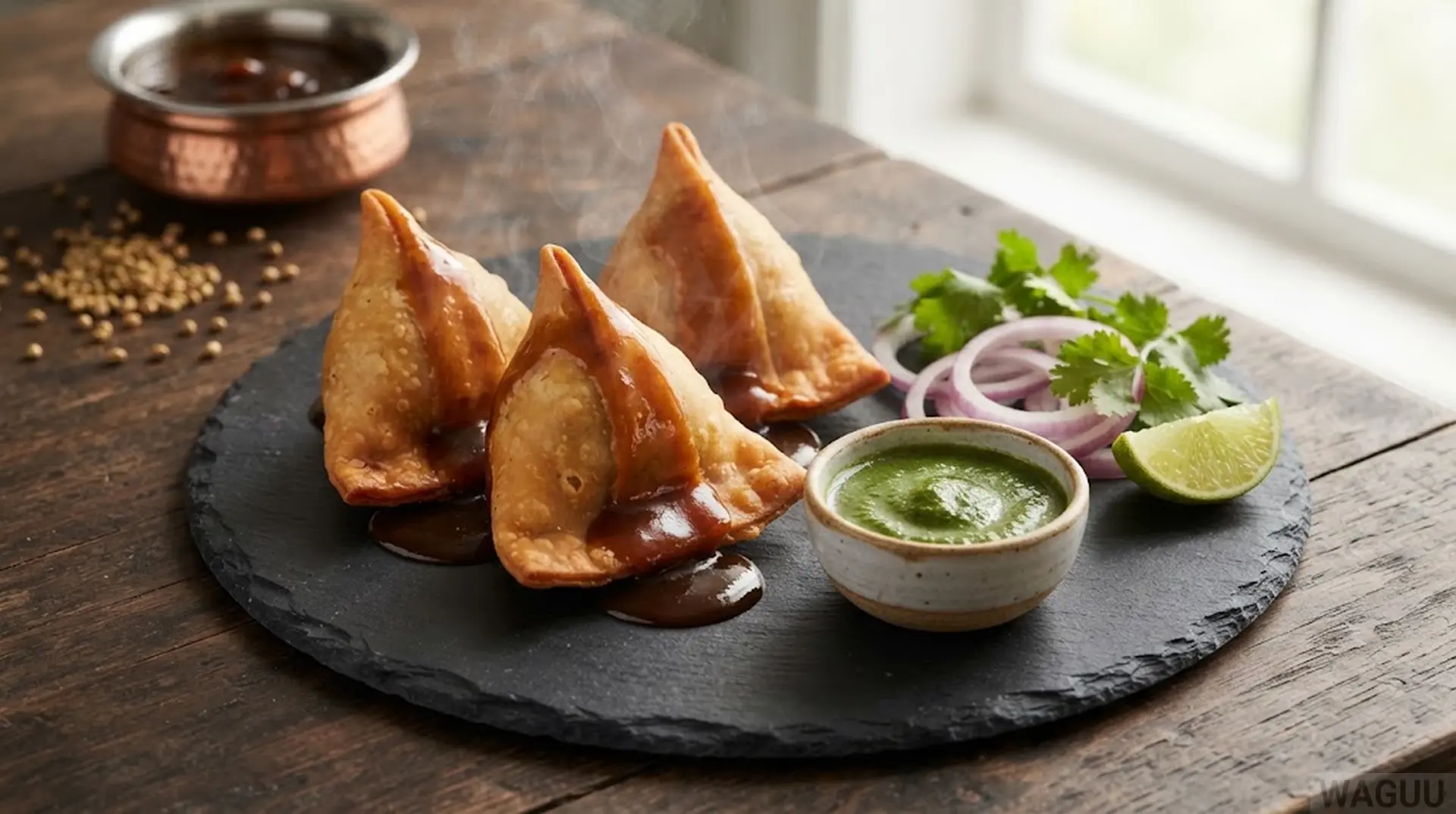
Summary: Thin sheets are rolled from a stiff dough made with plain flour and ghee, then shaped into cones and filled with spiced potatoes and peas. The parcels are fried in oil at the correct temperature until golden brown. Total time 90 minutes, makes 6 servings.
Have you cooked this recipe? Share your results with the community.
Categories: starters, indian-cuisine
Success rate: not rated yet % of users managed this recipe
Quick overview
- Dish: Samosa – fried triangular parcels filled with potatoes, peas and spices
- Categories: starters, indian-cuisine
- Cuisine: Indian
- Main ingredient: Potatoes, 700 g (boiled in their skins) (quality specification)
- Guide: 12 most famous Indian dishes: traditional recipes from Indian cuisine
- Total time: 90 minutes (40 min preparation + 50 min cooking)
- Difficulty: Challenging
- Servings: 6 (Serving weight: 321 g)
- Key technique: Shaping triangular parcels from stiff dough and frying in oil
- Preparation types: Frying, oven baking
- Dietary info & allergens: gluten (plain flour); milk (ghee)
- Suitable for: Family dinner, dinner with friends, a festive multi-course table, or batch cooking for several days ahead.
- Nutritional values (per 1 serving): 737, Protein: 12.1 g, Fat: 42.4 g, Carbohydrates: 76.8 g
- Storage: 3 days in the fridge, 1 month in the freezer
- Pairing: Indian light lager, dry Riesling, masala chai
- In brief: Thin sheets are rolled from a stiff dough made with plain flour and ghee, then shaped into cones and filled with spiced potatoes and peas. Total time 90 minutes, 6 servings.
WAGUU says: “”Samosa is fried in oil that works quietly. Not in oil that shouts.””
Key facts
| Preparation time: | 40 |
| Cooking time: | 50 |
| Temperature: | Frying 160–170 °C, oven baking 200 °C, dough 20–22 °C |
| Number of servings: | 6 |
At a glance
Samosa has three conditions: the dough must be stiff so it doesn’t tear, the filling must be cooled so it doesn’t steam the dough, and the oil must be at the right temperature so the parcel cooks through inside. The oil temperature is decisive – oil that’s too hot burns the surface and leaves the dough raw. Anyone frying in overheated oil gets a dark shell with pale dough inside.
Ingredients
Base servings: 6 servings • Serving weight: 321 g
| Ingredient | Amount | Quality |
|---|---|---|
| plain flour | 400 g | wheat, for stiff dough |
| ghee | 60 g | clarified butter, for the dough |
| potatoes | 700 g | floury, boiled in their skins |
| frozen peas | 200 g | fine, defrosted |
| onion | 2 pcs | medium, finely chopped |
| ginger | 20 g | fresh, finely grated |
| green chilli | 2 pcs | fresh, deseeded |
| ground cumin | 2 tsp | whole, for toasting |
| ground coriander | 2 tsp | ground, toasted |
| garam masala | 2 tsp | freshly ground blend |
| turmeric | 1 tsp | ground |
| crushed chillies | 1 tsp | coarse flakes |
| vegetable oil | 200 ml | for frying, withstands 180 °C (only some ends up in the food) |
| salt | 1 tsp | fine, for the dough and filling |
| fresh coriander | 25 g | fresh, for the filling |
| lime | 1 pcs | juicy, for juice in the filling |
Why you’ll love this recipe
- Crispy without greasiness: The right oil temperature creates a dry layer on the surface that doesn’t let fat inside. The parcel is crispy, not greasy.
- Filling from what’s at home: Potatoes, peas and spices. The dish is cheap and the filling can be prepared the day before.
- Baked or fried: The same parcels can be baked in the oven if you don’t want to fry. They’re lighter and go well with tea.
Success guaranteed: Dough made from plain flour and ghee is kneaded only until it holds together. The fat coats the flour particles and prevents gluten formation, which is why the dough doesn’t tear when rolled. Frying happens at a lower temperature than usual: the surface cooks through at the same time as the inside, and bubbles on the dough show that water is escaping correctly. The filling must be cold, otherwise steam will tear the dough.
Recipe overview
Preparation: 40 min min | Cooking: 50 min min | Difficulty: Challenging | Servings: 6 | Type: Starter | Origin: Indian
Detailed method
Total progress: 0 % done
Phase 1: Stiff dough – 20 min
Equipment: bowl, rolling pin, tea towel
1. Mix the flour with salt and ghee and rub them together with your hands until the mixture starts to hold together like wet sand. The fat must be worked into the flour, not just on the surface.
2. Add water by the tablespoon and knead only as long as it takes for the dough to hold. Then cover it with a tea towel and leave to rest so the gluten relaxes.
VKB: The dough is stiff, smooth and doesn’t stick to your hands. It holds its shape when pressed and doesn’t tear when stretched.
Before you move to the next step:
Kneading for a long time develops gluten and the dough springs back when you roll it. Knead briefly and let it rest.
Stage 2: Potato filling – 20 min
Equipment: saucepan, frying pan, wooden spoon
1. Boil the potatoes in their skins until tender, peel and mash them. Let them cool so the filling doesn’t steam the pastry.
2. Heat a little oil in a frying pan, add the cumin and let it sizzle. Add the onion, ginger and chilli, then the ground coriander, turmeric and garam masala.
3. Stir in the peas and warm them through. Then add the mashed potatoes, salt, lime juice and coriander. Let the filling cool completely.
VKB: The filling is dry and holds its shape when squeezed, not sticky. The flavour is spiced, slightly sour and hot.
Before you move to the next step:
A wet filling will soak the pastry and the parcels will burst during frying. Boil the potatoes in their skins and mash them without milk or butter.
Stage 3: Rolling the discs – 15 min
Equipment: rolling pin, board, knife
1. Divide the dough into equal pieces and roll each into a thin oval. The disc should be as thin as paper but must not tear.
2. Cut each oval in half. Cover the discs with a damp cloth so they don’t dry out and start to crack.
VKB: The discs are evenly thin, dry to the touch and translucent. When folded they hold their shape and don’t break.
Before you move to the next step:
A thick disc won’t cook through and the parcel will be raw inside. If the dough sticks, dust it with only a little flour – too much flour will dry out the disc.
Stage 4: Shaping the parcels – 20 min
Equipment: bowl of water, fingers, tray
1. Roll half of the oval into a cone: fold the edges over each other and brush with water to seal. You’ll have a cone with an open top edge.
2. Fill the cone with a spoonful of cooled filling, don’t overfill. Brush the top edge with water, fold over and press to make a firm point.
VKB: The parcel is triangular, the edges are firmly sealed and no filling shows through. It holds its shape when stood on the tray.
Before you move to the next step:
Too little water on the edge means the parcel will open during frying. Too much water will soak the pastry. Brush only a thin layer.
Stage 5: Frying – 15 min
Equipment: deep pan or deep-fat fryer, thermometer, slotted spoon
1. Heat the oil to the right temperature. Test with a piece of dough: it should rise slowly and be covered in bubbles, not brown immediately.
2. Fry the parcels four at a time so the oil doesn’t cool down. Turn them when one side is golden and fry until evenly golden brown.
3. Remove the cooked parcels with a slotted spoon and drain on a rack, not on kitchen paper – that will steam them.
VKB: The surface is evenly golden brown, with fine bubbles and no large blisters. The parcel is dry to the touch and not greasy.
Before you move to the next step:
Overheated oil will burn the surface and leave the pastry raw inside. Keep the temperature below 175°C and fry in small batches.
Stage 6: Serving – 5 min
Equipment: rack, serving plate, small bowls
1. Let the parcels drain on the rack and while still warm transfer them to a plate lined with kitchen paper.
2. Make a chutney from tamarind paste with sugar and a pinch of chilli, and a mint chutney from mint, coriander and yogurt. Serve them in small bowls.
VKB: The parcels are dry and crisp even after ten minutes. The chutney holds on a spoon and doesn’t run off.
Required equipment
| Utensils | Ideal size | Alternative | Risk |
|---|---|---|---|
| deep pan or deep-fat fryer | 4 l capacity | wok or deep frying pan | shallow oil cools rapidly when parcels are added and the pastry absorbs fat |
| kitchen oil thermometer | up to 200°C | test with a piece of dough | without measuring, oil easily overheats and the surface burns before the inside cooks |
| rolling pin | 40 cm long | glass with a flat base | a blunt rolling pin just presses the disc and the dough tears when folding |
| draining rack | 30 by 40 cm | baking tray with a wire rack | kitchen paper under the parcels steams them and the crispness disappears |
Shopping list
Nutritional profile
Values per 1 portion (without side dish). Calculated from average nutritional values of ingredients.
| Nutrient | Per 100 g | Per 1 portion | Per 6 portions |
|---|---|---|---|
| Energy | 962 kJ / 230 kcal | 3084 kJ / 737 kcal | 18502 kJ / 4422 kcal |
| Fat | 13.2 g | 42.4 g | 254.4 g |
| of which saturates | 3.3 g | 10.6 g | 63.6 g |
| Carbohydrate | 23.9 g | 76.8 g | 460.8 g |
| of which sugars | 1.9 g | 6.0 g | 36.0 g |
| Protein | 3.8 g | 12.1 g | 72.6 g |
| Salt | 0.3 g | 0.8 g | 5.0 g |
Reference intake of an average adult (8400 kJ / 2000 kcal).
WAGUU Pro level
- Pro standard: Verified recipe with precise ratios and visual checkpoints.
- Tip 1: Verified recipe with precise ratios and visual checkpoints.
- Tip 2: The dough is firm, smooth and doesn’t stick to your hands. It holds its shape when pressed and doesn’t tear when stretched. Kneading for a long time develops gluten and the dough springs back when you roll it. Knead briefly and let it rest.
- Tip 3: The filling is dry and holds its shape when squeezed, not sticky. The flavour is spiced, slightly sour and hot. A wet filling will soak the pastry and the parcels will burst during frying. Boil the potatoes in their skins and mash them without milk or butter.
- Tip 4: Prepare the ingredients on the table in small bowls beforehand. Indian cooking relies on spices added in a precise order, and there’s no time to measure during cooking.
The Science Behind It
At around 160°C, water from the surface of the pastry begins to escape as bubbles, forming a thin dry layer. This keeps the oil out, so the samosa isn’t greasy when fried correctly. If the oil were hotter, the layer would form sooner and the inside would stay raw. Salt seasons both pastry and filling, so there’s no need to salt the finished parcel.
Fine Dining – Professional Techniques
- Plating: Stand the samosa on one side so the triangle sits upright. Serve two chutneys in small bowls alongside.
- Texture Contrasts: Add contrast – thin slices of pickled onion and a coriander leaf. Crisp pastry needs a moist, acidic counterpart.
- Temperature Contrast: Put a drop of mint chutney on the tip of the parcel. The white and green will highlight the golden-brown shell.
- Aromatic Additions: Serve on a warmed stoneware plate. Fried pastry cools quickly and loses its crispness.
Sensory Radar
- Appearance: The parcels are triangular, evenly golden-brown with fine bubbles on the surface.
- Aroma: Fried pastry, then toasted cumin, and finally fresh coriander and lime.
- Taste: Crisp pastry, sweet potato with peas, and a finish of warm spice and lime acidity.
- Texture: The shell is dry and crisp, the filling soft and crumbly. The parcel snaps, not bends.
Pairing
- Indian pale lager: A lager with higher carbonation cuts through the fat from the fried pastry. Serve at 5–7°C.
- Dry Riesling: The acidity in Riesling matches the spiced filling and doesn’t get lost in the fried flavour.
- Masala chai: Masala chai with milk, ginger and cardamom. It suits a starter better than a sweet lemonade.
Variations
- Oven-baked samosa: Brush the parcels with oil and bake at 200°C until golden brown. Lighter and without frying, but the pastry is crisper.
- Meat-filled samosa: Replace potatoes with minced lamb, peas and spices. A heartier version served as a main with chutney.
Allergens and Dietary Information
Contains: gluten (plain flour); milk (ghee) • Gluten: no, this recipe contains gluten (wheat flour in the pastry) • Not suitable for: people with coeliac disease and gluten allergy
Suitable for
Family dinner, dinner with friends, a festive multi-course table, or making ahead for several days.
Substitution Catalogue
- plain flour: wholemeal wheat flour (pastry will be denser)
FAQ
Why does my samosa burst during frying?
The filling was warm or wet, or the edges weren’t sealed well. Let the filling cool completely and brush the edges with water, pressing firmly.
What should the oil temperature be?
Between 160 and 170°C. A piece of pastry should slowly rise and become covered in bubbles. If it browns immediately, the oil is too hot.
Can I bake samosas instead of frying?
Yes, at 200°C for about twenty minutes. Brush the parcels with oil and turn them halfway. The pastry will be crisper but drier.
Can I prepare the filling in advance?
Yes, it keeps for two days in the fridge. Before filling, let it come to room temperature and check it isn’t wet.
Can I freeze samosas?
Yes, but only unfried. Spread the parcels on a tray, freeze, then store in a bag. Fry from frozen at a lower temperature.
What to serve with samosas?
Tamarind chutney and mint chutney, plus pickled onion and yogurt. The acidity and coolness balance the fried pastry.
WAGUU Petr advises: Cooking for 6 or more?
6–8 people: Make the masala (fried spice base) in double quantity and refrigerate half. When cooking for more people, use two pans rather than one large one – spices don’t roast evenly in too thick a layer. • 10+ people: A grill or a cast-iron pan heated to maximum in the oven can replace a tandoor. Prepare the naan dough and chicken marinade the day before and keep them in the fridge – both flavour and texture will be better.
Sides and Serving
Serving: Serve samosas warm with tamarind chutney and mint chutney. Pickled onion and yogurt go alongside. Serve on paper towels to keep them dry.
Storage and Reheating
Fridge: 3 days • Freezer: 1 month • Reheating: Fridge: 3 days • Freezer: 1 month • Reheating: in the oven at 180°C for eight minutes; in the microwave the pastry goes soft
Author: WAGUU Petr & Team • Published: 9 Oct 2026 • Updated: 10 Oct 2026
More recipes from the article
Guide: 12 most famous Indian dishes: traditional recipes from Indian cuisine
Butter Chicken – chicken in a smooth creamy tomato sauce with butter and aromatic spices
Chicken Tikka Masala – pieces of marinated chicken in a spiced tomato and cream sauce
Tandoori Chicken – chicken marinated in yogurt and spices and cooked at high temperature
Biryani – aromatic layered rice with meat, saffron and a blend of spices
Palak Paneer – Indian paneer cheese in a lightly spiced spinach base
Palak Paneer – Indian paneer cheese in a lightly spiced spinach base
Chana Masala – chickpeas simmered in a spicy sauce of tomatoes, onions and aromatic spices
Dal Tadka – lentils flavoured with fried spices, garlic, onion and chilli
Masala Dosa – thin crisp fermented rice and lentil pancake with spiced potatoes
Chole Bhature – spiced chickpeas with large fried leavened bhature breads
Naan – traditional Indian flatbread baked at high temperature in a tandoor
More recipes you might like
Why WAGUU?
Recipes on WAGUU are checked for accuracy of ingredients, methods and nutritional values.
Photo gallery from the process
Photos from the community: Cook, take a photo and share your result.
You can upload photos in the comments below or send them by email.
Did you film a video of our recipe? Paste the link to YouTube, YouTube Shorts, TikTok, Instagram Reels, Facebook Reels, Pinterest, Vimeo or X (Twitter) in the comments – we’ll be happy to publish it and help you and your content get noticed.
Most common mistakes
- Tough pastry – Long kneading develops gluten and the dough shrinks back when rolled. Knead briefly and let it rest.
- Potato filling – Wet filling soaks the pastry and the parcels burst during frying. Boil potatoes in their skins and mash without milk or butter.
- Rolling the discs – A thick disc won’t cook through and the parcel will be raw inside. If the dough sticks, dust with only a little flour – too much flour dries the disc.
- Shaping the parcels – Too little water on the edge means the parcel opens during frying. Too much water makes the pastry soggy. Brush only a thin layer.