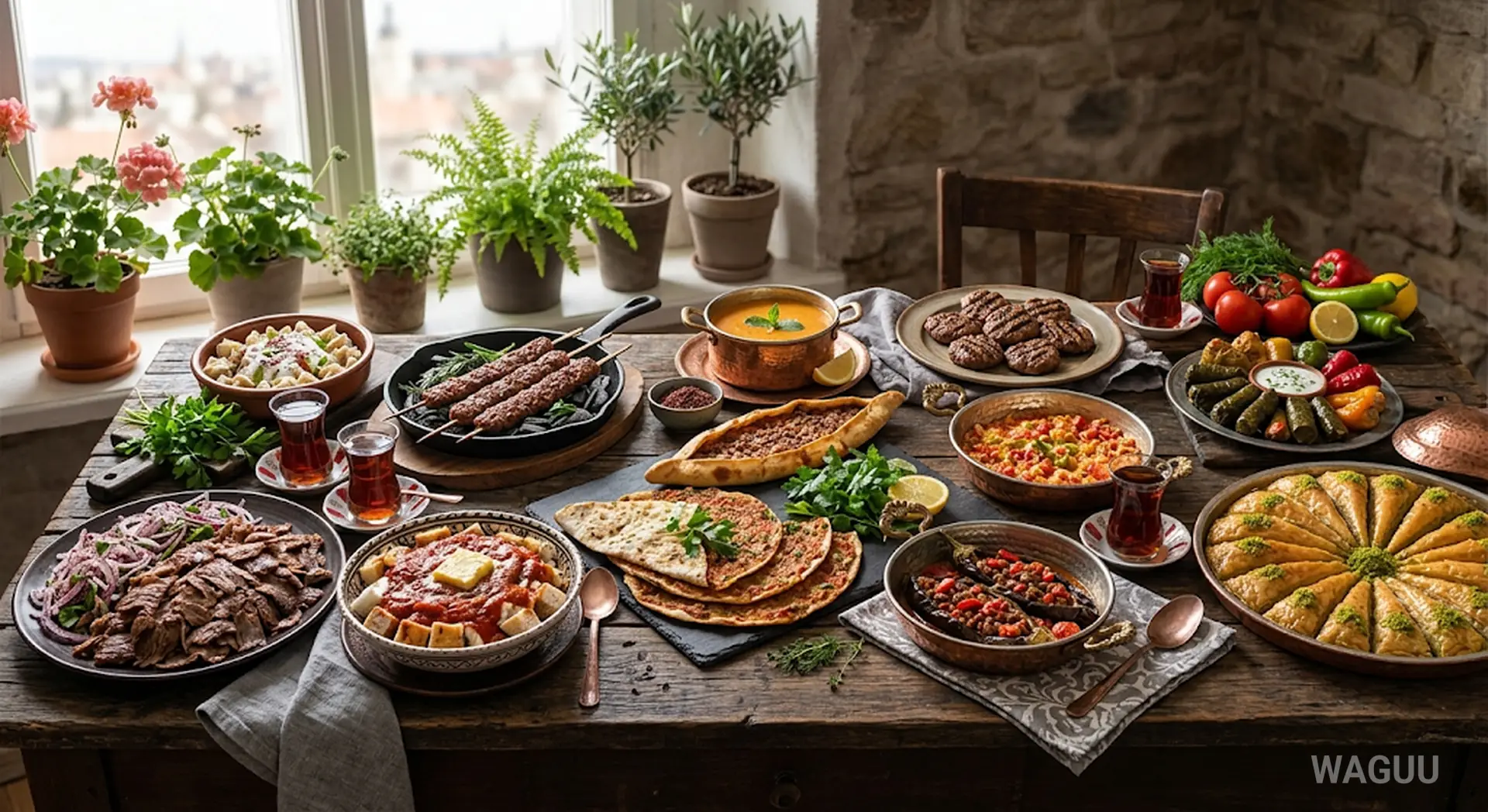
Summary: A guide to twelve Turkish dishes that have travelled far beyond their home country – from döner and Adana kebab to menemen, mantı and baklava. You will find what each dish is, which technique actually decides the result, how long it takes at home, and the classic mistakes that separate a good plate from a disappointing one. Reading time about 14 minutes.
Category: Articles, Mediterranean Cuisine |
Reading time: 14 minutes
Photo gallery from the method
Cooked one of these dishes? Share a photo in the comments under the recipe and we are happy to add it to the gallery. Filmed a video of the method? Paste a link to YouTube, YouTube Shorts, TikTok, Instagram Reels, Facebook Reels, Pinterest, Vimeo or X (Twitter) in a comment and we are glad to publish it.
No photos yet. Be the first to add a photo of your creation!
Turkish cooking is not one cuisine but a map. Along the Aegean coast it is olive oil, vegetables and herbs; in the south-east it is charcoal, hand-chopped lamb and pepper; in the Black Sea it is anchovies, maize and greens; and in Kayseri and Gaziantep it is dough, butter and pistachios. The twelve dishes in this guide come from all of those corners, and each one teaches a different technique: marinating, kneading, rolling, grilling, simmering and syphoning. Learn the techniques and the dishes follow.
Quick overview
- Topic / Dish: The twelve most famous dishes of Turkish cuisine, with the technique that decides each one
- Category: Articles, Mediterranean Cuisine
- Cuisine: Turkish
- Included variations: Döner Kebab, İskender Kebab, Adana Kebab, Lahmacun, Pide, Mantı, Köfte, Menemen, Karnıyarık, Mercimek Çorbası, Dolma, Baklava
- Key techniques: Marinading and pressed roasting, hand chopping and kneading, thin dough rolling, charcoal grilling, stone baking, starch gelatinisation, sugar syphoning
- Physico-chemical background: Maillard browning, protein denaturation and water loss, gluten development, starch gelatinisation, osmosis and salt diffusion, sugar concentration
- Common mistakes: Warm mixtures that lose their fat, wet fillings that break the dough, weak grills that dry the meat, syrup poured warm onto pastry
- In short: Turkish cuisine rewards method over ingredients – the same lamb, flour and yogurt produce twelve completely different dishes depending on how they are handled.
- Last updated: 22 August 2026
WAGUU says: “Ask a Turkish cook what makes a dish and you will get a technique, not a list. The ingredients are simple almost everywhere – what changes from city to city is how they are treated.”
Key facts
| Preparation time: | From 25 minutes (menemen, lentil soup) to 6 hours (baklava, including resting) |
| Cooking time: | From 10 minutes (köfte, Adana) to 60 minutes (karnıyarık) |
| Main ingredient: | Lamb and beef, bread flour, rice, red lentils, aubergine and pistachios |
| Servings: | Every recipe in the guide is written for 6 portions |
| Difficulty: | Easy (menemen, lentil soup, köfte) to advanced (mantı, baklava, Adana kebab) |
Method in brief
- Choose your starting point: a grill dish, a dough dish, a vegetable dish or a dessert.
- Prepare the meat or the dough first, because both need time – marinading, chilling or proving.
- Build the sauce, the filling or the syrup while the first element rests.
- Cook at the temperature the technique demands: hard and fast for grills, gentle for pulses, hot and dry for bread.
- Finish at the pass – herbs, lemon, butter, yogurt – and serve immediately, because almost every dish here is at its peak within five minutes of being finished.
At a glance
- Grills: Döner, İskender, Adana and köfte all depend on one thing – a dry, very hot surface and meat that has been kept cold until the moment it goes on.
- Dough: Lahmacun, pide and mantı use three different doughs and three different thicknesses; the same flour behaves differently at 40 %, 61 % and 64 % hydration.
- Vegetables: Karnıyarık and dolma are absorption dishes – both cook in a measured amount of liquid that has to disappear by the end.
- Pulses and eggs: Mercimek çorbası and menemen are the two quickest dishes here, and both live or die on texture rather than flavour.
- Sweets: Baklava is the only dish in the guide where the timing of two components – hot pastry and cool syrup – decides everything.
- Result: Twelve dishes, six techniques, one shopping list of lamb, beef, flour, rice, lentils, aubergine, tomatoes, peppers, yogurt, butter and pistachios.
Who this guide is for: Beginner – start with menemen, köfte or mercimek çorbası; all three forgive small mistakes and teach heat control. Advanced – take on lahmacun, pide and karnıyarık, which introduce dough handling and measured-liquid cooking. Professional – Adana kebab and baklava are the two technical challenges in the guide, and both are won or lost before the cooking starts.
What Turkish cooking is built on
Turkish cuisine rests on four pillars, and almost every dish in this guide uses at least two of them. The first is lamb and beef, usually minced or sliced thin, seasoned with salt, pepper and cumin, and cooked over fire. The second is dough: with nothing more than flour, water, yeast and salt, Turkish bakers produce flatbreads, boats, thin sheets and tiny parcels, each with a different ratio and a different bake. The third is the vegetable kitchen of the Aegean and the south, where aubergines, peppers, tomatoes and vine leaves are stuffed, roasted and simmered in olive oil. The fourth is dairy – yogurt in all its forms, from the drinkable ayran to the thick strained yogurt that cools a plate of grilled meat.
Two further ideas run through everything. The first is that heat should be either very high or very low, rarely in between: charcoal at 260 °C for kebabs, a gentle simmer at 95 °C for pulses and stuffed vegetables. The second is the finish at the table – lemon, sumac, dried mint, pul biber, parsley, yogurt and butter, added in a specific order and often at the last second. These are not decorations. Each one contributes acidity, aroma or fat, and each one has a job to do.
The twelve dishes at a glance
The table below is the shortest honest summary of the guide: what each dish is, what actually decides whether it works, and how long it takes to cook once the preparation is done. Use it to plan a menu – a kebab, a dough dish, a vegetable dish and a dessert make a complete Turkish table without any dish repeating a technique.
| Dish | What decides it | Active cooking |
|---|---|---|
| Döner Kebab | Pressing and chilling the loaf before roasting | 75 minutes roasting |
| İskender Kebab | Three temperatures on one plate: meat, sauce, yogurt | 12 minutes griddling |
| Adana Kebab | Kneading the mixture cold until it grips a flat skewer | 12 minutes over charcoal |
| Lahmacun | Two millimetres of dough and a fully preheated stone | 6 minutes per pair |
| Pide | A dry filling and a pinched rim that stands up | 12 minutes + 3 for the egg |
| Mantı | One millimetre of dough and a pea-sized pinch of filling | 8 minutes boiling |
| Köfte | A bound but not compacted mixture, chilled before grilling | 8 minutes grilling |
| Menemen | Reducing the tomato until the fat separates | 12 minutes |
| Karnıyarık | Roasting the aubergines whole, then baking in stock | 55 minutes |
| Mercimek Çorbası | Blending and sieving, plus lemon at the table | 35 minutes |
| Dolma | Rolling raw rice tightly and packing the pan | 45 minutes |
| Baklava | Cool syrup poured onto pastry straight from the oven | 45 minutes baking |
WAGUU Pro Tip: Plan a Turkish menu around techniques, not around courses. One grill dish, one dough dish, one vegetable or pulse dish and one dessert is enough for six people, and it keeps you at the stove for a manageable amount of time. Trying to make döner, lahmacun and baklava on the same evening is how a good dinner turns into a bad one.
Frequently asked questions
What is the difference between döner, İskender and Adana kebab?
Döner is the meat itself, roasted on a vertical spit or pressed into a loaf at home and sliced thin. İskender takes that same meat and serves it on bread with tomato sauce, yogurt and butter. Adana is a different family altogether: hand-chopped lamb kneaded with pepper and grilled on flat skewers.
Which of these dishes is easiest for a first attempt?
Menemen, mercimek çorbası and köfte. All three have short ingredient lists, forgiving timings and no dough handling, and all three taste good even when the technique is not yet precise.
Do I need special equipment?
A heavy pan, a probe thermometer, a baking stone and flat metal skewers cover almost everything in this guide. A stand mixer helps with dough, and a charcoal barbecue improves the kebabs, but neither is essential.
Which ingredients are worth buying specially?
Pul biber, isot pepper, dried mint, sumac and good pistachios. They are the difference between a dish that tastes Turkish and one that tastes like a generic Mediterranean stew, and all five keep for months.
Also known as: Turkish cuisine, Anatolian cooking, Ottoman kitchen
Author: WAGUU Petr & Team • Published: 22 Aug 2026 • Updated: 13 Oct 2026
Conclusion
Turkish cooking is generous with the cook. The ingredients are ordinary – lamb, flour, rice, lentils, aubergines, yogurt – and the dishes are built on techniques that can be learned one at a time. Start with the quick ones, get used to cooking at the extremes of the heat range, and add the dough dishes when you have an afternoon to spare. The two dishes worth working towards are Adana kebab and baklava, because both reward precision and both are unmistakable when they are right.
Choose your recipe
Every dish below has a full recipe on WAGUU, written for six portions with exact quantities, visual check points and nutritional values. Pick the one that matches the time you have.
Döner Kebab – Turkish spit-roasted lamb and beef kebab – a pressed loaf of marinated lamb and beef, roasted slowly and sliced wafer-thin for wraps or a plate.
İskender Kebab – döner with tomato sauce, yoghurt and melted butter – griddled lamb steaks on cubed pide with tomato sauce, garlic yogurt and red butter.
Adana Kebab – spicy hand-minced lamb skewers from the charcoal grill – hand-chopped lamb kneaded with pul biber and isot pepper, grilled on flat skewers.
Lahmacun – thin Turkish flatbread with minced meat and herbs – a 2 mm sheet of dough with a raw lamb, tomato and pepper topping, baked in five minutes.
Pide – Turkish boat-shaped flatbread with meat, cheese and egg – a boat of leavened dough filled with spiced lamb, cheese and an egg cracked in at the end.
Mantı – Turkish dumplings with garlic yoghurt, butter and mint – tiny filled parcels boiled and dressed with garlic yogurt, tomato butter, mint and sumac.
Köfte – Turkish spiced minced meat patties – bound beef mince with onion, breadcrumb and warm spices, shaped into flat ovals and grilled hard.
Menemen – Turkish scrambled eggs with tomatoes and green peppers – the twenty-seven-minute breakfast of softened peppers, reduced tomato and softly folded eggs.
Karnıyarık – aubergine stuffed with minced beef and tomatoes – whole roasted aubergines filled with savoury mince and baked in stock with tomato and pepper on top.
Mercimek Çorbası – Turkish red lentil soup with lemon – red lentils and root vegetables blended to a velvet purée and finished with pul biber butter.
Dolma – stuffed vine leaves with rice and herbs – vine leaves rolled around raw rice, currants, pine nuts and warm spices, cooked in oil and lemon.
Baklava – layered filo pastry with pistachios and lemon syrup – twenty buttered sheets, ground pistachios and cool lemon syrup poured over hot pastry.
Other possible variations
Regional kebab variations
Every Turkish city with a grill has its own kebab, and most differ in the shape of the meat rather than in the ingredients. Urfa kebab leaves out the hot pepper and doubles the mild isot; İnegöl köfte flattens the mixture and cooks it on a hot plate with butter; Beyti wraps the grilled mince in flatbread with tomato sauce and yogurt and cuts it into rounds. If you have mastered Adana, all three are variations on the same technique.
Vegetable versions of the classics
The Turkish vegetable kitchen turns the same fillings into meat-free dishes without losing depth. İmam bayıldı is karnıyarık without the meat, relying on slow-cooked onion, tomato and a spoonful of currants for sweetness. Zeytinyağlı dolma uses rice, herbs and plenty of olive oil and is served cool. Mercimek köfte – red lentil and bulgur patties with tomato and pepper paste – is the most popular meat-free kebab in the country, and it costs almost nothing to make.
Breakfast variations
Menemen is the most adaptable dish in this guide. Sucuklu menemen starts with sliced fermented sausage fried until its paprika oil colours the pan; kaşarlı menemen folds grated cheese through at the very end; onion menemen adds a softened onion before the peppers and is the standard in central Anatolia. All three take the same twelve minutes.
Sweet variations
Baklava has as many regional forms as kebab. Gaziantep baklava is the pistachio original; walnut baklava is common further west; burma baklava is rolled around a stick into cylinders; and künefe takes the same syrup and pours it over shredded pastry and cheese. The syrup ratio in this guide – equal weights of sugar and water, with lemon – works for all of them.
Know another version of any of these dishes? Add your own suggestion below.
Missing a recipe?
Tell us what recipe you would like us to add. We will do our best to publish it soon!
Frequently asked questions about the variations
- Can I make any of these dishes vegetarian? Yes – karnıyarık becomes imam bayıldı without meat, dolma is already meat-free in its olive oil form, and menemen and mercimek çorbası contain no meat at all.
- Which dish freezes well? Mercimek çorbası, dolma, karnıyarık, pide without the egg and raw shaped köfte all freeze well for two to three months.
- Can I grill instead of using charcoal? A gas grill or a ridged pan works, but you lose the smoke phenols that settle on the fat; add a pinch of smoked paprika to the marinade as partial compensation.
- Is Turkish food spicy? No. Only Adana kebab and some köfte mixtures carry real heat. Isot pepper is smoky and mild, and dishes such as menemen, mantı and baklava are not spicy at all.
- What bread goes with a Turkish meal? Flatbreads – pide, lavash, bazlama – or a robust sourdough. Their job is to soak up oil, sauce and meat juices.
- How many dishes should a Turkish table have? For six people, four is generous: one grill, one dough or rice dish, one vegetable or pulse dish and one dessert, plus mezze such as dolma or ezme.
- Which of the twelve is the oldest? Dolma, mantı and baklava all trace back through the Ottoman palace kitchen; the kebab family is older still, with grilled meat on skewers documented across Anatolia for centuries.
- What should I drink with these dishes? Ayran with grilled meat, black tea with pastry and sweets, and a light red or a pilsner with almost everything else.
Contact: 12-most-famous-turkish-dishes-traditional-recipes-en@waguu.online