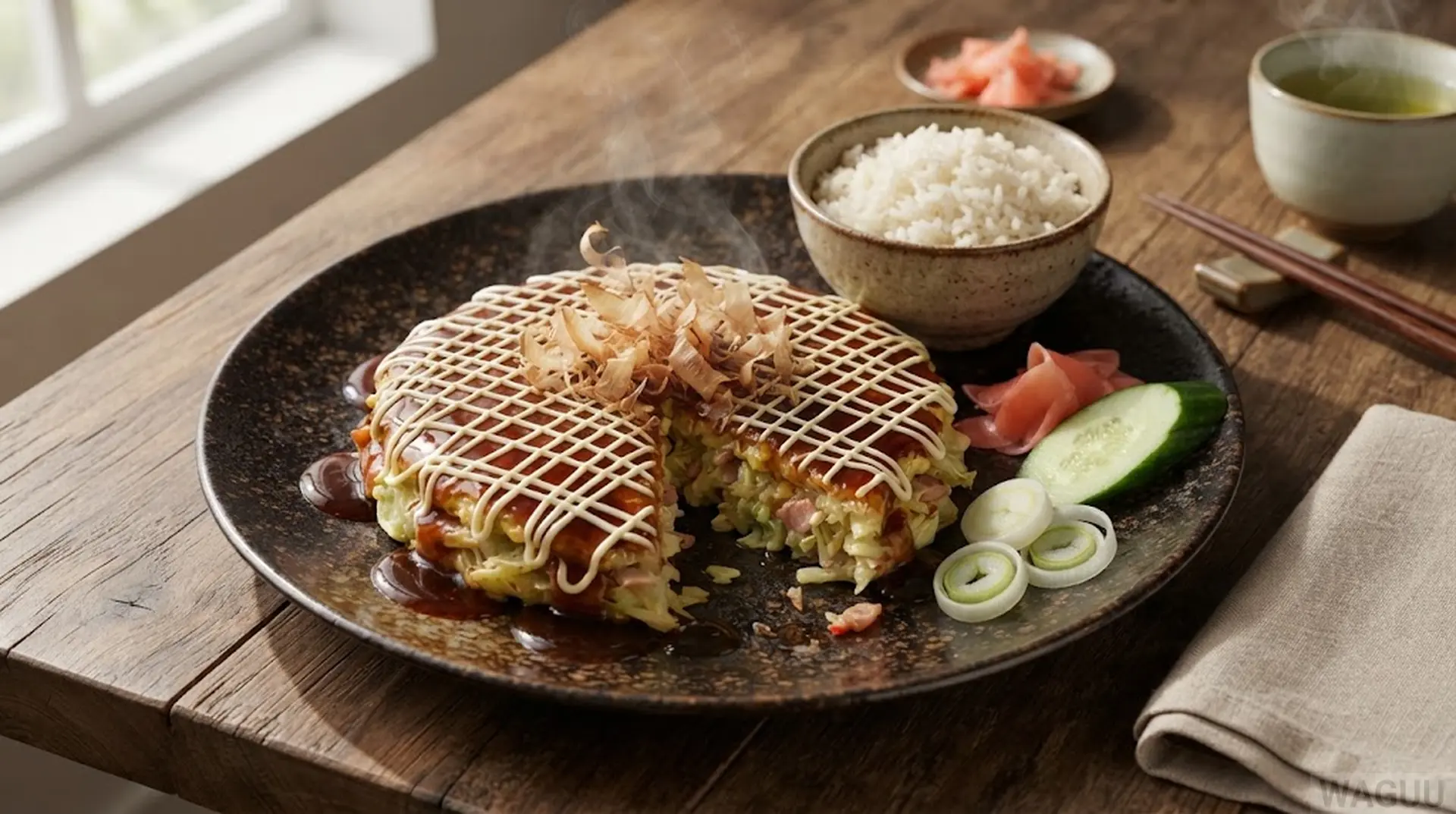
Summary: Okonomiyaki made from a batter of plain flour, eggs and dashi stock, mixed with a heap of shredded cabbage. A thick layer is fried on a hot plate under a lid so the cabbage inside steams and the pancake holds its shape. Before flipping, the pancake is covered with a plate. Top with sauce, mayonnaise, bonito flakes and spring onion. Total time 60 minutes, makes 6 portions.
Have you cooked this recipe? Share your result with the community.
Category: meat-free dishes, japanese cuisine
Success rate: not rated yet % of users managed this recipe
Quick overview
- Dish: Okonomiyaki – a Japanese savoury pancake made from batter, cabbage and other ingredients, typical of Osaka and Hiroshima
- Category: meat-free dishes, japanese cuisine
- Cuisine: Japanese
- Main ingredient: White cabbage, 900 g (finely shredded) (quality specification)
- Guide: 12 most famous Japanese dishes: traditional recipes from Japanese cuisine
- Total time: 60 minutes (25 min preparation + 35 min cooking)
- Difficulty: Medium
- Servings: 6 (Portion weight: 400 g)
- Key technique: Frying a thick layer of batter with cabbage on a hot plate under a lid so the cabbage inside steams
- Preparation types: Pan-frying, steaming under a lid
- Dietary info & allergens: gluten (plain flour, soy sauce), egg (egg, mayonnaise), soy (soy sauce), fish (bonito flakes, Worcestershire sauce), celery (Worcestershire sauce)
- Suitable for: Weekend lunch for six, family dinner with children, one-pan meal for guests, evening with friends at a Japanese table, homemade version of Osaka street food.
- Nutritional values (per 1 portion): 470, Protein: 20.0 g, Fat: 15.0 g, Carbohydrates: 39.0 g
- Storage: 2 days in the fridge, 1 month in the freezer
- Pairing: Japanese light lager, dry white wine, sencha green tea
- In short: Okonomiyaki made from a batter of plain flour, egg and dashi stock, mixed with a generous pile of shredded cabbage. Total time 60 minutes, serves 6.
WAGUU says: “”Okonomiyaki is not a pancake. It is a layer of cabbage bound with batter – if you use too little cabbage, you get a heavy pancake that stays raw inside.””
Key facts
| Preparation time: | 25 |
| Cooking time: | 35 |
| Temperature: | Hot plate 170–180 °C, frying under a lid at 160 °C |
| Number of servings: | 6 |
At a glance
Okonomiyaki is recognised by its height. The layer of cabbage is taller than the layer of batter, and it is the cabbage that keeps the pancake fluffy. The batter is just a binder that holds the cabbage together, so it is mixed just before frying and must not be left to stand. The lid over the pan is as important as the hot plate under it: the steam inside cooks the cabbage and heats the pancake through to the middle without burning the bottom. It is flipped by placing a plate on top, not with a spatula, because the pancake is soft and a spatula would tear it.
Ingredients
Base servings: 6 portions • Portion weight: 400 g
| Ingredient | Amount | Quality |
|---|---|---|
| white cabbage | 900 g | firm head, finely shredded |
| plain flour | 180 g | wheat, finely milled, sifted |
| eggs | 6 pcs | fresh, room temperature, size M |
| dashi stock | 240 ml | made from seaweed and dried fish |
| spring onions | 5 pcs | fresh, with firm stalks |
| bacon | 180 g | thin slices, smoked |
| rapeseed oil | 45 ml | for greasing the hot plate |
| fine sea salt | 5 g | for the batter |
| ground black pepper | 3 g | freshly ground |
| okonomiyaki sauce | 90 ml | thick, sweet and sour, with a fruity note |
| mayonnaise | 60 ml | Japanese, unsweetened |
| bonito flakes | 15 g | thin shavings of dried fish |
| toasted sesame seeds | 10 g | white, dry-toasted |
Why you will love this recipe
- Cabbage, not batter: Nine hundred grams of cabbage for six portions. The batter is just a binder; the flavour and texture come from the cabbage and eggs.
- One method, many variations: Bacon, prawns, cheese or mushrooms can be added to the base. The method stays the same, only the filling changes.
- Exact ratios for 6 portions: One hundred and fifty grams of cabbage per portion, two eggs per pancake and a batter that just binds the cabbage. Everything can be recalculated according to the number of diners.
Guaranteed success: Cabbage contains over ninety percent water. When the shredded cabbage is mixed with the batter and the pancake is placed on the hot plate, the water starts turning into steam. The lid traps this steam, the cabbage softens and the pancake heats through from top and bottom. Without a lid, the surface would stay raw while the bottom would burn. The plain flour batter creates a gluten network that binds the cabbage. If the batter is left to stand, the gluten tightens and the pancake becomes hard, so it is mixed just before frying. The eggs in the batter coagulate with heat and give the pancake firmness. That is why the pancake is only flipped once the egg has set on the surface – otherwise it falls apart. Bonito flakes are thin shavings of dried fish that curl with heat and moisture, so they are added just before serving.
Recipe overview
Preparation: 25 min min | Cooking: 35 min min | Difficulty: Medium | Servings: 6 | Type: Main course | Origin: Japanese
Detailed method
Overall progress: 6 % done
Phase 1: Preparing the cabbage – 12 min
Equipment: shredder or sharp knife
1. Cut the cabbage, remove the core and shred the head into thin strips. Put the shredded cabbage into a large bowl and leave it at room temperature.
2. Cut the spring onions diagonally into thin rings and cut the bacon into short strips. Set both aside in two bowls.
VKB: The cabbage is shredded into strips of even width and takes up a large volume in the bowl. It is dry to the touch, not wet, and holds its shape when squeezed in the palm.
Before you move to the next step:
Do not salt the shredded cabbage in advance. Salt draws out water, the mixture becomes soggy and the pancake only holds together with extra flour, which makes it dense.
Phase 2: Batter and mixing – 8 min
Equipment: none
1. Sift the plain flour into a bowl, add the eggs, dashi stock, salt and pepper. Mix only until the ingredients come together and small lumps of flour remain in the batter.
2. Just before frying, add the shredded cabbage to the batter and mix with two wooden spoons from the bottom up so the cabbage is coated in batter and stays fluffy.
VKB: The batter is thick, the cabbage holds together, but you can see gaps between the shreds. The mixture doesn’t fall off a spoon on its own; it needs to be pushed off. There’s no liquid pooling in the bowl.
Before you move to the next step:
Don’t let the batter sit or mix it with a blender. The gluten will tighten and the pancake will be raw and tough inside. A blender also crushes the cabbage and releases water.
Phase 3: Heating the griddle – 5 min
Equipment: cast-iron griddle or large frying pan, kitchen thermometer
1. Place the griddle over a medium flame and let it heat until a drop of water spreads and sizzles on the surface. Wipe the surface with a thin layer of rapeseed oil and remove any excess with a paper towel.
2. Check the griddle temperature with a drop of batter. It should catch immediately and turn golden quickly, not blacken straight away.
Key check: The griddle is evenly heated, a drop of batter catches and turns golden. There are no spots where the batter doesn’t catch.
Before you move to the next step:
The griddle must not be white-hot and the oil must not be burning. An overheated surface will burn the pancake outside while the inside stays raw.
Phase 4: Frying the pancakes – 18 min
Equipment: griddle, lid, spatula, plate
1. Place a mound of batter on the griddle and spread it with a spatula into a circle of even thickness. Lay bacon slices on top and cover the pancake with a lid.
2. Fry the pancake under the lid until the edges set and the bottom turns golden. Then place a plate on the pancake, hold it and flip the griddle and plate together. Return the pancake to the griddle raw side down and finish it uncovered.
Key check: The edges of the pancake are firm and golden, the centre doesn’t wobble when tapped with a spatula. When flipped, the pancake holds its shape and the filling doesn’t spill out. The bottom is golden brown, not black.
Before you move to the next step:
Don’t flip the pancake before the edges set. A soft pancake will tear on the plate and the filling will leak onto the griddle.
Phase 5: Finishing and garnish – 7 min
Equipment: brush or spoon, knife
1. Transfer the cooked pancake to a warmed plate and brush it with okonomiyaki sauce. Apply mayonnaise with a spoon in thin lines over the sauce to create a grid pattern.
2. Sprinkle the pancake with spring onion rings, toasted sesame seeds and bonito flakes. Cut it into quarters and serve immediately.
Key check: The sauce is glossy and clings to the surface, the mayonnaise grid is distinct and doesn’t mix with the sauce. The bonito flakes curl in the heat. The spring onion is crisp and dry.
Required equipment
| Utensil | Ideal size | Alternative | Risk |
|---|---|---|---|
| cast-iron griddle or large frying pan | 28 cm diameter, thick base | two smaller pans and frying in two batches | a thin base won’t hold heat and the pancake won’t cook through |
| lid | glass, with a vent hole | baking tray covered with foil | a tight lid without a hole traps water and the pancake becomes soggy |
| spatula | thin, 12 cm wide | two spatulas | a thick spatula will tear the pancake |
| plate for flipping | diameter larger than the pancake | wooden board | a small plate won’t support the pancake across its whole surface |
| grater or sharp knife | 20 cm blade or mandoline | vegetable peeler | a blunt knife bruises the cabbage and it releases water |
Shopping list
Nutritional profile
Values per 1 portion (without side dish). Calculated from average nutritional values of ingredients.
| Nutrient | Per 100 g | Per 1 portion | Per 6 portions |
|---|---|---|---|
| Energy | 389 kJ / 93 kcal | 1552 kJ / 371 kcal | 9314 kJ / 2226 kcal |
| Fat | 3.8 g | 15.0 g | 90.0 g |
| of which saturates | 1.1 g | 4.4 g | 26.4 g |
| Carbohydrate | 9.8 g | 39.0 g | 234.0 g |
| of which sugars | 1.8 g | 7.3 g | 43.8 g |
| Protein | 5.0 g | 20.0 g | 120.0 g |
| Salt | 0.5 g | 1.9 g | 11.4 g |
Reference intake of an average adult (8400 kJ / 2000 kcal).
WAGUU Professional level
- Professional standard: Tested recipe with precise ratios and visual checkpoints.
- Tip 1: Tested recipe with precise ratios and visual checkpoints.
- Tip 2: Mix the batter with the cabbage just before putting it on the griddle. If the mixture sits, the gluten tightens and the pancake becomes tough, raw inside.
- Tip 3: Flip the pancake by placing a plate over the pan, not with a spatula. The plate supports the pancake across its whole surface; a spatula will tear it.
- Tip 4: Add bonito flakes to the pancake only on the plate. They curl and wave in the heat, which is visible, but on a hot griddle they would burn.
Scientific background
Cabbage contains over ninety percent water. When shredded cabbage is mixed with batter and the pancake is placed on the griddle, the water starts turning into steam. The lid traps this steam, the cabbage softens and the pancake heats through from top and bottom. Without a lid, the surface would stay raw while the bottom burns. The batter from plain flour forms a gluten network that binds the cabbage. If the batter is left to stand, the gluten tightens and the pancake becomes tough. The eggs in the batter coagulate with heat and give the pancake firmness, which is why the pancake is flipped only when the eggs have set on the surface.
Fine Dining – Professional techniques
- Plate composition: Cut the pancake into quarters and place them on a plate slightly overlapping. Draw a thin mayonnaise grid on top and place a mound of bonito flakes in the centre.
- Texture contrasts: Place crisp cucumber cut into strips next to the soft pancake. The contrast between crisp and soft keeps the flavour fresh.
- Temperature contrast: Serve the pancake immediately after finishing, when the surface is crispiest. Inside it is soft and moist from the cabbage, which is exactly the difference that makes okonomiyaki.
- Aromatic additions: Mix the mayonnaise with a teaspoon of rice vinegar and a pinch of wasabi. The acid cuts through the sweet sauce and the wasabi aroma blends with the aroma of the seafood flakes.
Sensory radar
- Appearance: The pancake is golden brown on both sides, the surface decorated with glossy sauce and a white mayonnaise grid. When cut, layers of cabbage, bacon and batter are visible. Bonito flakes wave in the heat.
- Aroma: Aroma of fried bacon and cabbage, followed by the sweet aroma of the sauce and a fresh note of spring onion.
- Taste: Sweet and sour taste of the sauce, salty taste of bacon and gentle sweetness of cabbage. Mayonnaise rounds off the flavour.
- Texture: The surface of the pancake is crisp, the inside soft and moist from the cabbage. The bacon offers a slight resistance, the spring onion is crisp.
Pairing
- Japanese pale lager: The carbonation and gentle bitterness cut through the fat from the bacon and mayonnaise. Serve chilled at 6–8 °C.
- Dry white wine: Pinot Blanc or Muscadet with higher acidity. The wine’s acidity cuts through the sweet sauce.
- Sencha green tea: Warm, but not boiling. The tea’s bitterness balances the sweet sauce and mayonnaise.
Variations
- Hiroshima-style: The layers are not mixed but stacked: batter, a pile of cabbage, spring onion, thin bacon slices and finally noodles. It cooks longer and is turned more carefully.
- Seafood okonomiyaki: Add chopped prawns and pieces of squid to the mixture. The flavour is stronger, but the mixture holds together less well, so add an extra egg.
Allergens and dietary information
Contains: gluten (plain flour, soy sauce), egg (egg, mayonnaise), soy (soy sauce), fish (bonito flakes, Worcestershire sauce), celery (Worcestershire sauce) • Gluten: yes, in plain flour and soy sauce • Not suitable for: people with coeliac disease, egg, soy or fish allergies
Suitable for
A weekend lunch for six, a family dinner with children, a one-pan meal for guests, an evening with friends at a Japanese table, a home version of Osaka street food.
Substitution guide
- Okonomiyaki sauce: mix ketchup, Worcestershire sauce and a teaspoon of honey in a 2:1:1 ratio. The flavour will be fruitier and less sweet.
FAQ
Why is there so much cabbage in okonomiyaki?
Cabbage keeps the pancake fluffy and moist inside. The batter is just a binder that holds the strands together. If you use less cabbage, you get a heavy pancake that doesn’t heat through.
How do I flip the pancake without it falling apart?
Place a plate over the pan, hold it with one hand and invert the pan. The pancake is supported across its whole surface. A spatula will tear the soft pancake.
What can I use instead of dashi stock?
Stock made from kombu seaweed and dried shiitake mushrooms, or water with a teaspoon of soy sauce. The flavour will be less pronounced, but the batter will stay moist.
Can I make okonomiyaki ahead of time?
Cooked pancakes keep in the fridge for two days and in the freezer for a month. Reheat them in the oven at 180°C or in a pan. Add the toppings only after reheating; bonito flakes don’t curl when cold.
What can I use instead of okonomiyaki sauce?
Mix ketchup, Worcestershire sauce and a teaspoon of honey in a 2:1:1 ratio. The flavour will be fruitier and less sweet, but the pancake will stay balanced.
Can I make this recipe without a griddle?
Yes, in a heavy-based pan with a lid. A thick base that holds heat and a lid that traps steam are important. Cook smaller pancakes so they heat through to the middle.
WAGUU Petr’s tip: Cooking for 6 or more?
6–8 people: Cook the pancakes in two pans or in two batches and keep the finished ones in the oven at 80°C. Always mix fresh batter with cabbage; after twenty minutes it loses its structure. • 10+ people: Make smaller pancakes; they heat through faster and are easier to flip. Shred the cabbage in two batches so it doesn’t dry out.
Sides and serving
Serving: Serve the pancake cut into quarters on a warmed plate with a mayonnaise drizzle and bonito flakes. A bowl of rice and pickled vegetables are served alongside okonomiyaki.
Storage and reheating
Fridge: 2 days • Freezer: 1 month • Reheating: Fridge: 2 days • Freezer: 1 month • Reheating: Reheat the pancake in the oven at 180°C for 8 minutes or in a dry pan. Add the toppings only after reheating.
Author: WAGUU Petr & Team • Published: 7 Oct 2026 • Updated: 10 Oct 2026
More recipes from the article
Guide: 12 most famous Japanese dishes: traditional recipes from Japanese cuisine
Ramen – noodle soup with a rich broth, meat, egg, vegetables and other typical toppings
Tempura – lightly battered and fried seafood or vegetables in a thin, crisp batter
Tonkatsu – breaded and fried pork cutlet served with finely shredded cabbage and tonkatsu sauce
Takoyaki – round fried batter balls filled with octopus, typical of Osaka
Katsudon – a bowl of rice with breaded pork cutlet tonkatsu, egg and onion in a seasoned broth
Gyudon – a bowl of rice topped with thin slices of beef and onion simmered in a sweet-savoury sauce
More recipes you might like
Why WAGUU?
WAGUU recipes are checked for accuracy of ingredients, methods and nutritional values.
Photo gallery of the process
Community photos: Cook, take a photo and share the result.
You can upload photos in the comments below or send them by email.
Did you film a video of our recipe? Paste the link to YouTube, YouTube Shorts, TikTok, Instagram Reels, Facebook Reels, Pinterest, Vimeo or X (Twitter) in the comments – we’ll be happy to publish it and help you and your content get noticed.
Common mistakes
- Too little cabbage in the batter – the pancake is heavy, raw inside and burnt on the surface. Cabbage should make up a larger part of the mixture than the batter.
- Letting the mixture stand – the gluten tightens and the pancake becomes tough. Mix the batter with the cabbage only when the griddle is hot.
- Cooking without a lid – the surface of the pancake stays raw and the bottom burns. The lid traps steam that cooks the cabbage inside.
- Flipping with a spatula – the soft pancake tears with a spatula and the filling spills onto the griddle. Flip by placing a plate over the pan.