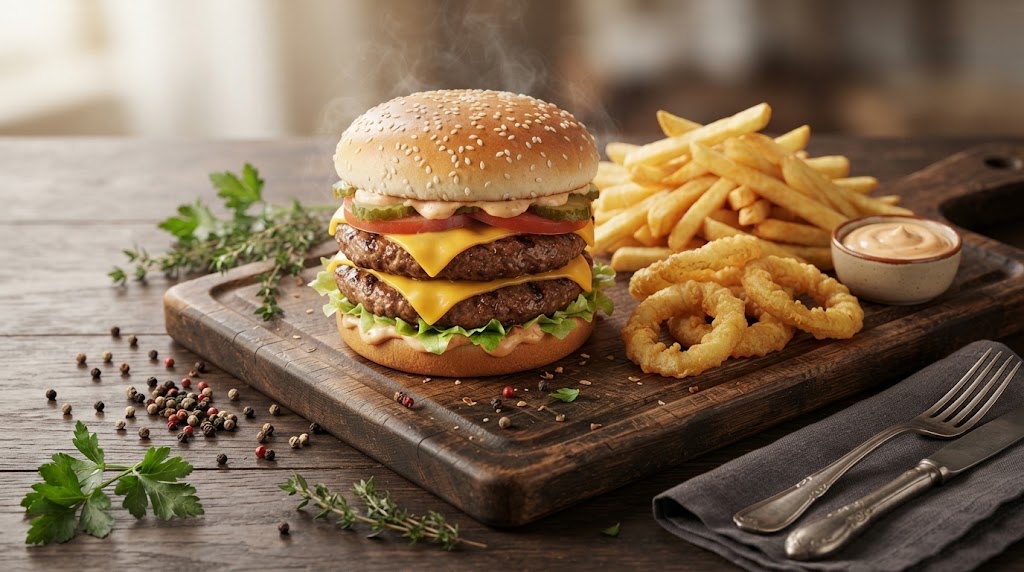
Summary: Two coarse-ground beef patties, two slices of mature Cheddar, and a proper toasted sesame bun. This is the double cheeseburger done right – juicy, cheesy, and unapologetically indulgent. Ready in 30 minutes. Serves 6.
Made this recipe? Share your result with the community.
Category: Beef, American Cuisine
Success rate: not rated yet % of users mastered this recipe
Quick overview
- Dish: Double Cheese Cheeseburger
- Category: Beef, American Cuisine
- Cuisine: American
- Main ingredient: British beef mince, 1.2 kg (20% fat, coarse ground)
- Guide: The Ultimate Cheeseburger Guide
- Total time: 30 minutes (15 min prep + 15 min cooking)
- Difficulty: Easy
- Servings: 6 (Portion weight: 340 g)
- Key technique: Pan-searing
- Preparation types: Pan-frying, grilling
- Dietary info & allergens: Contains gluten, milk, egg, mustard.
- Suitable for: Weekend treat, family meal, casual entertaining
- Nutritional values (per serving): 810 kcal, Protein: 52 g, Fat: 52 g, Carbohydrates: 32 g
- Storage: 2 days in fridge, 2 months in freezer
- Pairing: Pale ale, Malbec, homemade lemonade
- In short: Two patties, two slices of cheese, double the satisfaction.
- Last updated: 13 September 2026
WAGUU says: “A double cheeseburger is not just a bigger burger. It’s a different experience – more crust, more cheese, more everything.”
Key facts
| Prep time: | 15 minutes |
| Cook time: | 15 minutes |
| Temperature: | Pan on high heat |
| Servings: | 6 |
In a nutshell
A double cheeseburger with two coarse-ground beef patties and two slices of mature Cheddar. More crust, more cheese, more flavour.
Ingredients
Base servings: 6 servings • Portion weight: 340 g
| Ingredient | Amount | Quality |
|---|---|---|
| British beef mince (chuck and brisket) | 1200 g | 20% fat, coarse ground |
| Mature Cheddar | 12 slices | Thick-cut, room temperature |
| Sesame seed buns | 6 pieces | Fresh, split |
| Unsalted butter | 30 g | For toasting buns |
| Fine sea salt | 12 g | For seasoning |
| Black peppercorns, freshly ground | 6 g | Coarse grind |
| Little gem lettuce | 12 leaves | Crisp, washed, dried |
| Beefsteak tomatoes | 2 pieces | Ripe, sliced 1 cm thick |
| Red onion | 1 piece | Thinly sliced |
| Gherkins | 12 pieces | Sliced lengthways |
| Mayonnaise | 120 g | Good quality |
| Tomato ketchup | 60 g | For burger sauce |
| Dijon mustard | 15 g | For burger sauce |
Why you’ll love this recipe
- Double the indulgence: Two patties, two slices of cheese – this is the ultimate treat.
- Still simple: Same technique as a classic cheeseburger, just doubled up.
- Impressive: Looks and tastes like something from a proper burger joint.
Success guaranteed: If you can make a single cheeseburger, you can make a double. The principles are identical.
Recipe overview
Prep: 15 min | Cook: 15 min | Difficulty: Easy | Servings: 6 | Type: Main dish | Origin: American
Detailed method
Total progress: 0 % done
Phase 1: Preparing the burger sauce – 3 min
Equipment: Small bowl, spoon
1. Mix 120 g mayonnaise, 60 g tomato ketchup, and 15 g Dijon mustard in a small bowl until smooth. Season with a pinch of salt and a few grinds of black pepper. Taste and adjust. Set aside.
VKB: The sauce is smooth, pale pink, and holds its shape on a spoon.
Before you move on:
Don’t overmix the sauce. If it’s too thick, add a teaspoon of water. If it’s too thin, add a little more mayonnaise.
Phase 2: Forming the patties – 6 min
Equipment: Baking tray lined with parchment, digital scales
2. Divide the 1.2 kg beef mince into 12 equal portions (100 g each). Gently shape each into a thin patty about 1.5 cm thick – do not compact the meat. Make a slight indentation in the centre of each patty with your thumb. Place on the lined tray and refrigerate while you prepare the buns.
VKB: Patties are uniform, about 1.5 cm thick, with a shallow dimple in the centre.
Before you move on:
For a double cheeseburger, thinner patties are better. They cook faster and stack more neatly.
Phase 3: Toasting the buns – 2 min
Equipment: Frying pan, spatula
3. Place a large frying pan over medium heat. Add 15 g of unsalted butter. Once melted, place the split buns cut-side down in the pan. Toast for 1–2 minutes until golden brown. Remove and set aside. Repeat with remaining butter and buns.
VKB: Buns are golden brown on the cut side, with a slight crispness.
Before you move on:
Don’t walk away while toasting the buns – they can burn in seconds. Keep an eye on them and adjust the heat if needed.
Phase 4: Searing the patties – 6 min
Equipment: Heavy-based frying pan or cast iron skillet, spatula, kitchen paper
4. Wipe the pan clean with kitchen paper. Place over high heat and let it get smoking hot – this takes 3–4 minutes. Season the patties generously on both sides. Carefully place 6 patties in the pan – don’t overcrowd. Sear for 1.5 minutes without moving them. Flip once and sear for another 1.5 minutes. Remove and rest on a warm plate. Repeat with the remaining 6 patties.
VKB: Patties have a deep brown crust on both sides and release easily from the pan.
Before you move on:
Never press down on the patties with a spatula. Pressing squeezes out the juices and makes the burger dry.
Phase 5: Melting the cheese – 2 min
Equipment: Frying pan, lid or metal bowl
5. Return 6 patties to the pan over low heat. Place a slice of mature Cheddar on each patty. Cover the pan with a lid or an inverted metal bowl to trap the steam. The cheese will melt and drape over the patty. Remove and rest for 2 minutes. Repeat with the remaining 6 patties.
VKB: Cheese is fully melted, glossy, and covers the top of each patty.
Before you move on:
Don’t leave the cheese on for too long – it can split and become greasy. One minute with the lid on is usually enough.
Phase 6: Assembling the burger – 3 min
Equipment: None
6. Spread a generous tablespoon of burger sauce on the bottom half of each toasted bun. Add lettuce, tomato, and red onion. Place the first patty with cheese on top. Add a second patty with cheese on top of the first. Add 2 gherkin slices per burger. Spread more sauce on the top bun and place it on top. Press gently. Serve immediately.
VKB: The burger holds together when pressed. Both patties are visible, cheese is melted between them and on top.
Equipment needed
| Item | Ideal size | Alternative | Risk |
|---|---|---|---|
| Heavy-based frying pan or cast iron skillet | 30 cm diameter | Griddle pan | Small pan = overcrowding, no sear |
| Digital scales | 0.1 g precision | Kitchen scales | Inaccurate portions affect cooking time |
| Meat thermometer | Instant-read | None | Without it, judging doneness is guesswork |
Shopping list
Nutritional profile
Values per 1 serving (without sides). Calculated from average nutritional values of ingredients.
| Nutrient | Per 100 g | Per 1 serving | Per 6 servings |
|---|---|---|---|
| Energy | 238 kcal | 810 kcal | 4860 kcal |
| Fat | 15.3 g | 52 g | 312 g |
| of which saturates | 7.4 g | 25 g | 150 g |
| Carbohydrates | 9.4 g | 32 g | 192 g |
| of which sugars | 2.6 g | 9 g | 54 g |
| Protein | 15.3 g | 52 g | 312 g |
| Salt | 0.9 g | 3.0 g | 18 g |
Reference intake of an average adult (8400 kJ / 2000 kcal).
WAGUU Pro level
- Profi standard: Verified recipe with precise ratios and visual checkpoints.
- Tip 1: For a true double cheeseburger, use two thin patties rather than one thick one. More surface area means more crust.
- Tip 2: Place the cheese between the two patties as well as on top. It acts as a glue and keeps everything together.
- Tip 3: Let the assembled burger rest for 1 minute before eating. This allows the cheese to set slightly and the juices to redistribute.
- Tip 4: Serve on a warm plate. A cold plate will cool the burger too quickly.
Scientific background
Two thin patties sear faster and develop more crust than one thick patty. The increased surface area means more Maillard reaction, which creates more flavour compounds. The cheese between the patties melts and acts as a barrier, preventing the bottom patty from steaming the top one.
Fine Dining – Professional techniques
- Plate composition: Serve on a slate tile with a small bowl of burger sauce and a few extra gherkins on the side.
- Texture contrasts: The double patty creates more crust, which contrasts with the soft bun and melted cheese.
- Temperature contrast: Serve with a cold pickled onion or a crisp side salad.
- Aromatic additions: A few drops of truffle oil on the top patty before adding cheese.
Sensory radar
- Appearance: Tall, imposing burger with two visible patties and melted cheese oozing between them.
- Aroma: Intense beef, toasted sesame, rich melted Cheddar.
- Taste: Deeply savoury, rich, with tang from the sauce and pickles.
- Texture: Double the crust, double the juiciness, soft bun.
Pairing
- BEER: Double IPA or imperial stout – big beers for a big burger.
- WINE: Cabernet Sauvignon or Zinfandel – bold reds that can handle the richness.
- NON-ALCOHOLIC: Root beer or a thick vanilla milkshake.
Different preparation variations
- Grilled: Cook on a barbecue for a smoky char. Use a grill basket if the patties are thin.
- Smash burger style: Press the patties flat with a spatula immediately after placing in the pan. This creates a lacy, crispy edge.
Allergens and dietary information
Contains: Gluten, milk, egg, mustard • Gluten: Contains (from buns) • Not suitable for: Gluten-free, dairy-free, egg-free diets
Suitable for
Weekend treat, family meal, casual entertaining, special occasion
Substitution catalogue
- Beef mince: Turkey or chicken mince (add oil to the pan), plant-based mince for vegan version
- Mature Cheddar: Swiss, Gruyère, blue cheese, vegan cheese
- Sesame seed buns: Brioche buns, gluten-free buns, lettuce wraps
- Mayonnaise: Greek yogurt, vegan mayo
FAQ
Can I use one thick patty instead of two thin ones?
Yes, but the result will be different. Two thin patties give more crust and a better cheese-to-meat ratio.
How do I stop the burger from falling apart?
The cheese between the patties acts as glue. Make sure it’s properly melted. Also, don’t overfill the bun.
What is the best cheese for a double cheeseburger?
Mature Cheddar is the classic choice. American-style cheese melts beautifully. Swiss or Gruyère also work well.
Can I make this recipe ahead of time?
You can form the patties up to 24 hours in advance and keep them in the fridge. Bring to room temperature before cooking.
WAGUU Petr advises: Cooking for 6 or more?
6–8 people: Cook the patties in batches. Keep cooked patties warm in a low oven (100°C) while you cook the rest. • 10+ people: Consider making smaller patties (75 g each) and serving them as sliders. You can also cook the patties on a large griddle or barbecue.
Sides and serving
- Homemade Chips – Crispy, golden, and fluffy inside (not part of the recipe)
- Onion Rings – Crispy battered onion rings (not part of the recipe)
Serving: Serve the burger immediately on a wooden board or plate. Add a side of chips or onion rings. Provide extra sauce and pickles on the side.
Storage and reheating
Fridge: 2 days • Freezer: 2 months (patties only) • Reheating: Reheat patties in a hot pan for 1–2 minutes per side. Buns can be refreshed in a toaster or oven.
Other recipe variations
Other recipes you might like
Why WAGUU?
Recipes on WAGUU are checked for accuracy of ingredients, methods, and nutritional values.
Photo gallery
Community photos: Cook it, photograph it, and share your result.
You can upload photos in the comments below or send them by email.
Filmed a video of this recipe? Post a link to YouTube, YouTube Shorts, TikTok, Instagram Reels, Facebook Reels, Pinterest, Vimeo or X (Twitter) in the comments – we’ll feature it and help promote you and your content.
Most common mistakes
- Using thick patties – Thick patties won’t cook through before the outside burns. Keep them thin.
- Overloading the bun – Too many toppings make the burger impossible to eat. Stick to the essentials.
- Not resting the patties – Rest for 2 minutes before assembling. This allows the juices to redistribute.
- Skipping the cheese between patties – This cheese acts as glue and adds flavour. Don’t skip it.