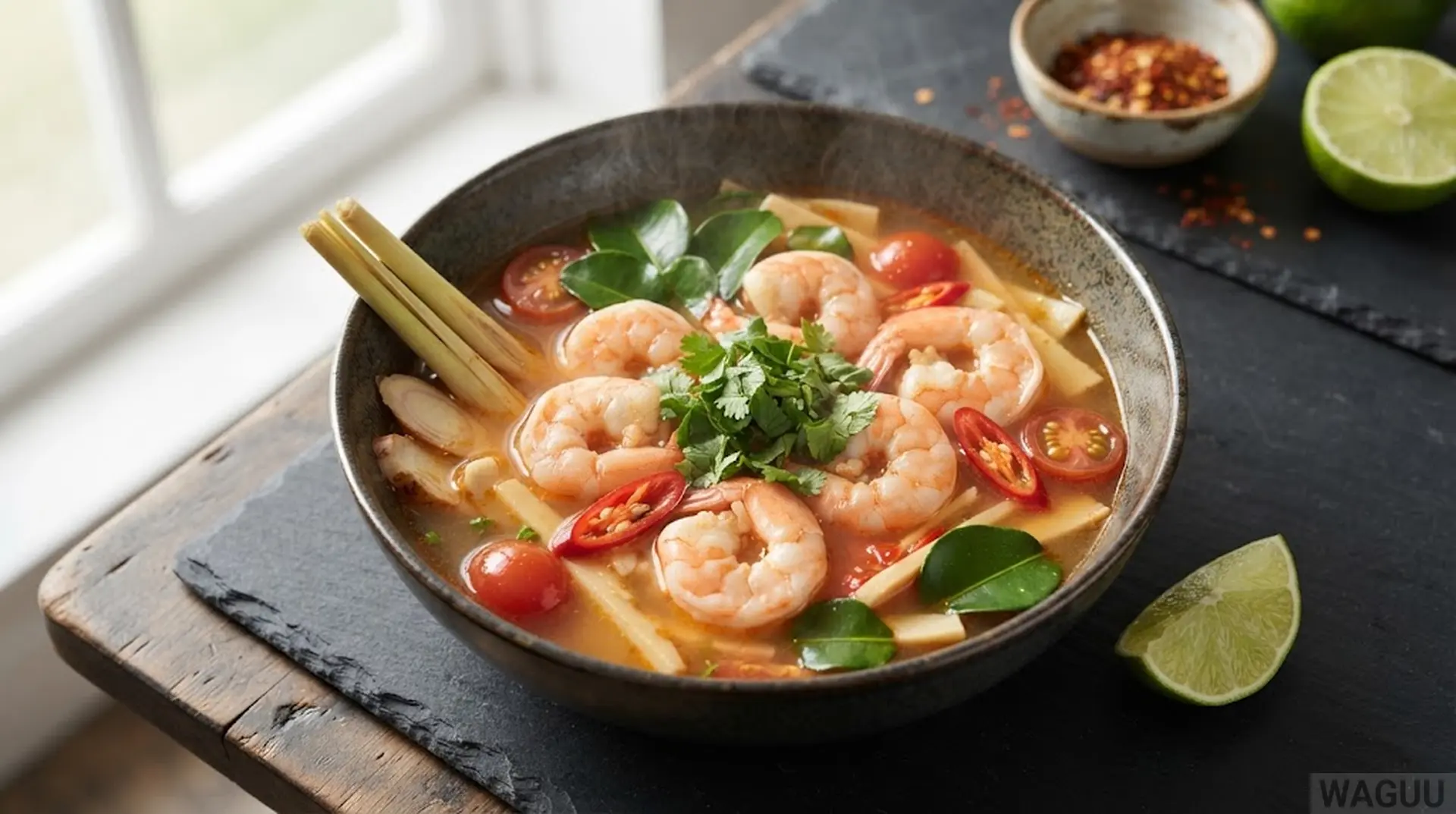
Summary: A fragrant broth made from prawn shells, lemongrass, galangal and kaffir lime leaves, with prawns, mushrooms and tomatoes added at the end. The flavour is finished with fish sauce and lime juice off the heat. Total time 45 minutes, base serves 6.
Have you cooked this recipe? Share your result with the community.
Category: Soups · Thai Cuisine
Success rate: not rated yet % of users managed this recipe
Quick overview
- Dish: Tom Yum Goong – a hot and sour soup with prawns, lemongrass, galangal and chilli
- Category: soups, thai-cuisine
- Cuisine: Thai
- Main ingredient: Prawns, 600 g (raw, in shell) (quality specification)
- Guide: 12 most famous Thai dishes: traditional recipes from Thai cuisine
- Total time: 45 minutes (25 min preparation + 20 min cooking)
- Difficulty: Medium
- Servings: 6 (Serving weight: 462 g)
- Key technique: Drawing the aromatic broth below boiling point and seasoning off the heat
- Preparation types: Simmering broth, brief cooking of prawns
- Dietary info & allergens: fish (fish sauce), crustaceans (prawns)
- Suitable for: Family dinner, dinner with friends, quick weekday lunch or a festive multi-course table.
- Nutritional values (per 1 serving): 171, Protein: 21.8 g, Fat: 4.4 g, Carbohydrates: 11.2 g
- Storage: 3 days in the fridge, 1 month in the freezer
- Pairing: Thai lager, dry Sauvignon Blanc, water with lime and mint
- In short: Aromatic broth made from prawn shells, lemongrass, galangal and kaffir lime leaves, with prawns, mushrooms and tomatoes added at the end. Total time 45 minutes, serves 6.
WAGUU says: “Tom Yum is not cooked, Tom Yum is assembled. The broth is ready the moment the lime goes in.”
Key facts
| Preparation time: | 25 minutes |
| Cooking time: | 20 minutes |
| Temperature: | Broth 85–90 °C (below boiling point), prawns cook for 2–3 minutes at 90 °C |
| Number of servings: | 6 |
At a glance
Tom Yum Goong is built on two curves: first the sweetness and sea aroma are drawn from the prawn shells, then the acidity of lime and the heat of chilli are added to the broth. If the broth boils after the lime is added, the acidity evaporates and the soup flattens. Prawns belong in the pot for the last three minutes, otherwise they toughen.
Ingredients
Base serving: 6 servings • Serving weight:462 g
| Ingredient | Amount | Quality |
|---|---|---|
| prawns | 600g | raw, in shell, with heads for the broth |
| water | 1500ml | soft, chlorine-free |
| lemongrass | 4 stalks | fresh, thick stems |
| galangal | 40g | fresh, sliced |
| kaffir lime leaves | 10 leaves | fresh, without stems |
| fish sauce | 25ml | fermented, no added sugar |
| lime juice | 80ml | freshly squeezed |
| red chilli | 4 pieces | fresh, sliced on the diagonal |
| cherry tomatoes | 200g | ripe, halved |
| bamboo shoots | 150g | thinly sliced, drained |
| demerara sugar | 15g | finely ground |
| rapeseed oil | 20ml | neutral |
| fresh coriander | 1 bunches | bunch, chopped |
| fine sea salt | 1 tsp | only for seasoning, watch the fish sauce |
Why you’ll love this recipe
- Broth from whole prawns: The shells and heads are briefly fried and then drawn in water. The sweetness and sea aroma come directly from them, not from stock cubes.
- Two temperatures, one soup: The broth must never boil hard. The prawns are just heated through and the lime is added off the heat so the aroma stays.
- Exact ratios for 6 servings: One hundred grams of prawns per serving, one and a half litres of broth and a sauce of acid, salt and sugar. The number of servings can be recalculated according to diners.
Success guaranteed: The acid in lime juice partially evaporates during cooking and changes the flavour. That is why lime and fish sauce are added to the pot off the heat. Lemongrass, galangal and kaffir lime leaves are only bruised and added whole – their aromatic oils are released by heat but remain in the plant tissues, so they are removed before serving. Prawns are cooked briefly because their protein sets quickly.
Recipe overview
Preparation: 25 min | Cooking: 20 min | Difficulty: Medium | Servings: 6 | Type: Soup | Origin: Thai
Detailed method
Overall progress: 6 % done
Phase 1: Prawn shell broth – 8 min
Equipment: 3 l pot, chopping board
1. Peel the prawns and set the shells and heads aside. Store the meat in the fridge. Heat the shells in the pot with oil until they turn pink and start to smell fragrant.
2. Pour water over the shells and bring it to the boil. Reduce the heat so the water only simmers gently, and draw the broth under a lid. Then strain it through a fine sieve.
Visual check: The broth is clear and lightly orange, smells of the sea and not fishy. No pieces of shell remain at the bottom.
Before you move to the next step:
Do not boil the shells hard and long, the broth will become bitter. Ten minutes below boiling point is enough; longer boiling adds a bitter taste.
Phase 2: Aromatic base – 7 min
Equipment: rolling pin, pot
1. Bruise the lemongrass stalks with a rolling pin so they crack, and cut them into longer pieces. Slice the galangal thinly and tear the kaffir lime leaves in half.
2.Tip everything into the strained stock and let it simmer gently with the lid on until the aroma opens up. Then lift out the herbs so the broth doesn’t turn brown.
Visual check:The broth smells of lemongrass and galangal but isn’t bitter. The colour stays pale, not green.
Before you move to the next step:
Both bruised and torn herbs are lifted out of the stock. If they stay in the pot, they release bitter compounds over time.
Phase 3: Prawns, mushrooms and tomatoes – 5 min
Equipment:pot, slotted spoon
1.Bring the stock to 90 °C, just below a simmer. Add the bamboo shoots and halved tomatoes and let them warm through for two minutes.
2.Add the prawns and cook until they turn pink and curl into a crescent. Leave the prawns in the soup but don’t boil the stock any further.
Visual check:The prawns are pink, firm and curled into a C shape. The tomatoes hold their shape and haven’t broken down.
Before you move to the next step:
Prawns cooked too long turn rubbery. Three minutes in hot stock is enough; the heat of the bowl finishes the job.
Phase 4: Chilli and seasoning – 4 min
Equipment:small bowl, ladle
1.Slice the chilli thinly on the diagonal and add it to the soup. Leave it for a minute so the heat spreads, then take the pan off the heat.
2.In a small bowl, stir together the fish sauce, lime juice and palm sugar. Pour the mixture into the soup off the heat and stir.
Visual check:The soup is sour, salty and hot in equal measure. The lime smells fresh, not cooked.
Before you move to the next step:
Lime added to boiling stock loses its fragrance and the soup turns bitter. Always add it off the heat, just before serving.
Phase 5: Taste check and rest – 3 min
Equipment:spoon, bowls
1.Taste the soup and add another squeeze of lime or a pinch of sugar if needed. Let it rest for two minutes so the flavours come together.
2.Put two prawns, a few pieces of tomato and bamboo shoot into each bowl and ladle over the broth with chilli slices.
Visual check:After resting, the aromas have blended and the soup no longer tastes of separate ingredients. Each bowl has the same number of prawns.
Before you move to the next step:
Don’t salt in advance. Fish sauce carries plenty of salt, so season only after tasting the finished soup.
Phase 6: Serving – 3 min
Equipment:deep bowls, spoons
1.Serve the soup in deep bowls you’ve warmed with hot water beforehand. Scatter chopped coriander over the surface.
2.Serve a bowl of jasmine rice or thin rice noodles on the side for guests to add to the soup as they like.
Visual check:The soup is still hot after five minutes on the table and the coriander hasn’t wilted.
Equipment needed
| Utensils | Ideal size | Alternative | Risk |
|---|---|---|---|
| pot | 3 l capacity, heavy base | deep frying pan with lid | a thin base scorches the shells and the stock turns bitter |
| fine sieve | 20 cm diameter | muslin over a colander | a coarse sieve lets shell fragments through into the soup |
| rolling pin or pestle | wooden | heavy knife | unbruised lemongrass won’t release its aroma |
| thermometer | up to 100 °C | judge by the bubbles | a hard boil destroys the aroma of the herbs and prawns |
Shopping list
Nutritional profile
Values per 1 serving (without side dish). Calculated from average nutritional values of the ingredients.
| Nutrient | Per 100 g | Per 1 serving | Per 6 servings |
|---|---|---|---|
| Energy | 155 kJ / 37 kcal | 715 kJ / 171 kcal | 4293 kJ / 1026 kcal |
| Fat | 1.0 g | 4.4 g | 26.4 g |
| of which saturates | 0.1 g | 0.5 g | 2.8 g |
| Carbohydrate | 2.4 g | 11.2 g | 67.2 g |
| of which sugars | 2.4 g | 11.2 g | 67.2 g |
| Protein | 4.7 g | 21.8 g | 130.8 g |
| Salt | 0.6 g | 2.8 g | 16.6 g |
Reference intake of an average adult (8400 kJ / 2000 kcal).
WAGUU Pro level
- Pro standard: A tested recipe with precise ratios and visual checkpoints.
- Tip 1: A tested recipe with precise ratios and visual checkpoints.
- Tip 2: The stock is clear and lightly orange, smelling of the sea rather than fish. No shell fragments are left at the bottom. Don’t boil the shells hard or for long, or the stock turns bitter. Ten minutes below simmering is enough; longer boiling adds bitterness.
- Tip 3: The broth smells of lemongrass and galangal but isn’t bitter. The colour stays pale, not green. Both bruised and torn herbs are lifted out of the stock. If they stay in the pot, they release bitter compounds over time.
- Tip 4: Prepare the ingredients in small bowls on the counter beforehand. Thai cooking happens over a high flame and there’s no time to portion things out mid-cook.
The science behind it
The aromatic compounds in lemongrass (citral) and galangal (gingerols) are volatile oils. Heat releases them, but a long boil drives them off in the steam. That’s why the stock is simmered briefly and with the lid on. Chilli contains capsaicin, which is fat-soluble – a drop of oil binds it and spreads the heat more evenly. The acid in lime lowers the pH of the stock, which slows bacterial growth.
Fine Dining – Professional techniques
- Plate composition: Stand the prawns in the bowl on the tip of the tail so they touch the surface. They look as if they’re floating but stay submerged.
- Textural contrasts: Put a small bowl of coriander, chilli flakes and a lime wedge next to the soup. Guests adjust the soup themselves, which is the norm in Thailand.
- Temperature contrast: Warm the bowls with hot water and dry them. Warm ceramic keeps the broth hot even with prawns at the bottom.
- Aromatic additions: A drop of sesame oil on the surface holds the galangal aroma in the soup and stops it escaping into the air.
Sensory radar
- Appearance: The soup is clear, pale orange, with pink prawns, red chilli slices and green coriander floating on top.
- Aroma: First lemongrass and galangal, then the sea-fresh scent of prawns and finally a bright lime note.
- Taste: Sour and hot comes first, saltiness from fish sauce holds the middle, and the sweetness of prawns arrives at the end.
- Texture: The prawns are firm and springy, bamboo shoots crunchy, tomatoes soft and juicy.
Pairing
- Thai lager: A light lager with higher carbonation and a gentle bitterness balances the chilli heat. Serve it chilled to 6 °C.
- dry Sauvignon Blanc: Sauvignon Blanc with grassy notes pairs with lemongrass and lime. Avoid oaked wines, they overpower the prawn broth.
- lime and mint water: Lime and mint water, lightly chilled. Mint tempers the heat and lime keeps the soup’s acidity.
Variations
- Tom Yum with coconut milk (Tom Yum Nam Khon):: Stir in two hundred millilitres of coconut milk at the end and just warm through. The soup is milder, the heat is spread out and the colour turns golden.
- Tom Yum with chicken (Tom Yum Gai):: Replace the prawns with thinly sliced chicken breast and make the broth with chicken stock. The meat cooks two minutes longer than prawns.
Allergens and dietary information
Contains: fish (fish sauce), crustaceans (prawns) • Gluten: no, this recipe is gluten-free • Not suitable for: people with fish and crustacean allergies
Suitable for
Family dinner, dinner with friends, a quick weekday lunch or a festive multi-course table.
FAQ
Why must the broth not boil?
The aromatic oils from lemongrass and galangal evaporate during a rolling boil and the broth turns bitter. Keep it between 85 and 90 °C, just below boiling point.
Can I use peeled prawns?
Yes, then make the broth with chicken or fish stock and add a tablespoon of prawn paste to the soup. The flavour will be flatter, but the soup will be ready in twenty minutes.
How can I make the soup milder for children?
Remove the chilli and serve it on the side. Halve the heat and add a tablespoon of coconut milk, which dilutes the capsaicin.
What can I use instead of galangal?
Ginger, but the flavour will be sharper and less citrusy. Use a third less and add an extra stalk of lemongrass.
Why is the soup sour after reheating?
Lime changes when heated and the acidity comes to the fore. When reheating, keep the temperature below 80 °C and add fresh lime only to the finished bowl.
How can I thicken the soup?
Tom Yum Goong is a clear soup and is not thickened. If you want a thicker version, add a hundred millilitres of coconut milk at the end and just warm it through.
WAGUU Petr advises: Cooking for 6 or more?
6–8 people: Heat the wok or pan in batches and keep the finished dish warm in an oven at 80 °C. Add the flavourings (fish sauce, lime, sugar) at the end, otherwise the aroma disappears. • 10+ people: Make the base (paste, stock or marinade) in double quantity and keep half for the next day. Fill the wok no more than two-thirds full, otherwise the ingredients steam instead of fry.
Sides and serving
Serving: Serve the soup in deep bowls, with a bowl of rice on the side. Put a bowl of chilli flakes and fresh coriander on the table.
Storage and reheating
Fridge: 3 days • Freezer: 1 month • Reheating: Fridge: 3 days • Freezer: 1 month • Reheating: over a gentle heat up to 80 °C, add lime and coriander only to the reheated soup
Satay Gai – grilled marinated chicken skewers with peanut sauce and pickled vegetables
Author: WAGUU Petr & Team • Published: 8 Oct 2026 • Updated: 10 Oct 2026
More recipes from the article
Guide: 12 most famous Thai dishes: traditional recipes from Thai cuisine
Pad Thai – stir-fried rice noodles with egg, prawns, tofu, tamarind, peanuts and lime
Tom Kha Gai – coconut soup with chicken, galangal, lemongrass and lime leaves
Green Curry (Gaeng Keow Wan) – green curry with coconut milk, chicken and Thai basil
Massaman Curry – aromatic curry with beef, coconut milk, potatoes and peanuts
Som Tam – spicy green papaya salad with chilli, lime, fish sauce and peanuts
Som Tam – spicy green papaya salad with chilli, lime, fish sauce and peanuts
Pad Kra Pao – stir-fried meat with Thai basil, chilli and garlic, served with rice and a fried egg
Khao Pad – Thai fried rice with egg, vegetables and chicken
Khao Soi – northern Thai noodle soup with coconut curry, chicken and crispy noodles
Satay Gai – grilled marinated chicken skewers with peanut sauce and pickled vegetables
Mango Sticky Rice (Khao Niao Mamuang) – sticky rice with coconut milk and ripe mango
More recipes you might like
Why WAGUU?
WAGUU recipes are checked for accuracy of ingredients, methods and nutritional values.
Photo gallery from the process
Photos from the community: Cook, take a photo and share your result.
You can upload photos in the comments below or send them by email.
Did you film a video of our recipe? Paste the link to YouTube, YouTube Shorts, TikTok, Instagram Reels, Facebook Reels, Pinterest, Vimeo or X (Twitter) in the comments – we’ll be happy to publish it and help you and your content get noticed.
Most common mistakes
- Prawn broth from shells – Do not boil the shells hard or for long, the broth turns bitter. Ten minutes below boiling point is enough, longer boiling adds bitterness.
- Aromatic base – Bruised and torn herbs are removed from the broth. If left in the pot, they release bitter compounds over time.
- Prawns, mushrooms and tomatoes – If you cook prawns for too long, they become rubbery. Three minutes in hot broth is enough, the residual heat of the bowl finishes the job.
- Chilli and seasoning – Lime added to boiling broth loses its aroma and the soup turns bitter. Always add it off the heat, just before serving.