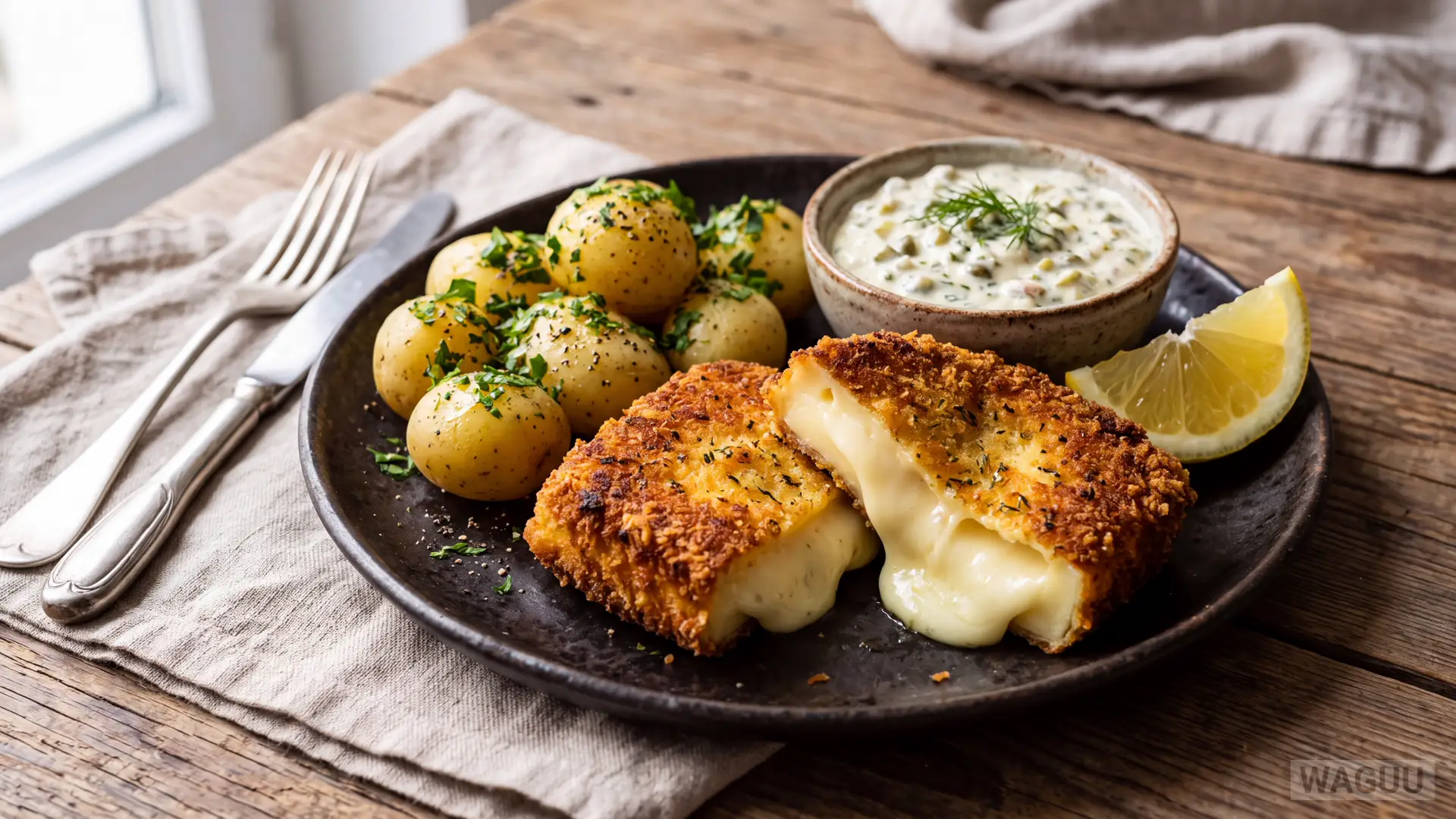
Summary: Fried cheese with tartar sauce is a legendary golden classic featuring thick slices of Edam cheese coated in flour, beaten eggs, and crisp breadcrumbs, then deep-fried until meltingly gooey inside and perfectly crunchy outside, served with creamy homemade tartar sauce and French fries in 35 minutes for 6 servings.
Did you make this recipe? Share the result with the community.
Category: Main Dishes, Czech Cuisine
Success rate: not rated yet% of users successfully made this recipe
Quick overview
- Dish: Fried cheese with tartar sauce
- Category: Main Dishes, Czech Cuisine
- Cuisine: Czech
- Main ingredient: Edam cheese, 1 lb 8 oz (medium firmness, 30% fat)
- Guide: The 12 Most Popular Czech Dishes: Favorite Recipes of Czech Cuisine
- Total time: 35 minutes (15 min prep + 20 min cooking)
- Difficulty: Medium
- Servings: 6 servings (Serving weight: 260.0 g)
- Key technique: Double breading and deep-frying
- Preparation types: Breading and deep-frying
- Dietary info & Allergens: Contains milk, eggs, wheat gluten
- Suitable for: Meatless diet, comfort food lovers
- Nutritional values (per 1 serving): 620.4 kcal, Protein: 28.5 g, Fat: 44.2 g, Carbs: 31.6 g
- Storage: 1 days in the fridge, 0 months in the freezer
- Pairing: Light pale lager beer, dry white wine, sparkling water with lemon
- In a nutshell: Thick blocks of Edam cheese double-breaded and fried until golden and gooey, served alongside zesty homemade tartar sauce and crispy French fries.
- Last updated: September 21, 2026
WAGUU says: “The secret to preventing cheese from leaking into the hot oil lies in an airtight double breading barrier and proper chilling before frying.”
How to take it further: Add a pinch of smoked paprika to the breadcrumbs for an earthy aroma, or whisk a spoonful of finely chopped capers into the tartar sauce.
Key facts
| Prep time: | 15 minutes |
| Cooking time: | 20 minutes |
| Temperature: | 350 °F oil temperature |
| Number of servings: | 6 servings |
In a nutshell
Fried cheese with tartar sauce brings the ultimate pub comfort food experience right to your home kitchen. Crisp on the outside and wonderfully molten on the inside, it pairs perfectly with tartar sauce and golden fries.
Ingredients
Base servings: 6 servings • Serving weight: 260.0 g
| Ingredient | Quantity | Quality |
|---|---|---|
| Edam cheese | 1.5 lb | Medium firmness, 30% fat block |
| All-purpose flour | 0.5 cup | Fine wheat flour |
| Large eggs | 2 pcs | Fresh room temperature eggs |
| Whole milk | 2 tbsp | Whole dairy milk |
| Plain breadcrumbs | 1.5 cups | Finely ground dry breadcrumbs |
| Salt | 0.5 tsp | Fine sea salt |
| Canola oil | 3 cups | High smoke point vegetable oil for frying |
| Mayonnaise | 1 cup | Full-fat traditional mayonnaise |
| Sour cream | 0.5 cup | Cultured sour cream |
| Dill pickles | 0.33 cup | Finely minced crunchy pickles |
| Yellow onion | 0.25 cup | Very finely minced onion |
| Dijon mustard | 1 tsp | Smooth Dijon mustard |
| Lemon juice | 1 tbsp | Freshly squeezed lemon juice |
| Black pepper | 0.25 tsp | Freshly ground black pepper |
| Russet potatoes | 2 lb | Peeled potatoes for frying (not part of the recipe) |
Why you’ll love this recipe
- Ultimate crunch: The double-breading technique creates a sturdy outer crust that keeps the melting cheese securely inside.
- Homemade freshness: Paired with a zesty, cooling tartar sauce made from scratch with crunchy pickles and fresh lemon.
- Pub classic: Recreates the beloved Central European pub experience right in your own dining room.
Why it works: Chilling the breaded cheese before frying solidifies the fats and sets the coating, preventing blowouts in the hot oil.
Recipe overview
Prep: 15 min | Cooking: 20 min | Difficulty: Medium | Servings: 6 | Type: Main dish | Origin: Czech
Detailed instructions
Overall progress: 0% completed
Phase 1: Preparing the tartar sauce – 5 min
Appliances: Refrigerator
1. In a medium mixing bowl, combine 1 cup of mayonnaise, 0.5 cup of sour cream, 0.33 cup of finely minced dill pickles, 0.25 cup of very finely minced yellow onion, 1 tsp of Dijon mustard, 1 tbsp of lemon juice, and 0.25 tsp of black pepper. Stir thoroughly until smooth and blended. Cover the bowl and place it in the refrigerator to chill for at least 30 minutes so the flavors meld together.
CP: Visual check point (VKB): The sauce is thick, creamy, and uniform in color with visible flecks of pickle and onion.
Before moving to the next step:
Ensure the tartar sauce is resting in the refrigerator before preparing the cheese to allow the acidity of the pickles and lemon to balance the creamy base.
Phase 2: Slicing and initial station setup – 5 min
Appliances: None
2. Cut 1.5 lb of Edam cheese into 6 equal rectangular slices, each approximately 0.75-inch thick. Prepare a breading station with three shallow bowls. In the first bowl, place 0.5 cup of all-purpose flour. In the second bowl, whisk together 2 large eggs, 2 tbsp of whole milk, and 0.5 tsp of salt until smooth. In the third bowl, place 1.5 cups of plain breadcrumbs.
CP: VKB: All 6 cheese slices are uniformly cut and the three-station dredging bowls are arranged in a neat line.
Before moving to the next step:
Verify that the cheese slices are thick enough so they do not melt through too quickly during frying.
Phase 3: Double breading the cheese – 10 min
Appliances: Refrigerator
3. Take each cheese slice, dredge it first in the flour, shaking off any excess. Dip it into the beaten egg mixture, ensuring it is fully coated, then coat it thoroughly in breadcrumbs. To guarantee a blowout-proof crust, dip the cheese back into the egg mixture a second time and roll it once more in the breadcrumbs, pressing gently to seal all edges. Place the double-breaded cheese slices on a tray and chill in the refrigerator for 15 minutes.
CP: VKB: Every cheese slice has a seamless, thick, double-layered coating with no exposed cheese corners.
Before moving to the next step:
Ensure no gaps remain in the breadcrumb crust; any microscopic crack will let the cheese escape into the frying oil.
Phase 4: Heating oil and preparing fries – 5 min
Appliances: Stove, Deep fryer or deep skillet
4. Pour 3 cups of canola oil into a deep skillet or heavy-bottomed pot. Heat the oil over medium-high heat until it reaches 350 °F on a deep-fry thermometer. Meanwhile, peel and cut 2 lb of Russet potatoes into French fries (not part of the recipe) and fry them in a separate pan until golden and crisp, keeping them warm.
CP: VKB: Oil temperature registers precisely at 350 °F and shimmers gently without smoking.
Before moving to the next step:
Check that the oil is deep enough to fully submerge the cheese slices so they fry evenly without sticking to the bottom.
Phase 5: Deep-frying the cheese – 10 min
Appliances: Stove
5. Carefully lower chilled cheese slices into the hot 350 °F oil, frying in batches of two to avoid dropping the oil temperature. Fry for 2 to 3 minutes per side until the breadcrumb crust turns a deep golden brown. Use a slotted spoon or spider skimmer to remove the fried cheese, and drain excess oil on a wire rack lined with paper towels.
CP: VKB: Crust is uniformly golden brown and crisp, with no cheese leaking out into the frying oil.
Before moving to the next step:
Ensure the fried cheese rests on a wire rack rather than flat on paper towels so the bottom crust stays crispy.
Phase 6: Plating and serving – 5 min
Appliances: None
6. Plate each hot fried cheese slice immediately alongside a generous portion of freshly fried French fries (not part of the recipe). Add a large dollop of chilled homemade tartar sauce on the side of the plate. Garnish with a lemon wedge and serve piping hot while the cheese remains molten and stretchy.
CP: VKB: The golden fried cheese contrasts sharply with the cool white tartar sauce and crisp golden fries on the plate.
Required equipment
| Utensil | Ideal size | Alternative | Risk |
|---|---|---|---|
| Deep skillet | 10-inch diameter, 3-inch depth | Cast iron Dutch oven | Oil splatter if too shallow |
| Deep-fry thermometer | 8-inch stem | Candy thermometer | Incorrect oil temp causing soggy crust |
| Wire cooling rack | 12×17 inches | Paper towel-lined baking sheet | Steam softening the bottom crust |
Shopping list
Nutrition profile
Values per 1 serving (excluding side dishes). Calculated from average ingredient nutrition values.
| Nutrient | Per 3.5 oz (100 g) | Per 1 serving | Per 6 servings |
|---|---|---|---|
| Energy | 238.6 kcal | 620.4 kcal | 3,722.4 kcal |
| Fat | 17.0 g | 44.2 g | 265.2 g |
| of which saturates | 6.2 g | 16.1 g | 96.6 g |
| Carbohydrates | 12.2 g | 31.6 g | 189.6 g |
| of which sugars | 1.1 g | 2.8 g | 16.8 g |
| Protein | 11.0 g | 28.5 g | 171.0 g |
| Salt | 1.1 g | 2.9 g | 17.4 g |
Reference intake of an average adult (8400 kJ / 2000 kcal).
WAGUU Pro level
- Pro standard: Verified recipe with precise ratios and visual checkpoints.
- Tip 1: Choose a semi-hard cheese with approximately 30% fat content; lower fat cheeses will not melt properly, while higher fat ones melt too fast and burst through the crust.
- Tip 2: Always double-bread the cheese (flour, egg, breadcrumbs, egg, breadcrumbs) to form an impenetrable wall against escaping melted fats.
- Tip 3: Maintain the frying oil strictly at 350 °F; oil that is too cold will soak into the breadcrumbs, while oil that is too hot will burn the crust before the cheese warms through.
- Tip 4: Chill the breaded cheese for at least 15 minutes before frying to set the coating and firm up the interior structure.
Scientific background
When cheese is heated, its protein matrix softens and milk fats liquefy. The double-breading process creates a physical barrier consisting of gelatinized starch from the flour, coagulated egg albumins, and toasted breadcrumbs. This barrier traps steam and molten fats inside, utilizing the Maillard reaction on the outer breadcrumb layer to develop rich savory flavors and a crisp texture while keeping the internal temperature below the boiling point.
Fine Dining – Professional techniques
- Plate composition: Serve the golden rectangle of fried cheese diagonally across the center of a warm plate, flanked by a neat stack of artisanal fries and a quenelle of tartar sauce.
- Texture contrasts: Balance the shatteringly crisp exterior crust against the velvety, molten cheese and the fluffy interior of the fries.
- Temperature contrast: Serve the piping hot fried cheese alongside ice-cold tartar sauce for a dynamic thermal sensation on the palate.
- Aromatic garnishes: Finish the plate with a fresh sprig of flat-leaf parsley and a bright yellow lemon wedge for visual pop and fresh aromatics.
Sensory radar
- Appearance: Deep golden brown, crisp breadcrumb crust with a molten, gooey interior upon cutting.
- Aroma: Rich toasted breadcrumbs, buttery fried cheese, and zesty pickles with subtle hints of lemon.
- Taste: Savory, creamy, and mildly nutty cheese balanced by the tangy, bright acidity of the tartar sauce.
- Texture: Crunchy exterior shell giving way to a smooth, stretchy, and meltingly soft interior.
Pairing
- BEER: A crisp Czech-style Pilsner with prominent hop bitterness to cut through the rich fried cheese.
- WINE: A dry, high-acid Grüner Veltliner or Sauvignon Blanc to complement the creamy texture.
- NON-ALCOHOLIC: Sparkling mineral water with a fresh slice of lemon or iced herbal lemon verbena tea.
Various preparation methods
- Air fryer method: Spray the double-breaded cheese generously with canola oil and air fry at 400 °F for 8 to 10 minutes, flipping halfway through.
- Gouda variation: Substitute Edam cheese with young Gouda for a slightly sweeter flavor profile and exceptionally gooey stretch.
Allergens and dietary information
Contains: Milk, eggs, wheat gluten • Gluten: Contains wheat flour and breadcrumbs • Not suitable for: Lactose intolerance, vegan diets
Suitable for
Meatless diet, comfort food lovers, pub food enthusiasts
Substitution guide
- Edam cheese: Use Gouda, Emmental, or mild Cheddar.
- Sour cream: Substitute with plain Greek yogurt for the tartar sauce.
FAQ
Why did my cheese leak out into the frying oil?
Leaking usually happens because of single breading, missed spots in the coating, or oil that was not hot enough. Always double-bread and chill the cheese before frying.
Can I bake this in the oven instead of deep-frying?
Deep-frying is traditional because it cooks the crust instantly before the cheese melts out. Oven baking often results in leaks, though an air fryer at high heat works as a healthier alternative.
What is the best cheese to use?
Edam or semi-hard Gouda with around 30% fat content works best because they melt smoothly without separating into pure oil.
Can I make the tartar sauce ahead of time?
Yes, making the tartar sauce a few hours in advance allows the flavors of the pickles and lemon juice to blend harmoniously.
WAGUU Petr advises: Cooking for 12 or more people?
12–16 people: Double all ingredient quantities and prepare the cheese slices in advance, storing them on trays in the refrigerator. Fry in two separate large skillets simultaneously or in successive batches, keeping the finished pieces warm in a 200 °F oven on a wire rack.
20+ people: Set up a dedicated frying station with two heavy-duty deep fryers or large Dutch ovens. Enlist a helper to manage the breading station while you focus exclusively on maintaining the oil temperature at 350 °F and executing quick, flawless batches.
Sides and serving
- French fries – Crispy golden potato sticks seasoned with sea salt (not included in the recipe)
- Boiled potatoes – Tossed with melted butter and fresh parsley (not included in the recipe)
Serving: Serve immediately while hot and gooey, accompanied by a cold lemon wedge and a generous bowl of tartar sauce.
Storage and reheating
Fridge: 1 days • Freezer: 0 months • Reheating: Reheat in an air fryer at 350 °F for 4 to 5 minutes to restore crispness; microwave reheating is not recommended as it ruins the crust.
Author: WAGUU Petr & Team • Published: 21 Sep 2026 • Updated: 29 Oct 2026
More Recipes in This Article
Guide: The 12 Most Popular Czech Dishes: Favorite Recipes of Czech Cuisine
Other recipes you might enjoy
Why WAGUU?
Recipes on WAGUU undergo checks for ingredient accuracy, procedures, and nutritional values.
Process photo gallery
Community photos: Cook, take a picture, and share your results.
You can upload photos in the comments below or send them via email.
Did you record a video of your process for our recipe? Paste a link to YouTube, YouTube Shorts, TikTok, Instagram Reels, Facebook Reels, Pinterest, Vimeo, or X (Twitter) in the comments – we’d love to share it and help give you and your content more visibility.
Common mistakes
- Single breading: Failing to apply a double layer of breadcrumbs allows the melting cheese to break through the crust during frying.
- Incorrect oil temperature: Frying in oil colder than 350 °F causes the breadcrumbs to absorb excessive grease before the cheese melts.
- Skipping the chilling step: Not resting the breaded cheese in the refrigerator leads to a weak crust structure that easily bursts in hot oil.
- Wrong cheese selection: Using low-fat or overly aged cheeses prevents proper melting and stretchy texture.