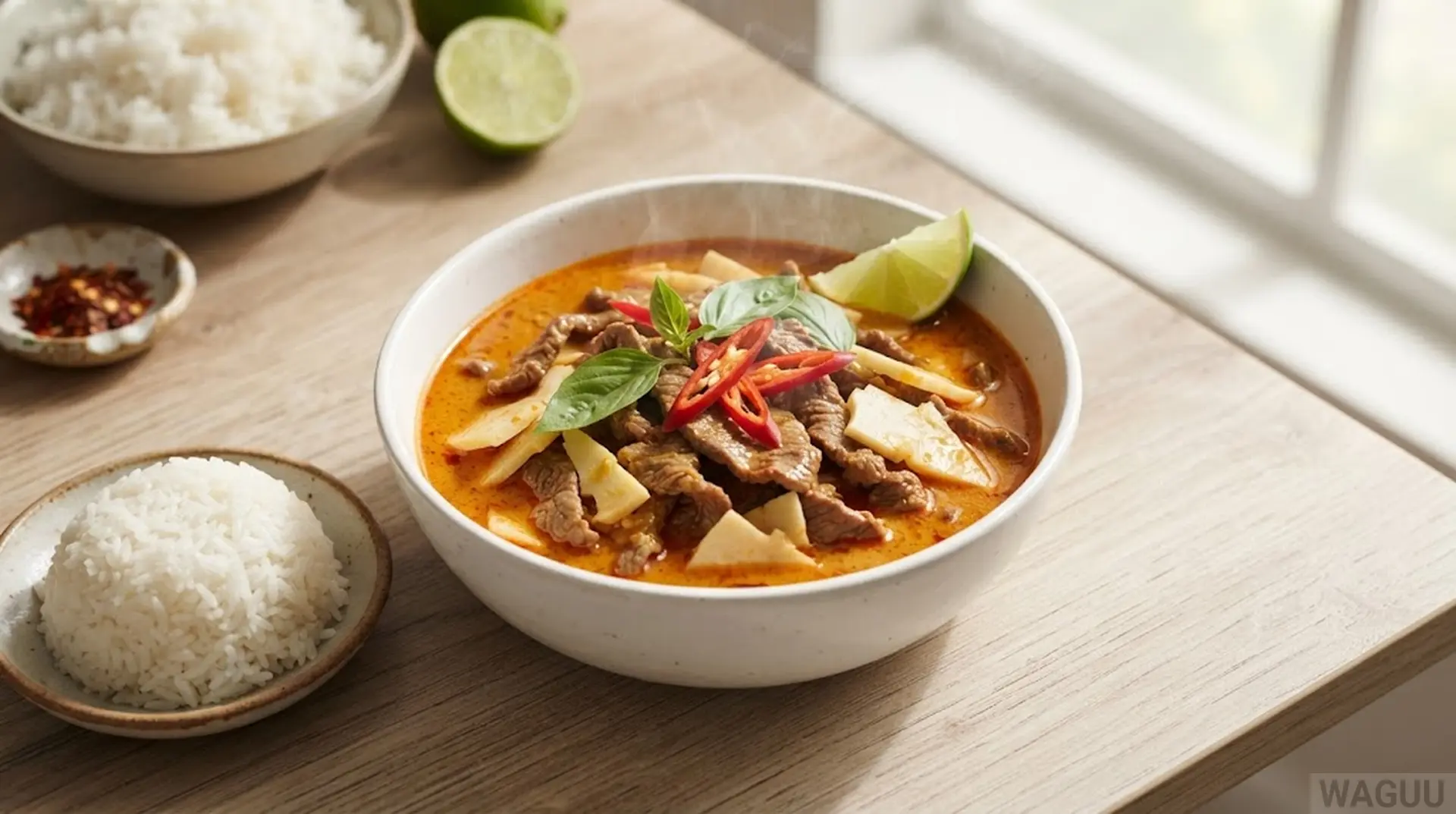
Summary: Red curry paste is dissolved in the thick part of the coconut milk, the meat is sealed in it, and then the curry is briefly simmered with bamboo shoots and aubergine. The flavour is finished with fish sauce, palm sugar and lime. Total time 55 minutes, base 6 servings.
Have you cooked this recipe? Share your result with the community.
Category: Beef · Thai Cuisine
Success rate: not rated yet % of users managed the recipe
Quick overview
- Dish: Red Curry (Gaeng Daeng) – red curry from red paste and coconut milk with beef
- Category: beef, thai-cuisine
- Cuisine: Thai
- Main ingredient: Beef, 900 g (topside or rump) (quality specification)
- Guide: 12 most famous Thai dishes: traditional recipes of Thai cuisine
- Total time: 55 minutes (25 min preparation + 30 min cooking)
- Difficulty: Medium
- Servings: 6 (Serving weight: 366 g)
- Key technique: Dissolving red paste in coconut fat and briefly simmering thin slices of meat
- Preparation types: Simmering in coconut milk
- Dietary info & allergens: crustaceans and fish (red curry paste, fish sauce)
- Suitable for: Family dinner, dinner with friends, quick weekday lunch or a festive multi-course table.
- Nutritional values (per 1 serving): 569, Protein: 34.5 g, Fat: 42.0 g, Carbohydrates: 13.2 g
- Storage: 3 days in the fridge, 1 month in the freezer
- Pairing: Thai lager, dry Syrah, iced tea with lemongrass
- In short: Red curry paste is dissolved in the thick part of the coconut milk, the meat is sealed in it, then the curry simmers briefly with bamboo shoots and aubergine. Total time 55 minutes, serves 6.
WAGUU says: “Red curry is recognised by its colour, not by its heat. If it’s brown, the paste was burnt.”
Key facts
| Preparation time: | 25 minutes |
| Cooking time: | 30 minutes |
| Temperature: | Dissolving paste 90 °C, simmering meat 85–90 °C |
| Number of servings: | 6 |
In a nutshell
Red curry is straightforward: paste, coconut, meat, sauce. The difference from green is in the paste – red contains dried chilli, so it’s sharper and the colour is deep red. The meat is cut into thin slices and simmered briefly to stay juicy. The paste is never added to boiling milk.
Ingredients
Base servings: 6 servings • Serving weight:366 g
| Ingredient | Amount | Quality |
|---|---|---|
| beef for curry | 900g | topside or rump, thinly sliced |
| coconut milk | 700ml | full-fat |
| red curry paste | 45g | no colourings, with chilli |
| fish sauce | 30ml | fermented |
| palm sugar | 20g | dark, grated |
| bamboo shoots | 250g | thinly sliced |
| kaffir lime leaves | 6 pcs | fresh, torn |
| Thai basil | 25g | fresh, leaves only |
| red chilli | 3 pcs | sliced on the diagonal |
| lime | 2 pcs | juicy, cut into wedges |
| fresh coriander | 1 pcs | bunch, chopped |
| rapeseed oil | 20ml | neutral |
| spring onion | 3 pcs | sliced on the diagonal |
| fine sea salt | 1 tsp | only as needed |
Why you’ll love this recipe
- Rich colour from paste, not colourings: The paste dissolves in coconut fat, which draws out the red pigment from dried chilli. The curry is red on its own.
- Ready in an hour: Thin slices of meat simmer for twelve minutes. The curry is on the table sooner than massaman and doesn’t need a long stock.
- Exact ratios for 6 servings: One hundred and fifty grams of meat per serving, seven hundred millilitres of coconut milk and a paste that holds its heat. The number of servings is recalculated.
Success guaranteed: Red curry paste is made from dried red chilli, which have a higher content of fat-soluble pigments. That’s why the paste dissolves in thick coconut cream – the fat draws out both pigment and aroma, and the curry gets a deep red colour. When the paste is added to diluted milk, the colour stays pale and some of the heat is lost.
Recipe overview
Preparation: 25 min min | Cooking: 30 min min | Difficulty: Medium | Servings: 6 | Type: Main course | Origin: Thai
Detailed method
Total progress: 6 % done
Phase 1: Dissolving red paste – 6 min
Appliances: wok or deep pan, spatula
1. Skim the thick top layer from the coconut milk and heat it in the wok over medium heat until the fat separates and looks like glossy cream.
2. Add the red curry paste and fry it in the fat until the aroma develops and the colour darkens to deep red.
Visual check: The paste is evenly dissolved, the colour is deep red and there are no brown burnt spots on the bottom.
Before you move to the next step:
Paste added to diluted milk stays pale and the heat disperses. Always use the thick layer of milk first.
Phase 2: Sealing the meat – 6 min
Appliances: wok, spatula
1. Cut the meat into thin slices against the grain and add them to the paste. Fry briefly until the surface darkens and is coated with a red layer.
2.Pour in the rest of the coconut milk and bring the curry to 90°C, just below boiling point.
Visual check:The meat is coated in the paste and the colour has spread through the milk. The slices hold their shape and are not overcooked.
Before you move on:
Fry the thin slices of meat for no more than two minutes. Longer frying dries them out and makes them tough.
Phase 3: Brief simmer – 12 min
Equipment:wok with lid
1.Add the torn kaffir lime leaves and simmer the curry with the lid on at 85–90°C until the meat is tender.
2.Shake the wok occasionally so the sauce doesn’t stick to the bottom. Don’t stir vigorously or the emulsion will split.
Visual check:The meat is tender but holds its shape. The sauce is smooth, deep red and the fat hasn’t separated.
Before you move on:
Long simmering of beef without collagen dries it out. Keep to twelve minutes and below boiling point.
Phase 4: Bamboo shoots and chilli – 5 min
Equipment:wok
1.Add the bamboo shoots and sliced fresh chilli. Leave them in the curry for three minutes so they stay crunchy.
2.Take the curry off the heat and add the fish sauce and palm sugar. Stir and taste.
Visual check:The shoots resist when bitten, the taste is salty, sweet and spicy in balanced proportion.
Before you move on:
Never add fish sauce and sugar to a boiling curry, the flavour flattens. Always off the heat.
Phase 5: Basil and resting – 3 min
Equipment:wok
1.Stir the Thai basil leaves into the warm curry and let them rest for two minutes with the lid on.
2.Season the curry with fresh lime juice and transfer it to a serving bowl.
Visual check:The basil is bright green and fragrant, the sauce hasn’t turned yellow. The taste is balanced.
Before you move on:
Basil in boiling curry turns black and bitter. Always add it off the heat.
Phase 6: Serving with rice – 3 min
Equipment:deep bowls
1.Spoon the jasmine rice into warmed bowls and pour the curry alongside, not over it.
2.Top with basil leaves, spring onion rings and chopped coriander.
Visual check:The rice stays fluffy and the curry doesn’t soak into it. The curry colour is deep red.
Required equipment
| Utensil | Ideal size | Alternative | Risk |
|---|---|---|---|
| wok or deep frying pan | 30 cm diameter | wide casserole | a narrow pan won’t let the paste dissolve |
| sharp knife | 20 cm blade | long smooth knife | a blunt knife tears the meat and the slices cook unevenly |
| wooden spoon | 30 cm long | silicone spatula | a metal spoon scratches the wok surface |
| thermometer | up to 100°C | estimate by bubbles | a rolling boil breaks the coconut emulsion |
Shopping list
Nutritional profile
Values per 1 portion (without side dish). Calculated from average nutritional values of ingredients.
| Nutrient | Per 100 g | Per 1 portion | For 6 portions |
|---|---|---|---|
| Energy | 649 kJ / 155 kcal | 2381 kJ / 569 kcal | 14284 kJ / 3414 kcal |
| Fat | 11.5 g | 42.0 g | 252.0 g |
| of which saturates | 6.8 g | 24.7 g | 148.4 g |
| Carbohydrate | 3.6 g | 13.2 g | 79.2 g |
| of which sugars | 3.6 g | 13.2 g | 79.2 g |
| Protein | 9.4 g | 34.5 g | 207.0 g |
| Salt | 0.9 g | 3.5 g | 20.8 g |
Reference intake of an average adult (8400 kJ / 2000 kcal).
WAGUU Professional level
- Pro standard: Tested recipe with precise ratios and visual checkpoints.
- Tip 1: Tested recipe with precise ratios and visual checkpoints.
- Tip 2: The paste is evenly dissolved, the colour is deep red and there are no brown burnt spots on the bottom. Paste added to diluted milk stays pale and the heat disperses. Always use the thick layer of milk first.
- Tip 3: The meat is coated in the paste and the colour has spread through the milk. The slices hold their shape and are not overcooked. Fry the thin slices of meat for no more than two minutes. Longer frying dries them out and makes them tough.
- Tip 4: Prepare the ingredients on the table in small bowls beforehand. Thai cooking is done over high heat and there’s no time to divide ingredients during cooking.
Scientific background
Dried chilli contains capsaicin, which is soluble in fat and insoluble in water. Coconut fat therefore binds it and the heat spreads throughout the sauce. Thin slices of meat are simmered briefly because beef muscle without collagen toughens with longer cooking. Bamboo shoots are added towards the end to keep them crunchy.
Fine Dining – Professional techniques
- Plate composition: Pour the curry into a deep white bowl where the red colour stands out. Put the rice in a small mould alongside.
- Texture contrasts: Place three basil leaves and a thin slice of fresh chilli on the surface. The aroma is released before the first bite.
- Temperature contrast: Serve pickled cucumber in a small bowl on the side. The acidity and crunch contrast with the creamy curry.
- Aromatic additions: Before serving, add a drop of lime juice directly to the sauce. The acid cuts through the fat and brightens the colour.
Sensory radar
- Appearance: The curry is a deep red, smooth, with thin slices of beef, white bamboo shoots and green basil on top.
- Aroma: Pungent red paste with coconut, then fresh basil and lime after stirring.
- Taste: Hot and salty with coconut sweetness, finishing with lime acidity.
- Texture: Beef tender and juicy, bamboo shoots crunchy, sauce creamy.
Pairing
- Thai lager: A lager with higher carbonation cleanses the palate of coconut fat and tones down the heat. Serve at 6°C.
- Dry Syrah: A Syrah with fruity flavour and soft tannins stands up to the beef. Avoid heavily oaked wines.
- Lemongrass iced tea: Iced tea with lemongrass and honey. The grassy aroma echoes the paste and the lime acidity keeps the curry fresh.
Variations
- Prawn red curry:: Replace the beef with prawns and add them in the last three minutes. The curry will be sweeter and lighter, and the simmering time reduces to five minutes.
- Vegetarian red curry:: Omit the beef and use firm tofu, aubergine and red pepper. Add the tofu in the last five minutes so it holds its shape.
Allergens and dietary information
Contains: crustaceans and fish (red curry paste, fish sauce) • Gluten: no, this recipe is gluten-free • Not suitable for: people with an allergy to crustaceans and fish
Suitable for
A family dinner, dinner with friends, a quick weekday lunch or a festive multi-course table.
FAQ
What is the difference between red and green curry?
Red paste is made from dried red chillies, so it is hotter and the colour is deeper. Green paste uses fresh chillies and has a fresh, grassy flavour.
Why is my curry pale?
The paste did not dissolve in the fat. Spoon off the thick layer of coconut milk, heat it until the fat separates and only then add the paste.
Can I use other meat?
Yes. Chicken thigh simmers for ten minutes, pork shoulder for fifteen. Add prawns in the last three minutes.
How can I make the curry milder?
Reduce the paste to thirty grams and add two tablespoons of coconut cream. The heat disperses and the curry becomes creamier.
What can I use instead of bamboo shoots?
Red pepper, peas or Thai aubergine. All are added in the last five minutes to keep them firm.
Why does the sauce split?
The curry was boiled too hard. Lower the heat, add a tablespoon of cold coconut milk and whisk; the emulsion will come back together.
WAGUU Petr advises: Cooking for 6 or more?
6–8 people: Heat the wok or pan in batches and keep the finished dish warm in an oven at 80°C. Add the flavourings (fish sauce, lime, sugar) at the very end, otherwise the aroma disappears. • 10+ people: Make the base (paste, stock or marinade) in double quantity and keep half for the next day. Fill the wok no more than two-thirds full, otherwise the ingredients steam instead of fry.
Sides and serving
Serving: Serve the curry in a deep bowl with jasmine rice. Top with Thai basil leaves and chilli slices.
Storage and reheating
Fridge: 3 days • Freezer: 1 month • Reheating: Fridge: 3 days • Freezer: 1 month • Reheating: over a gentle heat to 80°C with a tablespoon of water, add basil only to the finished curry
Satay Gai – grilled marinated chicken skewers with peanut sauce and pickled vegetables
Author: WAGUU Petr & Team • Published: 8 Oct 2026 • Updated: 10 Oct 2026
More recipes from the article
Guide: 12 most famous Thai dishes: traditional recipes from Thai cuisine
Pad Thai – stir-fried rice noodles with egg, prawns, tofu, tamarind, peanuts and lime
Tom Yum Goong – hot and sour soup with prawns, lemongrass, galangal and chilli
Tom Kha Gai – coconut soup with chicken, galangal, lemongrass and lime leaves
Green Curry (Gaeng Keow Wan) – green curry with coconut milk, chicken and Thai basil
Som Tam – spicy green papaya salad with chilli, lime, fish sauce and peanuts
Som Tam – spicy green papaya salad with chilli, lime, fish sauce and peanuts
Pad Kra Pao – stir-fried meat with Thai basil, chilli and garlic, served with rice and a fried egg
Khao Pad – Thai fried rice with egg, vegetables and chicken
Khao Soi – northern Thai noodle soup with coconut curry, chicken and crispy noodles
Satay Gai – marinated grilled chicken skewers with peanut sauce and pickled vegetables
Mango Sticky Rice (Khao Niao Mamuang) – sticky rice with coconut milk and ripe mango
More recipes you might like
Why WAGUU?
WAGUU recipes are checked for accuracy of ingredients, methods and nutritional values.
Photo gallery from the method
Photos from the community: Cook, take a photo and share the result.
You can upload photos in the comments below or send them by email.
Did you film a video of our recipe? Post a link to YouTube, YouTube Shorts, TikTok, Instagram Reels, Facebook Reels, Pinterest, Vimeo or X (Twitter) in the comments – we will happily publish it and help you and your content get noticed.
Common mistakes
- Dissolving the red paste – Paste added to diluted milk stays pale and the heat disperses. Always use the thick layer of milk first.
- Sealing the meat – Sear the thin slices of beef for no more than two minutes. Longer cooking dries them out and makes them tough.
- Short simmering – Long simmering of beef without collagen dries it out. Keep it to twelve minutes and below boiling point.
- Bamboo shoots and chilli – Never add fish sauce and sugar to boiling curry, the flavour flattens. Always off the heat.