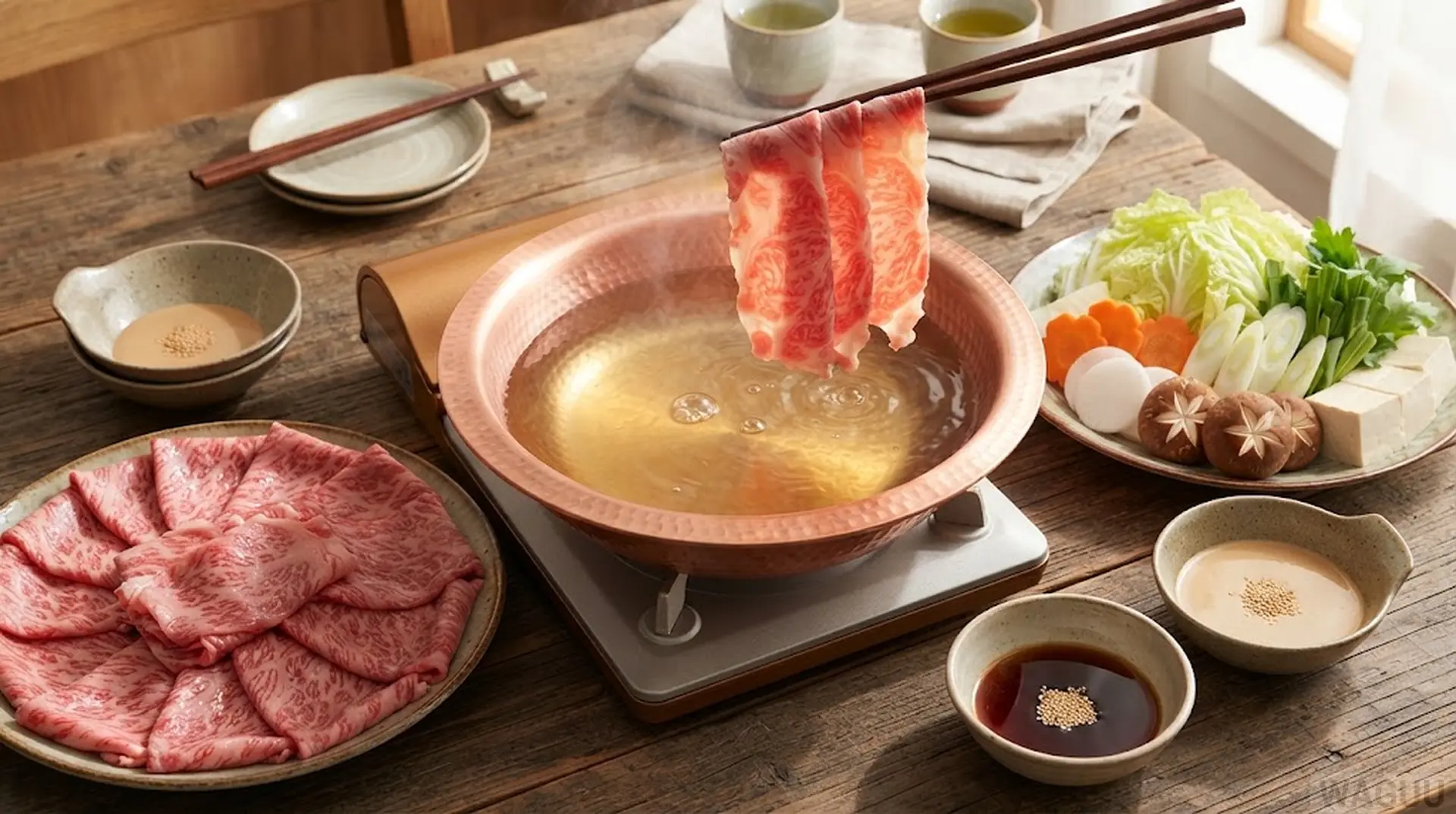
Summary: Shabu-shabu is made with thin slices of beef topside that are dipped into simmering kombu stock for just a few seconds. Vegetables, tofu and mushrooms are placed on the table and cooked in the same stock for longer. The cooked pieces are dipped into sesame sauce and ponzu. At the end, noodles or rice are added to the flavoured stock. Total time 60 minutes, serves 6.
Have you cooked this recipe? Share your result with the community.
Category: beef, japanese-cuisine
Success rate: not rated yet % of users managed this recipe
Quick overview
- Dish: Shabu-Shabu – a Japanese hot pot where thin slices of meat and vegetables are briefly cooked in hot stock and dipped into sauces
- Category: beef, japanese-cuisine
- Cuisine: Japanese
- Main ingredient: Beef topside, 900 g (slices 1–2 mm) (quality specification)
- Guide: 12 most famous Japanese dishes: traditional recipes from Japanese cuisine
- Total time: 60 minutes (35 min preparation + 25 min cooking)
- Difficulty: Medium
- Servings: 6 (portion weight: 420 g)
- Key technique: Brief dipping of thin meat slices into simmering kombu stock and dipping into two sauces
- Cooking methods: Classic cooking, poaching
- Dietary info & allergens: soy (soy sauce, miso paste), sesame (sesame sauce), gluten (soy sauce)
- Suitable for: A celebratory dinner for six to eight people, a family gathering around one pot, a winter evening, dinner with friends, a home version of dishes from Japanese restaurants.
- Nutritional values (per 1 portion): 505, Protein: 42.0 g, Fat: 26.0 g, Carbohydrates: 22.0 g
- Storage: 2 days in the fridge, 2 months in the freezer
- Pairing: Japanese light lager, dry red wine, sencha green tea
- In short: Shabu-shabu made from thin slices of beef topside, dipped into boiling kombu stock for a few seconds. Total time 60 minutes, serves 6.
WAGUU says: “”Shabu-shabu is not boiled. The meat slice is just swished through the stock – two strokes with chopsticks and it is done.””
Key facts
| Preparation time: | 35 |
| Cooking time: | 25 |
| Temperature: | Stock 90–95 °C, meat slice in stock 5–8 seconds |
| Number of servings: | 6 |
In a nutshell
Shabu-shabu is a dish made right at the table. A slice of meat is held with chopsticks and just swished back and forth in simmering stock; if it stays in the heat longer, it loses its juices and becomes tough. Vegetables and mushrooms are cooked in the same stock, so the flavours of the meat and vegetables gradually blend. The stock is not boiled vigorously, because it would become cloudy and lose the kombu flavour. After dinner, the flavoured stock remains in the pot, noodles are added and the meal is finished – the second half of dinner comes from what is left.
Ingredients
Base servings: 6 servings • Portion weight: 420 g
| Ingredient | Amount | Quality |
|---|---|---|
| beef topside | 900 g | slices 1–2 mm, against the grain, with fine marbling |
| kombu seaweed | 30 g | dried, wide sheets |
| water for stock | 2000 ml | soft, chlorine-free |
| Chinese cabbage | 400 g | firm, cut into 5 cm pieces |
| carrot | 2 pcs | medium, cut into thin rounds, 160 g |
| daikon radish | 300 g | firm, cut into thin slices |
| spring onion | 6 pcs | fresh, cut into 5 cm lengths |
| shiitake mushrooms | 8 pcs | fresh, caps sliced |
| firm tofu | 300 g | firm, cut into 2 cm cubes |
| udon noodles | 600 g | thick wheat noodles, pre-cooked |
| soy sauce | 90 ml | naturally fermented, for ponzu sauce |
| mirin | 60 ml | sweet rice cooking wine |
| lemon | 2 pcs | juicy, for ponzu sauce, 240 g |
| sesame sauce | 120 ml | creamy, roasted sesame paste |
| roasted sesame | 20 g | white, dry-roasted |
| shichimi togarashi | 3 g | Japanese seven-spice blend |
Why you will love this recipe
- A dish everyone controls themselves: The pot sits in the middle of the table and everyone cooks what they want, when they want. The meat stays as each person makes it.
- Two sauces for two flavours: Sesame sauce is creamy and sweet, ponzu is fresh and sour. The same slice of meat tastes different every time.
- Exact ratios for 6 servings: One hundred and fifty grams of meat per portion, vegetables at two thirds of the weight and stock topped up as needed. Everything recalculates according to the number of diners.
Success guaranteed: A thin slice of meat heats through faster than a thick one, because heat penetrates the meat from both sides. A slice one to two millimetres thick needs only a few seconds. Muscle fibre proteins contract above 60 °C and squeeze out water. The longer the meat stays in the stock, the more water it releases and the tougher it becomes. That is why the slice is held with chopsticks and just swished through the stock. Kombu stock is kept below boiling point, because kombu contains substances that are released as bitter compounds during vigorous boiling. Vegetables and mushrooms are cooked in the same stock for longer, so they pass sugars and acids into it and the stock gains depth. At the end, noodles are added to the stock, soaking up the flavour of the meat and vegetables, and the dinner gets a second course.
Recipe overview
Preparation: 35 min min | Cooking: 25 min min | Difficulty: Medium | Servings: 6 | Type: Main course | Origin: Japanese
Detailed method
Overall progress: 6 % done
Phase 1: Preparing the meat – 15 min
Equipment: fridge, freezer, sharp long knife
1. Put the beef topside in the freezer for a quarter of an hour so it firms up slightly. Then cut it with a long stroke of the knife against the grain into slices one to two millimetres thick.
2. Spread the meat slices on a large tray in a single layer, cover with cling film and return to the fridge. Put the tray on the table only when serving.
VKB: The meat slices are equally thin, translucent when placed on the palm and hold their shape. The fibres are visible in cross-section. The cling film is not sagging, the slices do not overlap.
Before you move to the next step:
Do not slice the meat with the grain or into thick pieces. A thick slice will not heat through in the broth without turning tough.
Phase 2: Vegetables and mushrooms – 12 min
Equipment: sharp knife, chopping board
1. Cut the Chinese cabbage into pieces, the carrot into thin rounds and the daikon into thin slices. Cut the spring onions into lengths and slice the shiitake mushrooms.
2. Cut the tofu into evenly sized cubes. Arrange all the vegetables, mushrooms and tofu on a large platter in a circle by type, so that each person can take what they want.
VKB: The vegetables are cut into evenly sized pieces that fit on one fork. The types are separated on the platter and nothing overlaps. The tofu holds its shape.
Before you move to the next step:
Do not cut the vegetables into pieces that are too thick. They cook in the broth at the table and a thick piece would stay raw by the time the meat is eaten.
Phase 3: Kombu broth – 15 min
Equipment: wide fondue pot or electric pot, kitchen thermometer
1. Wipe the kombu with a damp cloth and put it in a pot with cold water. Place the pot over a low heat and warm the water slowly until it reaches 80°C.
2. Remove the kombu from the pot before the water boils and bring the broth to 90–95°C. Move the pot to the table on a stand and keep it at this temperature.
VKB: The broth is clear, light amber and smells of the sea and fresh vegetables. Only occasional bubbles appear on the surface; the broth is not boiling vigorously. The thermometer reads 90–95°C.
Before you move to the next step:
Never let the broth come to a vigorous boil. The kombu will release bitter compounds and the broth will turn bitter, the meat will cloud it and lose flavour.
Phase 4: Sauces – 10 min
Equipment: none
1. For the ponzu sauce, mix the soy sauce, mirin and freshly squeezed lemon juice. Pour the sauce into two small bowls and season with a pinch of shichimi togarashi.
2. Whisk the sesame sauce with a little broth to thin it so it can be spooned. Pour it into two bowls and sprinkle with toasted sesame seeds.
VKB: The ponzu is clear, light brown and smells of lemon. The sesame sauce is creamy, smooth and coats a spoon. Each guest has two bowls in front of them.
Before you move to the next step:
Do not thin the sesame sauce with water. Thin it with broth from the pot so that the flavour of the sauce stays connected to the flavour of the meal.
Phase 5: Cooking at the table – 18 min
Equipment: fondue pot, chopsticks, ladle
1. First put the vegetables that take the longest to cook into the broth: daikon, carrot and Chinese cabbage. Add the mushrooms and tofu later so they stay firm and do not fall apart.
2. Pick up a slice of meat with chopsticks, dip it into the simmering broth and swish it back and forth for just a few seconds. Dip the cooked slice into one of the sauces and eat it while hot.
VKB: After being lifted from the broth, the meat slice is pink to light brown, holds its shape and is juicy. The vegetables are soft but hold their shape. The broth has stayed clear and no grey foam forms on the surface.
Before you move to the next step:
Do not leave the meat in the broth. After a few extra seconds it releases water, turns tough and clouds the flavour of the broth.
Phase 6: Finishing the noodles – 10 min
Equipment: fondue pot, sieve, bowls
1. When the meat has been eaten, strain the remaining vegetables from the broth and let the broth reduce slightly. Taste it and adjust the seasoning with soy sauce if needed.
2. Add the udon noodles to the broth and let them heat through. Divide the noodles between bowls, pour over the broth and serve as a second course with the remaining vegetables and spring onions.
VKB: The broth is darker and fuller than at the start, but still clear. The noodles are heated through, springy and hold their shape. The bowl shows broth, noodles and remaining vegetables.
Required equipment
| Utensil | Ideal size | Alternative | Risk |
|---|---|---|---|
| fondue pot or electric pot | 3 l capacity, wide base | cast-iron pot on a portable hob | a thin base only holds the temperature at a vigorous boil and the broth will cloud |
| sharp long knife | 24 cm blade, smooth | electric meat slicer | a serrated blade tears the meat and the slices are not evenly thin |
| chopsticks | wooden, 30 cm | long fondue forks | metal chopsticks get hot in the broth and burn your fingers |
| kitchen thermometer | up to 150°C, fast response | check for occasional bubbles on the surface | without measuring, the broth easily comes to a vigorous boil |
| large platter for ingredients | 35 cm diameter, shallow | two smaller plates | a small platter forces you to stack ingredients and the vegetables get crushed |
Shopping list
Nutritional profile
Values per 1 serving (without side dish). Calculated from average nutritional values of ingredients.
| Nutrient | Per 100 g | Per 1 serving | Per 6 servings |
|---|---|---|---|
| Energy | 502 kJ / 120 kcal | 2113 kJ / 505 kcal | 12678 kJ / 3030 kcal |
| Fat | 6.2 g | 26.0 g | 156.0 g |
| of which saturates | 2.2 g | 9.1 g | 54.6 g |
| Carbohydrate | 5.2 g | 22.0 g | 132.0 g |
| of which sugars | 1.6 g | 6.9 g | 41.4 g |
| Protein | 10.0 g | 42.0 g | 252.0 g |
| Salt | 0.4 g | 1.5 g | 9.0 g |
Reference intake of an average adult (8400 kJ / 2000 kcal).
WAGUU Professional level
- Professional standard: Tested recipe with precise ratios and visual checkpoints.
- Tip 1: Tested recipe with precise ratios and visual checkpoints.
- Tip 2: Chill the meat in the freezer before slicing and cut it against the grain into slices one to two millimetres thick. A thicker slice will not heat through in the broth without turning tough.
- Tip 3: Keep the broth at 90 to 95°C, below a vigorous boil. At a vigorous boil the meat clouds the broth and the kombu releases bitter compounds.
- Tip 4: At the end of the meal, add cooked noodles or rice and the strained vegetables to the broth. The broth is flavoured by the meat and vegetables, so it would be a shame to pour it away.
The science behind it
A thin slice of meat heats through faster than a thick one because heat penetrates from both sides. A slice one to two millimetres thick needs only a few seconds. Muscle proteins contract above 60°C and squeeze out water, so hold the slice with chopsticks and just swish it through the stock. Kombu stock is kept below boiling point because kombu releases bitter compounds when boiled hard. Vegetables and mushrooms cook longer in the same stock and give it sugars and acids.
Fine Dining – Professional techniques
- Plating:Arrange the meat and vegetables on a large platter in a circle by type so each guest can take what they want. Place the pot in the centre of the table on a portable stove.
- Texture contrasts:Creamy sesame sauce contrasts with fresh ponzu. Dip each piece of meat into only one of them so the flavours stay separate.
- Temperature contrast:Hold the slice of meat with chopsticks and swish it through the stock for just a few seconds. Serve it immediately, when it is hottest and juiciest.
- Aromatic additions:Add a teaspoon of rice vinegar and a pinch of Japanese shichimi togarashi to the sesame sauce. The acid cuts through the fat and the spice aroma underlines the meat’s flavour.
Sensory radar
- Appearance:Clear stock trembles in the pot, on the table a platter with pink slices of meat, white tofu, vegetables and mushrooms. In bowls are two sauces: dark ponzu and creamy sesame.
- Aroma:Fresh aroma of kombu stock and fresh vegetables, followed by beef. Sesame sauce adds a roasted, nutty note.
- Taste:Clean taste of stock and meat, then the salty and sour ponzu or the creamy sweet sesame sauce.
- Texture:The meat slice is soft and juicy, the vegetables tender but holding their shape. Tofu offers a brief resistance, mushrooms are firm.
Pairing
- Japanese pale lager:The carbonation and gentle bitterness cut through the fat of the meat. Serve chilled at 6–8°C.
- Dry red wine:Pinot Noir with lower tannins. The tannins bind with the meat proteins and the taste balances out.
- Sencha green tea:Warm but not boiling. The bitterness of the tea balances the saltiness of ponzu.
Variations
- Pork shabu-shabu::Replace beef sirloin with pork tenderloin cut into thin slices. The meat heats through faster, so keep it in the stock for only three to four seconds.
- Seafood shabu-shabu::Use prawns and salmon slices instead of meat. Make the stock from kombu and add a little sake; the flavour will be fresher.
Allergens and dietary information
Contains:soy (soy sauce, miso paste), sesame (sesame sauce), gluten (soy sauce) • Gluten:yes, in soy sauce • Not suitable for:people with coeliac disease, soy and sesame allergies
Suitable for
A celebratory dinner for six to eight people, a family gathering around one pot, a winter evening, dinner with friends, a home version of dishes from Japanese restaurants.
Substitution catalogue
- Sesame sauce::roasted sesame paste (tahini) thinned with stock and a teaspoon of soy sauce. The taste will be similar, just less sweet.
FAQ
How long should the meat stay in the stock?
A slice one to two millimetres thick only needs to be swished back and forth in the hot stock. After a few extra seconds it squeezes out water, becomes tough and loses its juiciness.
Why is the stock not boiled hard?
Kombu seaweed contains compounds that are released as bitter substances when boiled hard. Keep the stock at 90–95°C; the surface should only tremble. The meat then does not become cloudy and the flavour stays clean.
What is ponzu sauce?
A fresh Japanese sauce made from soy sauce, mirin and citrus juice. This recipe uses lemon; in Japan yuzu is used. The acid cuts through the fat of the meat.
Can I make shabu-shabu without a tabletop cooker?
Yes, swish the meat in the hot stock in the kitchen and serve it on a warmed plate. But you lose part of the experience because the dish is meant to be cooked at the table.
Which vegetables are suitable?
Those that hold their shape and cook quickly: Chinese cabbage, carrot, daikon radish, spring onion and shiitake mushrooms. Avoid soft vegetables that fall apart in the stock.
Can I use the stock after dinner?
Yes, it is the base for a second course. Strain out the vegetables, reduce it slightly, add udon noodles or rice and cook them in it. Pouring it away is a waste.
WAGUU Petr advises: Cooking for 6 or more?
6–8 people:Arrange the meat and vegetables on two platters and place them at both ends of the table. Top up the stock with hot water so the temperature does not drop below 90°C. • 10+ people:Choose pork tenderloin or chicken thigh; the slices heat through faster. Prepare two noodle baskets and divide the stock between two pots.
Side dishes and serving
Serving:Serve at the table with the pot in the centre, the platter of ingredients to the side and two bowls of sauce in front of each guest. At the end of the meal, add udon noodles to the stock.
Storage and reheating
Fridge:2 days • Freezer:2 months • Reheating:Fridge: 2 days • Freezer: 2 months • Reheating: Warm the stock to 90°C and let the meat come to room temperature for a quarter of an hour. Never reheat the meat in a microwave.
Author: WAGUU Petr & Team • Published: 7 Oct 2026 • Updated: 10 Oct 2026
More recipes from the article
Guide: 12 most famous Japanese dishes: traditional recipes from Japanese cuisine
Ramen – noodle soup with a rich broth, meat, egg, vegetables and other typical toppings
Tempura – lightly battered and fried seafood or vegetables in a thin, crisp batter
Tonkatsu – breaded and fried pork cutlet served with finely shredded cabbage and tonkatsu sauce
Takoyaki – round fried batter balls filled with octopus, typical of Osaka
Katsudon – bowl of rice with breaded pork cutlet tonkatsu, egg and onion in a seasoned broth
Gyudon – bowl of rice topped with thin slices of beef and onion simmered in a sweet-savoury sauce
More recipes you might like
Why WAGUU?
WAGUU recipes are checked for accuracy of ingredients, methods and nutritional values.
Photo gallery from the process
Photos from the community:Cook, take a photo and share the result.
You can upload photos in the comments below or send them by email.
Did you film a video of our recipe? Paste a link to YouTube, YouTube Shorts, TikTok, Instagram Reels, Facebook Reels, Pinterest, Vimeo or X (Twitter) in the comments – we will be happy to publish it and help you and your content get noticed.
Most common mistakes
- Meat left in the stock – the slice squeezes out water, becomes tough and loses flavour. Hold it with chopsticks and just swish it back and forth in the stock.
- Boiling the stock hard – the stock becomes cloudy and kombu releases bitter compounds. Keep the temperature at 90–95°C; the stock should only tremble.
- Thick slices of meat – a thick slice does not heat through in the stock, or stays in the heat longer and becomes tough. Cut slices one to two millimetres thick.
- Pouring away the stock after dinner – the stock is flavoured by the meat and vegetables and is the base for a second course. Add noodles or rice and cook them in it.
