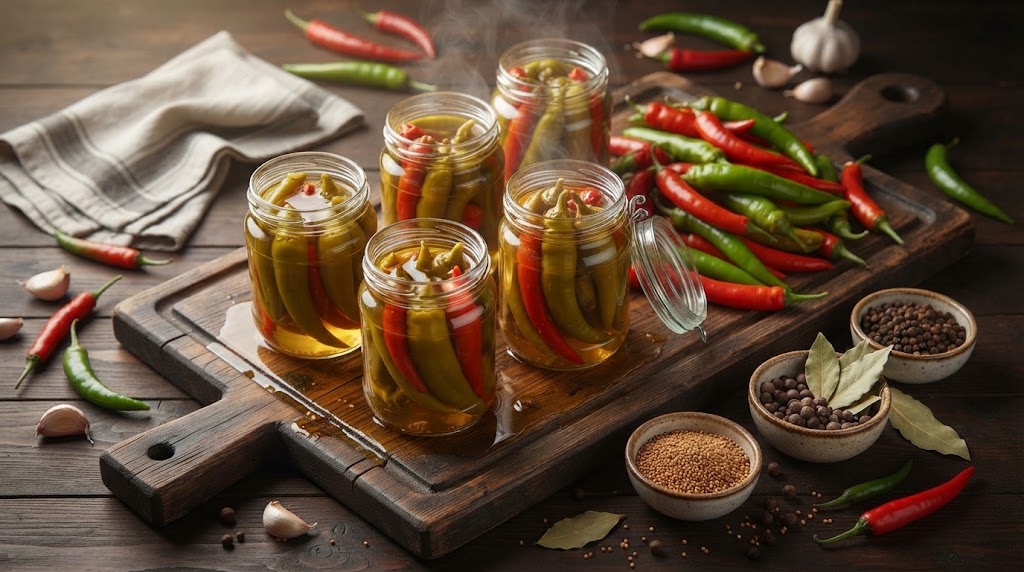
Summary: Spicy lamb horn peppers pickled in a perfectly balanced sweet and sour brine with spices. A traditional British preserve that lasts for months. Preparation time 45 minutes, 6 jars of 500 ml.
Have you cooked the recipe? Share your result with the community.
Categories: Preserves, Techniques, British Cuisine
Success rate: not rated yet % of users managed the recipe
Quick overview
- Dish: Classic Lamb Horn Peppers in Sweet and Sour Brine
- Categories: Preserves, Techniques
- Cuisine: British
- Main ingredient: Spicy lamb horn peppers, 1 kg (fresh, firm, no signs of mould)
- Guide: Spicy Lamb Horn Peppers in Sweet and Sour Brine
- Total time: 45 minutes (30 min prep + 15 min cooking)
- Difficulty: Easy
- Servings: 6 jars (500 ml)
- Key technique: Pickling, Preserving
- Preparation types: Preserving
- Dietary info & allergens: Gluten-free, lactose-free, vegan
- Suitable for: Chilli lovers, as an accompaniment to meat and cheese
- Nutritional values (per 100 g): 45 kcal, Protein: 1 g, Fat: 0.5 g, Carbohydrates: 9 g
- Storage: 12–18 months in a cool, dark place, once opened 2 months in the fridge
- Pairing: Pale ale, Rulandské bílé, Kefir
- In short: Spicy lamb horn peppers in a perfectly balanced sweet and sour brine that lasts for months and is excellent with meat and cheese.
- Last updated: 13 September 2026
WAGUU says: “Lamb horn peppers in sweet and sour brine prove that even sharp heat can be perfectly balanced and pleasantly refreshing.”
Key facts
| Prep time: | 30 minutes |
| Cook time: | 15 minutes |
| Temperature: | 85 °C (water bath) |
| Servings: | 6 jars (500 ml) |
At a glance
Spicy lamb horn peppers pickled in a perfectly balanced sweet and sour brine with spices. A traditional British preserve that lasts for months and is excellent with meat, cheese or as a standalone starter.
Ingredients
Base servings: 6 jars • Serving weight: 500 ml
| Ingredient | Amount | Quality |
|---|---|---|
| Spicy lamb horn peppers | 1000 g | Fresh, firm, no signs of mould |
| Wine vinegar 8% | 250 ml | Good quality wine vinegar |
| Water | 500 ml | Filtered, not chlorinated |
| Caster sugar | 250 g | White caster sugar |
| Salt | 20 g | Fine sea salt |
| Mustard seeds | 10 g | Yellow and black |
| Allspice berries | 6 pcs | Whole berries |
| Bay leaves | 6 pcs | Dried |
| Black peppercorns | 10 pcs | Whole peppercorns |
Why you will love this recipe
- Perfect flavour: The correct ratio of vinegar and sugar creates a harmonious sweet and sour flavour that enhances the heat of the peppers.
- Long shelf life: With proper sterilisation, the pickled peppers last 12–18 months.
- Versatile use: Excellent with meat, cheese, in sandwiches or as a standalone starter.
Success guaranteed: This recipe is based on traditional British preserving practice and has been tested by many generations. The correct ratio of ingredients and following the method ensures a perfect result.
Recipe overview
Prep: 30 min | Cook: 15 min | Difficulty: Easy | Servings: 6 jars | Type: Preserve | Origin: British
Detailed method
Total progress: 0 % done
Phase 1: Preparing the peppers – 15 min
Equipment: Chopping board, knife, paper towels
1. Wash the lamb horn peppers under running water and dry thoroughly with a paper towel. Remove the stalks and any damaged parts. Leave the peppers whole; only if they are too large, cut them in half lengthwise.
VCB: The peppers are dry, firm and stalkless.
Before you continue:
Never leave the peppers wet. Water in the brine can cause spoilage.
Phase 2: Preparing the brine – 10 min
Equipment: 3 l saucepan, wooden spoon, measuring jug
2. In a saucepan, combine the water, wine vinegar, sugar and salt. Bring to the boil and stir until the sugar and salt are completely dissolved. Add the mustard seeds, allspice, bay leaves and black peppercorns. Simmer for 5 minutes over a low heat.
VCB: The brine is clear, the sugar and salt are completely dissolved, the spices are evenly distributed.
Before you continue:
Do not bring the brine to a rapid boil, as this could evaporate the vinegar and change the ratio.
Phase 3: Filling the jars – 10 min
Equipment: Sterilised 500 ml jars, ladle
3. Fill the sterilised jars tightly with the lamb horn peppers. Pack the peppers closely together to minimise empty space. Pour over the hot brine so that the peppers are completely submerged and the level is 1 cm below the rim of the jar. Add a few allspice berries, a bay leaf and a teaspoon of mustard seeds to each jar.
VCB: The peppers are completely submerged, the brine level is 1 cm below the rim, the spices are evenly distributed.
Before you continue:
Do not fill the jars to the brim. The brine needs room to expand during sterilisation.
Phase 4: Sterilising – 15 min
Equipment: Large water-bath pan, thermometer
4. Seal the jars tightly and place them in the water bath so they are submerged 3 cm below the surface. Bring the water to 85 °C and sterilise for 15 minutes. Check the temperature with a thermometer and keep it constant.
VCB: The lids are tightly sealed, the jars are submerged, the temperature is stable at 85 °C.
Before you continue:
The temperature must not exceed 90 °C, otherwise the peppers will soften and lose their crunch.
Phase 5: Cooling and maturing – 2 weeks
Equipment: Clean tea towel, dark dry place
5. Remove the jars from the water bath and place them upside down on a clean tea towel. Leave them to cool completely. Then store them in a dark, dry, cool place at 10–15 °C. Let the brine mature for at least 2 weeks, ideally 4–6 weeks before eating.
VCB: The lids are sealed, the brine is clear, the peppers are evenly pickled.
Equipment needed
| Equipment | Ideal size | Alternative | Risk |
|---|---|---|---|
| Saucepan | 3 l, stainless steel | Enamelled | Reaction with vinegar |
| Sterilised jars | 500 ml, with lid | Pickle jars | Insufficient sterilisation |
| Thermometer | Up to 100 °C | Sugar thermometer | Inaccurate temperature |
Shopping list
Nutritional profile
Values per 100 g (without side dish). Calculated from average nutritional values of ingredients.
| Nutrient | Per 100 g | Per 1 serving (500 ml) | Per 6 servings |
|---|---|---|---|
| Energy | 45 kcal | 225 kcal | 1350 kcal |
| Fat | 0.5 g | 2.5 g | 15 g |
| of which saturates | 0.1 g | 0.5 g | 3 g |
| Carbohydrates | 9 g | 45 g | 270 g |
| of which sugars | 8 g | 40 g | 240 g |
| Protein | 1 g | 5 g | 30 g |
| Salt | 0.4 g | 2 g | 12 g |
Reference intake of an average adult (8400 kJ / 2000 kcal).
WAGUU Professional level
- Professional standard: Tested recipe with precise ratios and visual checkpoints.
- Tip 1: For crunchier peppers, use young, thin-walled lamb horn peppers.
- Tip 2: If you want a milder brine, use cider vinegar instead of wine vinegar.
- Tip 3: For longer shelf life, add a teaspoon of oil to each jar to create a protective layer on the surface.
- Tip 4: Before eating, leave the jar open for 10 minutes to let the brine breathe and the flavour fully develop.
Scientific background
Preserving peppers in sweet and sour brine is based on several physico-chemical processes. Acetic acid lowers the pH of the brine below 4.5, creating an environment unsuitable for the growth of most bacteria and moulds. The sugar in the brine acts as a preservative through osmosis – it binds water that would otherwise be available to microorganisms. Thermal sterilisation at 85 °C for 15 minutes kills the vegetative forms of microorganisms and ensures long shelf life.
Fine Dining – Professional techniques
- Plate composition: Serve the pickled lamb horn peppers on a small ceramic plate as part of a starter, garnished with fresh herbs.
- Textural contrasts: Combine the crunchy peppers with cream cheese or pâté.
- Temperature contrast: Serve the chilled peppers with warm bread.
- Aromatic additions: Before serving, drizzle the peppers with good quality olive oil and sprinkle with fresh thyme.
Sensory radar
- Appearance: Fresh green and red pepper colour, clear brine with spices.
- Aroma: Sharp, vinegary with hints of spice and peppers.
- Taste: Harmonious sweet and sour flavour with pronounced pepper heat.
- Texture: Crunchy peppers with juicy flesh.
Pairing
- BEER: Pale ale or wheat beer.
- WINE: Rulandské bílé or Grüner Veltliner.
- SOFT DRINK: Kefir or buttermilk.
Different preparation variations
- Lamb horn peppers with honey: Use honey instead of sugar.
- Lamb horn peppers with garlic: Add 2–3 garlic cloves to the jars.
Allergens and dietary information
Contains: Mustard • Gluten: None • Not suitable for: People with mustard allergy
Suitable for
Chilli lovers, as an accompaniment to meat and cheese, as a starter, as a homemade gift.
Substitution catalogue
- Wine vinegar: Cider vinegar or white wine vinegar.
- Caster sugar: Honey or brown sugar.
- Mustard seeds: Caraway or coriander.
FAQ
How long do pickled lamb horn peppers last?
With proper sterilisation and storage in a cool, dark place, pickled lamb horn peppers last 12–18 months.
Can I use other peppers instead of lamb horn peppers?
Yes, you can use any spicy peppers. Jalapeño, serrano or even habanero.
Why has my brine gone cloudy?
Cloudy brine can be caused by insufficient jar sterilisation, using chlorinated water or too much sugar.
How do I achieve crunchy peppers?
Crunchiness is achieved with the correct vinegar-to-water ratio, using fresh peppers and the correct sterilisation time.
WAGUU Petr advises: Cooking for 6 or more people?
6–8 people: Double the ingredients and use 12 jars. • 10+ people: Triple the ingredients and use 18 jars. The sterilisation time remains the same.
Storage and reheating
Fridge: Once opened 2 months • Freezer: Not recommended • Reheating: Not needed, serve chilled
Other recipe variations
Other recipes you might like
Why WAGUU?
Recipes on WAGUU are checked for accuracy of ingredients, methods and nutritional values.
Photo gallery from the process
Community photos: Cook, photograph and share your result.
You can upload photos in the comments below or send them by email.
Have you filmed a video of our recipe? Post a link to YouTube, YouTube Shorts, TikTok, Instagram Reels, Facebook Reels, Pinterest, Vimeo or X (Twitter) in the comments – we will happily publish it and help you and your content get noticed.
Most common mistakes
- Insufficient jar sterilisation – The jars must be perfectly clean and sterilised, otherwise spoilage can occur.
- Wrong vinegar-to-sugar ratio – Too much vinegar or sugar upsets the balance of flavour.
- Overfilling the jars – The brine needs room to expand during sterilisation.
- Too long a sterilisation – The peppers will soften and lose their crunch.