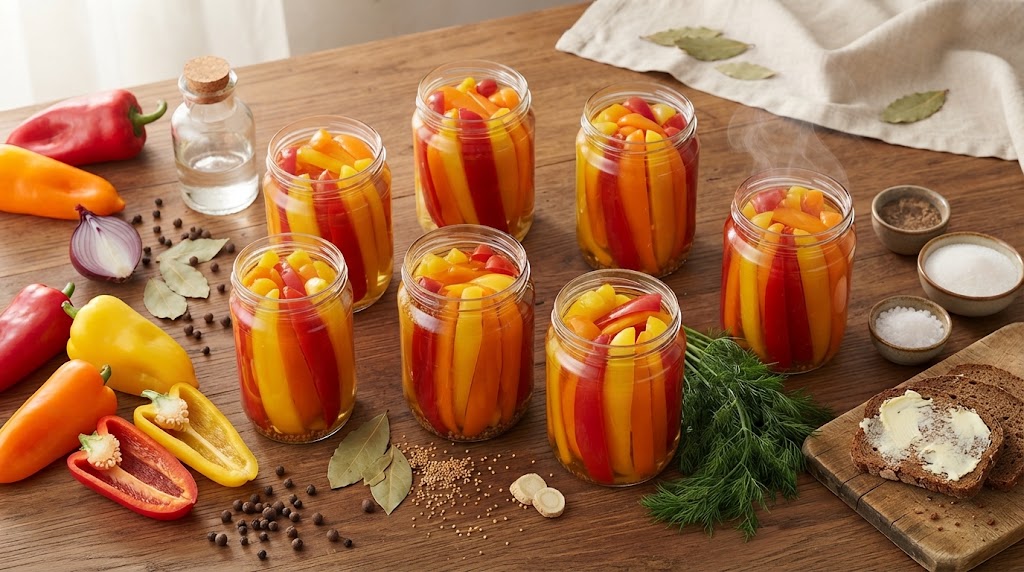
Summary: A complete guide to home-preserving sweet peppers in a sweet and sour brine. Learn which peppers to choose, how to cut them lengthwise into six strips, how to mix a balanced brine, how to sterilise jars and how to achieve a crisp texture that lasts a full year. Written for beginners and experienced preservers alike. Reading time approximately 11 minutes.
Category: Articles | Reading time: 11 minutes
Photo gallery from the process
Have you made any of the variations? Share a photo in the comments on the recipe and we will happily add it to the gallery. Filmed a video of the process? Post a link to YouTube, YouTube Shorts, TikTok, Instagram Reels, Facebook Reels, Pinterest, Vimeo or X (Twitter) in the comments and we will happily feature it.
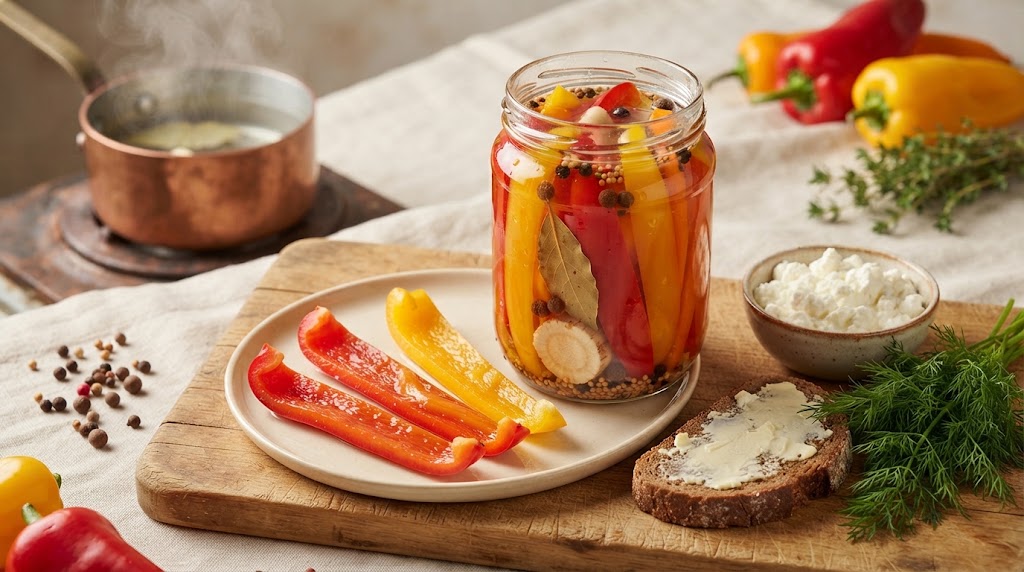
Sweet and sour pickled peppers are one of the most rewarding homemade preserves you can make. Crisp pepper strips in a gently sweet yet vinegary brine are easy enough for a first-time preserver. The key is choosing the right peppers, cutting them lengthwise into six strips and balancing the sugar and vinegar properly. The result keeps in a cool cupboard for a full year and tastes far better than anything from a supermarket shelf.
Quick overview
- Topic / Dish: Sweet and sour pickled peppers
- Category: Preserves, British Kitchen
- Cuisine: British and Central European
- Variations included: Sweet and sour pickled peppers
- Key techniques: Lengthwise pepper cutting, brine preparation, sterilisation, jar filling
- Physico-chemical background: Osmosis, acidic environment, heat sterilisation
- Common mistakes: Brine not acidic enough, insufficient sterilisation, overfilled jars, cross-cutting the peppers
- In short: Cut the peppers lengthwise into six strips, pack into jars, cover with hot sweet and sour brine and sterilise.
- Last updated: 13 September 2026
WAGUU says: “Sweet and sour brine is a compromise between flavour and shelf life. The more vinegar, the longer it keeps, but the sharper the taste. You know the ratio is right when the peppers taste fresh and sweet, not harsh.”
Key facts
| Preparation time: | 30 minutes |
| Cooking time: | 15 minutes (brine) + 15 minutes sterilisation |
| Main ingredient: | Sweet peppers |
| Yield: | 6 jars (approx. 500 ml each) |
| Difficulty: | Easy |
Method in brief
- Clean the peppers, remove the cores and cut lengthwise into six strips.
- Prepare the sweet and sour brine from water, vinegar, sugar, salt and spices.
- Pack the peppers tightly into clean jars.
- Pour over the hot brine so they are fully submerged.
- Seal the jars and sterilise at 85 °C for approximately 15 minutes.
At a glance
- Choosing peppers: Firm, thick-walled varieties with thin skins, ideally red and yellow.
- Cutting: Lengthwise into six strips, never cross-cut into rings.
- Brine: Water to vinegar ratio 2:1, sugar to salt 7:1.
- Spices: Bay leaves, allspice berries, black peppercorns, mustard seeds.
- Sterilisation: 15 minutes at 85 °C, 20 minutes for larger jars.
- Maturing: At least 3–4 weeks in a cool, dark place.
- Result: Crisp peppers with a sweet and sour flavour that keep for 12 months.
Who this guide is for: Beginner – you will get a precise recipe and learn the basics of sterilisation and proper cutting. Intermediate – you will find tips on brine variations and spice combinations. Professional – you will appreciate the advice on multi-purpose processing of a single batch of peppers and working with lengthwise strips.
Why preserve peppers at home
Home-pickled peppers have three advantages that shop-bought jars simply cannot match. First, you know exactly what is inside. No colourings, stabilisers or excess preservatives. Second, you can tune the flavour to your own taste. Some like a sweeter brine, others a sharper one, some add chilli, others add cumin. Third, a jar costs you a fraction of the supermarket price.
Sweet and sour pickled peppers are among the most versatile preserves you can keep in the cupboard. They work as an accompaniment to roasts, in sandwiches, on pizza, in salads, in sauces and, of course, on their own as a nibble with a pint or a glass of wine. In many households the first jar is opened at Christmas, even though the recipe keeps for far longer.
How to choose the right peppers
For pickling you want firm, thick-walled varieties with thin skins. Classic bell peppers from the greengrocer are ideal. Avoid thin-walled varieties, which go mushy in the brine. Sweet pointed peppers or Romano peppers also work beautifully – they are sweet, meaty and hold their shape. For colour, combine red, yellow and orange so the finished jar looks attractive on the shelf.
Why cut the peppers lengthwise into six strips
Cutting the peppers matters more than it might seem. Cross-cutting into rings is unsuitable for pickling because the strips fall apart during sterilisation and turn soft in the brine. Cutting lengthwise into six strips preserves the pepper’s structure – the fibres stay intact, the strips hold their shape and the peppers remain crisp long after the jar is opened.
The method is straightforward. Stand each pepper on its stalk, cut off the top with the core and remove the white inner membranes. Lay the pepper on its side and, with a single cut of the knife, slice it lengthwise into six evenly wide strips. Each strip runs the full length of the pepper and is roughly 2 cm wide.
This method has another advantage – more peppers fit into a jar and the strips stack evenly. The finished jar looks fuller and more compact.
The anatomy of sweet and sour brine
The brine has four components. Water is the base, vinegar preserves, sugar balances the acidity and salt supports the flavour. Spices are added on top. A 2:1 water to vinegar ratio using standard 8% pickling vinegar produces a brine of roughly 3% acidity. That is enough to preserve safely and gentle enough for the peppers to taste pleasant.
| Brine type | Water : Vinegar |
|---|---|
| Mild, sweeter | 3 : 1 |
| Classic | 2 : 1 |
| Sharper, longer keeping | 1 : 1 |
WAGUU Pro Tip: If you want really crisp peppers, add a slice of horseradish or a few cherry leaves to each jar. The tannins they contain slow down the softening process.
Sterilisation without the stress
Sterilisation is the most common reason people are nervous about preserving. Yet it is a simple process. Jars must be clean, ideally rinsed in hot water and dried. Peppers are packed firmly but not forced. Brine is poured in hot but not boiling. The jars are sealed and placed in a pan of water reaching about two-thirds up their height. The water is held at 85 °C for 15 minutes for small jars and 20 minutes for larger ones.
After sterilising, lift the jars out, stand them upside down on a tea towel and leave to cool. If the lid curves downward as it cools and sounds hollow when tapped, the jar is properly sealed. If the lid stays domed, use that jar soon.
Storage and shelf life
Store the pickled peppers in a cool, dark, dry place. A larder, cellar or the bottom shelf of the fridge is ideal. Properly sealed and stored, they keep for 12 months, or up to 18 months with a stronger brine. Once opened, keep the jar in the fridge and use within 3–4 weeks.
What to serve pickled peppers with
Sweet and sour pickled peppers are endlessly versatile. They are at their best with roast meat, grilled chicken, roast pork or as part of a cold buffet. They work in burgers, wraps, on pizza and in salads. They pair beautifully with charcuterie, cheese and fresh bread. You can even turn the brine into a salad dressing – simply whisk it with olive oil and mustard.
Frequently asked questions
How do I know the peppers have spoiled?
A healthy preserve has clear brine, firm peppers and a lid that gives a soft hiss when opened. A spoiled jar has cloudy brine, floating white films, an unpleasant smell or a domed lid. Throw such a jar away.
Do I need to peel the peppers?
No. The skin is thin and softens in the brine while keeping its crispness. Peeling is unnecessary and slows you down. With firm varieties the skin is not noticeable.
Which vinegar is best?
Standard 8% distilled pickling vinegar is the most suitable. Malt vinegar gives a fuller, more traditional British flavour. White wine vinegar is a good choice if you want a gentler taste.
How much sugar do I actually need?
Sugar is not just about sweetness. It balances the vinegar’s acidity and makes the brine pleasant. A 7:1 sugar to salt ratio is classic. For a sweeter result, double the sugar. Less sugar means a sharper, more acidic taste.
Also known as: Sweet and sour peppers, pickled peppers, peppers in vinegar brine, pickled bell peppers, sweet vinegar peppers
Conclusion
Pickling peppers is simple, quick and rewarding. An hour of work gives you six jars that will last you a year. There is no complicated science involved – just get the brine ratio right, cut the peppers lengthwise into six strips, sterilise properly and give the preserve time for the flavours to marry. The result will be far better than anything you can buy in a shop.
Choose your recipe
Below you will find the recipe for classic sweet and sour pickled peppers. It is a recipe that even a beginner can manage and that has been proven in many kitchens.
Sweet and Sour Pickled Peppers – A classic recipe for crisp peppers cut lengthwise into six strips, keeping for a full year.
Other variations worth trying
Pickled peppers with carrot
Carrot coins are added to the jar alongside the peppers. The carrot adds a gentle sweetness to the brine and a colourful contrast. Great for anyone who wants more vegetables in a single jar and a more interesting visual result.
Pickled peppers with onion
Rings of white onion are layered between the peppers. The onion softens in the brine and gains a sweet note. For those who like a bolder flavour – excellent with cold meats and in sandwiches.
Pickled peppers with chilli
Add one or two pieces of chilli pepper to each jar. The brine gains a pleasant heat while the peppers stay sweet and sour. For those who like a gently spicy kick.
Pickled peppers with mustard seeds
Mustard seeds add a subtle sharpness and more pronounced aroma. A classic of the German kitchen, where similar pickles are served with beer and charcuterie.
Pickled peppers with honey
Part of the sugar is replaced with honey. The result is gentler and fuller. Add the honey to the brine just before pouring so it keeps its aroma. Excellent with cheese and bread.
Pickled peppers with apple
Slices of sharper apples are added to the peppers. The apple brings a fruity freshness and natural sweetness. A variation that children enjoy too.
Pickled peppers with root vegetables
Carrot, celeriac and parsley root are added alongside the peppers. The jar is more colourful and the flavour more complex. Ideal as part of a cold buffet.
Pickled peppers with dill
Fresh dill or dill seeds are added to the brine. The result is a fresh, aromatic preserve reminiscent of pickled cucumbers. Excellent with fish.
Pickled peppers with thyme
A sprig of thyme in each jar gives the brine a herbal undertone. Distinct but not overpowering – pairs beautifully with grilled meat.
Pickled peppers with cider vinegar
Replace the distilled vinegar with cider vinegar. The result is gentler and fruitier. For anyone who finds standard pickling vinegar too harsh.
Pickled peppers with white wine vinegar
White wine vinegar gives the preserve a more elegant flavour. Suitable for special occasions when you want something impressive on the table.
Pickled peppers with balsamic vinegar
Dark balsamic gives the preserve a darker colour and deeper flavour. Best suited to autumn and winter, when it pairs beautifully with roast meat.
Pickled peppers with horseradish
A slice of horseradish in each jar ensures crispness while giving a gentle pungent undertone. A classic British counterpart to the continental style.
Pickled peppers with cherry leaves
A few cherry leaves in each jar. They contain tannins that keep the peppers crisp just like horseradish, but with a gentler flavour.
Know another variation? Add your own suggestion below.
Missing a recipe?
Tell us what recipe you would like us to add. We will do our best to publish it soon!
Frequently asked questions about other variations
- Can I combine several variations in one jar? Yes, but do not overdo it. Two to three additions are enough. Too many spices will overpower the peppers.
- What role does horseradish play? Horseradish contains tannins that slow down the softening of the peppers. That is why they stay crisp even after months.
- Do I need to sterilise if I use a lot of vinegar? Yes, sterilisation is always necessary. Vinegar alone is not enough if the jar is not hermetically sealed.
- Can I use frozen peppers? Not recommended. Once thawed they are soft and will fall apart in the brine.
- How long does the brine keep? Unopened brine keeps for 2–3 weeks in the fridge. Once poured into jars it is used together with the peppers.
- How many jars does one batch make? The recipe below gives you 6 jars of 500 ml. The quantity is easy to double.
- What is the difference between sweet and sour and plain sour brine? Sweet and sour has a higher sugar content that balances the vinegar. Plain sour has minimal sugar and a sharper taste.
- Can I add a cherry leaf to the brine? Yes, cherry leaves contain tannins and help keep the peppers crisp just like horseradish.