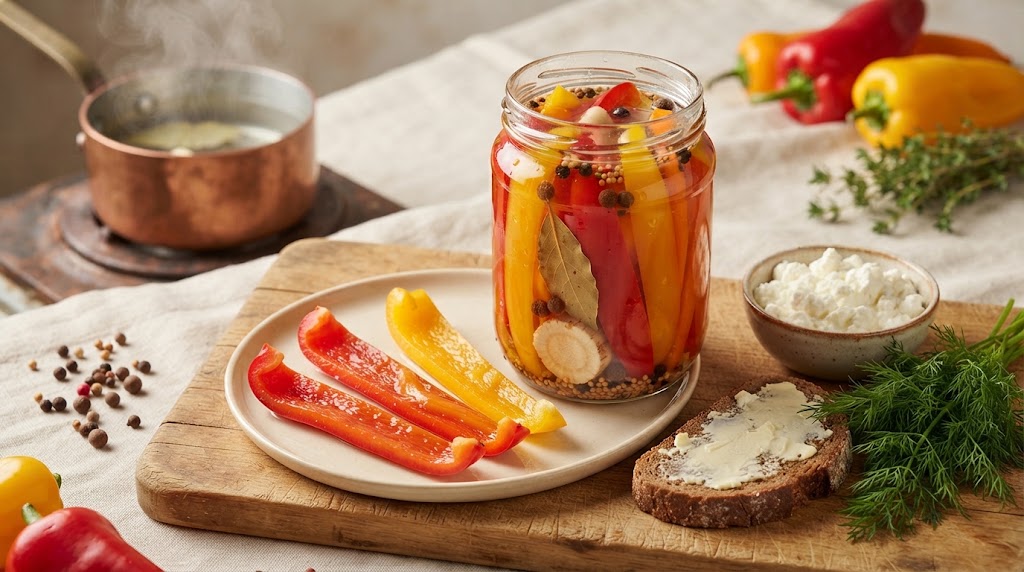
Summary: Sweet peppers cut lengthwise into six strips and packed in a gentle sweet and sour brine. A crisp preserve that keeps in a cool, dark cupboard for up to 12 months. Makes six 500 ml jars, with 30 minutes of preparation plus sterilisation.
Cooked the recipe? Share your result with the community.
Category: Preserves, British Kitchen
Success rate: not rated yet % of users managed the recipe
Quick overview
- Dish: Sweet and Sour Pickled Peppers
- Category: Preserves, British Kitchen
- Cuisine: British
- Main ingredient: Sweet peppers 1,500 g (firm thick-walled varieties, red and yellow)
- Guide: Sweet and Sour Pickled Peppers: A Year-Round Homemade Preserve
- Total time: 60 minutes (30 min preparation + 15 min brine + 15 min sterilisation)
- Difficulty: Easy
- Yield: 6 jars (Jar weight: approx. 500 g)
- Key technique: Lengthwise cutting into six strips, water-bath sterilisation
- Preparation types: Preserving, brine making
- Dietary info & Allergens: Gluten-free, dairy-free, egg-free, vegan
- Suitable for: Beginners, autumn preserving, gifts
- Nutrition (per jar): approx. 150 kcal, Protein: 1.5 g, Fat: 0.3 g, Carbohydrates: 34 g
- Storage: 12 months in a cool dark place, 3–4 weeks in the fridge once opened
- Pairing: Pale ale, dry Riesling, homemade lemonade
- In short: Cut peppers lengthwise into six strips, pack into jars, cover with hot sweet and sour brine and sterilise.
- Last updated: 13 September 2026
WAGUU says: “Preserving is the simplest way to keep the taste of summer. Peppers cut lengthwise into six strips stay crisp and hold their shape even after months in the jar.”
Key facts
| Preparation time: | 30 minutes |
| Cooking time: | 15 min brine + 15 min sterilisation |
| Temperature: | 85 °C (sterilisation) |
| Yield: | 6 jars of 500 ml |
At a glance
Sweet and sour pickled peppers are a classic British preserve, perfect with roasts, in sandwiches or as a nibble. Cut firm peppers lengthwise into six strips, pack them into a balanced brine of water, vinegar, sugar and spices, and sterilise. Within an hour you have six jars that will keep for a year.
Ingredients
Base yield: 6 jars • Jar weight: 500 g
| Ingredient | Quantity | Quality |
|---|---|---|
| Sweet peppers | 1500 g | Firm thick-walled varieties, red and yellow |
| Water | 500 ml | Filtered, if possible |
| Distilled pickling vinegar 8% | 250 ml | Clear, white |
| Caster sugar | 150 g | White |
| Fine sea salt | 20 g | Uniodised |
| Bay leaves | 6 leaves | Dried |
| Allspice berries | 12 berries | Whole |
| Black peppercorns | 20 peppercorns | Whole |
| Yellow mustard seeds | 2 tsp | Yellow |
| Horseradish | 6 slices | Fresh, strong |
Why you will love this recipe
- Simplicity: Even a complete beginner can manage it. Just get the brine ratio right, cut the peppers lengthwise and sterilise properly.
- Versatility: The peppers go with roasts, sandwiches, pizza, salads and as a nibble with a pint or a glass of wine.
- Long shelf life: Properly stored, they keep for 12 months – or up to 18 with a stronger brine.
Guaranteed success: The recipe is based on traditional British preserving, proven in many kitchens. A 2:1 water to vinegar ratio using 8% vinegar gives a brine of roughly 3% acidity – enough to preserve safely and gentle enough on the palate.
Recipe overview
Prep: 30 min | Cook: 30 min | Difficulty: Easy | Yield: 6 jars | Type: Preserve | Origin: British
Detailed method
Overall progress: 0 % done
Stage 1: Preparing and cutting the peppers – 20 min
Equipment: Chopping board, knife, large bowl
1. Rinse the peppers under running water and dry with kitchen paper. Stand each pepper on its stalk, cut off the top with the core and remove the white inner membranes. Lay the pepper on its side and, with a single cut of the knife, slice it lengthwise into six evenly wide strips. Each strip runs the full length of the pepper and is roughly 2 cm wide.
Checkpoint: The peppers are dry, free of seeds and cut into long lengthwise strips. Each pepper has become six evenly wide strips. The bowl is filled with an even mix of colours.
Before you move on:
Cut the peppers lengthwise, never crosswise into rings. Lengthwise strips hold their shape and stay crisp. Dry the peppers thoroughly after washing – water on the surface would dilute the brine.
Stage 2: Making the brine – 15 min
Equipment: 3-litre saucepan, wooden spoon, measuring jug
2. Pour 500 ml water and 250 ml vinegar into the saucepan. Add 150 g caster sugar, 20 g salt, 6 bay leaves, 12 allspice berries, 20 black peppercorns and 2 tsp mustard seeds. Bring to the boil, reduce the heat and simmer gently for 5 minutes. Take off the heat.
Checkpoint: The brine is clear, with sugar and salt fully dissolved. On tasting it is sweet and sour, well balanced.
Before you move on:
Do not boil the brine for too long. Prolonged boiling evaporates the vinegar and reduces the shelf life. Five minutes of gentle simmering is enough.
Stage 3: Filling the jars – 10 min
Equipment: 6 jars of 500 ml, lids, ladle
3. Rinse the jars with hot water and leave to drain. Place one slice of horseradish in the bottom of each jar. Pack the lengthwise pepper strips firmly in layers up to the rim, but do not force them. Pour over the hot brine so the peppers are fully submerged and the liquid sits 1 cm below the rim. Tap each jar gently on the worktop to release trapped air.
Checkpoint: The peppers are fully submerged, the liquid sits 1 cm below the rim. No air bubbles are visible in the jar. The strips are evenly stacked.
Before you move on:
Do not fill the jars to the very top. Brine rises slightly during sterilisation and could overflow. Always leave 1 cm of headspace.
Stage 4: Sealing and sterilising – 20 min
Equipment: Large pan, thermometer, tea towel
4. Seal the jars tightly. Place a tea towel at the bottom of a large pan and stand the jars on it so they do not touch. Pour in water to two-thirds of the jar height. Bring to the boil, then reduce to 85 °C. Sterilise for 15 minutes. Turn off the heat, leave the jars in the pan for 5 more minutes, then lift them onto a dry tea towel upside down.
Checkpoint: Once cool, the lids are concave. They sound hollow when tapped. The brine is clear and the peppers firm.
Before you move on:
Keep the water at 85 °C during sterilisation. A rolling boil is not suitable – the peppers would go mushy and the brine would turn cloudy.
Stage 5: Maturing and storage – 3 weeks
Equipment: Larder, cellar, fridge
5. Store the cooled jars in a cool, dark, dry place. An ideal temperature is 5–15 °C. Leave the preserve to mature for the first three to four weeks so the flavour of the peppers marries with the brine. Once opened, keep the jar in the fridge and use within 3–4 weeks.
Checkpoint: When you open the jar, the lid gives a soft hiss. The peppers are crisp, the brine is clear and smells of vinegar, sugar and spice.
Required equipment
| Item | Ideal size | Alternative | Risk |
|---|---|---|---|
| Brine saucepan | 3 l, enamelled or stainless steel | 2.5-litre pan | Small pan cannot hold the brine and overflows |
| Jars | 6 × 500 ml | Smaller or larger jars | Different sizes change the sterilisation time |
| Large sterilising pan | At least 10 litres | Dedicated steriliser | A small pan will not fit the jars |
Shopping list
Nutritional profile
Values per jar (500 g including brine). Calculated from average nutritional values of the ingredients.
| Nutrient | Per 100 g | Per jar | Per 6 jars |
|---|---|---|---|
| Energy | 30 kcal | 150 kcal | 900 kcal |
| Fat | 0.1 g | 0.3 g | 1.8 g |
| of which saturates | 0.02 g | 0.05 g | 0.3 g |
| Carbohydrates | 6.8 g | 34 g | 204 g |
| of which sugars | 6 g | 30 g | 180 g |
| Protein | 0.3 g | 1.5 g | 9 g |
| Salt | 0.8 g | 4 g | 24 g |
Reference intake for an average adult (8400 kJ / 2000 kcal). Most of the salt and sugar remains in the brine, which is not usually consumed in full. The values are therefore slightly inflated.
WAGUU Professional level
- Pro standard: A tested recipe with precise ratios and visual checkpoints.
- Tip 1: Add one slice of horseradish to each jar. The tannins in horseradish slow down the softening of the peppers, keeping them crisp even after months.
- Tip 2: Stack the lengthwise strips vertically rather than horizontally. The jar fills evenly and the strips do not snap.
- Tip 3: Do not turn the jars after sterilisation until they are fully cool. A rapid change in temperature can crack the glass.
- Tip 4: Make the brine the day before and let it cool. Reheat and use the next day. The spices infuse better and the flavour is fuller.
The science behind it
Preserving vegetables in acidic brine rests on two principles. First, lowering the pH of the environment. The vinegar in the brine drops the pH below 4.6, the threshold under which dangerous bacteria, particularly Clostridium, cannot multiply. Second, osmosis. The sugar and salt in the brine create high osmotic pressure that draws water out of microbial cells and stops them multiplying. Heat sterilisation then destroys any microorganisms that might have survived in the brine. Cutting the peppers lengthwise into strips also preserves the cell structure – the fibres remain intact and the peppers retain their crispness.
Fine dining – professional techniques
- Plate composition: Lengthwise pepper strips make a colourful accent on the plate. Combined with a white cheese or charcuterie they create a striking visual contrast.
- Texture contrasts: Crisp peppers work beautifully with soft textures – pâté, cheese, avocado. The contrast of firm and soft is the key to an interesting experience.
- Temperature contrast: Cold peppers with hot meat or warm bread. The temperature difference lifts the flavour of both elements.
- Aromatic additions: Fresh thyme, rosemary or basil just before serving will enhance the aroma of the peppers. A few leaves on the plate is enough.
Sensory radar
- Appearance: Bright pepper colours, clear brine, long lengthwise strips, visible spices.
- Aroma: Fruity pepper, vinegar, spice, a gentle note of horseradish.
- Taste: Sweet and sour, balanced, with a long spicy finish.
- Texture: Crisp, firm, not mushy – the strips hold their shape.
Pairing
- BEER: Pale ale, wheat beer
- WINE: Dry Riesling, Grüner Veltliner
- SOFT DRINK: Homemade lemonade, buttermilk
Other preparation variations
- Spicier version: Add 1 chilli pepper to each jar. The brine gains heat.
- Sweeter version: Increase the sugar to 200 g. The peppers become sweeter and the brine gentler.
Allergens and dietary information
Contains: Mustard seeds • Gluten: None • Not suitable for: People with a mustard intolerance, people sensitive to vinegar
Suitable for
Vegetarians, vegans, gluten-free diet, lactose-free diet, beginners in preserving, gifts and Christmas hampers.
Substitution guide
- Distilled pickling vinegar: Cider vinegar, white wine vinegar, balsamic vinegar
- Caster sugar: Light brown sugar, honey (reduce to 120 g), maple syrup
- Bay leaves: Fresh bay leaves, dried thyme
- Mustard seeds: Mustard powder, caraway seeds
FAQ
How long will the peppers keep?
Unopened jars keep for 12 months in a cool, dark place. Once opened, keep in the fridge and use within 3–4 weeks.
Can I use a different vinegar?
Yes. Cider vinegar gives a gentler, fruitier flavour and white wine vinegar is more elegant. If you use a weaker vinegar (5% for example), reduce the water so the final acidity stays the same.
Why do my peppers go soft after a month?
Most often because there is no horseradish or cherry leaves. Overlong sterilisation or too high a temperature also causes softening. Hold at 85 °C for 15 minutes.
Do I have to cut the peppers lengthwise?
Yes, cutting lengthwise into six strips is the most suitable method for pickling. Cross-cutting into rings disrupts the fibres and the peppers fall apart and soften in the brine.
WAGUU Petr advises: cooking for 6 or more?
6–8 people: Make a double batch. 500 ml jars are the ideal size for one family. 10+ people: Make a triple batch. Use a steriliser that can take two loads so you can finish everything in one day.
Storage and reheating
Fridge: 21 days once opened • Freezer: Not recommended, the peppers lose their crispness • Reheating: Serve cold or at room temperature. Reheating is not suitable.
Other recipe variations
Guide: Sweet and Sour Pickled Peppers: A Year-Round Homemade Preserve
This recipe covers only the basic variations. The complete list of further variations can be found in the guide above.
Other recipes you might like
Why WAGUU?
Recipes on WAGUU are checked for accuracy of ingredients, method and nutritional values. Every recipe is tested and precisely written.
Photo gallery from the process
Photos from the community: Cook, photograph and share your result.
You can upload photos to the comments below or send them by email.
Filmed a video of the process using our recipe? Post a link to YouTube, YouTube Shorts, TikTok, Instagram Reels, Facebook Reels, Pinterest, Vimeo or X (Twitter) in the comments – we will happily feature it and help you and your content reach more people.
Most common mistakes
- Brine not acidic enough – If the brine does not have enough vinegar, it cannot preserve safely. A 2:1 water to vinegar ratio using 8% vinegar is the minimum.
- Insufficient sterilisation – Too short a time or too low a temperature means bacteria can multiply in the jars. Hold at 85 °C for 15 minutes.
- Overfilled jars – If you leave less than 1 cm of headspace, the brine will overflow during sterilisation and the jar will not seal.
- Cross-cutting the peppers – Rings fall apart and soften in the brine. Cut lengthwise into six strips and the structure stays intact.