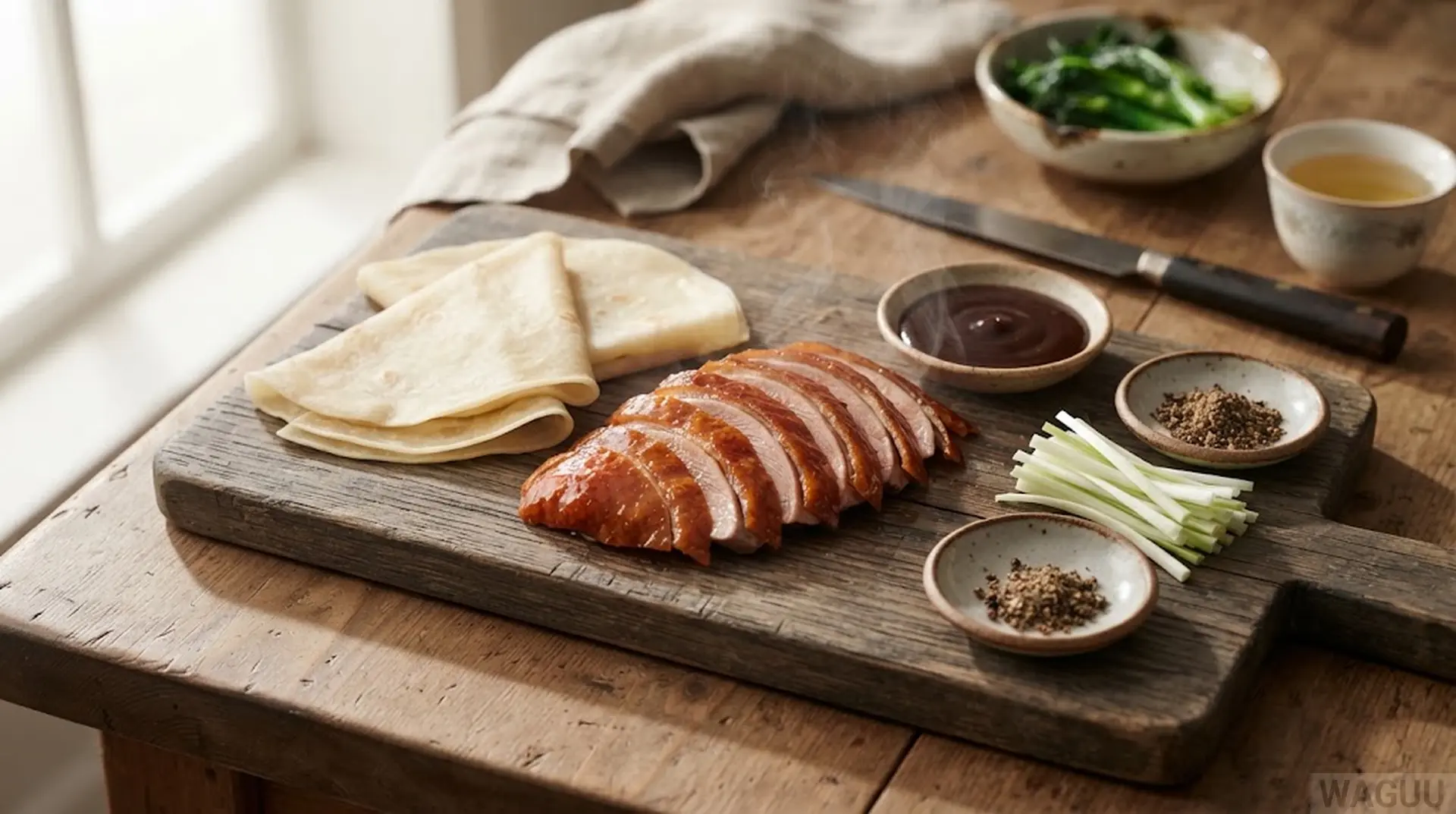
Summary: Peking duck roasted until the skin is glassy and crisp, served with thin wheat pancakes, spring onion, cucumber and a sweet fermented sauce. The duck is scalded, brushed with a honey and vinegar mixture and dried in the fridge for at least twelve hours – the drying is what makes the skin puff and crisp. It is roasted on a rack so the fat drips away and the meat does not stew in its own juices. Total time 2 hours 15 minutes, plus 12 hours drying, base 6 servings.
Cooked this recipe? Share the result with the community.
Category: Poultry · Chinese Cuisine · Festive Menu
Success rate: not rated yet % of users managed this recipe
Quick overview
- Dish: Peking duck – celebratory roast duck with crisp skin, thin pancakes and a sweet sauce
- Category: Poultry, Chinese Cuisine, Festive Menu
- Cuisine: Chinese
- Main ingredient: Whole duck, 2400 g (400 g per portion)
- Guide: 12 most famous Chinese dishes: traditional recipes from Chinese cuisine
- Total time: 2 hours 15 minutes (30 minutes preparation + 1 hour 45 minutes cooking), plus 12 hours drying
- Difficulty: Challenging
- Servings: 6 (Portion weight: 393 g)
- Key technique: Scalding the skin, drying it uncovered and roasting on a rack at two temperatures
- Method types: Roasting, scalding, grilling to finish, steaming pancakes
- Dietary info & allergens: gluten, soy, sesame
- Great for: Celebratory dinners, Christmas and New Year menus, impressing guests, weekend cooking projects
- Nutrition (per portion): 1057 kcal, Protein: 45.2 g, Fat: 74.3 g, Carbohydrates: 51.7 g
- Storage: 3 days in the fridge, 2 months in the freezer
- Pairing: Jasmine tea, dry Riesling, light lager
- In short: Dry skin, a rack instead of a tray and a two-stage roast – three steps that decide whether the skin crisps to glass or stays soft.
WAGUU says: “Peking duck is not cooked with spices. It is cooked with dry air. Twelve hours in the fridge do more for the skin than any glaze applied at the last minute.”
Key facts
| Preparation time: | 30 minutes plus 12 hours drying |
| Cooking time: | 1 hour 45 minutes |
| Temperature: | Oven 180 °C, then 220 °C, internal meat temperature 74 °C |
| Servings: | 6 (portion weight 393 g) |
At a glance
Peking duck rests on a single principle: water must leave the skin. Duck skin contains a thick layer of fat; while that fat stays covered by moisture, it renders without crisping. Scalding tightens the skin, a honey and vinegar glaze holds the surface dry and the fridge removes the remaining moisture. During roasting the fat under the skin renders and pushes the skin upwards, which is what creates the characteristic glassy layer. The meat cooks at a gentler temperature so the protein does not contract and squeeze out its juices; the final ten minutes at 220 °C colour the surface without drying out the meat underneath.
Ingredients
Base servings: 6 • Portion weight: 393 g
| Ingredient | Quantity | Quality |
|---|---|---|
| whole duck | 2400 g | chilled, skin on, giblets removed |
| fine sea salt | 8 g | for the cavity and the skin |
| honey | 40 g | runny, for brushing the skin |
| rice vinegar | 40 ml | clear, not balsamic |
| Shaoxing rice wine | 50 ml | dry, for the glaze |
| soy sauce | 30 ml | light, into the sauce served with the hoisin |
| hoisin sauce | 90 g | sweet, for serving |
| ginger | 20 g | fresh, sliced into the cavity |
| star anise | 2 g | whole, into the cavity |
| Sichuan pepper | 3 g | whole, toasted and ground just before use |
| spring onions | 60 g | fresh, cut into fine strips |
| cucumber | 200 g | firm, seeds removed, cut into matchsticks |
| plain flour | 300 g | wheat, for the thin pancakes |
| water | 180 ml | warm, for the dough |
| sesame oil | 20 ml | toasted, for the dough and for brushing the pancakes |
Why you will love this recipe
- A restaurant centrepiece at home: The skin crackles like glass and the meat stays juicy, because the duck roasts on a rack rather than sitting in its own fat.
- Most of the work happens unattended: The duck dries in the fridge overnight. On the day itself you only glaze it twice and turn the oven up once.
- Exact quantities for 6 servings: 400 g of duck per portion, 300 g of flour for sixteen pancakes and 90 g of hoisin for the table.
- A challenge worth taking: Six phases, five checkpoints and one oven. What separates a good result from an average one is the drying time and the moment you add the final glaze.
Why it works: Duck skin is roughly a third fat by weight. Fat only renders and crisps once surface moisture has gone, because water holds the skin temperature at 100 °C while it evaporates. Scalding tightens the skin and opens the pores; the honey glaze gives the surface a thin sugary film that dries hard and browns quickly. Overnight in the fridge removes the remaining water from the skin, so in the oven the temperature climbs past 150 °C and the fat under the skin starts to render. Steam from that fat lifts the skin away from the flesh, which is exactly the effect you want. Roasting begins at 180 °C so the meat heats evenly; only the last ten minutes at 220 °C brown the surface. The pancakes are made with warm water, which keeps the gluten relaxed and gives a soft, pliable dough that can be rolled thin.
Recipe overview
Prep: 30 min | Cook: 1 h 45 min | Difficulty: Challenging | Servings: 6 | Type: Main course | Origin: Chinese
Detailed method
Overall progress: 0 % complete
Phase 1: Scalding and glazing – 20 min and 12 h in the fridge
Equipment: large pan, kettle, rack, fridge
1. Bring four litres of water to the boil in a large pan. Hold the duck by the neck and lower it into the water for thirty seconds, then turn it and scald the other side. Lift it out and pat the surface dry. Warm the honey with the rice vinegar, Shaoxing wine and soy sauce until it is runny, then brush the mixture over the whole bird, inside and out, and rub the fine sea salt into the cavity and the skin. Put the duck on a rack over a tray and leave it uncovered in the fridge for twelve hours.
Checkpoint: The skin is tight and pale gold, the glaze has dried to a thin sticky film and no drops gather under the bird on the tray.
Before you move on:
Never cover the duck in the fridge. Wrapped in foil or cling film, moisture returns to the skin and no amount of roasting will crisp it. Leave it open on the rack, even if it takes up half a shelf.
Phase 2: Preparing the oven – 10 min
Equipment: oven, deep roasting tray, rack, meat thermometer
2. Heat the oven to 180 °C with the fan on. Pour a centimetre of water into a deep roasting tray, so the fat that drips down does not burn, and set a rack on top. Put the duck breast side up on the rack, tuck the wing tips under the body and put the sliced ginger inside the cavity. Push the meat thermometer into the thickest part of the thigh without touching bone.
Checkpoint: The oven holds 180 °C, the duck sits clear of the water below and the thermometer reads around 8 °C at the start.
Before you move on:
Never put the duck straight onto the tray. Resting in the fat it releases means the lower half stews instead of roasting, and the skin there stays soft and pale.
Phase 3: Roasting – 1 h 10 min
Equipment: oven, rack, meat thermometer
3. Roast the duck for seventy minutes without opening the door during the first thirty. Baste it once after thirty minutes with the fat collecting in the tray, then leave it alone. The skin will slowly turn an even amber and the fat underneath will begin to bubble.
Checkpoint: The skin is amber and glossy all over, the thermometer in the thigh reads 65 to 70 °C and the tray holds a good layer of rendered fat.
Before you move on:
Do not baste more than once. Every time the door opens the oven loses heat, and a glaze applied repeatedly darkens the skin long before the meat is cooked through.
Phase 4: Crisping the skin – 15 min
Equipment: oven, meat thermometer, brush
4. Turn the oven up to 220 °C. Brush the skin with a thin layer of the glaze left over from the marinade and return the duck for five minutes. Repeat twice more, so the skin receives three thin coats in total and dries between each one. Measure the thigh again.
Checkpoint: The skin is deep mahogany and crackles when tapped with a spoon. The thermometer in the thigh reads 74 °C and the juices from a pierced thigh run clear.
Before you move on:
Apply the final glaze in thin coats and let each one dry. A thick layer of sugary glaze burns on the surface within two minutes, while the meat underneath still needs time.
Phase 5: Pancakes – 20 min
Equipment: bowl, rolling pin, non-stick pan
5. While the duck rests, put the flour in a bowl and pour in the warm water, stirring with a spoon until the mixture comes together. Knead for five minutes, cover and leave for ten minutes. Divide into sixteen pieces, roll each into a thin circle about fifteen centimetres across, brush with sesame oil and cook in a dry pan for forty seconds on each side, until pale blisters appear. Stack the pancakes under a clean cloth so they stay soft.
Checkpoint: The pancakes are soft and pliable, with light brown spots on both sides, and they bend without cracking.
Before you move on:
Do not cook the pancakes in oil. A dry pan gives them a soft, dry surface that holds sauce; oil makes them greasy and they tear when folded.
Phase 6: Carving and serving – 15 min
Equipment: carving knife, board, small bowls
6. Let the duck rest for ten minutes, then carve it. First remove the skin in rectangles about five centimetres long and keep it separate. Then slice the breast and leg meat thinly across the grain. Arrange the meat on a warm platter, put the hoisin sauce, spring onion strips and cucumber matchsticks in small bowls and take the pancakes to the table in a covered dish. Each guest spreads sauce on a pancake, adds meat, skin, spring onion and cucumber, and rolls it up.
Checkpoint: The skin stays crisp on its own plate, the sliced meat is pale pink inside and the pancakes are still warm and soft when the first one is rolled.
Equipment needed
| Item | Ideal size | Alternative | Risk |
|---|---|---|---|
| roasting rack | 40 × 30 cm | a steamer trivet set in a deep tray | a duck resting on the tray stews in its own fat and the skin stays soft |
| meat thermometer | probe type, reads to 250 °C | check that the juices run clear | without measuring, overcooking is judged only by the colour of the skin |
| pastry brush | silicone, 4 cm wide | a spoon and kitchen paper | a thick glaze layer burns before the meat is ready |
| non-stick frying pan | 24 cm, flat base | a flat cast-iron pan | a warped base cooks the pancakes unevenly and they dry out at the edges |
| carving knife | 21 cm blade, thin | a filleting knife | a blunt knife tears the skin away from the meat instead of cutting through it |
Shopping list
Nutrition profile
Values per portion (as served, with pancakes). Calculated from average nutritional values of the ingredients. Portion weight 393 g. The calculation is based on the raw ingredients and the fat that drains into the tray is not counted back in.
| Nutrient | Per 100 g | Per portion | For 6 servings |
|---|---|---|---|
| Energy | 269 kcal | 1057 kcal | 6341 kcal |
| Fat | 19.0 g | 74.3 g | 446.0 g |
| of which saturates | 6.1 g | 24.0 g | 144.2 g |
| Carbohydrates | 13.2 g | 51.7 g | 310.3 g |
| of which sugars | 2.5 g | 10.0 g | 59.9 g |
| Protein | 11.5 g | 45.2 g | 271.4 g |
| Salt | 0.82 g | 3.23 g | 19.38 g |
| of which sodium | 0.33 g | 1.29 g | 7.75 g |
Reference intake of an average adult (8400 kJ / 2000 kcal). Salt comes mainly from the soy sauce, the hoisin sauce and the glaze; the dish is not salted further.
WAGUU Pro level
- Pro standard: A tested recipe with exact quantities and visual checkpoints.
- Tip 1: Scald the duck over the sink with a kettle rather than lifting it in and out of a pan. The water reaches every fold of the skin and you avoid scalding your hands.
- Tip 2: Dry the duck on a rack over a tray, not on a plate. Air circulates underneath and the underside dries as well as the breast.
- Tip 3: Keep the rendered fat from the tray. Strained and chilled, it keeps for a month and is superb for roast potatoes.
- Tip 4: Roll the pancakes between two sheets of baking paper. They come off the pin without sticking and keep a perfectly round shape.
The science behind it
Two processes run in parallel in Peking duck. The first is evaporation. While surface moisture remains, the skin cannot rise above 100 °C, so the fat beneath it renders without browning. Drying the duck overnight drops the surface water content and allows the skin temperature to climb past 150 °C in the oven, where the Maillard reaction between amino acids and reducing sugars produces the brown colour and roasted aroma. The second process is rendering. Duck fat melts at around 14 °C and flows freely above 60 °C; as it renders, the steam it produces lifts the skin away from the flesh, creating the air gap that makes the skin shatter rather than chew. The maltose glaze adds reducing sugars to the surface, which accelerates browning, and its slight acidity from the rice vinegar helps the skin tighten. Roasting starts at 180 °C so that heat reaches the centre of the thigh gradually; only the final ten minutes at 220 °C brown the surface. Pancake dough made with warm water is soft and easy to roll very thin; the gluten network stays relaxed, so the pancakes bend without cracking when they are folded around the filling.
Fine dining – professional techniques
- Plating: Fan the sliced meat across a warm platter, lay three rectangles of skin on top and place the pancakes folded in a cloth beside it. Bring the sauces in small bowls so each guest builds their own roll.
- Texture contrast: Keep the cucumber matchsticks ice cold and the spring onion at room temperature. One brings crunch, the other softness, and both cut through the fat of the skin.
- Temperature contrast: Serve the hoisin sauce at room temperature. Straight from the fridge it dulls the aroma and cools the meat as soon as it is spread.
- Aromatic finish: Grate a little orange zest over the platter just before serving. The citrus oils lift the five-spice and the fermented sweetness of the sauce.
Sensory radar
- Appearance: Deep mahogany skin with a glassy sheen, pale pink meat beneath and a stack of thin pale pancakes on the side.
- Aroma: Roast duck fat and five-spice, with the sweet fermented note of hoisin underneath.
- Taste: Salty soy and sweet hoisin over rich duck, finished by the sharp freshness of spring onion and cucumber.
- Texture: Skin that crackles and shatters, tender meat with a fine grain, and a soft pancake that holds everything together.
Pairing
- Jasmine tea: Floral aroma cleanses the palate between rolls and does not compete with the five-spice.
- Dry Riesling: High acidity cuts through the duck fat and its citrus note echoes the glaze.
- Light lager: Hop bitterness refreshes after a rich mouthful. Serve at 6–8 °C.
- Homemade limeade: Acidity and fizz work well for anyone avoiding alcohol, and children like it.
Variations
- Duck breasts instead of a whole bird: Score the skin, salt it, brush with honey and vinegar and dry for four hours. Roast at 200 °C for twenty-five minutes, skin side up, then rest. Quicker and cheaper, but there are no leg juices for the sauce.
- Roasted over a tray of water: The duck sits on a rack above a tray of water so the meat stays moist even with a longer roasting time. The skin is less crisp and is finished under the grill.
- Duck cooked in a home rotisserie: The bird turns continuously and bastes itself in its own fat. The skin crisps evenly, but you need the oven attachment and a duck that fits inside the drum.
Allergens and dietary information
Contains: gluten (plain flour, hoisin sauce); soy (soy sauce, hoisin sauce); sesame (sesame oil) • Gluten: yes, in the flour and the sauce • Not suitable for: anyone with coeliac disease or an allergy to soy and sesame
Great for
Celebratory dinners, Christmas and New Year menus, impressing guests, weekend cooking projects, anyone who wants a restaurant dish at home.
Substitution guide
- Whole duck: two duck breasts plus two legs. Roast the legs for fifty minutes and the breasts for twenty-five; the fat content drops noticeably.
- Honey: golden syrup or maltose syrup. The skin browns slightly faster with honey, so watch the final ten minutes.
- Rice vinegar: white wine vinegar with a spoon of water. Sharper, so use slightly less.
- Shaoxing rice wine: dry sherry. The aroma is different but it suppresses the smell of the meat just as well.
- Hoisin sauce: dark soy sauce with a spoon of honey and a pinch of five-spice. Less sweet and more savoury.
- Plain flour pancakes: ready-made Chinese pancakes or small wheat tortillas. Quicker, but thicker and less delicate.
FAQ
How long must the duck dry?
Twelve hours is the minimum, twenty-four is ideal. After a day the skin feels like parchment and crisps in the oven in minutes. Less than eight hours and part of the skin stays soft.
Can I dry the duck at room temperature?
No. Duck is raw meat and must stay below 5 °C. The fridge is the only safe place, which is why the drying stage needs planning the day before.
Why does the skin not crisp?
Almost always because of moisture. Either the duck was covered in the fridge, the oven was not hot enough at the end, or the glaze went on in one thick coat that burned before the skin dried.
How many pancakes does one duck serve?
Sixteen to twenty, roughly three per person. If you have extra meat left over, the pancakes reheat well in a dry pan the next day.
What should I do with the rendered fat?
Strain it and keep it in a jar in the fridge for up to a month. Duck fat roasts potatoes better than any oil and gives them an unmistakable flavour.
Can Peking duck be gluten free?
Only partly. The duck and its glaze are naturally gluten free if you use tamari, but the pancakes are made from wheat. Gluten-free flour makes a dough that tears when rolled thin.
WAGUU Petr advises: cooking for 6 or more?
6–8 people: Roast one 2600 g duck or two smaller birds side by side on the rack. Two ducks roast in about the same time as one, because air circulates between them, but the tray needs to be wider. • 10+ people: Roast in two batches and hold the first in the oven at 80 °C with the door ajar, skin side up, so it stays crisp. Make the pancakes in advance, stack them, wrap in foil and warm for ten minutes before serving.
Sides and serving
Storage and reheating
Fridge: 3 days • Freezer: 2 months • Reheating: Reheat the meat in a covered dish at 160 °C for ten minutes. Refresh the skin in a dry pan for two minutes or under a hot grill for ninety seconds – never in the microwave, where it turns rubbery. Pancakes steam back to life in a covered pan for two minutes.
Author: WAGUU Petr & Team • Published: 8 Oct 2026 • Updated: 10 Oct 2026
More recipes from this article
Guide: 12 most famous Chinese dishes: traditional recipes from Chinese cuisine
Kung Pao chicken – spicy Sichuan chicken with peanuts, chilli and a sweet-savoury sauce
Mapo tofu – tofu in a spicy Sichuan sauce with minced meat and Sichuan pepper
Sweet and sour pork – fried pork pieces in the classic sweet and sour sauce
Char siu – Cantonese roast pork with a glossy caramelised crust
Dim sum – small Cantonese dishes, especially steamed dumplings and parcels
Xiaolongbao – delicate Shanghai dumplings filled with pork and hot soup
Chow mein – stir-fried wheat noodles with vegetables, meat or seafood
Yangzhou fried rice – fried rice with egg, prawns, ham and peas
Hot pot – a shared meal cooked in bubbling broth at the table
Dan dan noodles – Sichuan noodles with a spicy sauce and chilli oil
Wonton soup – clear broth with filled wonton dumplings and spring onion
Other recipes you might like
Why WAGUU?
Recipes on WAGUU are checked for accurate quantities, method and nutrition. In this recipe the amounts match across the ingredient table, the cooking phases, the shopping list and the print view – 2400 g of duck serves six at 400 g each, 300 g of flour makes sixteen pancakes, and 90 g of hoisin is enough for every roll at the table.
Photo gallery from the process
Community photos: Cook it, photograph it and share the result.
Upload your photos in the comments below or send them by email.
Filmed a video following our recipe? Post a link to YouTube, YouTube Shorts, TikTok, Instagram Reels, Facebook Reels, Pinterest, Vimeo or X (Twitter) in the comments – we will gladly publish it and help get your work seen.
Most common mistakes
- Covering the duck in the fridge – moisture returns to the skin and it never crisps. Leave it open on a rack, even if it takes up half a shelf.
- Cooking the duck on a flat tray – the underside stews in the rendered fat and stays pale. Always use a rack over a tray with a little water in it.
- A thick glaze applied at the start – the sugar burns long before the meat is cooked. Add thin coats only in the final fifteen minutes.
- Carving straight from the oven – the juices run out and the meat dries. Rest the duck for ten minutes before carving.