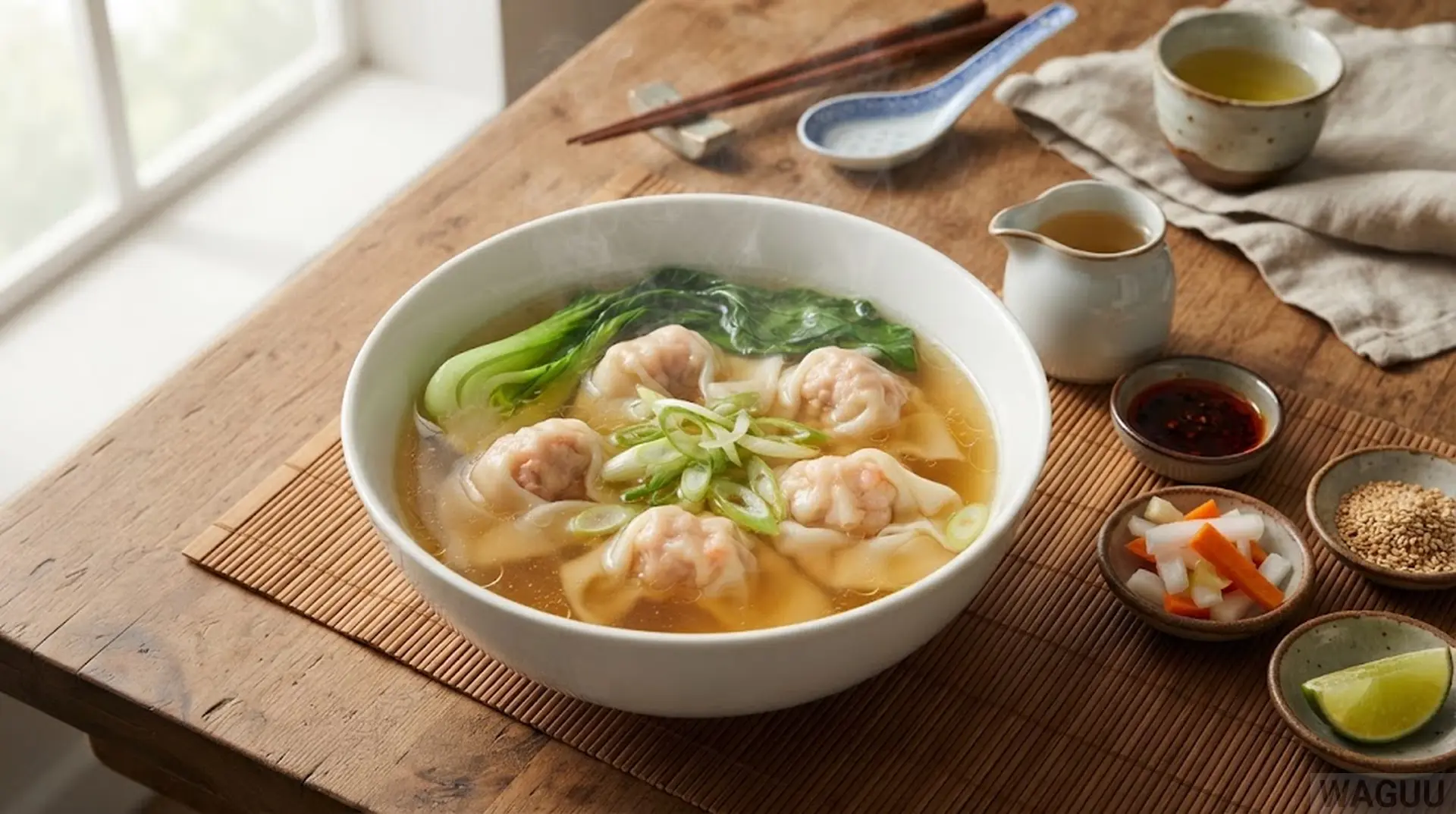
Summary: Wonton soup made with a clear chicken broth and dumplings filled with minced pork, prawns and bamboo shoots. The filling is seasoned with soy sauce, Shaoxing wine, ginger and sesame oil and wrapped in thin squares that are steamed for two minutes before going into the boiling broth. Bok choy, spring onion and a drop of sesame oil finish the soup. Total time 65 minutes, base 6 servings, 24 dumplings.
Cooked this recipe? Share the result with the community.
Category: Soups · Chinese Cuisine
Success rate: not rated yet % of users managed this recipe
Quick overview
- Dish: Wonton soup – clear broth with filled wonton dumplings and spring onion
- Category: Soups, Chinese Cuisine
- Cuisine: Chinese
- Main ingredient: Wonton wrappers, 300 g (24 pieces) plus minced pork belly, 400 g
- Guide: 12 most famous Chinese dishes: traditional recipes from Chinese cuisine
- Total time: 65 minutes (45 minutes preparation + 20 minutes cooking)
- Difficulty: Medium
- Servings: 6 (Portion weight: 566 g including broth, four dumplings per portion)
- Key technique: Pre-steaming the dumplings and finishing them in the boiling broth
- Method types: Steaming, simmering broth, frying the filling
- Dietary info & allergens: gluten, soy, crustaceans, sesame
- Great for: A light supper, a starter before a Chinese menu, a meal when you have a cold, a lunchbox
- Nutrition (per portion): 439 kcal, Protein: 26.3 g, Fat: 21.7 g, Carbohydrates: 34.5 g
- Storage: 2 days in the fridge, 1 month in the freezer (dumplings separately)
- Pairing: Jasmine tea, dry Riesling, rice beer
- In short: A chilled filling, wrappers sealed without air and pre-steaming before the broth – three steps that decide whether the dumplings hold together.
WAGUU says: “Wontons are not boiled in the soup, they are warmed in it. Cooked from raw in the broth, the wrapper soaks up water and the filling gives its flavour away to the soup.”
Key facts
| Preparation time: | 45 minutes (including 20 minutes chilling the filling) |
| Cooking time: | 20 minutes |
| Temperature: | Broth held between 95 and 100 °C, filling heated to 75 °C |
| Servings: | 6 (24 dumplings, portion weight 566 g including broth) |
At a glance
Wonton soup separates two steps: the dumplings are pre-steamed and only go into the broth for the final minutes. In the steamer the wrapper sets and firms, so in the soup it absorbs flavour without falling apart. The filling must be cold, otherwise it holds its shape poorly and dampens the wrapper from the inside. Bamboo shoots in the filling soak up the extra juices from the pork and prawns. The broth is kept at a gentle simmer, because a hard boil breaks the dumplings and clouds the soup; soy sauce, ginger and sesame oil carry the seasoning, so no salt is added.
Ingredients
Base servings: 6 • Portion weight: 566 g
| Ingredient | Quantity | Quality |
|---|---|---|
| wonton wrappers | 300 g | 24 squares, 8 cm across, thin |
| minced pork belly | 400 g | freshly minced, around 25 % fat |
| peeled prawns | 200 g | raw, deveined, chopped finely |
| spring onions | 80 g | fresh, chopped finely |
| ginger | 25 g | fresh, grated finely |
| soy sauce | 40 ml | light, in the filling and the broth |
| Shaoxing rice wine | 30 ml | dry, lifts the smell of the meat |
| sesame oil | 15 ml | toasted, in the filling and the broth |
| caster sugar | 5 g | to balance the saltiness of the soy sauce |
| white pepper | 2 g | freshly ground, for the filling |
| chicken stock | 2000 ml | unsalted, homemade or from a cube |
| bok choy | 200 g | young, leaves cut into ribbons |
| bamboo shoots | 100 g | in water, well drained, chopped finely |
Why you will love this recipe
- A light supper that fills you up: Twenty-four dumplings and two litres of broth make six generous portions without the dish feeling heavy.
- Flavour that stays in the soup: The filling is salty and gingery, the broth gentle. Together they balance without extra salt.
- Exact quantities for 6 servings: 400 g of pork, 200 g of prawns and 300 g of wrappers make exactly 24 dumplings, four per portion.
- Beginners can manage it: Six phases, five checkpoints and one pan. What separates a good result from an average one is a chilled filling and pre-steaming.
Why it works: A wheat wrapper sets at temperatures above 70 °C. In the steamer its surface coagulates and forms a continuous layer that keeps water out once the dumpling reaches the broth. Cooked from raw in the soup, water would soak the wrapper, the filling would leak flavour into the broth and the dumpling would fall apart. The filling must be cold because the fat in the pork sets at low temperature and the mixture holds its shape; a warm filling releases water as you wrap and dampens the wrapper. Bamboo shoots are largely insoluble fibre, which binds the free juices released by the pork and prawns. Prawns set at 65 °C; cooked longer they squeeze out water and turn rubbery, which is why two minutes of steam is enough. Sesame oil goes in off the heat so its aromatics survive.
Recipe overview
Prep: 45 min | Cook: 20 min | Difficulty: Medium | Servings: 6 | Type: Soup | Origin: Chinese
Detailed method
Overall progress: 0 % complete
Phase 1: Filling – 20 min
Equipment: board, knife, bowl, fridge
1. Put the minced pork in a bowl and add the soy sauce, Shaoxing wine, sesame oil, caster sugar, white pepper and grated ginger. Knead the mixture with your hand for two minutes, until it becomes sticky, then fold in the chopped prawns, bamboo shoots and spring onions. Cover the filling and chill it for twenty minutes.
Checkpoint: The filling is cold, sticky and holds on a spoon; it does not run off when the bowl is tilted. The pieces of prawn and bamboo shoot stay whole in it.
Before you move on:
Never wash the meat. Water on the surface would end up in the filling and dampen the wrapper from the inside. Pat the meat dry and work with cold ingredients.
Phase 2: Shaping the wontons – 20 min
Equipment: board, small bowl of water
2. Lay the wrappers on the board and cover them with a damp cloth. Put a spoonful of filling in the centre of each square. Wet the edges with a finger dipped in water, fold them over the filling into a triangle and press them so that no air is trapped between filling and wrapper. Then pull the two opposite corners together and join them, which gives the shape known as a nun’s cap.
Checkpoint: The wontons hold their shape, the wrapper is dry to the touch and no filling shows through. They do not move when the board is shaken gently.
Before you move on:
Press the air out of the wonton with your fingers. In the heat the air expands and splits the wrapper; the filling then floats out into the broth and clouds it.
Phase 3: Pre-steaming – 8 min
Equipment: pan, bamboo steamer, meat thermometer
3. Pour three centimetres of water into a pan and bring it to the boil. Set a bamboo steamer lined with perforated baking paper on top, arrange half the wontons in it with space between them and cover. Steam them for two minutes, until the wrappers firm up and turn translucent. Pre-steam the second half in the same way.
Checkpoint: The wrapper is translucent and springy to the touch, the filling inside is still pink. The thermometer in the filling reads 60 to 65 °C, so the wontons are not yet cooked through.
Before you move on:
Do not steam the wontons all the way through. They should still be pink inside and finish in the broth; heated twice, the filling turns firm and dry.
Phase 4: The broth – 5 min
Equipment: large pan
4. Pour the chicken stock into a large pan, add the rest of the soy sauce and simmer it gently for five minutes. Skim off the foam that rises to the surface so the soup stays clear. Taste it and adjust; salt is usually not needed, because the soy sauce and the stock carry enough.
Checkpoint: The broth is clear, golden and free of foam on the surface. The flavour is full and balanced, not over-salted.
Before you move on:
Do not boil the broth hard. A rolling boil swirls proteins and fat into the liquid, the soup clouds and it loses the clean look that belongs to wonton soup.
Phase 5: Finishing the soup – 5 min
Equipment: pan, ladle, slotted spoon
5. Add the sliced bok choy leaves to the simmering broth and cook them for a minute, until they soften. Then add the pre-steamed wontons and leave them in the broth for two minutes to heat through. Lift the wontons with a slotted spoon rather than a solid one – the wrapper is delicate and a spoon can tear it.
Checkpoint: The wrapper is glossy and translucent and the filling reads 75 °C. The broth stays clear, the bok choy bright green and the wontons keep their shape.
Before you move on:
Do not leave the wontons in the broth longer than two minutes. The wrapper soaks up water, turns pale and falls apart, and the filling gives its flavour away to the soup.
Phase 6: Serving – 3 min
Equipment: deep bowls, ladle
6. Put four wontons and some bok choy into each warmed bowl and pour the hot broth over them. Scatter spring onion on the surface and add a drop of sesame oil. Serve at once with chopsticks and a spoon; the broth is eaten with the spoon and the wontons with chopsticks.
Checkpoint: Each bowl holds four whole wontons and the broth is clear and golden. A thin film of sesame oil floats on the surface and the spring onion stays bright green.
Equipment needed
| Item | Ideal size | Alternative | Risk |
|---|---|---|---|
| bamboo steamer | 24 cm across | a metal steamer insert with a lid | without a lid, steam escapes and the wrapper stays sticky |
| large pan for the broth | 4 litre capacity | a wide casserole | in a small pan the broth cools when the wontons go in and they soak up water |
| slotted spoon | 12 cm, with a handle | a ladle with a perforated base | a solid spoon tears the wrapper and the filling runs into the broth |
| meat thermometer | probe type, reads to 250 °C | cut one wonton open and check the juices | without measuring, the filling is judged only by the look of the wrapper |
| damp cloth | cotton, 40 × 40 cm | cling film | wrappers left in the air harden within minutes and cannot be folded |
Shopping list
Nutrition profile
Values per portion (including the broth). Calculated from average nutritional values of the ingredients. Portion weight 566 g. The water used to raise steam is not counted in the weight.
| Nutrient | Per 100 g | Per portion | For 6 servings |
|---|---|---|---|
| Energy | 77 kcal | 439 kcal | 2631 kcal |
| Fat | 3.8 g | 21.7 g | 130.1 g |
| of which saturates | 4.1 g | 4.1 g | 4.1 g |
| Carbohydrates | 6.1 g | 34.5 g | 207.0 g |
| of which sugars | 2.8 g | 2.8 g | 2.8 g |
| Protein | 4.7 g | 26.3 g | 158.0 g |
| Salt | 2.2 g | 2.2 g | 2.2 g |
| of which sodium | 0.22 g | 1.26 g | 7.56 g |
Reference intake of an average adult (8400 kJ / 2000 kcal). Salt comes from the stock, the soy sauce and the wrappers; the soup is not salted again.
WAGUU Pro level
- Pro standard: A tested recipe with exact quantities and visual checkpoints.
- Tip 1: Make the filling an hour ahead and keep it in the fridge. A cold mixture wraps more easily and does not dampen the wrappers.
- Tip 2: Pre-steam the wontons and add them to the broth only just before serving. The difference from cooking them in the soup is visible at a glance.
- Tip 3: Freeze spare wontons uncooked in a single layer on a tray, then transfer them to a bag. They keep for a month.
- Tip 4: Make the broth a day ahead and let it cool; the next day lift off the set fat and the soup will be clear and light.
The science behind it
Wonton soup rests on two techniques. The first is how a wrapper sets: wheat proteins cross-link above 70 °C and form a network that holds water and fat. In the steamer that network forms quickly on the surface, so the wrapper firms even though the filling inside is not yet cooked. In the broth the filling then finishes and the wrapper takes on flavour without soaking through. The second is how broth behaves. Proteins from the meat and from the wrappers coagulate in water and create cloudiness; a hard boil stirs them through the liquid and makes the cloudiness worse, which is why the broth is kept at a gentle simmer and the foam is skimmed. Prawns need two minutes of steam because their proteins set at 65 °C and squeeze out water if cooked longer. Ginger and sesame oil bring aromatic compounds that dissolve partly in water and partly in fat; some stay in the filling and some reach the broth, which is why the soup needs no added salt.
Fine dining – professional techniques
- Plating: Serve in a deep white bowl: four wontons fanned out, a leaf of bok choy over the rim and the broth poured at the table from a jug.
- Texture contrast: Lay crisp strips of spring onion and a few dry-toasted sesame seeds on the wontons.
- Temperature contrast: Warm the bowls with hot water and dry them. A cold bowl drops the temperature of the broth and firms the wrapper.
- Aromatic finish: Grate a thin strip of lime zest over the bowl and add a drop of sesame oil at the table.
Sensory radar
- Appearance: Clear golden broth with translucent wontons showing a pink glow, bright green bok choy and spring onion.
- Aroma: A gentle chicken broth with ginger, sesame underneath and a sweet note from the pork.
- Taste: A clean, savoury broth, a juicy filling with prawns and a fresh finish of spring onion.
- Texture: Wrapper tender and slippery, filling juicy with crunchy bamboo shoots, broth hot and light.
Pairing
- Jasmine tea: A floral aroma cleanses the palate and complements the ginger in the filling.
- Dry Riesling: Higher acidity cuts the fat in the pork and underlines the prawns.
- Rice beer: Light sweetness and low bitterness suit the delicate soup.
- Homemade limeade: Citrus refreshes without masking the broth, and suits children and drivers.
Variations
- Fried wontons: Instead of pre-steaming, fry the wontons for two minutes in oil at 175 °C. Serve them separately with a bowl of sweet and sour sauce and leave the soup without them.
- Prawn version: Replace the pork with 700 g of prawns and add a spoon of sesame paste. Steam the wontons for one minute only so the prawns stay juicy.
- Chicken version: Use minced chicken thigh instead of pork. The filling is leaner, so add a spoon of sesame oil and serve with a drop of chilli oil.
Allergens and dietary information
Contains: gluten (wonton wrappers); soy (soy sauce); crustaceans (peeled prawns); sesame (sesame oil) • Gluten: yes, in the wrappers • Not suitable for: anyone with coeliac disease or an allergy to crustaceans, soy or sesame; a gluten-free version needs rice wrappers and tamari
Great for
A light supper, a starter before a Chinese menu, a meal when you have a cold, a lunchbox, dinner for six with one pan on the table.
Substitution guide
- Wonton wrappers: spring roll pastry cut into squares. Thinner and more fragile, so they are harder to shape.
- Minced pork belly: minced chicken thigh or minced beef with 15 % fat. The filling is drier, so add a spoon of oil.
- Peeled prawns: frozen prawns, defrosted and drained, or pieces of white fish. Less sweet in flavour.
- Bamboo shoots: water chestnuts or chopped carrot. They soak up less juice, so add a spoon of breadcrumbs.
- Bok choy: spinach or young cabbage. Spinach cooks in half a minute.
- Chicken stock: vegetable stock with a spoon of soy sauce. The soup loses some depth.
FAQ
Why pre-steam the wontons?
In the steamer the wrapper sets without absorbing water. Cooked from raw in the broth it would soak, and the filling would give its flavour to the soup. Pre-steamed wontons simply warm through.
How do I know the filling is cooked?
The thermometer in the filling reads 75 °C and the wrapper is translucent and taut. If the filling is still pink, leave the wontons in the broth for another minute.
Can the wontons be frozen?
Yes. Freeze them uncooked in a single layer on a tray and then transfer them to a bag. Drop them into boiling broth straight from the freezer and cook them a minute longer.
Why does the soup turn cloudy?
Usually because of a hard boil or a torn wonton. Keep the broth at a gentle simmer, skim the foam and lift the wontons with a slotted spoon.
Which stock is best?
An unsalted homemade chicken stock made from bones and root vegetables. A cube works too, but it is saltier; in that case halve the soy sauce.
Can the recipe be gluten free?
Not with wheat wrappers. Use rice wrappers or a gluten-free dough and tamari instead of soy sauce. The filling and the broth contain no gluten.
WAGUU Petr advises: cooking for 6 or more?
6–8 people: Double the number of wontons and increase the stock to 2500 ml. Pre-steam them in two batches and add them to the broth batch by batch. • 10+ people: Make two full batches of wontons and freeze half of them uncooked. Serve the soup from two pans so the broth stays hot; fill the bowls at the table and top them up from a jug.
Sides and serving
Storage and reheating
Fridge: 2 days (wontons and broth separately) • Freezer: 1 month • Reheating: Bring the broth to a gentle simmer, steam the wontons for three minutes and then add them to the broth. In the microwave the wrapper hardens and the soup clouds.
Author: WAGUU Petr & Team • Published: 8 Oct 2026 • Updated: 10 Oct 2026
More recipes from this article
Guide: 12 most famous Chinese dishes: traditional recipes from Chinese cuisine
Peking duck – celebratory roast duck with crisp skin, thin pancakes and a sweet sauce
Kung Pao chicken – spicy Sichuan chicken with peanuts, chilli and a sweet-savoury sauce
Mapo tofu – tofu in a spicy Sichuan sauce with minced meat and Sichuan pepper
Sweet and sour pork – fried pork pieces in the classic sweet and sour sauce
Char siu – Cantonese roast pork with a glossy caramelised crust
Dim sum – small Cantonese dishes, especially steamed dumplings and parcels
Xiaolongbao – delicate Shanghai dumplings filled with pork and hot soup
Chow mein – stir-fried wheat noodles with vegetables, meat or seafood
Yangzhou fried rice – fried rice with egg, prawns, ham and peas
Hot pot – a shared meal cooked in bubbling broth at the table
Dan dan noodles – Sichuan noodles with a spicy sauce and chilli oil
Other recipes you might like
Why WAGUU?
Recipes on WAGUU are checked for accurate quantities, method and nutrition. In this recipe the amounts match across the ingredient table, the cooking phases, the shopping list and the print view – 400 g of pork, 200 g of prawns and 300 g of wrappers make exactly 24 wontons, four per portion, and 2000 ml of stock gives 333 ml per portion.
Photo gallery from the process
Community photos: Cook it, photograph it and share the result.
Upload your photos in the comments below or send them by email.
Filmed a video following our recipe? Post a link to YouTube, YouTube Shorts, TikTok, Instagram Reels, Facebook Reels, Pinterest, Vimeo or X (Twitter) in the comments – we will gladly publish it and help get your work seen.
Most common mistakes
- Wontons cooked right through in the soup – the wrapper soaks and the filling loses flavour to the broth. Pre-steam them and give them two minutes in the soup.
- A warm filling – it releases water as you wrap and dampens the wrapper. Chill the filling for twenty minutes first.
- Air trapped inside – it expands in the heat and splits the wrapper. Press the edges so the air escapes.
- A hard boil – the soup clouds and the wontons break up. Keep it at a gentle simmer and skim off the foam.