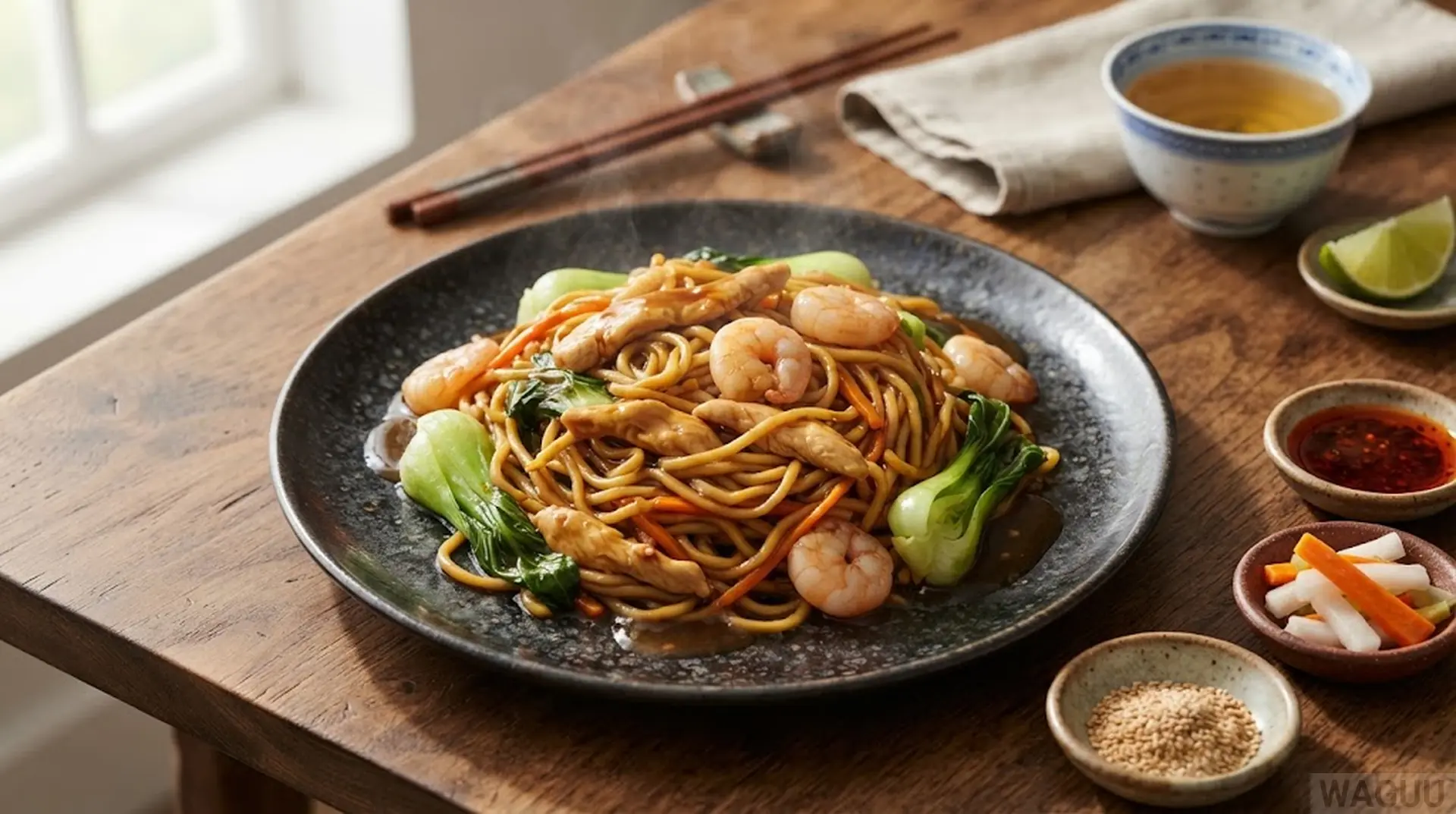
Summary: Stir-fried wheat noodles with chicken thigh, prawns and vegetables. The noodles are boiled a minute less than the packet says, rinsed in cold water and tossed with a little oil so they do not stick. Meat and prawns are fried separately from the vegetables and everything comes together with a soy and oyster sauce in the final two minutes. Total time 35 minutes, base 6 servings.
Cooked this recipe? Share the result with the community.
Category: Pasta · Chinese Cuisine
Success rate: not rated yet % of users managed this recipe
Quick overview
- Dish: Chow mein – stir-fried wheat noodles with vegetables, meat or seafood
- Category: Pasta, Chinese Cuisine
- Cuisine: Chinese
- Main ingredient: Dried egg wheat noodles, 450 g (75 g per portion)
- Guide: 12 most famous Chinese dishes: traditional recipes from Chinese cuisine
- Total time: 35 minutes (20 minutes preparation + 15 minutes cooking)
- Difficulty: Easy
- Servings: 6 (Portion weight: 312 g)
- Key technique: Boiling the noodles to just underdone and stir-frying each component separately over the highest heat
- Method types: Stir-frying, boiling, pan-frying
- Dietary info & allergens: gluten, egg, soy, crustaceans, sesame
- Great for: A quick weeknight dinner, using up vegetables, a meal children and adults both like, cooking in one pan
- Nutrition (per portion): 516 kcal, Protein: 27.9 g, Fat: 16.8 g, Carbohydrates: 63.3 g
- Storage: 3 days in the fridge, 1 month in the freezer
- Pairing: Jasmine tea, light lager, homemade limeade
- In short: Noodles boiled to just underdone, each component fried on its own and the sauce added in the last two minutes – three steps that decide whether the noodles stay firm or turn to mush.
WAGUU says: “Chow mein is not about the sauce, it is about the pan. The noodles are fried on a dry hot surface until brown spots appear – those spots give a flavour no sauce can imitate.”
Key facts
| Preparation time: | 20 minutes |
| Cooking time: | 15 minutes |
| Temperature: | Wok at 200–220 °C, noodles boiled in plenty of water |
| Servings: | 6 (portion weight 312 g) |
At a glance
Chow mein rests on two techniques. The first is pre-cooking the noodles: they are boiled a minute less than the packet says and then rinsed in cold water, which washes off the surface starch so they do not clump together in the pan. The second is frying on a dry, very hot surface: the noodles are left alone for a minute so brown spots form, and only then are they tossed. Aromas from the sauce arrive in the last stage, when everything is combined. Meat and prawns are fried separately because they release water; cooked together with the noodles that water would drop the pan temperature and the noodles would steam instead of frying.
Ingredients
Base servings: 6 • Portion weight: 312 g
| Ingredient | Quantity | Quality |
|---|---|---|
| dried egg wheat noodles | 450 g | thin, sold in bundles |
| boneless skinless chicken thighs | 300 g | fresh, cut into strips |
| peeled prawns | 200 g | raw, deveined |
| bok choy | 300 g | firm, leaves and stalks cut separately |
| carrot | 150 g | fresh, cut into thin strips |
| onion | 100 g | yellow, cut into thin wedges |
| spring onions | 60 g | fresh, cut on the diagonal |
| garlic | 20 g | fresh, sliced |
| ginger | 20 g | fresh, sliced thinly |
| soy sauce | 60 ml | light, naturally fermented |
| oyster sauce | 40 g | thick, dark |
| peanut oil | 60 ml | for stir-frying, high smoke point |
| sesame oil | 15 ml | toasted, to finish |
| chicken stock | 100 ml | unsalted, homemade or from a cube |
Why you will love this recipe
- Ready in 35 minutes: The noodles boil in five minutes and the stir-frying takes ten. The rest is chopping, which can be done ahead.
- Flavour from the pan, not the packet: The noodles are fried dry until brown spots appear, which gives a savoury depth quick noodles never have.
- Exact quantities for 6 servings: 75 g of dried noodles per portion, 50 g of chicken and 33 g of prawns. Every amount matches the shopping list.
- Beginners can manage it: Six phases, five checkpoints and one pan. What separates a good result from an average one is rinsing the noodles and keeping the pan hot.
Why it works: Wheat noodles are mostly starch and protein. During boiling the starch swells and leaves a sticky layer on the surface, which is what makes noodles clump. Rinsing in cold water removes that layer and firms the strands. Frying on a very hot wok evaporates the remaining surface water and pushes the surface above 140 °C, where Maillard reactions between amino acids and reducing sugars produce brown spots and roasted aromas. Chicken and prawns are fried separately because they are more than seventy per cent water; together with the noodles that water would drop the temperature below 150 °C and the mixture would steam. Oyster sauce brings free amino acids, mainly glutamate, which intensify the perception of savoury flavour, and sugars that caramelise slightly on the hot noodles. Sesame oil is added off the heat so its aromatics survive.
Recipe overview
Prep: 20 min | Cook: 15 min | Difficulty: Easy | Servings: 6 | Type: Main course | Origin: Chinese
Detailed method
Overall progress: 0 % complete
Phase 1: Preparing the ingredients – 15 min
Equipment: board, knife, kitchen scales
1. Pat the chicken thighs dry and cut them into strips half a centimetre thick. Dry the prawns and leave them whole. Wash the bok choy, cut the stalks on the diagonal and the leaves into wider ribbons. Cut the carrot into thin strips, the onion into wedges, the spring onions on the diagonal and the garlic and ginger into thin slices. Arrange everything in bowls in the order it will go into the wok.
Checkpoint: All the ingredients are cut to a similar thickness and arranged in bowls. The chicken and prawns are dry to the touch, not glossy with moisture.
Before you move on:
Never wash chicken or prawns. Water on the surface has to evaporate in the wok, which drops the temperature and steams the ingredients instead of frying them. Dry them with kitchen paper.
Phase 2: Pre-cooking the noodles – 6 min
Equipment: large pan, colander
2. Bring three litres of water to the boil in a large pan and add the dried noodles. Boil them a minute less than the packet says – usually four to five minutes. Drain them into a colander, rinse under cold water and leave them to drain. While still warm, toss them with a tablespoon of the peanut oil so they do not stick together.
Checkpoint: The noodles are firm to the bite but not hard in the middle. The surface is matte and dry and the strands separate instead of clumping.
Before you move on:
Do not boil the noodles until soft. They are heated again in the wok, so they would break down into a paste. Take them out a minute before the packet suggests.
Phase 3: Chicken and prawns – 5 min
Equipment: wok, spatula, meat thermometer
3. Set the wok over the highest heat and warm it empty for two to three minutes. Pour in half the peanut oil and add the chicken strips. Stir-fry for two minutes, until the edges turn golden, then lift them into a bowl. Add the prawns to the wok and fry them for one minute, until they turn pink and curl; take them out to join the chicken.
Checkpoint: The chicken has golden edges and reads 74 °C on the thermometer. The prawns are pink and curled and no water has collected in the base of the wok.
Before you move on:
Fry the prawns for one minute at most. Longer and their proteins contract, squeeze out water and leave them rubbery.
Phase 4: Vegetables – 4 min
Equipment: wok, spatula
4. Pour the rest of the peanut oil into the wok, add the garlic and ginger and stir for thirty seconds, until fragrant. Add the onion, carrot and bok choy stalks and stir-fry for two minutes. Then add the bok choy leaves and cook for another minute, until they wilt but stay bright green.
Checkpoint: The carrot still has a slight bite, the bok choy stalks are glossy and the leaves bright green. Only a thin film of oil is left in the wok.
Before you move on:
Do not crowd the wok with vegetables. They are more than ninety per cent water; add too much and the temperature drops, so they release water in steam instead of frying.
Phase 5: Noodles and sauce – 4 min
Equipment: wok, spatula
5. Add the drained noodles to the wok and spread them over the base. Leave them for a minute without stirring so brown spots form underneath, then turn them and fry for another minute. Pour in the soy sauce and oyster sauce mixed with the chicken stock, return the chicken and prawns and toss everything together. Fry for one minute more, until the sauce is absorbed and the noodles darken.
Checkpoint: The noodles carry brown spots in places and are evenly coated with sauce. No liquid is left in the base of the wok and the mixture moves as one.
Before you move on:
Leave the noodles still for the first minute. They need contact with the hot metal to develop the brown spots; stirring constantly only warms them and leaves them pale.
Phase 6: Finishing and serving – 2 min
Equipment: wok, serving dish
6. Take the wok off the heat, sprinkle over the sesame oil and fold in the spring onion. Tip the chow mein into a warmed dish and serve at once; chilli oil or pickled vegetables go well alongside and are not part of the recipe.
Checkpoint: The noodles are glossy but not oily and the spring onion is bright green. Lifted with a fork, the strands hang in long threads rather than clumps.
Equipment needed
| Item | Ideal size | Alternative | Risk |
|---|---|---|---|
| wok | 30 cm, thick base | a deep cast-iron pan | a thin pan loses heat and the noodles steam instead of frying |
| large pan for the noodles | 5 litre capacity | two smaller pans for two batches | in a small pan the noodles clump and the water stops boiling |
| colander | 24 cm | a sieve and a bowl of cold water | without rinsing, surface starch makes the noodles stick together |
| spatula | metal, long handle | two wooden spoons | short utensils mean burns from spitting oil |
| meat thermometer | probe type, reads to 250 °C | cut the thickest strip open and check the juices | without measuring, overcooking is judged only by the colour of the surface |
Shopping list
Nutrition profile
Values per portion (as served, without a side). Calculated from average nutritional values of the ingredients. Portion weight 312 g. The water used to boil the noodles is not counted in the weight.
| Nutrient | Per 100 g | Per portion | For 6 servings |
|---|---|---|---|
| Energy | 165 kcal | 516 kcal | 3094 kcal |
| Fat | 5.4 g | 16.8 g | 100.6 g |
| of which saturates | 4.6 g | 4.6 g | 4.6 g |
| Carbohydrates | 20.2 g | 63.3 g | 379.5 g |
| of which sugars | 7.3 g | 7.3 g | 7.3 g |
| Protein | 8.9 g | 27.9 g | 167.6 g |
| Salt | 2.5 g | 2.5 g | 2.5 g |
| of which sodium | 0.38 g | 1.18 g | 7.08 g |
Reference intake of an average adult (8400 kJ / 2000 kcal). Salt comes from the soy sauce, the oyster sauce and the stock; the dish is not salted again and can be seasoned at the table.
WAGUU Pro level
- Pro standard: A tested recipe with exact quantities and visual checkpoints.
- Tip 1: Rinse the noodles in cold water the moment they are drained. The quicker the surface cools, the less they stick together.
- Tip 2: Heat the wok empty until a faint wisp of smoke appears. A drop of water must evaporate instantly.
- Tip 3: Have the chicken and prawns cut and dried before you start. Once the wok is hot you do not leave the pan, and seconds matter.
- Tip 4: Reheat leftovers in a dry pan rather than the microwave. The pan drives off water and the noodles return to their firm texture.
The science behind it
Chow mein depends on how wheat starch behaves. In boiling water above 60 °C the starch granules swell and, at around 90 °C, their chains open and form a sticky layer on the surface of the noodles. Rinsing in cold water washes that free starch away and firms the strands, which is why rinsed noodles separate instead of clumping. In a wok at 200–220 °C the remaining surface water evaporates within seconds and the surface passes 140 °C, where Maillard reactions between amino acids and reducing sugars create the brown spots and roasted aromas. Chicken and prawns are fried separately because they are more than seventy per cent water: together with the noodles that water would drop the surface temperature below 150 °C and the mixture would steam rather than fry. Oyster sauce contains free amino acids, mainly glutamate, which intensify the perception of savoury flavour, and its sugars caramelise slightly on the hot noodles, adding gloss and colour.
Fine dining – professional techniques
- Plating: Lift the noodles with a fork and twist them into a small nest, place the chicken and prawns on top and arrange the vegetables around the edge. Scatter sesame seeds over.
- Texture contrast: Cut part of the carrot into fine shreds and leave it crisp, cook the rest until soft. One dish then carries two textures.
- Temperature contrast: Serve a cold pickled cucumber alongside. Chill and acidity cut the oil from the wok.
- Aromatic finish: Add a spoon of chilli oil and strips of lime zest. Citrus ties the oyster sauce to the prawns.
Sensory radar
- Appearance: Golden brown noodles with darker patches, pink prawns, pale chicken and bright green bok choy.
- Aroma: Fried garlic and ginger over soy sauce with an oyster note underneath and a faint trace of sesame.
- Taste: Salty soy and the sweetness of oyster sauce, finishing with fresh spring onion and sesame.
- Texture: Noodles firm and slightly springy, prawns juicy, vegetables crunchy.
Pairing
- Jasmine tea: Floral and light, it cleanses the palate without masking the noodles.
- Light lager: Hop bitterness cuts the oil from the wok. Serve at 6–8 °C.
- Homemade limeade: Acidity refreshes after a savoury dish and suits children and drivers.
- Dry Riesling: Its higher acidity matches the oyster sauce and its citrus note underlines the prawns.
Variations
- Rice noodles: Soak and blanch them instead of boiling, then stir-fry. The dish is naturally gluten free and lighter, though the noodles snap more easily.
- Vegetarian version: Replace the chicken and prawns with 300 g of shiitake mushrooms and 150 g of tofu. Add a spoon of soy sauce to compensate.
- Spicier version: Add a spoon of chilli oil and a spoon of chopped pickled chilli. The heat rises, but the noodles stay readable.
Allergens and dietary information
Contains: gluten (egg wheat noodles); egg (egg wheat noodles); soy (soy sauce); crustaceans (peeled prawns); sesame (sesame oil) • Gluten: yes, in the noodles • Not suitable for: anyone with coeliac disease or an allergy to egg, crustaceans, soy or sesame
Great for
A quick weeknight dinner, using up vegetables, a meal children and adults both like, cooking in one pan, a lunchbox the next day.
Substitution guide
- Egg wheat noodles: egg-free wheat noodles or rice noodles. Egg-free noodles are less springy; rice noodles break more easily.
- Peeled prawns: frozen prawns, defrosted and drained, or pieces of salmon. The flavour is less sweet.
- Bok choy: Chinese cabbage, kale or spinach. Kale needs longer, spinach much less.
- Oyster sauce: dark soy sauce with a spoon of honey. Less marine, sweeter.
- Chicken stock: vegetable stock with a spoon of soy sauce. The dish loses some depth.
- Peanut oil: rapeseed or sunflower oil. Peanut oil tolerates higher heat and adds a faint nutty note.
FAQ
Why rinse the noodles in cold water?
Free starch on the surface is what makes noodles stick together. Cold water washes it off and firms the strands, so in the pan they behave as separate threads rather than one block.
How long should the noodles boil?
A minute less than the packet says, usually four to five minutes. They must still have a bite, because they are heated again in the wok.
Can I use cooked noodles from the fridge?
Yes, but rinse them in warm water first to separate them. Fry them for a minute longer and add a spoon of stock so they do not catch.
Why fry the chicken separately?
Chicken is more than seventy per cent water. In the pan it releases that water, the temperature drops and the mixture steams. Frying in stages keeps the surface dry and lets it brown.
Can the dish be prepared in advance?
Chop everything up to four hours ahead and keep it in the fridge. Do the stir-frying at the last moment; reheated chow mein loses its bite and the spring onion fades.
Is chow mein gluten free?
Not with wheat noodles. Use rice noodles and tamari instead of soy sauce, and check the oyster sauce. The other ingredients contain no gluten.
WAGUU Petr advises: cooking for 6 or more?
6–8 people: Boil the noodles in one large pan but stir-fry in two batches. Keep the first batch warm in the oven at 80 °C under foil. • 10+ people: Set two pans side by side and split the ingredients in half. Pre-cook the noodles, rinse them and toss them with oil; before serving they need only two minutes in the pan and the sauce.
Sides and serving
Storage and reheating
Fridge: 3 days • Freezer: 1 month • Reheating: Warm in a dry pan or wok for two to three minutes with a spoon of stock. The microwave softens the noodles and costs them their bite; if you use it, cover the dish and heat in short bursts.
Author: WAGUU Petr & Team • Published: 8 Oct 2026 • Updated: 10 Oct 2026
More recipes from this article
Guide: 12 most famous Chinese dishes: traditional recipes from Chinese cuisine
Peking duck – celebratory roast duck with crisp skin, thin pancakes and a sweet sauce
Kung Pao chicken – spicy Sichuan chicken with peanuts, chilli and a sweet-savoury sauce
Mapo tofu – tofu in a spicy Sichuan sauce with minced meat and Sichuan pepper
Sweet and sour pork – fried pork pieces in the classic sweet and sour sauce
Char siu – Cantonese roast pork with a glossy caramelised crust
Dim sum – small Cantonese dishes, especially steamed dumplings and parcels
Xiaolongbao – delicate Shanghai dumplings filled with pork and hot soup
Yangzhou fried rice – fried rice with egg, prawns, ham and peas
Hot pot – a shared meal cooked in bubbling broth at the table
Dan dan noodles – Sichuan noodles with a spicy sauce and chilli oil
Wonton soup – clear broth with filled wonton dumplings and spring onion
Other recipes you might like
Why WAGUU?
Recipes on WAGUU are checked for accurate quantities, method and nutrition. In this recipe the amounts match across the ingredient table, the cooking phases, the shopping list and the print view – 450 g of dried noodles serve six at 75 g each, 300 g of chicken gives 50 g per portion and 200 g of prawns 33 g per portion.
Photo gallery from the process
Community photos: Cook it, photograph it and share the result.
Upload your photos in the comments below or send them by email.
Filmed a video following our recipe? Post a link to YouTube, YouTube Shorts, TikTok, Instagram Reels, Facebook Reels, Pinterest, Vimeo or X (Twitter) in the comments – we will gladly publish it and help get your work seen.
Most common mistakes
- Overcooked noodles – they break down in the pan. Boil them a minute less than the packet says and rinse them at once.
- Noodles straight into the pan without rinsing – free starch glues them into a block. Rinse them and toss with a spoon of oil.
- Everything in the wok at once – the temperature drops and the mixture steams. Fry meat, prawns and vegetables separately and combine at the end.
- Sauce added at the start – the noodles soak and lose their bite. Add the sauce in the last two minutes.