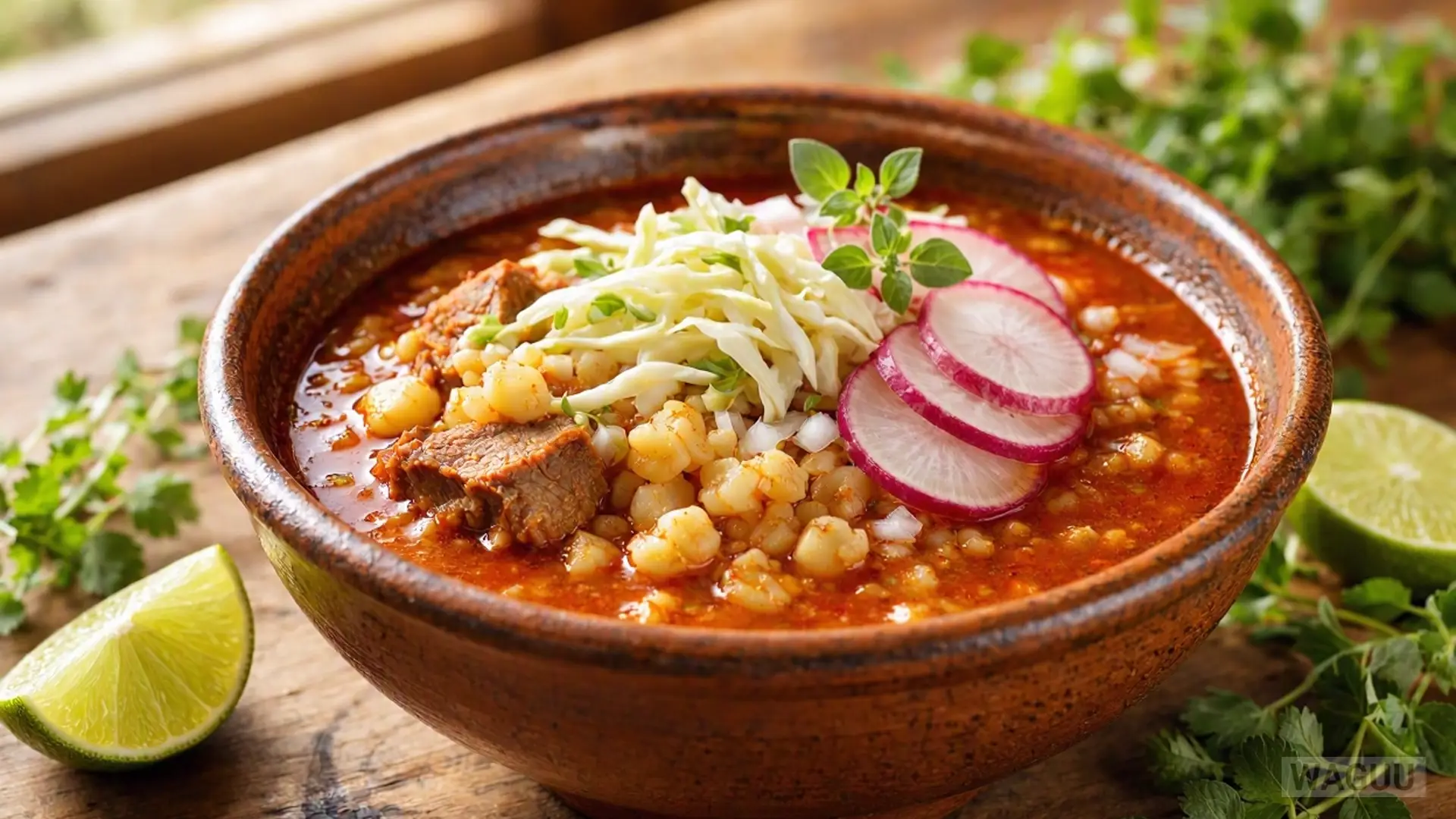
Summary: Pozole is a traditional hearty Mexican soup made from large nixtamalised maize kernels (hominy), most commonly prepared with tender pork shoulder, aromatic spices, and a rich chilli broth, then served fresh with shredded cabbage, radishes, lime, and oregano. This authentic recipe yields 6 hearty portions with a preparation time of 30 minutes and a slow simmering time of 150 minutes.
Did you cook this recipe? Share the result with the community.
Category: Main Dishes, Soups, Mexican Cuisine
Success rate: not rated yet% of users successfully made this recipe
Quick overview
- Dish: Pozole
- Category: Main Dishes, Soups, Mexican Cuisine
- Cuisine: Mexican
- Main ingredient: Pork shoulder, 1200 g (premium quality, bone-in or boneless marbled cut)
- Guide: 12 most popular Mexican dishes: favourite Mexican cuisine recipes
- Total time: 180 minutes (30 min prep + 150 min cooking)
- Difficulty: Medium
- Portions: 6 portions (Portion weight: 550 g)
- Key technique: Simmering with nixtamalised corn and whole spices
- Preparation types: Boiling, blending, simmering
- Dietary info & Allergens: Gluten-Free, Dairy-Free (Contains: None of the major 14 allergens)
- Suitable for: Festive occasions, family dinners, winter warming
- Nutritional values (per 1 portion): 520 kcal, Protein: 38 g, Fat: 22 g, Carbohydrates: 42 g
- Storage: 4 days in the fridge, 3 months in the freezer
- Pairing: Mexican Lager, Agua de Horchata, Limeade
- In short: An iconic Mexican celebration soup uniting tender pork, bloomed hominy corn, and vibrant fresh garnishes.
- Last updated: 2025-02-15
WAGUU says: “Never rinse the hominy corn with cold water directly from the can without draining properly; allowing it to gently warm in the simmering pork broth releases its essential starchy body into the soup.”
Key facts
| Prep time: | 30 minutes |
| Cooking time: | 150 minutes |
| Temperature: | Medium simmer at 95 °C |
| Number of portions: | 6 portions |
In a nutshell
Pozole is much more than just a soup; it is a cornerstone of Mexican heritage with ancient roots. Combining exceptionally tender pork shoulder, nutrient-rich nixtamalised hominy corn, and a deeply aromatic red chilli paste made from guajillo and ancho chillies, this dish delivers an extraordinary symphony of earthy, smoky, and zesty flavours that transform any ordinary meal into a vibrant fiesta.
Ingredients
Base portions: 6 portions • Portion weight: 550 g
| Ingredient | Amount | Quality |
|---|---|---|
| Pork shoulder | 1200 g | bone-in or well-marbled |
| Dried hominy corn | 800 g | canned nixtamalised maize, drained |
| Guajillo chillies | 60 g | dried, stemmed and seeded |
| Ancho chillies | 40 g | dried, sweet and smoky |
| White onion | 200 g | fresh, peeled (half diced, half halved) |
| Garlic cloves | 25 g | fresh whole cloves (approx. 6 cloves) |
| Dried oregano | 10 g | Mexican oregano preferred |
| Ground cumin | 5 g | freshly ground |
| Bay leaves | 2 pcs | dried aromatic leaves |
| Water | 3500 ml | filtered and clean |
| Fine sea salt | 30 g | pure sea salt |
| White cabbage | 250 g | finely shredded for serving |
| Radishes | 150 g | fresh, thinly sliced |
| Limes | 120 g | cut into wedges |
Why you will love this recipe
- Incomparable tenderness: Slow-simmered pork shoulder becomes melt-in-your-mouth tender, infusing every spoonful with rich collagen.
- Authentic Mexican flavours: The blend of toasted guajillo and ancho chillies creates a complex, smoky, and mildly spicy broth.
- Interactive serving ritual: Customising each bowl with fresh cabbage, radish, lime, and oregano makes every bite uniquely refreshing.
Success guaranteed: Follow the precise simmering times and temperature guidelines for a flawless, deeply flavourful authentic pozole every single time.
Recipe overview
Prep: 30 min | Cooking: 150 min | Difficulty: Medium | Portions: 6 portions | Type: Main course soup | Origin: Mexican
Detailed instructions
Overall progress: 0% complete
Phase 1: Preparing and simmering the pork – 110 min
Appliances: Large stockpot, stove
1. Cut the 1200 g of pork shoulder into large 5 cm chunks, keeping any bone attached for extra broth depth. Place the pork into a large stockpot with 3500 ml of filtered water, half of the white onion, 15 g of garlic cloves, 2 bay leaves, and 15 g of fine sea salt. Bring the water to a rolling boil over high heat, then immediately reduce the heat to a gentle simmer (95 °C). Cover with a lid and simmer gently for 110 minutes, skimming off any impurities that rise to the surface during the first 15 minutes.
VKB: Visual control point: The pork is ready when it pulls apart effortlessly with a fork and the broth has become rich and aromatic.
Before moving to the next step:
Ensure the meat is tender and the scum is completely skimmed from the broth surface before adding the chilli paste.
Phase 2: Preparing the dried chilli pods – 20 min
Appliances: Medium saucepan, stove
2. While the pork is simmering, take the 60 g of guajillo chillies and 40 g of ancho chillies. Remove the stems and shake out most of the seeds. Place the chilli pods into a medium saucepan, cover with water, and bring to a boil. Turn off the heat, cover the pan, and let the chillies soak and soften for 20 minutes until completely pliable.
VKB: Visual control point: The chilli skins should feel soft, tender, and easily pierceable with the tip of a knife.
Before moving to the next step:
Drain the soaked chillies thoroughly and discard the bitter soaking water before blending.
Phase 3: Blending the aromatic chilli paste – 10 min
Appliances: High-speed blender, fine mesh strainer
3. Transfer the softened guajillo and ancho chillies into a high-speed blender. Add the remaining 10 g of garlic cloves, 5 g of ground cumin, a pinch of salt, and 300 ml of fresh water. Blend on high speed for 3 to 4 minutes until a completely smooth, vibrant red paste is formed. Pour the blended paste through a fine mesh strainer directly into a bowl, pressing with the back of a ladle to discard any tough seed fragments or skin flecks.
VKB: Visual control point: The resulting puree should be velvety smooth with zero coarse particles remaining.
Before moving to the next step:
Verify that all pork chunks in the main pot are tender before combining the ingredients.
Phase 4: Shredding the pork and combining – 15 min
Appliances: Two forks, cutting board, stockpot
4. Carefully remove the cooked pork chunks from the stockpot using a slotted spoon and place them on a cutting board. Discard the cooked onion halves and bay leaves from the broth. Once the meat is cool enough to handle, use two forks to shred the pork into bite-sized strips, discarding any excess hard fat or bone. Return the shredded pork back into the simmering stockpot.
VKB: Visual control point: Shreds should be uniform and tender, ready to absorb the rich chilli flavours.
Before moving to the next step:
Ensure the hominy corn is thoroughly drained before adding it to prevent diluting the broth.
Phase 5: Incorporating hominy and chilli paste – 25 min
Appliances: Stockpot, wooden spoon, stove
5. Pour the strained red chilli paste and the 800 g of drained dried hominy corn into the stockpot with the shredded pork and broth. Add the remaining 15 g of fine sea salt and 10 g of dried Mexican oregano, crushing it between your palms to release the essential oils. Stir everything thoroughly to combine. Bring the soup back to a gentle simmer and cook uncovered for 25 minutes so the hominy plumps up and the chilli flavours meld seamlessly into the broth.
VKB: Visual control point: The soup develops a brilliant crimson hue and the corn kernels swell and soften.
Before moving to the next step:
Taste the soup and adjust salt levels if necessary before final plating and garnishing.
Phase 6: Final seasoning and garnish preparation – 10 min
Appliances: Sharp knife, cutting board, soup bowls
6. Finely shred 250 g of white cabbage, thinly slice 150 g of fresh radishes, and cut 120 g of limes into wedges. Dice the remaining half of the white onion. Ladle the hot pozole into warmed deep bowls, ensuring each serving gets an abundant share of tender pork and plump hominy corn. Serve immediately accompanied by bowls of shredded cabbage, sliced radishes, diced onion, fresh lime wedges, and extra oregano so guests can garnish to their preference.
VKB: Visual control point: Vibrant green cabbage and bright red radishes contrast beautifully against the deep red soup.
Required equipment
| Utensil | Ideal size | Alternative | Risk |
|---|---|---|---|
| Large stockpot | 6 to 8 litres capacity | Dutch oven | Boiling over if heat is too high |
| High-speed blender | 1.5 litres capacity | Immersion blender | Incomplete puréeing of tough skins |
| Fine mesh strainer | 20 cm diameter | Chinoise | Clogging if not pressed properly |
Shopping list
Nutritional profile
Values per 1 portion (excluding side dishes). Calculated from average nutritional values of ingredients.
| Nutrient | Per 100 g | Per 1 portion | Per 6 portions |
|---|---|---|---|
| Energy | 94.5 kcal | 520 kcal | 3120 kcal |
| Fat | 4.0 g | 22.0 g | 132.0 g |
| of which saturates | 1.4 g | 7.5 g | 45.0 g |
| Carbohydrates | 7.6 g | 42.0 g | 252.0 g |
| of which sugars | 1.1 g | 6.0 g | 36.0 g |
| Protein | 6.9 g | 38.0 g | 228.0 g |
| Salt | 0.9 g | 5.0 g | 30.0 g |
Reference intake of an average adult (8400 kJ / 2000 kcal).
WAGUU Pro Level
- Pro standard: Verified recipe with precise ratios and visual control points.
- Tip 1: Toast the dried chillies gently in a dry skillet for 30 seconds before soaking to unlock deeper secondary aromatic notes.
- Tip 2: Use bone-in pork shoulder if available; the dissolved collagen significantly improves the velvety consistency of the soup.
- Tip 3: Always strain the blended chilli paste through a fine sieve to eliminate any fibrous bits that would ruin the silky broth texture.
- Tip 4: Let the finished pozole rest off the heat for 20 minutes before serving so the flavours fully harmonise and deepen.
Scientific background
The defining scientific process in pozole is nixtamalisation—cooking and soaking field corn in an alkaline solution (traditionally slaked lime or wood ash). This ancient Mesoamerican technique breaks down tough hemicellulose in the corn hull, liberating bound niacin (vitamin B3), increasing calcium bioavailability, and allowing the starch granules to gelatinise properly during simmering so the hominy blossoms into its signature flower-like shape and thickens the surrounding broth.
Fine Dining – Professional techniques
- Plate composition: Present the vibrant red broth and plump hominy in a minimalist deep ceramic bowl, topped with precisely julienned crisp white cabbage and paper-thin radish rounds.
- Textural contrasts: Balance the unctuous, melting tenderness of the slow-cooked pork with the refreshing crunch of raw cabbage and radishes.
- Temperature contrast: Serve the piping hot soup immediately alongside ice-cold fresh garnishes and chilled lime wedges.
- Aromatic garnishes: Finish tableside with a drizzle of fresh lime juice and a dusting of freshly rubbed Mexican oregano.
Sensory radar
- Appearance: Deep ruby-red broth studded with blossomed white corn kernels and tender shredded pork, topped with crisp green and white garnishes.
- Aroma: Rich, earthy dried chilli fragrance backed by sweet corn, garlic, and herbal oregano notes.
- Taste: Deeply savory pork broth balanced by the natural sweetness of hominy and the mild, smoky heat of guajillo and ancho chillies.
- Texture: Velvety, collagen-rich broth with tender meat strands, chewy corn kernels, and crunchy fresh toppings.
Pairing
- BEER: Crisp Mexican Vienna-style lager or amber ale to cut through the rich pork broth.
- WINE: Light-bodied, chilled Beaujolais or a crisp dry rosé with vibrant acidity.
- NON-ALCOHOLIC: Traditional homemade Agua de Horchata or chilled sparkling limeade with fresh mint.
Various preparation variants
- Pozole Verde: Substitute the red chilli paste with a vibrant green salsa made from roasted tomatillos, green chillies, pumpkin seeds, and cilantro.
- Pozole Blanco: Omit the chilli paste entirely, creating a clear, garlic-and-onion-infused broth where the pure corn and pork flavors take center stage.
Allergens and dietary information
Contains: None of the major 14 allergens • Gluten: 100% Gluten-Free • Not suitable for: Strict vegans or vegetarians due to pork shoulder
Suitable for
Festive gatherings, winter celebrations, Mexican independence day feasts, and hearty weekend family dinners.
Substitution catalog
- Pork shoulder: Pork neck or boneless chicken thighs for a lighter poultry variant
- Guajillo chillies: New Mexico dried chillies or pasilla chillies for a slightly different earthy profile
FAQ
Can I use dried hominy corn instead of canned?
Yes, but dried nixtamalised field corn requires soaking overnight and boiling for 2 to 3 hours until fully softened before adding to the soup.
Is pozole supposed to be very spicy?
Traditional pozole using guajillo and ancho chillies is rich and flavorful rather than burning hot. You can adjust heat by adding chilli seeds or fresh serrano chillies if desired.
How do I store leftover pozole?
Store the soup in an airtight container in the refrigerator for up to 4 days. Keep fresh garnishes separate until serving.
Can I freeze pozole?
Yes, the soup freezes exceptionally well for up to 3 months without the fresh garnishes.
WAGUU Petr advises: Cooking for 12 or more people?
12–16 people: Double all ingredient quantities and use a 12-litre stockpot. Simmer the pork in two batches if your pot is not large enough • 20+ people: Divide the preparation across two large stockpots and combine the finished soup before serving to ensure uniform heat distribution.
Sides and Serving
- Warm corn tortillas – Freshly pressed and toasted (not included in the recipe)
- Crispy tostadas – Served with crema and cotija cheese (not included in the recipe)
Serving: Serve steaming hot in deep bowls with individual side plates of shredded cabbage, radishes, lime wedges, and dried oregano.
Storage and reheating
Fridge: 4 days • Freezer: 3 months • Reheating: Reheat gently on the stovetop over medium heat until piping hot, stirring occasionally.
Author: WAGUU Petr & Team • Published: 26 Aug 2026 • Updated: 31 Oct 2026
More Recipes from This Article
Other recipes you might be interested in
Why WAGUU?
Recipes on WAGUU undergo checks for the accuracy of ingredients, procedures, and nutritional values.
Process photo gallery
Community photos: Cook, take a photo, and share the result.
You can upload photos in the comments below or send them via email.
Did you record a video guide for our recipe? Insert a link to YouTube, YouTube Shorts, TikTok, Instagram Reels, Facebook Reels, Pinterest, Vimeo, or X (Twitter) in the comment – we’d be happy to publish it and help promote you and your content.
Common mistakes
- Not straining the chilli paste – Leaving coarse skins and seeds in the puree ruins the silky texture of the broth.
- Rinsing hominy incorrectly – Failing to drain the canned hominy properly dilutes the rich pork broth.
- Cooking at a rolling boil – Boiling the soup too aggressively makes the pork tough instead of melt-in-your-mouth tender.
- Skipping fresh garnishes – Serving pozole without cabbage, radishes, and lime misses the essential acid and crunch balance.