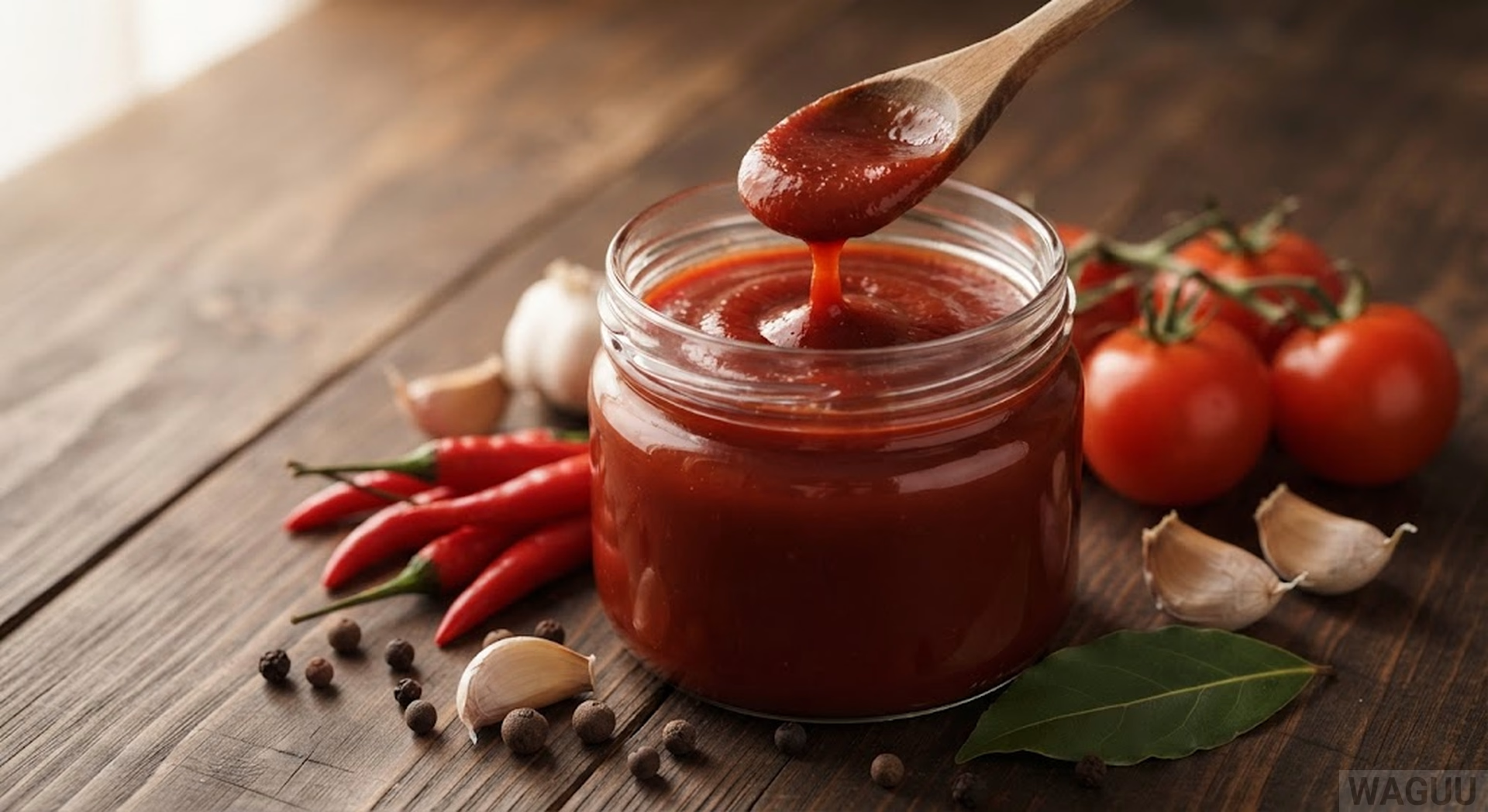
Summary: Homemade spicy chilli ketchup made from ripe tomatoes, fresh chillies, ginger and spices. Slowly reduced, no preservatives. 15 minutes prep, 90 minutes cooking, about 900 ml yield.
Cooked this recipe? Share your result with the community.
Categories: Sauces and Dips, Preserves
Success rate: not rated yet% of users mastered this recipe
Quick overview
- Dish: Spicy Chilli Ketchup
- Category: Sauces and Dips, Preserves
- Cuisine: International
- Main ingredient: Ripe tomatoes (meaty, San Marzano type), 1500 g
- Total time: 105 minutes (15 min prep + 90 min cooking)
- Difficulty: Easy
- Servings: 6 (Portion weight: 150 g, yield ~900 ml)
- Key technique: Reduction and passing
- Preparation types: Simmering, reduction, preserving
- Dietary info & Allergens: Gluten-free, lactose-free, vegan
- Suitable for: Grilling, burgers, cheese, roast meat
- Nutrition (per serving): 118 kcal, Protein: 1.8 g, Fat: 3.8 g, Carbs: 19 g
- Storage: 3 weeks in the fridge, 12 months in the freezer (or 12 months in jars after canning)
- Pairing: Pale ale, dry cider, homemade lemonade
- In short: Spicy ketchup from fresh tomatoes and chillies, slow reduction, no preservatives.
- Last updated: 19 September 2026
WAGUU says: “Ketchup does not have to be made from concentrate. From good tomatoes, a splash of vinegar and chillies you can make, in an hour, something no bottle will ever give you.”
Key facts
| Prep time: | 15 minutes |
| Cook time: | 90 minutes |
| Temperature: | Medium heat (95–98 °C) |
| Servings: | 6 (yield ~900 ml) |
At a glance
Thick, deep-red ketchup with balanced acidity, natural tomato sweetness and clean chilli heat. Deeper than shop-bought, without corn syrup or artificial flavourings.
Ingredients
Base servings: 6 • Portion weight: 150 g
| Ingredient | Amount | Quality |
|---|---|---|
| Tomatoes | 1500 g | Ripe, meaty, San Marzano type |
| Onion | 200 g | Brown onions, medium size |
| Fresh red chillies | 60 g | Cayenne or habanero, 4–5 pieces |
| Garlic | 5 cloves | Fresh |
| Fresh ginger | 20 g | Fresh, peeled |
| Brown sugar | 120 g | Muscovado or demerara |
| Cider vinegar | 200 ml | Apple cider vinegar, 5% acidity |
| Olive oil | 30 ml | Extra virgin |
| Sea salt | 15 g | Fine |
| Sweet paprika | 5 g | Hungarian |
| Ground cinnamon | 2 g | Ceylon |
| Cloves | 3 pieces | Whole |
| Black peppercorns | 5 pieces | Whole |
| Allspice berries | 4 pieces | Whole |
| Bay leaf | 1 piece | Dried |
Why you will love this recipe
- No preservatives: Acid from vinegar and sugar is enough to keep ketchup for months. Nothing else belongs in the jar.
- You control the heat: The amount of chilli and whether you remove the seeds determines how hot the ketchup is. From mildly spicy to seriously hot.
- Versatile: Works on burgers, grilled meat, cheese, eggs, and as a marinade. One base, many uses.
Why it works: Slow reduction at 95–98 °C removes excess water and concentrates the tomato flavour. The acid from the vinegar lowers the pH below 4.2, which slows bacterial growth and brightens the natural sweetness of the tomatoes. Sugar not only sweetens but, combined with tomato pectin, creates a thick texture without added thickeners.
Recipe overview
Prep: 15 min | Cook: 90 min | Difficulty: Easy | Servings: 6 | Type: Sauce | Origin: International
Detailed method
Overall progress: 0% done
Phase 1: Preparing the ingredients – 15 min
Equipment: Chopping board, knife, 4 l pot
1. Wash the tomatoes, remove the stems and cut into quarters. Peel the onion and chop finely. Remove the stems from the chillies, halve them and remove the seeds for a milder version or leave them in for a hotter one. Peel the garlic and ginger and slice.
VCP: Tomatoes cut into equal-sized pieces, chilli seeds removed according to chosen heat.
Before you continue:
Never chop chillies with bare hands. Wear gloves or wash your hands thoroughly afterwards – capsaicin transfers to mucous membranes and causes a burning sensation.
Phase 2: Sautéing onion and spices – 8 min
Equipment: 4 l pot, wooden spoon
2. Heat the olive oil in a pot over medium heat. Add the chopped onion and sauté for 5–6 minutes until soft and starting to turn golden. Add the sweet paprika, cinnamon, cloves, peppercorns, allspice and bay leaf. Sauté for 1 minute until the spices release their aroma.
VCP: Onion is translucent and golden, spices smell fragrant but are not burnt.
Before you continue:
Sweet paprika burns at too high a temperature and turns bitter. Sauté it only briefly and never increase the heat.
Phase 3: Simmering tomatoes with chillies – 30 min
Equipment: 4 l pot, lid
3. Add the chopped tomatoes, chillies, garlic and ginger. Stir, cover with a lid and simmer over low heat for 30 minutes. Stir occasionally so the tomatoes do not stick to the bottom.
VCP: Tomatoes are completely soft, have released their juice and merged with the onion into a thick mixture.
Before you continue:
If the mixture is boiling too vigorously, lower the heat. Tomatoes should simmer, not boil. A rolling boil breaks down the texture and the ketchup loses its gloss.
Phase 4: Adding vinegar and sugar, cooking down – 25 min
Equipment: 4 l pot
4. Add the brown sugar, cider vinegar and sea salt. Stir and cook uncovered for 25 minutes over low heat. Stir occasionally. The mixture should only bubble gently.
VCP: Volume reduces by about a third, mixture thickens, flavour is balanced – sweet, sour, salty.
Before you continue:
Do not increase the heat to speed things up. Sugar starts to scorch at high temperatures and the ketchup takes on a bitter taste.
Phase 5: Blending and passing – 10 min
Equipment: Blender or stick blender, fine sieve, second bowl
5. Remove the bay leaf and whole spices (cloves, peppercorns, allspice). Blend the mixture until smooth. Push it through a fine sieve into a clean bowl to remove tomato seeds and skin remnants.
VCP: Ketchup is smooth, no lumps, thick like double cream.
Before you continue:
If you push the ketchup through a sieve, do not return the contents to the pan. They contain tough skins and seeds that would ruin the texture.
Phase 6: Reducing and filling – 15 min
Equipment: Clean pot, sterilised jars, lids, thermometer
6. Return the ketchup to a clean pot and reduce over low heat for 8–10 minutes until it reaches the desired thickness. Pour the hot ketchup (above 85 °C) into sterilised jars, close immediately with a lid and turn upside down for 10 minutes. Leave to cool.
VCP: Ketchup coats the back of a spoon, holds its shape. Lids “pop” when cooled – firmly sealed.
Required equipment
| Item | Ideal size | Alternative | Risk |
|---|---|---|---|
| Heavy-based pot | 4 litres | Stainless steel pot | Thin-based pot scorches the sugar |
| Blender or stick blender | Min. 800 W | Food processor | A weak blender will not handle the thick mixture |
| Fine sieve | 20 cm diameter | Cheesecloth | A coarse sieve lets seeds through |
| Sterilised jars | 3 × 300 ml | Smaller jars | Unsterilised jars shorten shelf life |
Shopping list
Nutritional profile
Values per 1 serving (150 g). Calculated from average nutritional values of the ingredients.
| Nutrient | Per 100 g | Per 1 serving | Per 6 servings |
|---|---|---|---|
| Energy | 79 kcal | 118 kcal | 708 kcal |
| Fat | 2.5 g | 3.8 g | 22.8 g |
| of which saturates | 0.4 g | 0.6 g | 3.6 g |
| Carbohydrates | 12.7 g | 19 g | 114 g |
| of which sugars | 10.5 g | 15.8 g | 94.8 g |
| Protein | 1.2 g | 1.8 g | 10.8 g |
| Salt | 1.1 g | 1.65 g | 9.9 g |
Reference intake of an average adult (8400 kJ / 2000 kcal).
WAGUU Pro level
- Pro standard: Verified recipe with precise ratios and visual control points.
- Tip 1: For a thicker ketchup, use San Marzano tomatoes. They have less water and more pectin than standard round tomatoes.
- Tip 2: If you want a hotter ketchup, leave the seeds and white pith in the chillies. That is where capsaicin is most concentrated.
- Tip 3: Taste the ketchup 24 hours after filling. The flavour develops and balances – freshly made it tastes hotter than it will after resting.
- Tip 4: To sterilise jars, use an oven at 120 °C for 15 minutes. Dip the lids in boiling water for 5 minutes.
Scientific background
Tomatoes contain pectin and glutamate, which are released during slow cooking and naturally thicken the ketchup. The acid from the vinegar lowers the pH below 4.2 – the threshold below which Clostridium botulinum bacteria do not multiply in an acidic environment. Sugar participates in Maillard reactions during reduction and gives the ketchup a darker colour and caramel notes. Capsaicin from chillies is lipophilic – it binds to fats, which is why the heat disperses better in oil than in water.
Fine Dining – Professional techniques
- Plate composition: Serve the ketchup in a small ceramic ramekin alongside a burger or grilled meat. For fine dining, make a “dot” of ketchup on the plate and draw it out with a palette knife.
- Texture contrasts: Pair thick ketchup with crunchy elements – toasted baguette, beetroot crisps or crispy bacon.
- Temperature contrast: Serve the ketchup at room temperature, not ice-cold. Cold ketchup suppresses the tomato flavour.
- Aromatic additions: Before serving, add a drop of smoked paprika or a few drops of truffle oil.
Sensory radar
- Appearance: Deep red, glossy, smooth without lumps.
- Aroma: Tomatoes with a hint of vinegar, chilli and spice.
- Taste: Sweet and sour, pronounced tomato, with slowly developing chilli heat.
- Texture: Thick, coating, without graininess.
Pairing
- BEER: Pale ale, American pale ale, dry cider.
- WINE: Dry rosé, light red (Beaujolais), dry Riesling.
- SOFT DRINK: Homemade lemonade, iced tea, water with lemon.
Preparation variations
- Smoked chilli ketchup: Smoke the tomatoes over wood chips for 30 minutes before cooking. It gains smoky notes that suit meat.
- Mango-chilli ketchup: Replace 300 g of tomatoes with 300 g of mango. Sweeter, fruitier, ideal for fish.
- Extra hot (Ghost Pepper): Replace standard chillies with bhut jolokia. The heat rises sharply – wear gloves.
Allergens and dietary information
Contains: – (none of the main 14 allergens) • Gluten: None • Not suitable for: – (suitable for vegans, gluten-free, lactose-free)
Suitable for
Grilling, burgers, fried food, cheese, eggs, roast meat, vegetable fritters, chip dip, marinade.
Substitution catalogue
- Cider vinegar: Wine vinegar, white wine vinegar (milder flavour).
- Brown sugar: Demerara, honey (reduce by 20 %), maple syrup.
- Fresh tomatoes: Good-quality tinned peeled tomatoes (in their own juice, not syrup).
- Habanero: Cayenne, jalapeño (milder) or serrano (medium heat).
FAQ
How long does the ketchup keep?
Filled into sterilised jars and sealed, it keeps for 12 months in a dark, cool place. Once opened, store in the fridge and use within 3 weeks.
The ketchup is too thin. What can I do?
Return it to the pot and reduce over low heat for another 10–15 minutes. Thickness increases as water evaporates. Do not add starch – it changes the texture.
Can I water-bath the ketchup?
Yes, but it is not necessary. The ketchup is acidic enough (pH below 4.2) and hot-filled (above 85 °C). For extra safety, submerge the filled jars in a water bath at 90 °C for 15 minutes.
The ketchup is too hot. How can I tone down the heat?
Add more cooked tomatoes (200–300 g) and simmer briefly. Or add 1–2 tablespoons of cream or yogurt when serving – capsaicin binds to fat and the heat is reduced.
WAGUU Petr advises: Cooking for 6 or more?
6–8 people: Double the recipe. Use a larger pot (6 l) and reduce for 10 minutes longer. 10+ people: Triple the recipe and work in two pots. Reduce the ketchup gradually so it does not scorch.
Recommended dishes
Storage and reheating
Fridge: 21 days (once opened) • Freezer: 12 months • Reheating: Ketchup is served cold or at room temperature. You can warm it briefly in a water bath before serving, but it will lose some of its fresh flavour.
Author: WAGUU Petr & Team • Published: 19 Sep 2026
More recipes you might like
Why WAGUU?
Recipes on WAGUU go through checks for ingredient accuracy, method and nutritional values.
Photo gallery from the process
Community photos: Cook, photograph and share your result.
You can upload photos in the comments below or send them by email.
Shot a video of our recipe? Post the link to YouTube, YouTube Shorts, TikTok, Instagram Reels, Facebook Reels, Pinterest, Vimeo or X (Twitter) in the comments – we will gladly share it.
Most common mistakes
- Chopping chillies without gloves – capsaicin transfers to your hands and causes a burning sensation if you touch your face.
- Boiling too vigorously – the ketchup scorches, turns bitter and loses its gloss.
- Insufficient jar sterilisation – the ketchup moulds or ferments even with the right recipe.
- Underestimating the reduction – thin ketchup dilutes the flavour of the food and does not cling to a spoon.