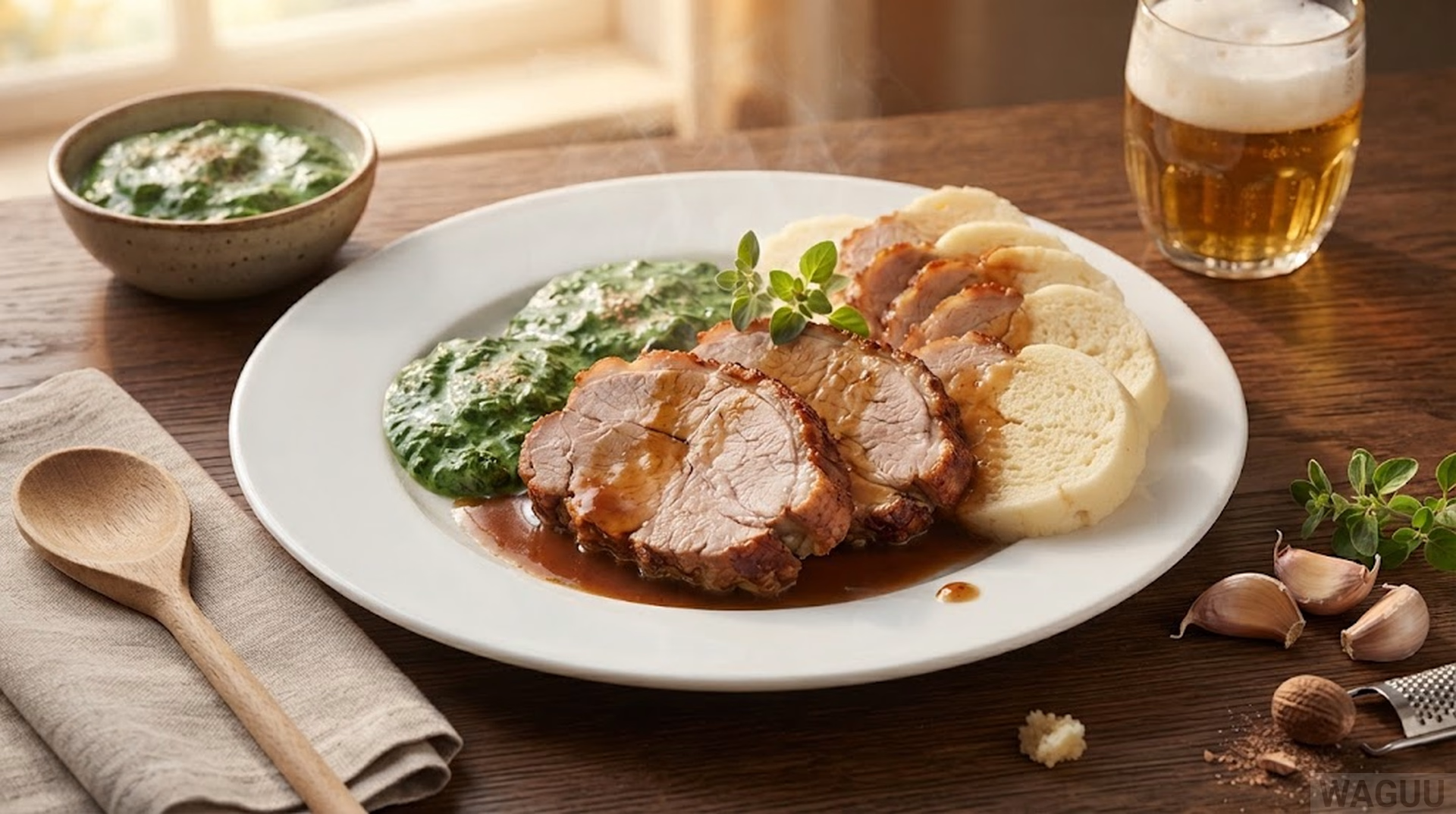
Summary: Pork loin rubbed with garlic and roasted at 180 °C, served with creamy spinach and bread dumplings. Ready in 2 hours, serves 6.
Cooked this recipe? Share your result with the community.
Category: Pork, Czech Cuisine
Success rate: not rated yet % of users mastered this recipe
Quick overview
- Dish: Garlic Roast Pork with Spinach and Dumplings
- Category: Pork, Czech Cuisine
- Cuisine: Czech
- Main ingredient: Pork loin, 1200 g (boneless, tied)
- Guide: 20 Most Famous Czech Dishes
- Total time: 120 minutes (20 min preparation + 100 min cooking)
- Difficulty: Easy
- Servings: 6 (Portion weight: 380 g)
- Key technique: Roasting
- Preparation types: Roasting, simmering, steaming
- Dietary info & allergens: Contains gluten, dairy, eggs
- Suitable for: Sunday lunch, family dinners, everyday cooking
- Nutritional values (per serving): 640 kcal, Protein: 46 g, Fat: 32 g, Carbohydrates: 42 g
- Storage: 3 days in the fridge, 3 months in the freezer
- Pairing: Pilsner, light red wine, apple juice
- In short: Pork loin roasted with garlic until golden, served with creamy spinach and soft bread dumplings.
- Last updated: 18 September 2026
WAGUU says: “Pork with spinach is the quiet cousin of roast pork with cabbage. It is lighter, faster and works on any day of the week.”
Key facts
| Preparation time: | 20 minutes |
| Cooking time: | 100 minutes |
| Temperature: | 180 °C (oven) |
| Servings: | 6 |
At a glance
Pork loin rubbed with crushed garlic and roasted until golden, served with creamy spinach and soft bread dumplings. Lighter than classic roast pork, but just as satisfying.
Ingredients
Base servings: 6 • Portion weight: 380 g
| Ingredient | Amount | Quality |
|---|---|---|
| Pork loin | 1200 g | boneless, tied, thin layer of fat |
| Garlic | 8 cloves | fresh, peeled, crushed |
| Ground caraway | 1 tsp | ground |
| Fine sea salt | 2 tsp | fine |
| Black pepper | 0.5 tsp | freshly ground |
| Pork lard | 40 g | or beef dripping |
| Onions | 2 pieces | brown, medium, sliced |
| Beef stock | 300 ml | good quality |
| Fresh spinach | 900 g | washed, thick stems removed |
| Onion (for spinach) | 1 piece | brown, medium, finely chopped |
| Garlic (for spinach) | 3 cloves | fresh, peeled, crushed |
| Butter (for spinach) | 40 g | unsalted |
| Plain flour (for spinach) | 30 g | fine |
| Double cream | 200 ml | 33–36% fat |
| Whole milk | 100 ml | whole |
| Nutmeg | 1 pinch | freshly grated |
| Plain flour (for dumplings) | 500 g | strong white bread flour |
| Milk (for dumplings) | 250 ml | whole |
| Eggs (for dumplings) | 2 pieces | large, room temperature |
| Stale bread rolls | 3 pieces | day-old, cubed |
| Dried yeast | 7 g | fast-action |
| Caster sugar (for dumplings) | 1 tsp | fine |
| Fine sea salt (for dumplings) | 1 tsp | fine |
Why you will love this recipe
- Faster than classic roast pork: Loin cooks in 90 minutes instead of 2.5 hours, and the spinach comes together in 15 minutes.
- Two garlic moments: Garlic on the pork and garlic in the spinach. The two work together – one roasted, one fresh.
- Three components, one kitchen: The pork roasts, the spinach simmers and the dumplings steam. All at the same time, without stress.
Why it works: Roasting the loin at 180 °C cooks the meat evenly without drying it out. The garlic and caraway form a crust that keeps the surface moist. The spinach is blanched first, then finished with a light roux and cream – this stops it from releasing water into the sauce. Nutmeg cuts through the cream and lifts the spinach, which would otherwise taste flat.
Recipe overview
Preparation: 20 min | Cooking: 100 min | Difficulty: Easy | Servings: 6 | Type: Main course | Origin: Czech
Detailed method
Total progress: 0 % done
Phase 1: Preparation – 20 min
Equipment: Chopping board, sharp knife, small bowl, roasting tin
1. Take the pork out of the fridge 30 minutes before cooking. Pat it dry with kitchen paper. Mix the crushed garlic with the ground caraway, salt and pepper. Rub this mixture all over the pork, pressing it into the surface. Slice the onions into rings and scatter them in the roasting tin.
VKB: The pork is coated evenly with the garlic mixture. The onions are in an even layer in the tin, not piled up.
Before you continue:
Do not wash the pork. Washing spreads bacteria and prevents the surface from catching colour in the oven. Pat it dry instead.
Phase 2: Roasting – 90 min
Equipment: Roasting tin (30 × 22 cm), meat thermometer, baster
2. Preheat the oven to 180 °C. Heat the lard in a large pan over medium-high heat and brown the pork on all sides for 5 minutes. Transfer it to the roasting tin on top of the onions. Pour the beef stock around the meat. Roast for 90 minutes, basting every 30 minutes. The pork is done when the internal temperature reaches 68 °C and the juices run clear.
VKB: The pork is deep golden on the outside and still juicy inside. The internal temperature reads 68 °C. The onions are soft and caramelised around the meat.
Before you continue:
Do not let the loin go past 70 °C. Above that, it dries out quickly. Check the temperature 10 minutes before the end of cooking.
Phase 3: Spinach base – 15 min
Equipment: Large pot, colander, medium saucepan, wooden spoon
3. While the pork roasts, bring a large pot of salted water to the boil. Add the spinach and blanch for 2 minutes. Drain immediately and plunge into cold water to stop the cooking. Squeeze the spinach dry with your hands – this is important, otherwise the sauce will be watery. Chop it roughly. Heat the butter in a medium saucepan, add the chopped onion and cook for 5 minutes until soft. Add the crushed garlic and cook for 30 seconds. Add the flour and cook for 1 minute, stirring constantly.
VKB: The spinach is dark green and squeezed dry. The roux is pale golden and smells nutty, not raw.
Before you continue:
Squeeze the spinach really well. If you skip this step, the water will thin the sauce and no amount of flour will fix it.
Phase 4: Creamy spinach – 10 min
Equipment: Same saucepan, whisk, measuring jug
4. Pour the milk into the roux gradually, whisking constantly to prevent lumps. Add the double cream and simmer gently for 3 minutes. Add the chopped spinach, stir well and cook for another 3 minutes. Season with salt, pepper and a pinch of freshly grated nutmeg. The sauce should be thick enough to hold its shape on a spoon.
VKB: The spinach is creamy, deep green and holds its shape on a spoon. It tastes of garlic and nutmeg, not of raw flour.
Before you continue:
Add the nutmeg last and only a pinch. Too much turns the spinach bitter and overwhelms the garlic.
Phase 5: Bread dumplings – 60 min
Equipment: Large mixing bowl, clean tea towel, large pot, string
5. Warm the milk to lukewarm. In a large bowl, mix the flour, yeast, sugar and salt. Add the warm milk and eggs and mix into a soft dough. Knead for 5 minutes until smooth and elastic. Fold in the cubed bread rolls. Cover with a tea towel and leave to rise in a warm place for 45 minutes, until doubled in size. Shape into two logs about 20 cm long. Tie each log tightly in a clean tea towel. Bring a large pot of water to a gentle simmer and cook the dumplings for 20 minutes, turning once halfway through.
VKB: The dough has doubled in size. The cooked dumplings feel firm and spring back when pressed gently. A skewer inserted in the centre comes out clean.
Before you continue:
Never boil the dumplings vigorously. If the water bubbles too hard, they will crack. Keep it at a gentle simmer.
Phase 6: Resting and slicing – 15 min
Equipment: Carving board, sharp knife, serving plates, foil
6. Take the pork out of the oven and rest it on a carving board for 15 minutes, loosely covered with foil. Meanwhile, slice the dumplings into 2 cm thick rounds. Slice the pork into 1 cm thick portions. Serve with a generous spoonful of creamy spinach, two dumpling rounds and a spoonful of the pan juices.
VKB: The pork slices are juicy and pale pink in the centre. The spinach is thick and glossy. The dumplings are soft with visible pieces of bread.
Required equipment
| Equipment | Ideal size | Alternative | Risk |
|---|---|---|---|
| Roasting tin | 30 × 22 cm | Large baking dish | Too small = juices overflow |
| Meat thermometer | Digital, instant-read | Skewer test | Without one, loin dries out |
| Colander | 24 cm | Sieve | Too fine = spinach sticks |
| Clean tea towel | 40 × 40 cm, cotton | Muslin cloth | Synthetic cloth will melt |
Shopping list
Nutritional profile
Values per serving (with dumplings and spinach). Calculated from average nutritional values of ingredients.
| Nutrient | Per 100 g | Per serving | Per 6 servings |
|---|---|---|---|
| Energy | 168 kcal | 640 kcal | 3840 kcal |
| Fat | 8.4 g | 32 g | 192 g |
| of which saturated | 3.4 g | 13 g | 78 g |
| Carbohydrates | 11 g | 42 g | 252 g |
| of which sugars | 2.2 g | 8 g | 48 g |
| Protein | 12.1 g | 46 g | 276 g |
| Salt | 0.4 g | 1.7 g | 10.2 g |
Reference intake of an average adult (8400 kJ / 2000 kcal).
WAGUU Pro level
- Pro standard: Tested recipe with exact ratios and visual control points.
- Tip 1: Tie the loin with kitchen string if your butcher has not done it. It keeps the meat in a uniform shape so it cooks evenly.
- Tip 2: Push some of the garlic mixture under the fat layer. The fat carries the aroma into the meat from the inside.
- Tip 3: Use frozen spinach if you are short on time. Thaw it and squeeze it dry – the result is nearly identical.
- Tip 4: Add a tablespoon of the pork pan juices to the spinach just before serving. It ties the two together.
Scientific background
Pork loin is a lean cut, so it cooks faster than shoulder or belly but dries out more easily. The internal temperature of 68 °C is the point where the muscle fibres have contracted enough to be safe but have not yet squeezed out all their moisture. The garlic and caraway crust slows evaporation from the surface and adds aromatic compounds that dissolve into the fat layer. Spinach contains oxalic acid, which is why it is blanched first – the boiling water leaches out the acid, leaving the spinach milder and less chalky. The nutmeg in the cream sauce contains myristicin, an aromatic compound that intensifies the perception of creaminess.
Fine Dining – Professional techniques
- Plate composition: Place two slices of pork in the centre, spoon the creamy spinach alongside, and lean two dumpling rounds against the meat.
- Texture contrasts: The soft pork contrasts with the creamy spinach and the fluffy dumplings.
- Temperature contrast: Serve the pork hot, the spinach hot, the dumplings hot. This dish is best served all at once.
- Aromatic additions: A few crispy fried onion strands on top of the spinach for a textural lift.
Sensory radar
- Appearance: Golden pork, deep green spinach, white dumplings
- Aroma: Roasted garlic, nutmeg, sweet cream, caraway
- Taste: Savoury pork, creamy spinach, gentle garlic, hint of nutmeg
- Texture: Juicy pork, silky spinach, soft dumplings
Pairing
- BEER: Pilsner Urquell or a wheat beer
- WINE: Light red – Pinot Noir or Zweigelt
- SOFT DRINK: Sparkling water with lemon or apple juice
Other preparation variations
- Pork shoulder version: Replace loin with shoulder and increase cooking time to 2 hours. The meat is more flavourful but less uniform.
- Creamed spinach with blue cheese: Add 80 g of crumbled blue cheese to the spinach at the end. It adds saltiness and depth.
Allergens and dietary information
Contains: Gluten, dairy, eggs • Gluten: Yes (dumplings, roux) • Not suitable for: Coeliac disease, lactose intolerance (without substitutions)
Suitable for
Sunday lunch, family dinners, everyday cooking, midweek meals
Substitution catalogue
- Pork loin: Pork neck or shoulder (longer cooking, richer flavour)
- Fresh spinach: Frozen spinach (thaw and squeeze dry)
- Double cream: Crème fraîche or lactose-free cream
- Pork lard: Beef dripping or sunflower oil
FAQ
Can I use pork shoulder instead of loin?
Yes. Shoulder is more flavourful and forgiving, but it needs to cook longer – about 2 hours at 170 °C. Loin is faster and gives cleaner slices.
Can I use frozen spinach?
Yes. Thaw it, squeeze it dry and use it in place of fresh spinach. You will need about 700 g of frozen spinach for 900 g fresh. The result is nearly identical.
Why does my spinach taste chalky?
It was not blanched long enough. Oxalic acid in spinach causes the chalky taste. Blanching for 2 minutes and draining well removes most of it.
Can I make this gluten-free?
Yes. Use gluten-free flour for the roux and gluten-free bread or cornstarch-based dumplings. The pork and spinach are naturally gluten-free.
WAGUU Petr advises: Cooking for 6 or more?
6–8 people: Use a 1.6 kg loin and increase the spinach to 1.2 kg. Keep the dumpling quantities the same. 10+ people: Roast two smaller loins instead of one large one. They cook faster and slice more cleanly.
Storage and reheating
Fridge: 3 days • Freezer: 2 months (pork and spinach separately) • Reheating: Reheat the pork in a covered dish at 160 °C for 15 minutes. Reheat the spinach gently on the hob, adding a splash of milk if it thickens too much. Reheat the dumplings by steaming for 5 minutes.
Author: WAGUU Petr & Team • Published: 18 Sep 2026
More recipes from this article
Guide: 20 Most Famous Czech Dishes
Roast Pork with Dumplings and Sauerkraut
More recipes you might like
Why WAGUU?
Recipes on WAGUU are checked for accuracy of ingredients, methods and nutritional values.
Photo gallery from the process
Photos from the community: Cook, take a photo and share your result.
You can upload photos in the comments below or send them by email.
Have you filmed a video of our recipe? Post a link to YouTube, YouTube Shorts, TikTok, Instagram Reels, Facebook Reels, Pinterest, Vimeo or X (Twitter) in the comments – we will gladly publish it and help promote you and your content.
Most common mistakes
- Overcooking the loin – above 70 °C it dries out fast. Use a thermometer and check at 60 minutes.
- Not squeezing the spinach – wet spinach thins the sauce. Squeeze it with your hands until it stops dripping.
- Too much nutmeg – a pinch lifts the spinach, half a teaspoon ruins it. Add less than you think you need.
- Boiling the dumplings – vigorous boiling cracks them. Keep the water at a gentle simmer.