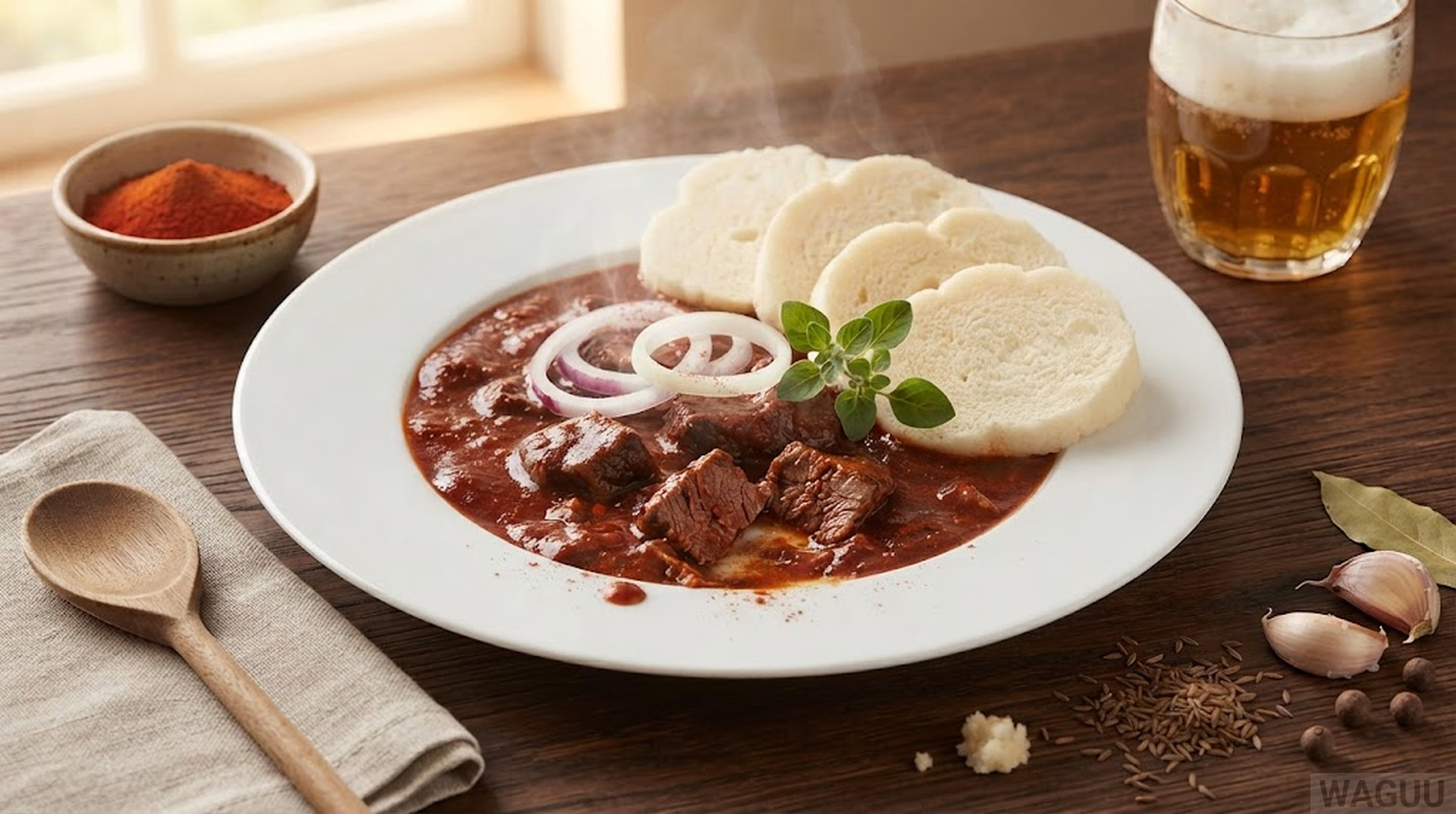
Summary: Beef chuck slow-simmered at low heat with onions, sweet paprika and a touch of vinegar, served with bread dumplings. Ready in 3 hours, serves 6.
Cooked this recipe? Share your result with the community.
Category: Beef, Czech Cuisine
Success rate: not rated yet % of users mastered this recipe
Quick overview
- Dish: Czech Goulash
- Category: Beef, Czech Cuisine
- Cuisine: Czech
- Main ingredient: Beef chuck, 1200 g (well-marbled, cut into 3 cm cubes)
- Guide: 20 Most Famous Czech Dishes
- Total time: 180 minutes (20 min preparation + 160 min cooking)
- Difficulty: Easy
- Servings: 6 (Portion weight: 400 g)
- Key technique: Slow simmering
- Preparation types: Braising, simmering
- Dietary info & allergens: Contains gluten, dairy, eggs
- Suitable for: Sunday lunch, family gatherings, everyday cooking
- Nutritional values (per serving): 650 kcal, Protein: 45 g, Fat: 30 g, Carbohydrates: 48 g
- Storage: 3 days in the fridge, 3 months in the freezer
- Pairing: Pilsner, dark lager, light red wine
- In short: Beef cubes simmered for three hours with onions and paprika until the sauce is thick, glossy and deep red.
- Last updated: 18 September 2026
WAGUU says: “Czech goulash is not a soup. It is a sauce with meat in it. The onions and paprika do the work – you just need to wait.”
Key facts
| Preparation time: | 20 minutes |
| Cooking time: | 160 minutes |
| Temperature: | Low simmer (95 °C on the hob) |
| Servings: | 6 |
At a glance
Beef chuck simmered with a large amount of onions and sweet paprika until the meat falls apart and the sauce turns thick and dark red. Served with bread dumplings that soak up every drop.
Ingredients
Base servings: 6 • Portion weight: 400 g
| Ingredient | Amount | Quality |
|---|---|---|
| Beef chuck | 1200 g | well-marbled, cut into 3 cm cubes |
| Onions | 600 g | brown, medium, finely chopped |
| Pork lard | 60 g | or beef dripping |
| Sweet paprika | 3 tbsp | Hungarian, fresh |
| Garlic | 4 cloves | fresh, peeled, crushed |
| Tomato purée | 2 tbsp | good quality |
| Beef stock | 800 ml | good quality |
| Red wine vinegar | 1 tbsp | good quality |
| Caraway seeds | 1 tsp | whole |
| Bay leaves | 2 pieces | dried |
| Marjoram | 1 tsp | dried |
| Fine sea salt | 2 tsp | fine |
| Black peppercorns | 6 pieces | whole |
| Plain flour (for dumplings) | 500 g | strong white bread flour |
| Milk (for dumplings) | 250 ml | whole |
| Eggs (for dumplings) | 2 pieces | large, room temperature |
| Stale bread rolls | 3 pieces | day-old, cubed |
| Dried yeast | 7 g | fast-action |
| Caster sugar (for dumplings) | 1 tsp | fine |
| Fine sea salt (for dumplings) | 1 tsp | fine |
Why you will love this recipe
- Five ingredients do the work: Beef, onions, paprika, garlic and vinegar. The rest is time.
- One pot, no fuss: Everything simmers in a single casserole dish. Stir every 20 minutes and let the hob do the rest.
- Better on day two: The sauce thickens and the paprika deepens overnight. Reheat gently on the hob.
Why it works: The large amount of onions (half the weight of the meat) melts down into a natural sauce. The sweet paprika is added off the heat so it does not burn – burnt paprika turns bitter. The vinegar at the end lifts the heaviness and balances the fat. Three hours of gentle simmering breaks down the beef’s collagen into gelatine, which gives the sauce its body.
Recipe overview
Preparation: 20 min | Cooking: 160 min | Difficulty: Easy | Servings: 6 | Type: Main course | Origin: Czech
Detailed method
Total progress: 0 % done
Phase 1: Preparation – 20 min
Equipment: Chopping board, sharp knife, kitchen paper
1. Pat the beef cubes dry with kitchen paper. Do not wash them. Season lightly with fine sea salt. Peel the onions and chop them finely – they should be about the same size as the beef cubes so they melt into the sauce. Peel and crush the garlic cloves.
VKB: The beef is dry to the touch and the onions are chopped into even, small pieces about the size of a peppercorn.
Before you continue:
Chop the onions finer than for a normal stew. They are the sauce, not just a flavour base. Large pieces will not melt down.
Phase 2: Browning the meat – 15 min
Equipment: Large heavy-bottomed casserole dish (28–30 cm), tongs
2. Heat the lard in the casserole dish over medium-high heat. Add the beef cubes in a single layer – work in two batches if needed. Brown them on all sides for about 8 minutes per batch. Remove the meat and set it aside. Do not crowd the pan.
VKB: The beef cubes are deep brown on all sides. The bottom of the pan has a brown crust (fond), but nothing is burnt.
Before you continue:
Do not overcrowd the pan. If the cubes touch each other, they steam instead of browning. Brown in two batches.
Phase 3: Onion base – 20 min
Equipment: Same casserole dish, wooden spoon
3. Add the chopped onions to the casserole dish with the remaining fat. Cook over medium heat for 15–20 minutes, stirring often, until the onions are soft, golden and slightly sticky. Scrape the brown crust off the bottom of the pan with a wooden spoon – that is where the flavour lives. Add the crushed garlic and cook for 1 minute.
VKB: The onions are soft, glossy and deep golden. The bottom of the pan is clean. The kitchen smells sweet, not sharp.
Before you continue:
Do not rush the onions. Pale onions mean pale goulash. They need the full 15–20 minutes to develop their sweetness.
Phase 4: Paprika and simmering – 120 min
Equipment: Casserole dish with lid, wooden spoon
4. Take the pan off the heat completely. Add the sweet paprika and stir it into the onions – the residual heat is enough. If you add paprika over direct heat, it burns in seconds and turns bitter. Return the beef to the pan along with the tomato purée, caraway seeds, bay leaves, marjoram and peppercorns. Pour in the beef stock – it should just cover the meat. Bring to a gentle simmer, cover and cook on the lowest heat for 2 hours. Stir every 20 minutes.
VKB: The sauce is dark red and glossy. The beef cubes are fork-tender – a fork slides in with almost no resistance. The liquid has reduced by about a third.
Before you continue:
Never let the goulash boil. A rolling boil makes the meat tough. Keep it at a lazy simmer with the lid on.
Phase 5: Bread dumplings – 60 min
Equipment: Large mixing bowl, clean tea towel, large pot, string
5. Warm the milk to lukewarm. In a large bowl, mix the flour, yeast, sugar and salt. Add the warm milk and eggs and mix into a soft dough. Knead for 5 minutes until smooth and elastic. Fold in the cubed bread rolls. Cover with a tea towel and leave to rise in a warm place for 45 minutes, until doubled in size. Shape into two logs about 20 cm long. Tie each log tightly in a clean tea towel. Bring a large pot of water to a gentle simmer and cook the dumplings for 20 minutes, turning once halfway through.
VKB: The dough has doubled in size. The cooked dumplings feel firm and spring back when pressed gently. A skewer inserted in the centre comes out clean.
Before you continue:
Never boil the dumplings vigorously. If the water bubbles too hard, they will crack. Keep it at a gentle simmer.
Phase 6: Finishing – 5 min
Equipment: Small bowl, knife, serving plates
6. Stir the red wine vinegar into the goulash and taste. Add more salt if needed. Remove the bay leaves and peppercorns. Meanwhile, slice the dumplings into 2 cm thick rounds. Serve the goulash in warm bowls with the dumplings on the side.
VKB: The sauce is thick enough to coat the meat but still flows off a spoon. The vinegar is present but not sharp. The dumplings are soft with visible pieces of bread.
Required equipment
| Equipment | Ideal size | Alternative | Risk |
|---|---|---|---|
| Heavy casserole dish | 28–30 cm, with lid | Dutch oven | Thin pans burn the onions |
| Wooden spoon | 30 cm | Silicone spatula | Metal spoon scratches the pan |
| Clean tea towel | 40 × 40 cm, cotton | Muslin cloth | Synthetic cloth will melt |
| Large pot | 5 litres | Wide saucepan | Too small = dumplings break |
Shopping list
Nutritional profile
Values per serving (with dumplings). Calculated from average nutritional values of ingredients.
| Nutrient | Per 100 g | Per serving | Per 6 servings |
|---|---|---|---|
| Energy | 163 kcal | 650 kcal | 3900 kcal |
| Fat | 7.5 g | 30 g | 180 g |
| of which saturated | 2.7 g | 11 g | 66 g |
| Carbohydrates | 12 g | 48 g | 288 g |
| of which sugars | 2.8 g | 11 g | 66 g |
| Protein | 11.3 g | 45 g | 270 g |
| Salt | 0.5 g | 2 g | 12 g |
Reference intake of an average adult (8400 kJ / 2000 kcal).
WAGUU Pro level
- Pro standard: Tested recipe with exact ratios and visual control points.
- Tip 1: Use onions and meat in a 1:2 ratio by weight. That is what makes the sauce thick without flour.
- Tip 2: Add the paprika off the heat. Burnt paprika ruins the whole pot.
- Tip 3: Cook the goulash the day before. The flavour deepens overnight and the fat rises to the top, so you can skim it off easily.
- Tip 4: If the sauce is too thin, take the lid off for the last 20 minutes and reduce it. Do not add flour.
Scientific background
The colour and flavour of Czech goulash come from the pigments in sweet paprika – mainly capsanthin and capsorubin. These are fat-soluble, which is why the paprika is stirred into the onions and fat rather than into the liquid. The onions break down into a natural thickener: their pectin and sugars melt during long cooking and form a sauce without flour. The beef’s collagen, when simmered at 95 °C for two hours, converts into gelatine, which adds body and a glossy sheen to the sauce.
Fine Dining – Professional techniques
- Plate composition: Spoon the goulash into a shallow bowl, place two dumpling rounds on the side, and add a small spoonful of sour cream on top.
- Texture contrasts: The tender meat and thick sauce contrast with the light, airy dumplings.
- Temperature contrast: Serve the goulash hot, the sour cream cold from the fridge.
- Aromatic additions: A pinch of fresh marjoram or a strip of lemon zest over the top before serving.
Sensory radar
- Appearance: Deep red-brown sauce, glossy, with visible chunks of beef
- Aroma: Sweet paprika, onions, caraway, marjoram
- Taste: Rich, sweet from the onions, mild heat from the paprika, tangy from the vinegar
- Texture: Tender beef, thick sauce, light dumplings
Pairing
- BEER: Pilsner Urquell or a dark lager like Kozel Černý
- WINE: Light red – Kékfrankos or Blaufränkisch
- SOFT DRINK: Sparkling water or a light apple juice
Other preparation variations
- Dark beer version: Replace 200 ml of the stock with dark lager. The beer adds depth and a slight bitterness.
- Slow cooker version: Brown the meat and onions first, then cook on low for 6–8 hours. Add the paprika in the last hour to keep its colour bright.
Allergens and dietary information
Contains: Gluten, dairy, eggs (in dumplings) • Gluten: Yes • Not suitable for: Coeliac disease, lactose intolerance (without substitutions)
Suitable for
Sunday lunch, family gatherings, everyday cooking, meal prep
Substitution catalogue
- Beef chuck: Beef shin or brisket (longer cooking, deeper flavour)
- Pork lard: Beef dripping or sunflower oil
- Sweet paprika: Half sweet, half hot paprika for a spicier version
- Red wine vinegar: Apple cider vinegar or lemon juice
FAQ
What is the difference between Czech and Hungarian goulash?
Czech goulash is thicker and served with bread dumplings as a main course. Hungarian goulash is more like a soup and is served with bread. Czech goulash also uses more onions and often includes caraway.
Can I use a slow cooker?
Yes. Brown the meat and onions first, then transfer everything to the slow cooker and cook on low for 6–8 hours. Add the paprika in the last hour to preserve its colour.
My goulash is too thin. How do I fix it?
Take the lid off for the last 20 minutes and let it reduce. Do not add flour – the onions are the thickener. If it is still thin, mash some of the onions against the side of the pan.
Can I freeze goulash?
Yes. Freeze it without the dumplings for up to 3 months. Reheat gently on the hob, adding a splash of stock if needed.
WAGUU Petr advises: Cooking for 6 or more?
6–8 people: Increase the meat and onions by 25%. Keep the paprika the same – too much paprika makes the goulash bitter. 10+ people: Double the recipe and cook in two dishes. Do not overcrowd the casserole dish.
Storage and reheating
Fridge: 3 days • Freezer: 3 months (without dumplings) • Reheating: Gently on the hob, adding a splash of stock or water if the sauce has thickened too much.
Author: WAGUU Petr & Team • Published: 18 Sep 2026
More recipes from this article
Guide: 20 Most Famous Czech Dishes
Roast Pork with Dumplings and Sauerkraut
Garlic Roast Pork with Spinach and Dumplings
More recipes you might like
Why WAGUU?
Recipes on WAGUU are checked for accuracy of ingredients, methods and nutritional values.
Photo gallery from the process
Photos from the community: Cook, take a photo and share your result.
You can upload photos in the comments below or send them by email.
Have you filmed a video of our recipe? Post a link to YouTube, YouTube Shorts, TikTok, Instagram Reels, Facebook Reels, Pinterest, Vimeo or X (Twitter) in the comments – we will gladly publish it and help promote you and your content.
Most common mistakes
- Burning the paprika – add it off the heat. Burnt paprika turns the whole pot bitter and nothing can fix it.
- Not enough onions – onions are the sauce, not a flavour base. Use half the weight of the meat.
- Boiling instead of simmering – a rolling boil makes the meat tough. Keep it at a lazy simmer for the full 2 hours.
- Skipping the vinegar – the vinegar lifts the heaviness and balances the fat. Without it, the goulash tastes flat.