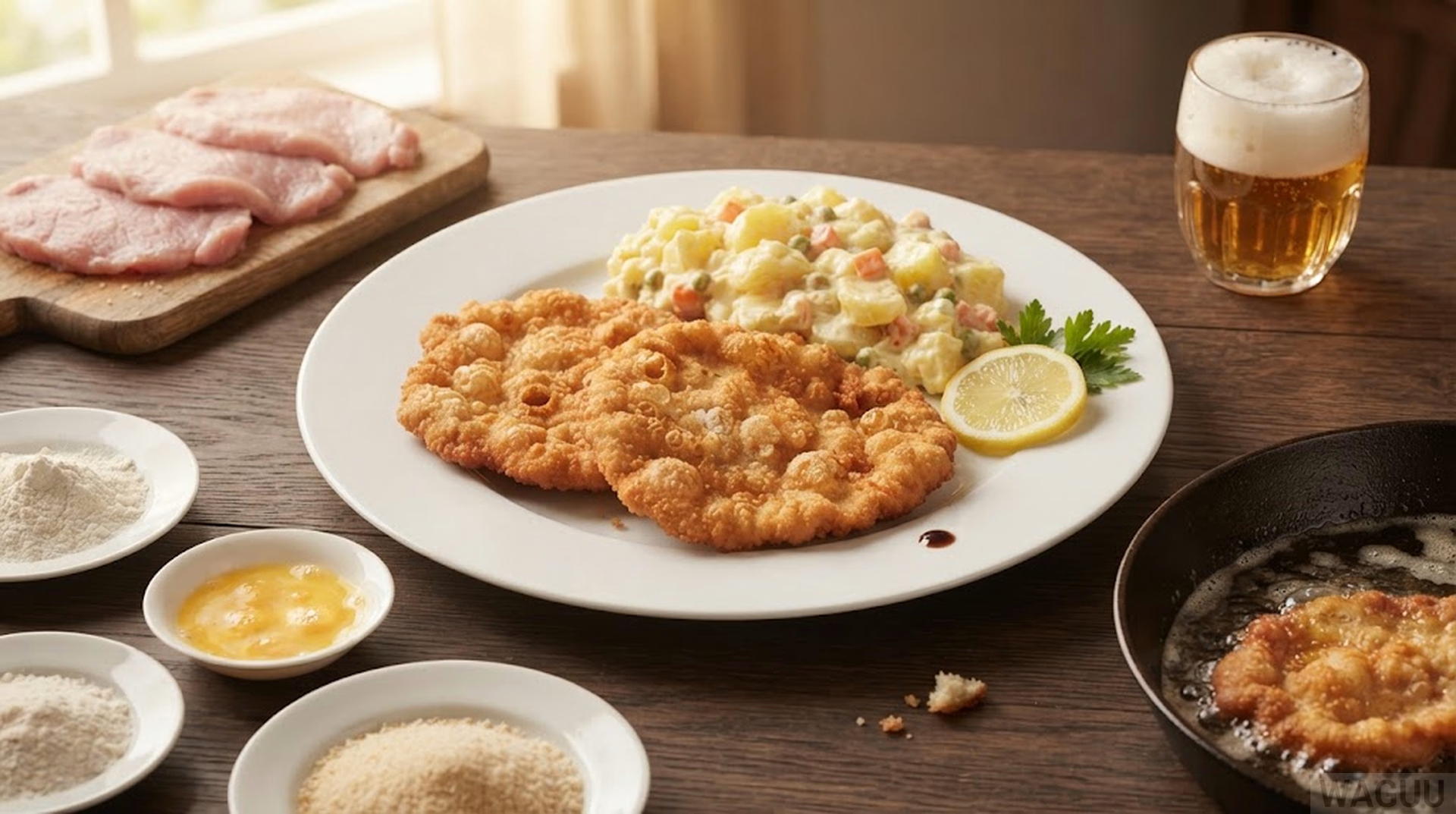
Summary: Pork loin steaks pounded thin, breaded in flour, egg and breadcrumbs, then shallow-fried at 170 °C until the crust is golden and puffed. Ready in 40 minutes, serves 6.
Cooked this recipe? Share your result with the community.
Category: Pork, Czech Cuisine
Success rate: not rated yet % of users mastered this recipe
Quick overview
- Dish: Fried Schnitzel (Smažený řízek)
- Category: Pork, Czech Cuisine
- Cuisine: Czech
- Main ingredient: Pork loin, 900 g (boneless, cut into 6 steaks)
- Guide: 20 Most Famous Czech Dishes
- Total time: 40 minutes (25 min preparation + 15 min frying)
- Difficulty: Easy
- Servings: 6 (Portion weight: 350 g)
- Key technique: Breaded shallow frying
- Preparation types: Frying
- Dietary info & allergens: Contains gluten, dairy, eggs
- Suitable for: Sunday lunch, everyday cooking, family dinners, parties
- Nutritional values (per serving): 620 kcal, Protein: 42 g, Fat: 32 g, Carbohydrates: 38 g
- Storage: 1 day in the fridge • Freezer: 1 month
- Pairing: Pilsner, dry white wine, sparkling water
- In short: A thin, tender pork steak in a golden breaded crust, puffed at the edges and crisp at the first bite.
- Last updated: 18 September 2026
WAGUU says: “A good schnitzel is not about the meat. It is about the crust. If the crust puffs at the edges and crackles when you cut it, you have done it right.”
Key facts
| Preparation time: | 25 minutes |
| Cooking time: | 15 minutes |
| Temperature: | 170 °C oil |
| Servings: | 6 |
At a glance
Pork loin steaks pounded to 6 mm, breaded in flour, egg and breadcrumbs, and fried in a thin layer of oil until the crust turns deep gold and puffs up at the edges. Served with potato salad or mashed potatoes and a lemon wedge.
Ingredients
Base servings: 6 • Portion weight: 350 g
| Ingredient | Amount | Quality |
|---|---|---|
| Pork loin | 900 g | boneless, cut into 6 steaks, pounded to 6 mm |
| Plain flour | 100 g | fine |
| Eggs | 3 pieces | large, beaten with 2 tbsp milk |
| Whole milk | 2 tbsp | for the egg wash |
| Breadcrumbs | 250 g | fine, dry, not panko |
| Fine sea salt | 2 tsp | fine |
| Black pepper | 0.5 tsp | freshly ground |
| Sunflower oil | 300 ml | for shallow frying, or pork lard |
| Potatoes | 1000 g | floury, for mashed potatoes |
| Butter | 80 g | unsalted, for the mash |
| Whole milk (for mash) | 150 ml | warm |
| Lemons | 1 piece | cut into 6 wedges, for serving |
| Fresh parsley | 10 g | fresh, chopped, for the mash |
Why you will love this recipe
- Ready in 40 minutes: Pounding, breading and frying take less time than a pot of goulash. This is a weekday dish in a household that knows what it is doing.
- Two textures in one bite: The crust crackles and puffs, the meat inside stays tender. A good schnitzel is defined by that contrast.
- One method, many meats: The same breading and frying works for chicken, turkey, veal or even cheese. Learn it once and use it for years.
Why it works: Pounding the meat to 6 mm does two things: it breaks the muscle fibres so the steak cooks in minutes, and it gives a flat, even surface for the breading to stick. The three-step breading – flour, egg wash, breadcrumbs – is what creates the puffed crust: when the egg wash hits the hot oil, the water inside it turns to steam and pushes the crust up from the meat. That is the puff you see at the edges. Frying at 170 °C sets the crust in seconds, which is why the breadcrumbs stay crisp instead of soaking up oil.
Recipe overview
Preparation: 25 min | Cooking: 15 min | Difficulty: Easy | Servings: 6 | Type: Main course | Origin: Czech
Detailed method
Total progress: 0 % done
Phase 1: Pounding the meat – 15 min
Equipment: Chopping board, meat mallet or heavy rolling pin, cling film, kitchen paper
1. Cut the pork loin into 6 steaks of equal thickness, about 150 g each. Place each steak between two sheets of cling film or inside a folded piece of baking paper. Pound it with the flat side of a meat mallet or a heavy rolling pin, working from the centre outwards, until it is 6 mm thick and evenly flat. Pat each pounded steak dry with kitchen paper and season lightly with salt and pepper on both sides.
VKB: Each steak is 6 mm thick and evenly flat. No thin spots and no thick patches. The steak is dry to the touch and holds its shape when lifted.
Before you continue:
Pound the meat between cling film or baking paper, not directly on the board. Without protection, the meat tears, the fibres break unevenly, and the juices spray across the kitchen.
Phase 2: Breading – 10 min
Equipment: Three shallow bowls, fork, plate
2. Arrange three shallow bowls in a line from left to right: one with plain flour, one with the beaten eggs mixed with 2 tablespoons of milk, and one with breadcrumbs. Take each steak through the three steps: first coat it in flour and shake off the excess; then dip it in the egg wash so every surface is covered; finally press it into the breadcrumbs on both sides. Use one hand for the dry steps (flour, breadcrumbs) and one for the wet step (egg wash). Place the breaded steaks on a plate in a single layer and let them rest for 5 minutes before frying.
VKB: The breadcrumbs form a complete, even coat with no bare patches. The steaks do not stick to each other on the plate. Some breadcrumbs have stuck to the plate – that is normal.
Before you continue:
Do not press the breadcrumbs too hard into the meat. If you press them, the crust becomes compact and stops puffing in the oil. A light press is enough – the crust forms in the pan, not in your hands.
Phase 3: Heating the oil – 3 min
Equipment: Large heavy frying pan (28 cm), kitchen thermometer
3. Pour the sunflower oil into a large frying pan to a depth of about 1.5 cm. Heat over medium heat until the oil reaches 170 °C. If you do not have a thermometer, drop a breadcrumb into the oil – it should sizzle gently and rise to the surface within 2 seconds. If it sizzles hard and browns immediately, take the pan off the heat for 30 seconds. If nothing happens, wait another minute.
VKB: The breadcrumb sizzles gently and rises within 2 seconds. The oil shimmers but does not smoke. The surface of the oil is calm, not bubbling.
Before you continue:
Keep the oil at 170 °C throughout frying. If the pan gets too hot, the crust browns before the pork cooks through. If it gets too cold, the crust soaks up oil and turns greasy.
Phase 4: Frying the schnitzels – 12 min
Equipment: Frying pan, two forks or a fish slice, plate lined with kitchen paper
4. Place one or two breaded steaks in the hot oil – do not crowd the pan. Fry for 2–3 minutes on the first side, until the crust is golden and the edges look puffed and curly. Turn carefully with two forks or a fish slice. Fry for another 2 minutes on the second side. The schnitzel is ready when the crust is deep gold on both sides and the edges are crisp. Lift it out with a fish slice and drain on kitchen paper. Keep warm in a low oven at 100 °C while you fry the rest. Between batches, skim loose breadcrumbs from the oil with a slotted spoon – burnt crumbs make the next schnitzel bitter.
VKB: The crust is deep golden on both sides and puffed up along the edges. When you lift the schnitzel with a fork, the crust does not slide off the meat. There is a visible air pocket between the crust and the meat.
Before you continue:
Do not press the schnitzel with a spatula while it fries. Pressing pushes the crust into the meat and stops the puff from forming. Let the oil do its work.
Phase 5: Mashed potatoes – 20 min
Equipment: Large pot, potato ricer or masher, small pan
5. Peel the potatoes and cut them into even chunks. Put them in a large pot, cover with cold water, add a teaspoon of salt and bring to a gentle boil. Cook for 15–18 minutes, until a knife slides in with no resistance. Drain and let them steam for 2 minutes to release excess moisture. Warm the milk and melt the butter in it. Rice or mash the potatoes, then add the warm milk and butter mixture gradually, stirring with a wooden spoon. Do not use a food processor – the blades turn the potatoes into a gluey paste. Stir in the fresh chopped parsley and season with salt and a pinch of nutmeg.
VKB: The mash is smooth, creamy and holds a soft peak on the spoon. It tastes of butter and milk, not of water. The parsley is evenly distributed.
Before you continue:
Never use a food processor or a blender for mashed potatoes. The blades break open the starch cells and release starch into the mash, which turns it gluey in seconds.
Phase 6: Serving – 3 min
Equipment: Warm plates, lemon wedges
6. Place one schnitzel on each warm plate with a generous spoonful of mashed potatoes next to it. Add a wedge of lemon on the side – the juice squeezed over the schnitzel before the first bite is part of the ritual. Serve immediately. A schnitzel that sits and cools loses the crackle in its crust, so eat while it is hot.
VKB: The crust crackles when the fork touches it. The meat inside is pale and juicy. The lemon is cold, the schnitzel is hot, the mash is creamy.
Required equipment
| Equipment | Ideal size | Alternative | Risk |
|---|---|---|---|
| Meat mallet | Flat side, heavy | Rolling pin, heavy pan | Toothing side tears the meat |
| Large frying pan | 28 cm, heavy bottom | Two smaller pans | Thin pans burn the breadcrumbs |
| Kitchen thermometer | Digital, up to 200 °C | Breadcrumb test | Without one, oil temp is guesswork |
| Potato ricer | Standard | Potato masher or fork | Food processor turns mash gluey |
Shopping list
Nutritional profile
Values per serving (with mashed potatoes). Calculated from average nutritional values of ingredients.
| Nutrient | Per 100 g | Per serving | Per 6 servings |
|---|---|---|---|
| Energy | 177 kcal | 620 kcal | 3720 kcal |
| Fat | 9.1 g | 32 g | 192 g |
| of which saturated | 3.4 g | 12 g | 72 g |
| Carbohydrates | 10.9 g | 38 g | 228 g |
| of which sugars | 1.7 g | 6 g | 36 g |
| Protein | 12 g | 42 g | 252 g |
| Salt | 0.7 g | 2.4 g | 14.4 g |
Reference intake of an average adult (8400 kJ / 2000 kcal).
WAGUU Pro level
- Pro standard: Tested recipe with exact ratios and visual control points.
- Tip 1: Use a mix of sunflower oil and pork lard (50/50). The lard gives the crust a deeper flavour and helps it puff better.
- Tip 2: After breading, rest the schnitzels for 10 minutes in the fridge. The cold egg wash delays the crust from setting too fast in the pan and gives a thicker, more even puff.
- Tip 3: Add a teaspoon of sweet paprika to the breadcrumbs. It gives the crust a warmer golden colour without changing the taste.
- Tip 4: For a lighter, crisper crust, replace half the breadcrumbs with panko. Purists will object, but the result is unmistakably crisper.
Scientific background
The puffed crust on a schnitzel comes from the water in the egg wash turning into steam. When the breaded schnitzel hits the hot oil, the water inside the egg layer boils in seconds. The steam cannot escape through the crust, so it pushes the breadcrumbs up away from the meat, creating the visible air pocket along the edges. If the meat has not been pounded flat, the steam escapes unevenly and the crust stays flat. This is why pounding the meat to 6 mm matters – it is not only about tenderness, it is about the crust. The oil temperature is equally important: at 170 °C the crust sets faster than the meat cooks, so the schnitzel cooks from the outside in and the crust stays crisp. At lower temperatures the crust absorbs oil and turns greasy; at higher temperatures it burns before the pork is cooked through.
Fine Dining – Professional techniques
- Plate composition: Place the schnitzel slightly off-centre, with the mashed potatoes fanned next to it and a lemon wedge on the opposite side. Do not cover the schnitzel with sauce – it should sit on top of the plate, not under anything.
- Texture contrasts: The crisp crust contrasts with the soft mash and the cold lemon. Every bite should have both textures.
- Temperature contrast: Serve the schnitzel hot and the lemon cold from the fridge. The cold juice on the hot crust is the point.
- Aromatic additions: A small sprig of fresh parsley on the mash, and a few drops of lemon juice on the schnitzel just before the first bite.
Sensory radar
- Appearance: Deep golden crust, puffed and curly at the edges, pale meat visible where the crust has cracked
- Aroma: Fried breadcrumbs, butter, mild pork, fresh lemon
- Taste: Salty, savoury, mild from the pork, tangy from the lemon
- Texture: Crisp crust, tender meat, creamy mash, cool lemon
Pairing
- BEER: Pilsner Urquell or Budvar
- WINE: Dry white – Riesling or Grüner Veltliner
- SOFT DRINK: Sparkling water with lemon, or dry cider
Other preparation variations
- Chicken schnitzel: Replace pork loin with chicken breast. Pound to 6 mm and fry for 2 minutes per side. The result is lighter and slightly sweeter.
- Veal schnitzel: Replace pork with veal escalope. This is the original Wiener Schnitzel – the crust is thinner and the meat more delicate.
Allergens and dietary information
Contains: Gluten, dairy, eggs • Gluten: Yes (flour, breadcrumbs) • Not suitable for: Coeliac disease (without substitutions), lactose intolerance
Suitable for
Sunday lunch, everyday cooking, family dinners, parties, birthdays
Substitution catalogue
- Pork loin: Chicken breast, turkey breast, veal escalope or pork leg
- Breadcrumbs: Gluten-free breadcrumbs (with gluten-free flour)
- Sunflower oil: Pork lard or rapeseed oil
- Mashed potatoes: Potato salad (classic Czech pairing), boiled potatoes or chips
FAQ
Why did my crust come off the meat?
The crust slides off when the egg wash was not thick enough or the flour step was skipped. Make sure the egg wash includes a splash of milk and coats every surface, and always flour the meat before dipping it in the egg.
Why is the crust not puffing?
Two possible reasons: the meat was not pounded evenly flat, or you pressed the schnitzel with a spatula while frying. Pound the meat to 6 mm and do not press it in the pan.
Why is my schnitzel greasy?
The oil was too cold. Below 160 °C, the crust absorbs fat instead of sealing. Keep the oil at 170 °C and fry only one or two schnitzels at a time. If the oil temperature drops, wait a minute before adding the next schnitzel.
Can I make schnitzels ahead of time?
You can bread them up to 4 hours ahead and store them in the fridge in a single layer. Fry them just before serving – reheating turns the crust soft. If you must reheat, use a hot oven at 200 °C for 5 minutes on a baking tray. Do not microwave.
WAGUU Petr advises: Cooking for 6 or more?
6–8 people: Use 1.2 kg of pork loin and fry in two pans at once. Keep the finished schnitzels in a low oven on a wire rack, not on kitchen paper – on paper they go soft at the bottom. 10+ people: Bread the schnitzels in batches and refrigerate. Fry them in three pans. Do not stack the finished schnitzels – one layer only.
Storage and reheating
Fridge: 1 day (best eaten fresh) • Freezer: 1 month (cool completely, then freeze in a single layer) • Reheating: Reheat in a hot oven at 200 °C for 5–6 minutes on a wire rack. Do not microwave – the crust turns soft and the meat rubbery.
Author: WAGUU Petr & Team • Published: 18 Sep 2026
More recipes from this article
Guide: 20 Most Famous Czech Dishes
Roast Pork with Dumplings and Sauerkraut
Garlic Roast Pork with Spinach and Dumplings
More recipes you might like
Why WAGUU?
Recipes on WAGUU are checked for accuracy of ingredients, methods and nutritional values.
Photo gallery from the process
Photos from the community: Cook, take a photo and share your result.
You can upload photos in the comments below or send them by email.
Have you filmed a video of our recipe? Post a link to YouTube, YouTube Shorts, TikTok, Instagram Reels, Facebook Reels, Pinterest, Vimeo or X (Twitter) in the comments – we will gladly publish it and help promote you and your content.
Most common mistakes
- Pounding the meat unevenly – the crust will not puff evenly and parts of the schnitzel will cook faster than others. Pound from the centre outwards until flat.
- Skipping the flour – without flour, the egg slides off the meat and the breadcrumbs will not stick.
- Pressing the schnitzel in the pan – pressing pushes the crust into the meat and stops the puff. Let it fry untouched.
- Oil too cold – the crust absorbs fat and turns greasy. Keep the oil at 170 °C throughout.