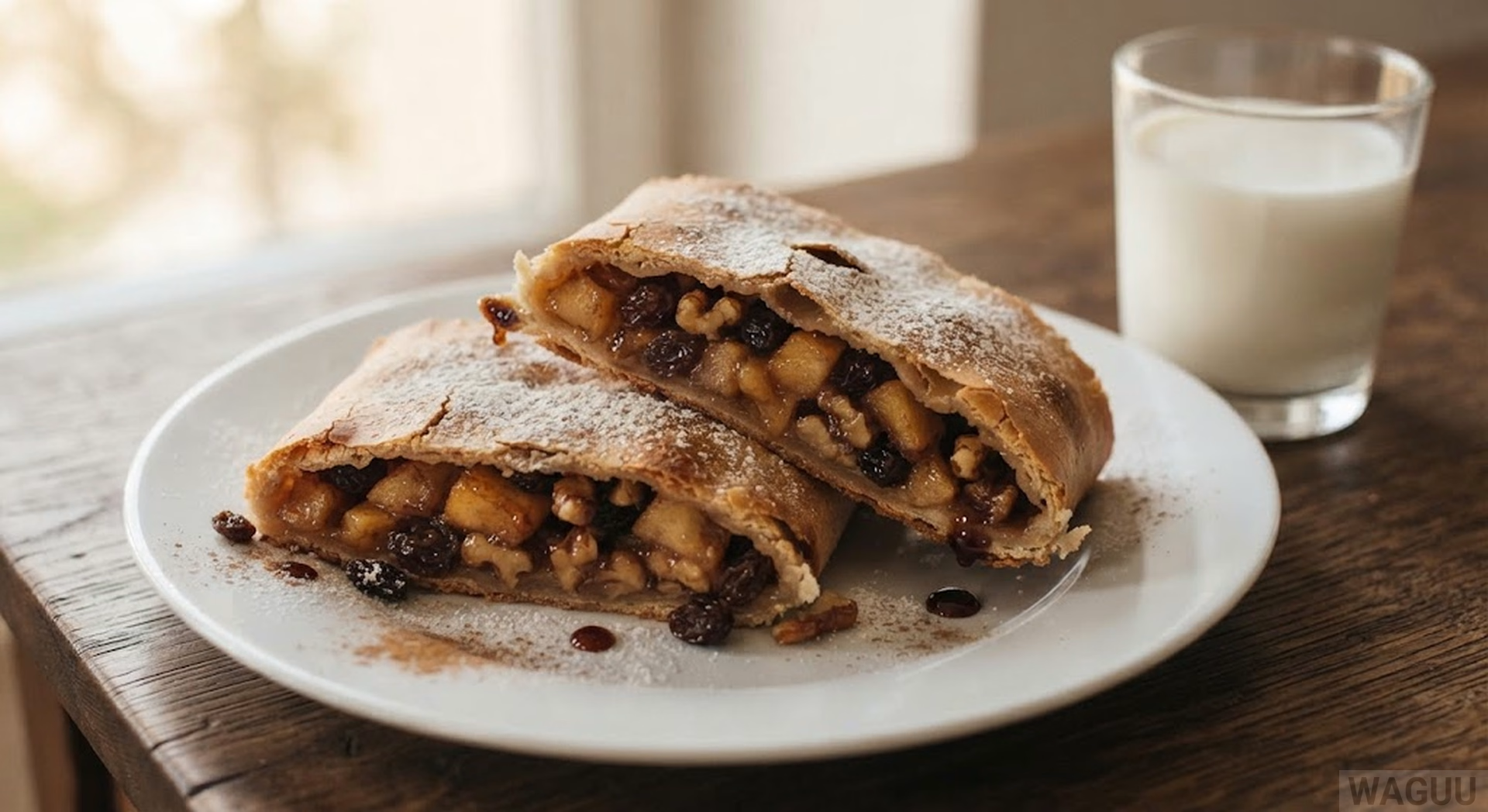
Summary: Stretched dough rolled around apples, cinnamon, raisins and walnuts, baked at 190 °C until golden and crisp. Ready in 2 hours, serves 6.
Cooked this recipe? Share your result with the community.
Category: Desserts, Czech Cuisine
Success rate: not rated yet % of users mastered this recipe
Quick overview
- Dish: Apple Strudel (Jablečný závin)
- Category: Desserts, Czech Cuisine
- Cuisine: Czech
- Main ingredient: Tart apples, 1200 g, and stretched dough
- Guide: 20 Most Famous Czech Dishes
- Total time: 120 minutes (40 min preparation + 30 min resting + 50 min baking)
- Difficulty: Intermediate
- Servings: 6 (2 slices per person)
- Key technique: Stretching dough, baking
- Preparation types: Baking
- Dietary info & allergens: Contains gluten, dairy, eggs, nuts
- Suitable for: Autumn baking, Sunday afternoon coffee, festive desserts, family gatherings
- Nutritional values (per serving): 450 kcal, Protein: 8 g, Fat: 18 g, Carbohydrates: 66 g
- Storage: 3 days at room temperature • Freezer: 1 month
- Pairing: Coffee, warm milk, black tea, vanilla ice cream
- In short: A paper-thin sheet of dough rolled around spiced apples, baked until the top crackles and the inside stays soft.
- Last updated: 18 September 2026
WAGUU says: “Strudel is a test of patience, not skill. The dough wants to be stretched until it is thin enough to read through. If you rush it, it snaps. If you trust it, it holds.”
Key facts
| Preparation time: | 40 minutes |
| Cooking time: | 50 minutes |
| Temperature: | 190 °C (oven) |
| Servings: | 6 |
At a glance
A paper-thin sheet of stretched dough rolled around a filling of grated apples, sugar, cinnamon, raisins and ground walnuts. Baked until the surface crackles under the knife and the inside steams when you cut it. Dusted with icing sugar and served warm.
Ingredients
Base servings: 6 • 2 strudels, 6 slices each
| Ingredient | Amount | Quality |
|---|---|---|
| Strong white bread flour | 500 g | for the dough |
| Warm water | 250 ml | lukewarm |
| Sunflower oil | 60 ml | for the dough |
| White wine vinegar | 1 tbsp | good quality |
| Fine sea salt | 0.5 tsp | fine |
| Egg | 1 piece | large, beaten, for the dough |
| Tart apples | 1200 g | Bramley or Granny Smith |
| Caster sugar | 120 g | fine |
| Ground cinnamon | 2 tsp | ground |
| Raisins | 100 g | soaked in rum or warm water |
| Ground walnuts | 100 g | freshly ground |
| Breadcrumbs | 80 g | fine, dry |
| Butter | 60 g | unsalted, melted |
| Lemon juice | 1 tbsp | fresh |
| Butter (for brushing) | 50 g | melted, for the tops |
| Icing sugar | 3 tbsp | for dusting |
Why you will love this recipe
- One dough, endless fillings: Once you learn to stretch the dough, you can fill it with apples, poppy seeds, curd, cherries or nuts. The technique is the same every time.
- The crust crackles, the inside steams: A good strudel has a paper-thin crust that shatters under the knife and a soft, spiced filling that steams when you cut it. Both happen because of how the dough is stretched.
- Better the same day: Unlike bread, strudel is best on the day it is baked, warm or at room temperature. It does not need time to improve – it starts at its peak.
Why it works: The dough for strudel is a simple mixture of flour, water, oil, vinegar and a little salt – no butter, no sugar. That makes it elastic and easy to stretch. The vinegar relaxes the gluten and helps the dough stretch without tearing. The dough is rested for 30 minutes so the gluten can relax fully, and then it is stretched by hand on a floured cloth until it is thin enough to read a newspaper through. The breadcrumbs are scattered over the stretched dough before the apples – they absorb the juice the apples release during baking and keep the bottom layer of dough from getting soggy. The strudel is rolled loosely, not tightly, so the filling has room to expand and the steam can escape through the gaps at the ends.
Recipe overview
Preparation: 40 min | Cooking: 50 min | Difficulty: Intermediate | Servings: 6 | Type: Dessert | Origin: Czech
Detailed method
Total progress: 0 % done
Phase 1: Making the dough – 15 min
Equipment: Large mixing bowl, wooden spoon, work surface
1. In a large bowl, mix the flour and salt. Add the warm water, oil, vinegar and beaten egg. Mix with a wooden spoon until a rough dough forms, then turn it out onto a lightly floured surface. Knead for 10 minutes – the dough will be soft, smooth and elastic. It should not stick to your hands after the first few minutes. Shape it into a ball, brush with a little oil and place it back in the bowl.
VKB: The dough is soft, smooth and elastic. When you press it with a finger, the indentation slowly springs back. It does not stick to your hands or the surface.
Before you continue:
Knead for the full 10 minutes. Short kneading leaves the gluten weak and the dough will tear when you try to stretch it. The dough should feel like soft clay, not like bread dough.
Phase 2: Resting the dough – 30 min
Equipment: Bowl, clean tea towel, warm spot
2. Cover the bowl with a clean tea towel and leave the dough to rest for 30 minutes in a warm place, away from draughts. During this time the gluten relaxes and the dough becomes much easier to stretch. Do not skip this step – if you try to stretch the dough straight after kneading, it will snap back and tear.
VKB: The dough has relaxed and feels softer than before. When you press it, it gives way easily without springing back hard.
Before you continue:
Do not rush the rest. Thirty minutes is the minimum. If the dough still snaps back when you pull it, leave it for another 15 minutes.
Phase 3: Preparing the filling – 20 min
Equipment: Large bowl, box grater, small pan, wooden spoon
3. Peel the apples, cut them into quarters and remove the cores. Grate them on the coarse side of a box grater, then squeeze them lightly with your hands to remove some of the juice – not too much, you want the filling moist but not dripping. Put the grated apples in a large bowl and add the sugar, cinnamon, drained raisins, ground walnuts and lemon juice. Stir well. In a small pan, melt the butter and toast the breadcrumbs in it for 2 minutes, until they are pale golden and smell nutty. Take them off the heat and set aside.
VKB: The apples are grated and moist but not dripping. The breadcrumbs are pale golden and smell nutty. The filling tastes sweet, spicy and slightly tangy from the lemon.
Before you continue:
Do not skip toasting the breadcrumbs. Dry breadcrumbs soak up the apple juice and form a barrier between the fruit and the dough. Without this step, the bottom of the strudel turns soggy.
Phase 4: Stretching the dough – 15 min
Equipment: Large clean tablecloth or tea towel, work surface, floured hands
4. Spread a large clean tablecloth on the table and dust it lightly with flour. Place the rested dough in the middle. Flatten it with your hands into a rough rectangle. Now begin to stretch it: slide the backs of your hands under the dough and gently pull it outward from the centre, working your way around the dough. Keep the dough moving – if it sticks, dust with a little flour and lift it. Stretch it until it is paper-thin – you should be able to see the pattern of the cloth through it. If a small tear appears near the edge, do not panic – it will not affect the final strudel. Trim the thick edges with a knife.
VKB: The dough is thin enough that you can read the pattern of the cloth through it. There are no large tears – small holes near the edges are fine. The dough covers an area roughly the size of a small table.
Before you continue:
Do not stretch the dough with your fingertips – the nails will tear it. Use the backs of your hands and let the weight of the dough do most of the stretching work. Patience is what makes the strudel thin.
Phase 5: Filling and rolling – 10 min
Equipment: Pastry brush, sharp knife, baking tray lined with baking paper
5. Brush the stretched dough generously with melted butter. Scatter the toasted breadcrumbs evenly across the entire surface, leaving a 3 cm border all around. Spread the apple filling in a long strip along one of the longer edges, about a third of the way in. Fold the 3 cm border over the filling, then lift the cloth on that side and let the strudel roll over itself – the cloth does the rolling for you. Roll as loosely as you can – a tight roll traps steam and makes the strudel soggy. Cut the finished strudel into two or three shorter pieces. Brush the tops with more melted butter, then transfer them carefully to the baking tray.
VKB: The strudels are rolled loosely, with visible layers of dough. The ends are open and the filling is just visible. The tops are brushed with butter. There are no cracks on the surface.
Before you continue:
Roll the strudel loosely. If you roll it tight, the steam from the apples gets trapped inside and makes the dough soft and heavy. A loose roll lets the steam escape through the open ends.
Phase 6: Baking and serving – 50 min
Equipment: Oven, pastry brush, sharp knife, cooling rack
6. Preheat the oven to 190 °C. Bake the strudels for 40–45 minutes, until the tops are deep golden and the dough crackles when touched. Brush them with melted butter twice during baking – once at 20 minutes and once at 35 minutes. This keeps the crust soft and gives it a glossy finish. Let the strudels cool on a rack for 15 minutes before cutting – if you cut them hot, the filling will run out. Dust with icing sugar and serve warm with a cup of coffee or a scoop of vanilla ice cream.
VKB: The crust is deep golden and crackles under the knife. The filling steams when you cut it. The apple slices are soft but still hold their shape – not turned into a mush.
Required equipment
| Equipment | Ideal size | Alternative | Risk |
|---|---|---|---|
| Large clean tablecloth | 120 × 80 cm, cotton | Large clean bedsheet | Small cloth = dough overlaps |
| Box grater | Standard 4-sided | Food processor | Fine grate = mushy filling |
| Pastry brush | Silicone, 3 cm | Small clean paintbrush | Synthetic bristles melt on hot dough |
| Cooling rack | Wire rack, 40 cm | Clean wooden board | Plate traps steam and softens the crust |
Shopping list
Nutritional profile
Values per serving (2 slices). Calculated from average nutritional values of ingredients.
| Nutrient | Per 100 g | Per serving | Per 6 servings |
|---|---|---|---|
| Energy | 180 kcal | 450 kcal | 2700 kcal |
| Fat | 7.2 g | 18 g | 108 g |
| of which saturated | 3.4 g | 9 g | 54 g |
| Carbohydrates | 26.4 g | 66 g | 396 g |
| of which sugars | 13 g | 33 g | 198 g |
| Protein | 3.2 g | 8 g | 48 g |
| Salt | 0.2 g | 1 g | 6 g |
Reference intake of an average adult (8400 kJ / 2000 kcal).
WAGUU Pro level
- Pro standard: Tested recipe with exact ratios and visual control points.
- Tip 1: Use the cloth to roll the strudel, not your hands. The cloth does the work evenly and prevents the dough from stretching unevenly while you roll.
- Tip 2: Soak the raisins in rum for 20 minutes before adding them. The rum softens the raisins and adds a subtle warmth that works with the cinnamon.
- Tip 3: Brushing the strudel with butter twice during baking is not decoration. It softens the crust slightly and prevents it from cracking.
- Tip 4: If the dough tears during stretching, do not panic. Small tears near the edges will disappear when you roll the strudel. Larger tears can be patched with a piece of dough from the trimmed edges.
Scientific background
Strudel dough is a lean dough – flour, water, oil, vinegar and a little salt. It contains no butter or sugar, which allows the gluten network to form long, elastic strands. The vinegar (acetic acid) lowers the pH of the dough slightly, which relaxes the gluten and makes the dough easier to stretch without tearing. The 30-minute rest lets the gluten hydrate and relax; without it, the dough springs back and tears. During stretching, the gluten network is pulled into a thin sheet – thinner than 1 mm – and the oil keeps the layers of gluten sliding past each other instead of tearing. The breadcrumbs on the dough absorb the juice the apples release during baking (mostly water with dissolved sugars and pectin). Without them, the bottom layer of dough would soak up the juice and turn soggy. The strudel is rolled loosely so steam can escape through the open ends, which keeps the crust crisp. The butter brushed on the surface during baking slows the evaporation of water from the crust and gives it a soft, glossy finish instead of a hard one.
Fine Dining – Professional techniques
- Plate composition: Place two slices of strudel slightly off-centre, dust with icing sugar, and add a small scoop of vanilla ice cream on the side.
- Texture contrasts: The crackling crust contrasts with the soft apples and the cold ice cream.
- Temperature contrast: Serve the strudel warm and the ice cream very cold – the contrast is the whole point of the plate.
- Aromatic additions: A small drizzle of honey over the ice cream, or a few strips of lemon zest on the plate for colour.
Sensory radar
- Appearance: Deep golden crust, slightly glossy from the butter, with visible thin layers
- Aroma: Baked apple, cinnamon, butter, toasted breadcrumbs
- Taste: Sweet-tart from the apples, warm from the cinnamon, nutty from the walnuts
- Texture: Crisp crust, soft apple filling, slight crunch from the walnuts
Pairing
- DRINK: Strong coffee, black tea or warm milk
- WINE: Sweet white – Riesling Auslese or Tokaji
- SOFT DRINK: Hot chocolate or apple juice
Other preparation variations
- Cherry strudel: Replace the apples with 900 g of pitted sour cherries and add 2 extra tablespoons of sugar. Reduce the lemon juice to 1 teaspoon.
- Poppy seed strudel: Replace the apple filling with a poppy seed mixture – 300 g ground poppy seeds, 150 g sugar, 150 ml warm milk and 1 tablespoon of rum.
Allergens and dietary information
Contains: Gluten, dairy, eggs, nuts • Gluten: Yes (flour, breadcrumbs) • Not suitable for: Coeliac disease (without substitutions), lactose intolerance (without substitutions), nut allergies
Suitable for
Autumn baking, Sunday afternoon coffee, festive desserts, family gatherings, Christmas and Easter
Substitution catalogue
- Tart apples: Any firm cooking apple – Granny Smith, Braeburn, Cox
- Ground walnuts: Ground almonds or hazelnuts
- Raisins: Dried cranberries or chopped dried apricots
- Plain flour: Gluten-free flour blend (the dough will be less elastic; use filo pastry instead)
FAQ
My dough keeps tearing when I stretch it. What went wrong?
The dough was not rested long enough, or the gluten was not developed enough during kneading. Knead for a full 10 minutes and rest the dough for at least 30 minutes. If the dough still tears, it may need a little more water – add 1 tablespoon and knead it in.
My strudel is soggy on the bottom. What went wrong?
Two possible reasons: you did not toast the breadcrumbs, or the apples released too much juice. Always toast the breadcrumbs in butter before scattering them on the dough – they form a barrier against the juice. If your apples are very juicy, squeeze them gently before mixing the filling.
Can I use shop-bought filo pastry instead?
Yes, in a hurry. Layer 6–8 sheets of filo, brushing each one with melted butter, and roll the filling inside them. The result is crisper and more fragile but takes 20 minutes instead of 90.
Can I make apple strudel ahead of time?
You can assemble the strudel up to 4 hours ahead and keep it in the fridge, covered with a tea towel. Brush the top with butter before baking. Baked strudel is best on the day it is made, but it can be reheated at 160 °C for 8 minutes on the second day.
WAGUU Petr advises: Cooking for 6 or more?
6–8 people: Use 600 g of flour and 1.5 kg of apples. Make two strudels instead of one – a single very long strudel is hard to handle and does not bake evenly. 10+ people: Double the recipe and bake three or four shorter strudels on two trays. Rotate the trays halfway through baking for even browning.
Storage and reheating
Room temperature: 2 days, loosely covered with a tea towel • Fridge: 3 days in an airtight container • Freezer: 1 month, sliced • Reheating: Reheat in a 160 °C oven for 8 minutes on a baking tray. Do not microwave – the crust turns soft and the filling leaks out.
Author: WAGUU Petr & Team • Published: 18 Sep 2026
More recipes from this article
Guide: 20 Most Famous Czech Dishes
Roast Pork with Dumplings and Sauerkraut
Garlic Roast Pork with Spinach and Dumplings
More recipes you might like
Why WAGUU?
Recipes on WAGUU are checked for accuracy of ingredients, methods and nutritional values.
Photo gallery from the process
Photos from the community: Cook, take a photo and share your result.
You can upload photos in the comments below or send them by email.
Have you filmed a video of our recipe? Post a link to YouTube, YouTube Shorts, TikTok, Instagram Reels, Facebook Reels, Pinterest, Vimeo or X (Twitter) in the comments – we will gladly publish it and help promote you and your content.
Most common mistakes
- Not resting the dough – unrested dough springs back and tears during stretching. Rest it for at least 30 minutes.
- Skipping the breadcrumbs – the apples release juice, which soaks into the dough and makes the bottom soggy. Always toast and scatter the breadcrumbs.
- Rolling too tightly – a tight roll traps steam and turns the crust soft. Roll loosely so steam can escape through the open ends.
- Cutting hot strudel – the filling runs out and the crust crumbles. Let it rest for 15 minutes on a rack before slicing.