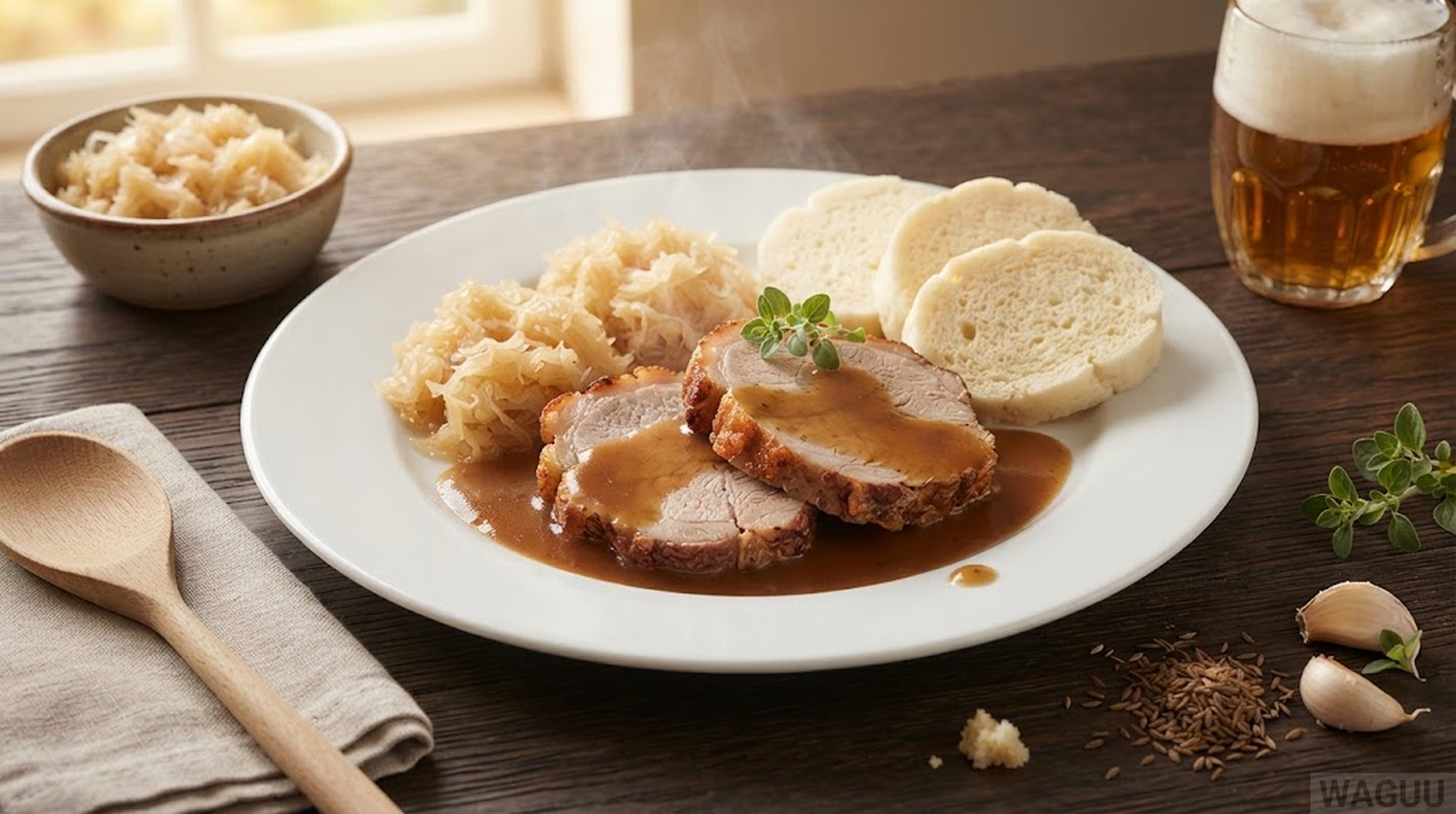
Summary: Pork shoulder rubbed with caraway, garlic and salt, roasted at 220 °C then 160 °C, served with sauerkraut and bread dumplings. Ready in 2.75 hours, serves 6.
Cooked this recipe? Share your result with the community.
Category: Pork, Czech Cuisine
Success rate: not rated yet % of users mastered this recipe
Quick overview
- Dish: Roast Pork with Dumplings and Sauerkraut
- Category: Pork, Czech Cuisine
- Cuisine: Czech
- Main ingredient: Pork shoulder, 1500 g (boneless, skin on)
- Guide: 20 Most Famous Czech Dishes
- Total time: 165 minutes (30 min preparation + 135 min cooking)
- Difficulty: Easy
- Servings: 6 (Portion weight: 420 g)
- Key technique: Roasting
- Preparation types: Roasting, simmering, steaming
- Dietary info & allergens: Contains gluten, dairy, eggs
- Suitable for: Sunday lunch, family gatherings, everyday cooking
- Nutritional values (per serving): 680 kcal, Protein: 48 g, Fat: 32 g, Carbohydrates: 52 g
- Storage: 3 days in the fridge, 3 months in the freezer
- Pairing: Pilsner, light red wine, apple juice
- In short: Pork shoulder roasted until the crackling crackles, served with tangy sauerkraut and bread dumplings.
- Last updated: 18 September 2026
WAGUU says: “Roast pork is not a dish for a hurry. It is a dish for a Sunday afternoon, when the whole house smells of caraway and garlic.”
Key facts
| Preparation time: | 30 minutes |
| Cooking time: | 135 minutes |
| Temperature: | 220 °C then 160 °C (oven) |
| Servings: | 6 |
At a glance
Pork shoulder rubbed with caraway, garlic and salt, roasted low and slow until the crackling crackles and the meat falls apart. Served with tangy sauerkraut and soft bread dumplings that soak up every drop of the juices.
Ingredients
Base servings: 6 • Portion weight: 420 g
| Ingredient | Amount | Quality |
|---|---|---|
| Pork shoulder | 1500 g | boneless, skin on, rind scored |
| Caraway seeds | 2 tsp | whole, fresh |
| Garlic | 6 cloves | fresh, peeled |
| Fine sea salt | 2 tsp | fine |
| Black peppercorns | 6 pieces | whole |
| Onions | 2 pieces | brown, medium |
| Pork lard | 30 g | or beef dripping |
| Beef stock | 400 ml | good quality |
| Sauerkraut | 800 g | drained, mild |
| Onion (for sauerkraut) | 1 piece | brown, medium |
| Caster sugar (for sauerkraut) | 2 tsp | fine |
| Plain flour (for sauerkraut) | 1 tbsp | fine |
| Ground cumin | 0.5 tsp | ground |
| Plain flour (for dumplings) | 500 g | strong white bread flour |
| Milk (for dumplings) | 250 ml | whole |
| Eggs (for dumplings) | 2 pieces | large, room temperature |
| Stale bread rolls | 3 pieces | day-old, cubed |
| Dried yeast | 7 g | fast-action |
| Caster sugar (for dumplings) | 1 tsp | fine |
| Fine sea salt (for dumplings) | 1 tsp | fine |
Why you will love this recipe
- One tin, everything inside: The pork roasts on a bed of onions, the sauerkraut simmers on the hob, and the dumplings steam in a cloth. Three components, one kitchen, no stress.
- Crackling that actually crackles: The two-stage roast dries the rind at 220 °C, then cooks the meat at 160 °C. The result is a crisp top and juicy meat underneath.
- Better on day two: The pork soaks up the pan juices overnight and tastes even richer. Reheat it covered, and refresh the crackling under the grill.
Why it works: The initial roast at 220 °C evaporates water from the rind and starts rendering the fat underneath, which fries the skin from below. The lower roast at 160 °C breaks down the pork’s connective tissue into gelatine, keeping the meat tender. The sauerkraut is simmered with a light roux, which softens its sharpness and gives it body.
Recipe overview
Preparation: 30 min | Cooking: 135 min | Difficulty: Easy | Servings: 6 | Type: Main course | Origin: Czech
Detailed method
Total progress: 0 % done
Phase 1: Preparation – 20 min
Equipment: Chopping board, sharp knife, small bowl, mortar and pestle, roasting tin
1. Take the pork out of the fridge 30 minutes before cooking. Pat the rind dry with kitchen paper. Score the rind in a diamond pattern, cutting just through the skin without piercing the meat. Crush the garlic cloves and mix with the caraway seeds, salt and crushed peppercorns. Rub this mixture into the rind, pressing it into the cuts. Slice the onions into thick rings and place them in the roasting tin.
VKB: The rind is dry to the touch and scored in an even diamond pattern. The garlic and caraway mixture is pressed into the cuts, not just sitting on top.
Before you continue:
Score just through the skin, not into the meat. If you cut too deep, the juices escape and the roast dries out.
Phase 2: Initial roast – 30 min
Equipment: Roasting tin (35 × 25 cm), oven
2. Preheat the oven to 220 °C. Place the pork on top of the onion rings, rind side up. Pour the beef stock into the tin around the meat. Roast for 30 minutes. This high heat dries the skin and starts the crackling.
VKB: The rind is beginning to bubble and turn golden. The stock in the tin is bubbling gently, not evaporating.
Before you continue:
Keep the oven door closed during these 30 minutes. Every time you open it, the temperature drops by about 20 °C and the crackling will not form.
Phase 3: Slow roast – 90 min
Equipment: Roasting tin, meat thermometer, baster or large spoon
3. Reduce the oven temperature to 160 °C. Baste the pork with the pan juices and continue roasting for 90 minutes. Baste every 30 minutes. If the tin dries out, add a splash more stock. The meat is done when the internal temperature reaches 75 °C and the juices run clear when pierced with a skewer.
VKB: The meat is fork-tender and pulls apart easily with two forks. The internal temperature reads 75 °C. The crackling is deep golden brown.
Before you continue:
Never pour stock directly onto the crackling. It will soften the skin and you will lose the crunch. Always pour it into the tin, around the meat.
Phase 4: Sauerkraut – 45 min
Equipment: Medium saucepan, wooden spoon
4. While the pork roasts, drain the sauerkraut and squeeze it lightly. Heat the lard in a medium saucepan and cook the chopped onion until soft and golden. Add the flour and ground cumin and cook for 1 minute. Add the sauerkraut, sugar and 200 ml of water. Stir, cover and simmer gently for 40 minutes. If it becomes too dry, add a splash of water.
VKB: The sauerkraut is soft, glossy and slightly sweet. It tastes tangy but not sharp. The onion is fully softened and no longer raw.
Before you continue:
Do not add salt before tasting. Sauerkraut is already salty. Taste first, then season if needed.
Phase 5: Bread dumplings – 60 min
Equipment: Large mixing bowl, clean tea towel, large pot, string
5. Warm the milk to lukewarm. In a large bowl, mix the flour, yeast, sugar and salt. Add the warm milk and eggs and mix into a soft dough. Knead for 5 minutes until smooth and elastic. Fold in the cubed bread rolls. Cover with a tea towel and leave to rise in a warm place for 45 minutes, until doubled in size. Shape into two logs about 20 cm long. Tie each log tightly in a clean tea towel. Bring a large pot of water to a gentle simmer and cook the dumplings for 20 minutes, turning once halfway through.
VKB: The dough has doubled in size. The cooked dumplings feel firm and spring back when pressed gently. A skewer inserted in the centre comes out clean.
Before you continue:
Never boil the dumplings vigorously. If the water bubbles too hard, they will crack. Keep it at a gentle simmer.
Phase 6: Resting and slicing – 15 min
Equipment: Carving board, sharp knife, serving plates, foil
6. Take the pork out of the oven and rest it on a carving board for 15 minutes, loosely covered with foil. Meanwhile, remove the dumplings from the tea towels and slice them into 2 cm thick rounds. Slice the pork into portions, cutting through the crackling. Serve with the sauerkraut, dumplings and a spoonful of the pan juices.
VKB: The crackling is crisp and shatters when cut. The meat is juicy and slices cleanly. The dumplings are soft with visible pieces of bread.
Required equipment
| Equipment | Ideal size | Alternative | Risk |
|---|---|---|---|
| Roasting tin | 35 × 25 cm | Large baking dish | Too small = juices overflow |
| Meat thermometer | Digital, instant-read | Skewer test | Without one, meat can dry out |
| Clean tea towel | 40 × 40 cm, cotton | Muslin cloth | Synthetic cloth will melt |
| Large pot | 5 litres | Wide saucepan | Too small = dumplings break |
Shopping list
Nutritional profile
Values per serving (with dumplings and sauerkraut). Calculated from average nutritional values of ingredients.
| Nutrient | Per 100 g | Per serving | Per 6 servings |
|---|---|---|---|
| Energy | 162 kcal | 680 kcal | 4080 kcal |
| Fat | 7.6 g | 32 g | 192 g |
| of which saturated | 2.9 g | 12 g | 72 g |
| Carbohydrates | 12.4 g | 52 g | 312 g |
| of which sugars | 2.6 g | 11 g | 66 g |
| Protein | 11.4 g | 48 g | 288 g |
| Salt | 0.5 g | 2.1 g | 12.6 g |
Reference intake of an average adult (8400 kJ / 2000 kcal).
WAGUU Pro level
- Pro standard: Tested recipe with exact ratios and visual control points.
- Tip 1: Dry the rind thoroughly and leave the pork uncovered in the fridge overnight. Dry skin equals crisp crackling.
- Tip 2: Pour a little dark beer into the roasting tin halfway through. It adds depth to the pan juices.
- Tip 3: Add a grated apple to the sauerkraut for natural sweetness. It balances the acidity without sugar.
- Tip 4: Rest the pork for a full 15 minutes before carving. The juices redistribute and the meat stays juicy.
Scientific background
The crackling forms through dehydration and rendering. During the initial roast at 220 °C, water evaporates from the skin and the fat underneath melts, frying the skin from below. The result is a crisp, glassy layer that shatters when cut. Meanwhile, the meat cooks slowly at 160 °C, breaking down collagen into gelatine and keeping the fibres tender. The lactic acid in the sauerkraut softens the cabbage’s cell walls during simmering and interacts with the pork’s fat, which is why the two are traditionally served together.
Fine Dining – Professional techniques
- Plate composition: Place a slice of pork with the crackling facing up in the centre, spoon the sauerkraut alongside, and lean two dumpling rounds against the meat.
- Texture contrasts: The crisp crackling contrasts with the soft dumplings and the tender meat.
- Temperature contrast: Serve the pork hot, the sauerkraut warm, the dumplings hot.
- Aromatic additions: A pinch of fresh marjoram over the sauerkraut before serving.
Sensory radar
- Appearance: Golden crackling, pale meat, amber sauerkraut, white dumplings
- Aroma: Caraway, garlic, roasted pork, tangy cabbage
- Taste: Savoury, tangy, slightly sweet, deeply satisfying
- Texture: Crisp crackling, tender meat, soft dumplings, silky sauerkraut
Pairing
- BEER: Pilsner Urquell or Budvar
- WINE: Light red – Zweigelt or Pinot Noir
- SOFT DRINK: Apple juice or sparkling water
Other preparation variations
- Red cabbage version: Replace sauerkraut with sweet and sour braised red cabbage. Add 2 tbsp red wine vinegar and 1 tbsp sugar.
- Slow cooker version: Brown the meat, then cook on low for 8 hours. Finish the crackling under the grill for 10 minutes.
Allergens and dietary information
Contains: Gluten, dairy, eggs • Gluten: Yes (dumplings) • Not suitable for: Coeliac disease, lactose intolerance
Suitable for
Sunday lunch, family gatherings, festive meals, everyday cooking
Substitution catalogue
- Pork shoulder: Pork belly (more fat, more flavour) or pork loin (leaner, less juicy)
- Sauerkraut: Braised red cabbage or white cabbage with vinegar
- Bread rolls: Any stale white bread or baguette
FAQ
Can I make this with pork loin instead?
Yes, but reduce the cooking time to 60 minutes at 160 °C. Loin is leaner and dries out faster, so baste it more often.
What if my crackling is not crisp?
Turn on the grill for 5–10 minutes at the end of cooking. Watch it closely. If it starts to burn, move the tin lower.
Can I use shop-bought dumplings?
Yes. Ready-made bread dumplings are available in Czech and Polish delis or online. Steam them for 10 minutes before serving.
How do I prevent the sauerkraut from being too sour?
Rinse it briefly under cold water, then squeeze it dry. Add a grated apple or a teaspoon of sugar to balance the acidity.
WAGUU Petr advises: Cooking for 6 or more?
6–8 people: Use a 2 kg pork shoulder and increase the sauerkraut to 1 kg. Keep the dumpling quantities the same. 10+ people: Roast two smaller joints instead of one large one. They cook faster and more evenly.
Storage and reheating
Fridge: 3 days • Freezer: 3 months (without dumplings) • Reheating: Reheat the pork in a covered dish at 160 °C for 15 minutes. Reheat the dumplings by steaming for 5 minutes. Refresh the crackling under the grill for 2 minutes.
Author: WAGUU Petr & Team • Published: 18 Sep 2026
More recipes from this article
Guide: 20 Most Famous Czech Dishes
Garlic Roast Pork with Spinach and Dumplings
More recipes you might like
Why WAGUU?
Recipes on WAGUU are checked for accuracy of ingredients, methods and nutritional values.
Photo gallery from the process
Photos from the community: Cook, take a photo and share your result.
You can upload photos in the comments below or send them by email.
Have you filmed a video of our recipe? Post a link to YouTube, YouTube Shorts, TikTok, Instagram Reels, Facebook Reels, Pinterest, Vimeo or X (Twitter) in the comments – we will gladly publish it and help promote you and your content.
Most common mistakes
- Wet rind – if the skin is wet, it will steam instead of crisping. Dry it thoroughly and leave it uncovered overnight.
- Scoring too deep – cutting into the meat releases juices and dries out the roast. Cut just through the skin.
- Opening the oven – every time you open the door, the temperature drops by about 20 °C. Keep it closed during the initial roast.
- Boiling the dumplings – vigorous boiling cracks the dumplings. Keep the water at a gentle simmer.