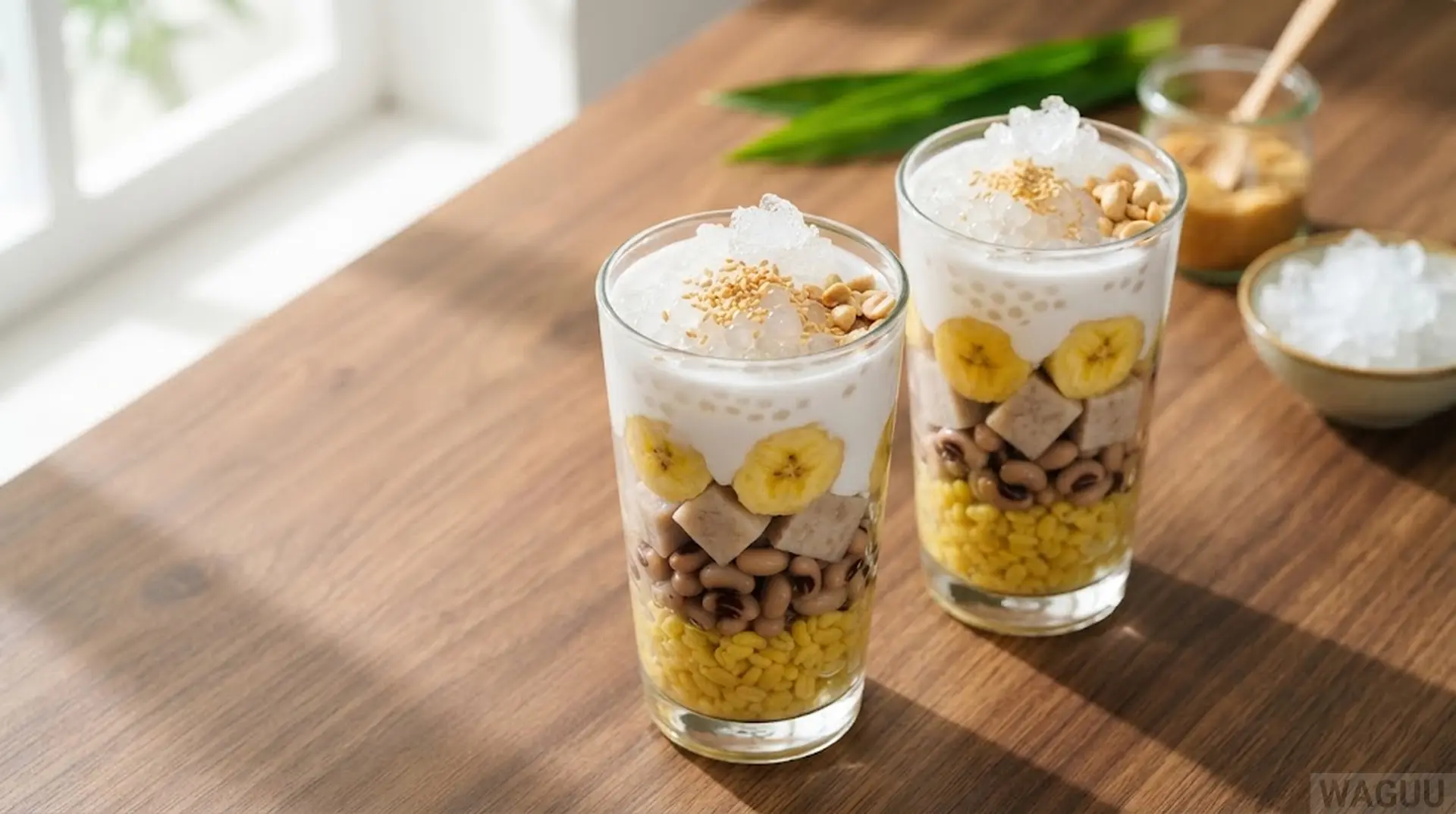
Summary: Vietnamese sweet dessert of mung beans, black-eyed peas and tapioca pearls in coconut milk, flavoured with pandan leaves and palm sugar, served cold with crushed ice. Total time 100 minutes, makes 6 servings.
Have you cooked this recipe? Share your result with the community.
Category: Desserts · Vietnamese Cuisine
Success rate: not rated yet % of users managed this recipe
Quick overview
- Dish: Chè – Vietnamese sweet dessert of beans, tapioca and coconut milk
- Category: desserts, vietnamese-cuisine
- Cuisine: Vietnamese
- Main ingredient: Mung beans, 200 g (split, peeled)
- Guide: 12 most famous Vietnamese dishes: traditional recipes from Vietnamese cuisine
- Total time: 100 minutes (20 min preparation + 80 min cooking)
- Difficulty: Easy
- Servings: 6 (Serving size: 454 g)
- Key technique: Pre-cooking each legume separately and assembling the dessert only in the glass with crushed ice
- Preparation types: Classic boiling, steaming, chilling
- Dietary info & allergens: none of the 14 European allergens in the ingredients
- Suitable for: Summer refreshment, dessert after a family lunch, a sweet finish for a celebration or a snack for children.
- Nutritional values (per 1 serving): 608 kcal, Protein: 12.5 g, Fat: 20.0 g, Carbohydrates: 86.0 g
- Storage: 3 days in the fridge, 1 month in the freezer
- Pairing: jasmine tea, iced green tea, coffee with condensed milk
- In short: Mung beans, black-eyed peas and tapioca pearls in sweetened coconut milk with pandan, served cold with ice. Total time 100 minutes, 6 servings.
WAGUU says: “Chè is not cooked as one soup. Each legume has its own time and they meet only in the glass.”
Key facts
| Preparation time: | 20 minutes |
| Cooking time: | 80 minutes |
| Temperature: | Legumes at 95 °C (below boiling point), coconut milk is not boiled, only warmed through |
| Number of servings: | 6 |
At a glance
Chè is a group of desserts, not one recipe. What they have in common is that the legumes are cooked separately because each needs a different time, and that the sweet mixture is assembled only in the glass. The ratio of sugar to coconut milk matters, and the milk is not boiled, only warmed through. Anyone who cooks all the legumes together or brings the milk to the boil will end up with a mushy porridge with separated fat.
Ingredients
Base servings: 6 servings • Serving size: 454 g
| Ingredient | Amount | Quality |
|---|---|---|
| mung beans | 200 g | split, peeled, no stones |
| black-eyed peas | 150 g | dried, whole, no debris |
| tapioca pearls | 120 g | white, average 5 mm |
| coconut milk | 400 ml | full-fat, no sugar or emulsifiers |
| palm sugar | 150 g | dark, coarse, for sweetening |
| pandan leaf | 4 pcs | fresh leaves, tied into a knot |
| taro | 200 g | tuber, peeled, cut into 2 cm cubes |
| banana | 2 pcs | firm, slightly unripe, sliced |
| salt | 2 g | fine sea salt, a pinch for the coconut milk |
| vanilla pod | 1 pcs | whole, split lengthways |
| white sesame seeds | 20 g | toasted, for sprinkling |
| roasted peanuts | 40 g | unsalted, roughly crushed |
Why you’ll love this recipe
- Can be made ahead: Both the legumes and the coconut milk keep in the fridge for three days. The dessert is assembled only in the glass just before serving.
- Naturally gluten-free and dairy-free: All ingredients are plant-based, so the dessert suits those with lactose intolerance too.
- Precise ratios for 6 servings: Legumes, tapioca, coconut milk and sugar are calculated for six glasses. The number of servings can be recalculated according to your guests.
Success guaranteed: Chè relies on two things: each legume is cooked separately because mung beans are done before black-eyed peas, and tapioca pearls are cooked last because they thicken quickly after cooking. Coconut milk is only warmed through with a pinch of salt so the fat does not separate. Sugar is added to the hot legumes, not to the milk, so it dissolves evenly.
Recipe overview
Preparation: 20 min | Cooking: 80 min | Difficulty: Easy | Servings: 6 | Type: Dessert | Origin: Vietnamese
Detailed method
Overall progress: 0 % done
Phase 1: Soaking the legumes and preparing the ingredients – 20 min
Equipment: two bowls, colander, chopping board
1. Pick over the mung beans and black-eyed peas, rinse them and cover with cold water. Leave them to soak so they absorb water evenly.
2. Peel the taro and cut into 2 cm cubes, slice the banana into 1 cm thick rounds. Tie the pandan leaves into a knot.
VKB: The legumes are swollen and the water is clear, not milky. The taro is cut into evenly sized cubes, the banana into evenly thick slices.
Before you move to the next step:
Soak the black-eyed peas longer than the mung beans; they need more time. If you put them in the pot unsoaked, they will stay hard after cooking.
Phase 2: Cooking the legumes separately – 45 min
Equipment: two pots, colander, ladle
1. Cover the mung beans with water, bring to the boil and reduce the heat to below boiling point. Cook until tender but still holding their shape, then drain.
2. In a second pot, cook the black-eyed peas with the knotted pandan leaf. Cook them longer than the mung beans and taste before draining.
3. Add half of the palm sugar to both pots and stir until dissolved. Leave the legumes to cool in their own sweet liquid.
VKB: Both pulses are soft but hold their shape and do not fall apart when pressed. The sweetened water is clear and smells of pandan.
Before you move to the next step:
Do not cook the pulses together. Mung beans break down sooner and the black-eyed peas would remain hard. Each needs its own pan.
Phase 3: Cooking taro and banana – 20 min
Equipment: pan, colander, fork
1. Put the taro into boiling water and cook until a fork goes through a cube without resistance. Drain and leave to drip dry.
2. Blanch the banana in boiling water only briefly, until it softens but still holds its shape. Longer cooking turns it to mush.
VKB: The taro cubes can be split with a spoon but do not crumble. The banana slices hold their shape and are pale when cut, not mushy.
Before you move to the next step:
Raw taro irritates the skin and leaves an itchy feeling on the hands. Peel it wearing gloves or under running water.
Phase 4: Tapioca pearls – 15 min
Equipment: pan, colander, bowl of cold water
1. Bring the water in the pan to the boil and add the tapioca pearls. Cook until they are translucent with no white dot in the centre.
2. Drain the pearls and immediately plunge them into cold water to stop the cooking. Leave to drip dry and stir with a spoonful of sugar to stop them sticking.
VKB: The pearls are translucent, chewy and spring back when pressed between the fingers. They do not clump in the colander.
Before you move to the next step:
Tapioca pearls firm up and stick together quickly after cooking. Rinse them in cold water and stir with sugar while they are still warm.
Phase 5: Sweet coconut milk – 8 min
Equipment: small pan, whisk
1. Pour the coconut milk into a small pan, add the remaining palm sugar, a pinch of salt and the split vanilla pod. Warm over a low heat, stirring until the sugar dissolves.
2. Leave the milk to stand for a moment to infuse, then remove the vanilla pod and the pandan knot. The milk must not boil, only warm through.
VKB: The milk is smooth, glossy and smells of vanilla and pandan. No oil separates on the surface and the milk has not started to bubble.
Before you move to the next step:
Never let coconut milk come to the boil. The fat separates, the milk turns grainy and the dessert becomes heavy in both look and taste.
Phase 6: Assembling the glasses – 6 min
Equipment: tall glasses, spoons, ice crusher
1. Put a spoonful of mung beans, black-eyed peas, taro cubes and banana into each glass. Pour over the sweet coconut milk.
2. Top with a spoonful of tapioca pearls and a handful of crushed ice. Sprinkle with toasted sesame seeds and crushed peanuts.
VKB: The layers are visible in the glass, the ice is crushed and not in large cubes. The milk is cold and smooth, the sesame on top dry and crisp.
Required equipment
| Utensil | Ideal size | Alternative | Risk |
|---|---|---|---|
| two pans | 2 l and 3 l capacity | one pan and cook the pulses in stages | a shared pan breaks down the mung beans before the peas soften |
| fine-mesh colander | 20 cm diameter | slotted spoon for the tapioca pearls | a coarse colander lets small pearls through and some of the dessert is lost |
| tall glasses | 350 ml capacity | deep dessert bowls | a shallow bowl will not hold the layers or the ice, the dessert spills |
| ice crusher | manual or electric | ice in a tea towel broken with a rolling pin | large ice cubes dilute the coconut milk and the dessert loses flavour |
Shopping list
Nutritional profile
Values per 1 portion (without side dish). Calculated from average nutritional values of ingredients.
| Nutrient | Per 100 g | Per 1 portion | Per 6 portions |
|---|---|---|---|
| Energy | 561 kJ / 134 kcal | 2544 kJ / 608 kcal | 15264 kJ / 3648 kcal |
| Fat | 4.4 g | 20.0 g | 120.0 g |
| of which saturates | 3.2 g | 3.2 g | 3.2 g |
| Carbohydrate | 18.9 g | 86.0 g | 516.0 g |
| of which sugars | 28.6 g | 28.6 g | 28.6 g |
| Protein | 2.8 g | 12.5 g | 75.0 g |
| Salt | 0.2 g | 0.2 g | 0.2 g |
Reference intake of an average adult (8400 kJ / 2000 kcal).
WAGUU Professional level
- Professional standard: Tested recipe with precise ratios and visual checkpoints.
- Tip 1: Cook each pulse separately. Mung beans are ready before black-eyed peas and would break down in a shared pan.
- Tip 2: Rinse the tapioca pearls in cold water and stir with sugar while they are warm. They stay separate and do not become sticky.
- Tip 3: Only warm the coconut milk. A pinch of salt brings out its sweetness and helps prevent the fat from separating.
- Tip 4: Assemble the dessert only in the glass. Mixed in advance it loses its layers and the ice melts.
Scientific background
Pulses contain starch that swells and absorbs water during cooking. Mung beans have smaller grains and a thinner skin, so they cook in less time than black-eyed peas. Tapioca pearls consist of pure starch without protein, so they soften evenly during cooking and form a chewy texture after cooling. Coconut milk is an emulsion of water and fat that breaks down when boiled. That is why it is only warmed and seasoned with salt, which helps the emulsion hold together. Palm sugar contains minerals in addition to sucrose, which give the dessert a caramel undertone.
Fine Dining – Professional techniques
- Plate composition: Serve the dessert in a tall glass where the layers of pulses, taro and banana are visible. Put the tapioca pearls on top so they remain visible.
- Texture contrasts: Add a spoonful of coffee bean jelly and a few crunchy candied nuts to the pulses. The crunchy layer contrasts with the soft pulses.
- Temperature contrast: Keep the pulses in the fridge and serve the coconut milk chilled. Add the ice only at the table so the dessert does not dilute too early.
- Aromatic additions: In addition to pandan, add lime zest to the milk. The aroma spreads and the milk gains a fresh aftertaste.
Sensory radar
- Appearance: White and brown pulses, translucent tapioca pearls, pale taro cubes, yellow banana slices and white coconut milk.
- Aroma: First pandan and vanilla, then coconut milk and finally toasted sesame.
- Taste: Sweet from palm sugar, creamy from coconut milk and nutty from taro and banana. A pinch of salt at the end brings out the sweetness.
- Texture: Beans soft, tapioca pearls chewy, taro crumbly, coconut milk smooth and ice crunchy.
Pairings
- jasmine tea: Unsweetened jasmine tea with floral notes. It complements coconut milk and lets pandan shine.
- iced green tea: Strong green tea with an ice cube. The tannins refresh the palate after a sweet dessert.
- coffee with condensed milk: Strong coffee with condensed milk served alongside the dessert. The bitterness of coffee balances the sweetness of coconut milk.
Variations
- Mango and agar jelly chè: Omit taro and banana, add cubes of agar jelly and ripe mango. The dessert is lighter and suits summer.
- Warm black sticky rice chè: Use black glutinous rice instead of beans and serve the dessert warm. The flavour is richer and suits cold days.
Allergens and dietary information
Contains: peanuts (roasted peanuts for serving) • Gluten: no, the recipe is gluten-free • Not suitable for: people with a peanut allergy; if you omit the peanuts, the dessert is suitable for vegans and those with lactose intolerance
Suitable for
Summer refreshment, dessert after a family lunch, a sweet treat for celebrations or a snack for children.
Substitution guide
- mung beans: peeled adzuki beans or white beans, cooking time will be longer
- black-eyed peas: adzuki beans or chickpeas, the flavour will be milder
- taro: sweet potato or hokkaido pumpkin, the dessert will be sweeter and softer
- palm sugar: dark brown sugar or maple syrup
- pandan leaf: vanilla pod or a teaspoon of coconut extract
FAQ
What is chè?
Chè is a Vietnamese group of sweet desserts and drinks made from beans, rice, tapioca, fruit and coconut milk. Each region has its own version, but they share a sweet taste and are served with ice.
Why are the beans cooked separately?
Mung beans and black-eyed peas have different skin thicknesses. In one pot, the mung beans would break down before the peas soften. Each legume needs its own cooking time.
Can I use canned beans?
Yes, but cut the cooking time in half and reduce the sugar. Canned beans are softer and sweeter. Taste them before adding to the dessert.
Where can I find pandan leaf?
In frozen form at Asian grocery shops. If you don’t have it, use a vanilla pod or a teaspoon of coconut extract. The aroma will be different, but the dessert will still work.
How is the dessert served?
Cold, in a tall glass, with crushed ice and a spoonful of coconut milk. In hot weather, serve with more ice; in cold weather, make it thinner and warm.
How long does chè keep in the fridge?
Three days. Store the beans and coconut milk separately so the milk doesn’t absorb the bean flavour. Add ice just before serving.
WAGUU Petr advises: Cooking for 6 or more?
6–8 people: Cook the beans a day ahead and keep them in the fridge in sweet water. Warm the coconut milk on the day of serving and let it cool. • 10+ people: Cook each bean in double quantity and store in separate containers. Assemble the dessert in two batches so the glasses don’t sit with ice. Prepare sesame and peanut toppings in bowls and let guests add their own.
Sides and serving
Serving: Chè is served in a tall glass or deep bowl with crushed ice. Beans and milk are spooned from shared bowls and guests assemble their own dessert. Jasmine tea or strong coffee goes well with it.
Storage and reheating
Fridge: 3 days • Freezer: 1 month • Reheating: Can be served cold or warm. To reheat, warm the beans in a pan with a little water and add the coconut milk at the end so the fat doesn’t separate.
Author: WAGUU Petr & Team • Published: 9 Oct 2026 • Updated: 10 Oct 2026
More recipes from the article
Guide: 12 most famous Vietnamese dishes: traditional recipes from Vietnamese cuisine
Phở Bò – beef noodle soup with star anise, cinnamon and charred ginger
Phở Gà – chicken noodle soup with a delicate broth, star anise and fresh herbs
Bánh Mì – crispy Vietnamese baguette with meat, pâté and pickled vegetables
Bún Chả – grilled pork slices and patties with rice noodles and sweet and sour sauce
Gỏi Cuốn – fresh summer rolls with rice paper, prawns and herbs
Bún Bò Huế – spicy noodle soup from Hue with lemongrass and chilli
Cơm Tấm – broken rice with grilled pork, egg and fish sauce
Cao Lầu – Hoi An speciality with firm rice noodles and crispy chips
Bánh Xèo – crispy rice pancake with turmeric, prawns and bean sprouts
Chả Giò – fried Vietnamese spring rolls with meat, vegetables and noodles
Cá Kho Tộ – caramelised braised fish in a sweet and savoury sauce
More recipes you might like
Why WAGUU?
WAGUU recipes are checked for accuracy of ingredients, methods and nutritional values.
Photo gallery from the process
Photos from the community: Cook, take a photo and share your result.
You can upload photos in the comments below or send them by email.
Did you film a video of our recipe? Paste the link to YouTube, YouTube Shorts, TikTok, Instagram Reels, Facebook Reels, Pinterest, Vimeo or X (Twitter) in the comments – we’ll be happy to publish it and help you and your content get noticed.
Common mistakes
- Beans in one pot – mung beans break down, peas stay hard. Cook each separately.
- Coconut milk brought to the boil – the fat separates and the milk becomes grainy. Just warm and stir.
- Unsoaked black-eyed peas – they stay hard after cooking. Soak them longer than mung beans.
- Assembling the dessert in advance – the layers mix and the ice melts. Assemble in the glass just before serving.