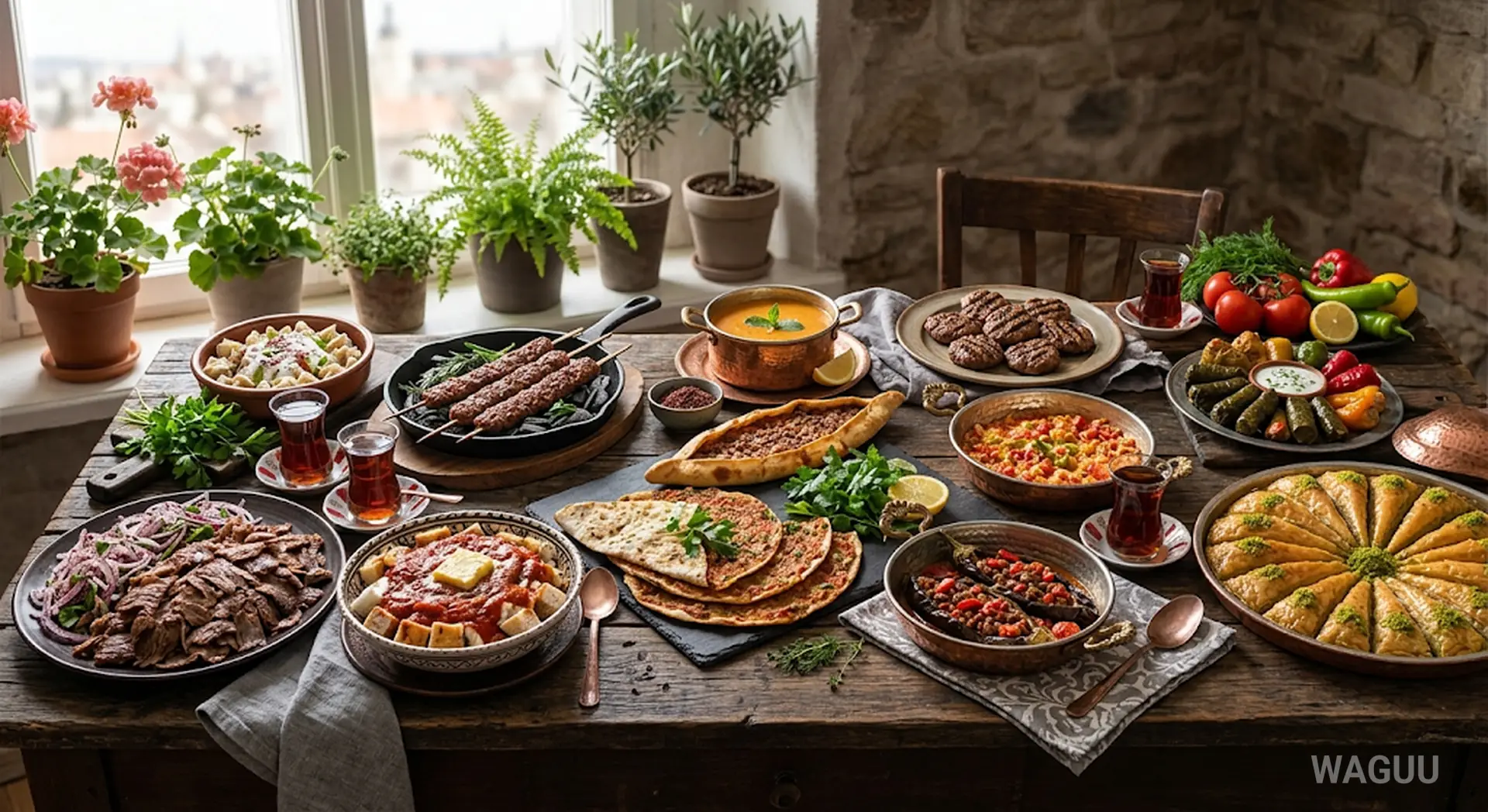
Summary: A guide to the twelve Turkish dishes most often cooked outside Turkey, from a pressed döner loaf and charcoal Adana kebabs to paper-thin lahmacun, stuffed eggplant and pistachio baklava. Written for home cooks in the United States, with the technique behind each dish explained and a full recipe linked from every section. Reading time about 14 minutes.
Categories: Articles | Turkish Cuisine |
Reading time: 14 minutes
Photo Gallery from the Process
Have you cooked one of these dishes? Share a photo in the comments under the recipe and we will add it to the gallery. Filmed a video of the process? Post a link to YouTube, YouTube Shorts, TikTok, Instagram Reels, Facebook Reels, Pinterest, Vimeo or X (Twitter) in a comment.
No photos yet. Be the first to add a photo of your creation!
Turkish cooking rewards technique more than it rewards ingredients. Master the charcoal fire, the pressed loaf, the paper-thin dough and the tempered butter, and a dozen dishes open up at once.
Quick Overview
- Topic: The twelve Turkish dishes most often cooked outside Turkey
- Categories: Articles, Turkish Cuisine
- Cuisine: Turkish, adapted for American kitchens
- Recipes included: Döner Kebab, İskender Kebab, Adana Kebab, Lahmacun, Pide, Mantı, Köfte, Menemen, Karnıyarık, Mercimek Çorbası, Dolma, Baklava
- Key techniques: charcoal grilling, layered loaf roasting, high-hydration flatbread, stuffing and weighting, butter tempering, syrup timing
- Scientific background: protein extraction by salt and mechanical work, starch gelatinization, Maillard browning, capillary absorption of syrup
- Common mistakes: under-kneading ground meat, wet fillings, a cool stone, cool syrup on cool pastry
- In short: Twelve dishes, six techniques, one shared pantry.
- Last updated: August 22, 2026
WAGUU says: “Turkish cooking is built on a short list of techniques used with confidence. Learn the fire and the dough, and the recipes follow.”
Key Facts
| Region: | Turkey, with the strongest charcoal traditions around Adana and Gaziantep and the strongest olive oil traditions along the Aegean |
| Core pantry: | Yogurt, olive oil, tomato paste, red lentils, bulgur, sweet paprika, Aleppo pepper, cumin, dried mint |
| Signature techniques: | Charcoal grilling, layered loaf roasting, thin dough baking, stuffing, butter tempering |
| Bread with everything: | Pide, lavash and pita appear at almost every meal and are used as a utensil as much as a side |
| Desserts: | Syrup-soaked pastry and milk puddings rather than chocolate, with pistachio as the dominant nut |
Process in Short
- Build the pantry: yogurt, olive oil, tomato paste, sweet paprika, Aleppo pepper, cumin, dried mint, bulgur and red lentils.
- Choose a starting dish based on the equipment you already have: a skillet and an oven cover menemen, karnıyarık and mercimek çorbası.
- Learn one binding technique from the döner loaf, because salt and kneading do the work that breadcrumbs do in other cuisines.
- Bake one flatbread recipe, lahmacun or pide, to understand how a very hot stone changes the texture of a dough.
- Finish with baklava, where the timing of the syrup matters more than the layering.
At a Glance
- One pantry covers most of the list: Yogurt, olive oil, tomato paste, paprika, cumin, dried mint and bulgur appear again and again, so a single shopping trip supports several of these dishes.
- The techniques transfer: A pressed loaf, a paper-thin dough, a rolled parcel and a tempered butter each show up in more than one recipe here.
- Built for a table, not a plate: Most of these dishes are designed to be shared, which is why they scale to two loaf pans or two sheet pans without changing the ratios.
- Result: A working repertoire of Turkish dishes built on six techniques that repeat across the whole list.
Who this guide is for: Beginner – Start with menemen or mercimek çorbası. Both are forgiving, both use one pot or one pan, and neither depends on precise timing. Advanced – Move to the döner loaf and to lahmacun. The loaf teaches binding and slicing, while lahmacun teaches dough handling at high hydration and very high heat. Professional – Take on dolma and baklava together. The rolling and the layering both reward patience, and both depend on one variable that can be measured: moisture.
Turkish Cooking in Three Regions
Turkish cooking is not one tradition but a set of regional kitchens that share a handful of techniques. Along the Aegean and the Marmara coast the emphasis falls on olive oil, vegetables and herbs, and dishes are served warm or at room temperature. Inland, in Gaziantep, Adana and Konya, the cooking turns to charcoal, lamb fat and pepper, and the results are bolder and hotter. The Black Sea coast cooks with anchovies, cornmeal and greens. What holds these kitchens together is a short list of methods: grilling over coals, layering thin dough, stuffing vegetables, and finishing a plate with yogurt and melted butter.
This guide walks through the twelve dishes most often associated with Turkish food outside the country, and each one is treated as a technique rather than a souvenir. A döner loaf is a lesson in how salt and pressure bind meat. Lahmacun is a lesson in how a wet topping and a very hot stone can cook in the same five minutes. Baklava is a lesson in temperature: hot pastry meets hot syrup, or the layers go soft. Once those principles are clear, the recipes stop being a list and start being a method you can apply to other dishes.
The Six Techniques Behind the Twelve Dishes
Each section below explains what the dish is, what makes it work, and which technique carries the result. The full step-by-step recipes, with exact quantities, temperatures and nutrition figures, are linked from every section.
| Technique | How it works |
|---|---|
| Charcoal grilling | Adana kebab and köfte both rely on a two-zone fire and a grate 3 inches above the coals. Direct radiant heat browns the surface in the same window the center reaches temperature. |
| Layered loaf roasting | Döner kebab and İskender kebab use the same pressed loaf. Salt and mechanical work extract myosin, the protein that holds the slices together under a 4 lb press. |
| High-hydration flatbread | Lahmacun dough sits near 70% hydration, which removes the elastic memory that would otherwise pull a thin sheet back into shape. |
| Stuffing and weighting | Karnıyarık and dolma both depend on packing a filling tightly and then holding it in place, either with a weighted plate or with a slit that closes over the meat. |
| Tempering with butter | Menemen, mantı and mercimek çorbası finish with butter melted with dried mint, paprika or Aleppo pepper. The herbs go in off the heat so they keep their color. |
| Syrup timing | Baklava works when hot pastry meets hot syrup. The same principle explains why a cool syrup leaves a soft surface on any syrup-soaked dessert. |
WAGUU Pro Tip: Weigh the salt for ground meat mixtures instead of measuring it by eye. Salt is what extracts the protein that binds a döner loaf or a köfte patty, and the difference between 1.5% and 2.5% by weight decides whether the mixture holds or crumbles.
The Twelve Dishes
1. Döner Kebab
The marinade does two jobs at once. Yogurt is mildly acidic, so it loosens the surface proteins without turning the meat mushy, while grated onion releases sulfur compounds that read as roasted rather than raw. Pressing the layers together under weight closes the gaps that would otherwise let steam escape and dry the loaf out.
Technique: Layered loaf roasting under a weighted press • Total time: 150 minutes • Difficulty: Advanced
Full recipe: Döner Kebab – Marinated Meat from a Vertical Spit – Marinated Meat from a Vertical Spit
2. İskender Kebab
The sauce is not a garnish here, it is the seasoning. Tomatoes cooked down with a little butter and paprika reduce until they coat a spoon, and that body is what carries salt and acid into every cube of bread. The yogurt stays cold on purpose, so each forkful moves between warm and cool.
Technique: Pressed loaf roast finished with a warm tomato sauce and browned butter • Total time: 130 minutes • Difficulty: Advanced
Full recipe: İskender Kebab – Döner with Tomato Sauce and Yogurt – Döner with Tomato Sauce and Yogurt
3. Adana Kebab
Kneading is not optional here. Working the meat with salt for several minutes extracts myosin, the same protein that makes sausage bind, and that stickiness is what holds a 10 inch kebab on a skewer with nothing else added. Chill the mixture and your hands stay cold, so the fat does not smear.
Technique: Hand chopping and working the paste onto flat skewers • Total time: 56 minutes • Difficulty: Intermediate
Full recipe: Adana Kebab – Spicy Hand-Chopped Lamb Skewers – Spicy Hand-Chopped Lamb Skewers
4. Lahmacun
The topping carries no binder, so it stays loose, moist and slightly tart. Grating the vegetables rather than dicing them releases their water, and that water is what steams the meat from below while the stone chars the dough from above.
Technique: High-hydration flatbread baked hard on a stone • Total time: 120 minutes • Difficulty: Intermediate
Full recipe: Lahmacun – Thin Flatbread with Minced Meat and Herbs – Thin Flatbread with Minced Meat and Herbs
5. Pide
Pide dough sits between flatbread and focaccia. A little olive oil and a longer, slower proof give it enough structure to hold a filling while staying soft enough to fold. The egg goes in at the very end, when the residual heat of the stone and the bread finishes the white without turning the yolk chalky.
Technique: Folding a raised rim to contain a wet filling • Total time: 130 minutes • Difficulty: Intermediate
Full recipe: Pide – Turkish Boat Bread with Meat, Cheese and Egg – Turkish Boat Bread with Meat, Cheese and Egg
6. Mantı
A stiff dough with egg rolls thinner than a soft one because the gluten is tight and the surface stays dry. The filling is spread paper thin across the sheet and cut into squares, which is how the parcels end up uniform without measuring each one. Simmering rather than boiling keeps the wrappers intact.
Technique: Rolling a stiff dough to paper thickness and sealing thumbnail-sized parcels • Total time: 105 minutes • Difficulty: Advanced
Full recipe: Mantı – Turkish Dumplings with Garlic Yogurt – Turkish Dumplings with Garlic Yogurt
7. Köfte
The panade is doing quiet work. Bread soaked in milk holds water inside the patty and interrupts the protein network just enough that the meat stays tender at 160 °F. Grated onion adds moisture and sulfur compounds that read as grilled rather than boiled, but the pulp has to be dry or the patties steam in their own liquid.
Technique: Onion water worked into ground meat for a bound, juicy patty • Total time: 40 minutes • Difficulty: Easy
Full recipe: Köfte – Seasoned Ground Meat Patties – Seasoned Ground Meat Patties
8. Menemen
The tomatoes do most of the seasoning. Cooked down with butter until their water evaporates, they concentrate into a jammy base that coats the eggs instead of watering them out. Green peppers go in first because they need longer than the tomatoes, and the eggs go in last because they need less time than either.
Technique: Soft scrambling in a tomato and pepper base held off direct high heat • Total time: 35 minutes • Difficulty: Easy
Full recipe: Menemen – Turkish Eggs with Tomatoes and Peppers – Turkish Eggs with Tomatoes and Peppers
9. Karnıyarık
Eggplant is a sponge, and the fry is what fills it. A brief salt rest pulls out bitter water and collapses some of the air pockets, so the flesh absorbs oil and turns creamy instead of greasy. Cooking the filling separately before it goes in means the eggplant only has to finish in the oven, not cook the meat from raw.
Technique: Salting and pre-roasting eggplant before stuffing • Total time: 95 minutes • Difficulty: Intermediate
Full recipe: Karnıyarık – Eggplant Stuffed with Ground Meat – Eggplant Stuffed with Ground Meat
10. Mercimek Çorbası
Red lentils have had their seed coats removed, which is why they cook in a fraction of the time of brown lentils and fall apart into a purée on their own. Potato adds starch that keeps the texture silky without cream, and the lemon at the end is not a garnish; without acid, the soup tastes flat no matter how much salt goes in.
Technique: Simmering until the lentils collapse, then blending smooth • Total time: 50 minutes • Difficulty: Easy
Full recipe: Mercimek Çorbası – Creamy Red Lentil Soup – Creamy Red Lentil Soup
11. Dolma
The filling goes into the leaves raw, and that is deliberate. As the rice cooks it absorbs the oil, tomato and herb liquid around it and swells to fill every corner of the parcel, which is what makes a dolma compact rather than loose. Weighting the pot keeps the rolls from floating and unwinding in the simmering water.
Technique: Rolling tight parcels and weighting them so they hold shape while they steam • Total time: 125 minutes • Difficulty: Advanced
Full recipe: Dolma – Stuffed Grape Leaves and Peppers – Stuffed Grape Leaves and Peppers
12. Baklava
The crackle in good baklava comes from thousands of starch layers separated by butter. Each sheet carries a film of fat that keeps the layers from fusing, and the bake drives off water so the structure sets brittle. A hot thin syrup then soaks in from the top and stops at the nut layer, which is why the base stays crisp while the surface turns glossy.
Technique: Layering buttered phyllo and matching syrup temperature to pastry temperature • Total time: 110 minutes • Difficulty: Advanced
Full recipe: Baklava – Layered Phyllo with Pistachios and Syrup – Layered Phyllo with Pistachios and Syrup
Frequently Asked Questions
Is Turkish food the same as Mediterranean food?
They overlap around olive oil, vegetables and yogurt, but Turkish cooking also includes a strong inland tradition of charcoal-grilled meat, lamb fat and hot pepper that Mediterranean cooking in the narrow sense does not.
What is the difference between döner and İskender?
The meat is the same pressed and roasted loaf. Döner is served in bread or on a plate with vegetables, while İskender is layered over toasted pide with tomato sauce, yogurt and browned butter.
Do I need a charcoal grill?
For Adana kebab and köfte a charcoal grill gives the strongest result, but a heavy cast iron grill pan at high heat works. Expect less smoke and slightly less char.
Is Aleppo pepper very hot?
It sits between 2,000 and 5,000 Scoville units, roughly a tenth of a jalapeño, and carries a fruity, almost raisiny flavor along with the warmth.
Also known as: Turkish cuisine, Anatolian cooking, Ottoman kitchen
Author: WAGUU Petr & Team • Published: 22 Aug 2026 • Updated: 14 Oct 2026
Conclusion
The twelve dishes in this guide look diverse on a table, but they come back to the same handful of ideas. Meat is bound with salt and pressure rather than with filler. Dough is rolled thin enough to cook in minutes at high heat. Vegetables are hollowed and packed, then held in place while they steam. Fat is browned with herbs and poured over at the last moment. Learn those four moves and the recipes become variations rather than separate projects, which is exactly how they function in a Turkish kitchen.
Choose Your Recipe
Every dish below has a full recipe with exact quantities, temperatures, timings and nutrition. Start with the one that matches the equipment you already have.
Döner Kebab – Marinated Meat from a Vertical Spit – Marinated beef chuck and lamb shoulder are pressed into a loaf, roasted slowly, chilled, then shaved and crisped in a hot skillet.
İskender Kebab – Döner with Tomato Sauce and Yogurt – Shaved döner meat is layered over toasted pide cubes, soaked with tomato sauce, then finished with cold yogurt and sizzling browned butter.
Adana Kebab – Spicy Hand-Chopped Lamb Skewers – Fatty lamb shoulder is hand chopped with sweet and hot pepper, kneaded into a sticky paste, molded onto flat skewers and grilled hard over charcoal.
Lahmacun – Thin Flatbread with Minced Meat and Herbs – A soft, high-hydration dough is stretched paper thin, spread with a raw meat and pepper paste, and baked hard at 500 °F until the edges crackle.
Pide – Turkish Boat Bread with Meat, Cheese and Egg – A soft enriched dough is shaped into long boats, filled with spiced meat or cheese, and baked on a stone until the rim sets and the egg just barely cooks.
Mantı – Turkish Dumplings with Garlic Yogurt – A stiff egg dough is rolled to paper thickness, cut into squares, filled with seasoned lamb, folded into tiny parcels and simmered, then dressed with garlic yogurt and mint butter.
Köfte – Seasoned Ground Meat Patties – Grated onion, bread soaked in milk and a long knead turn ground beef and lamb into pliable patties that stay juicy over hot coals.
Menemen – Turkish Eggs with Tomatoes and Peppers – Green peppers and tomatoes cook down with butter and olive oil, then eggs go in over low heat and come out in soft, glossy curds shot through with tomato.
Karnıyarık – Eggplant Stuffed with Ground Meat – Eggplant halves are salted, fried until silky, hollowed and packed with a spiced lamb and tomato filling, then baked with a spoonful of sauce over each one.
Mercimek Çorbası – Creamy Red Lentil Soup – Red lentils, carrot and potato collapse into a smooth golden purée, finished with a cumin butter poured over the top and a squeeze of lemon.
Dolma – Stuffed Grape Leaves and Peppers – Vine leaves and small peppers are packed with a herbed rice filling, layered in a pot under a weighted plate and simmered until the rice steams through.
Baklava – Layered Phyllo with Pistachios and Syrup – Twenty buttered phyllo sheets, a thick layer of pistachios and twenty more sheets bake into a shattering pastry that drinks a warm lemon syrup.
Other Possible Variations
Vegetarian mezze table
Combine dolma, mercimek çorbası and a yogurt dish, then add flatbread. The three cover protein, starch and acid without any meat, and the whole table can be prepared a day ahead.
Charcoal evening
Pair Adana kebab with köfte, grilled long peppers and sumac onion on one platter. Two charcoal dishes cook in the same 20 minute window, which keeps the fire useful.
Sunday baking
Bake lahmacun and pide in the same session. The doughs share flour, yeast and a stone, and the two together fill an afternoon without needing a second trip to the store.
Sweet finish
Serve baklava with Turkish coffee after any of the mains here. The bitterness of unsweetened coffee is what keeps a syrup dessert from overwhelming the end of a meal.
Freezer strategy
Make mantı and dolma in double batches and freeze both. Mantı simmers straight from frozen and dolma reheats covered, so a second dinner costs no additional work.
Do you know another variation? Add your own suggestion below.
Missing a recipe?
Tell us what recipe you would like us to add. We will do our best to publish it soon!
Frequently Asked Questions About the Variations
- Is Turkish food the same as Mediterranean food? They overlap around olive oil, vegetables and yogurt, but Turkish cooking also includes a strong inland tradition of charcoal-grilled meat, lamb fat and hot pepper that Mediterranean cooking in the narrow sense does not.
- What is the difference between döner and İskender? The meat is the same pressed and roasted loaf. Döner is served in bread or on a plate with vegetables, while İskender is layered over toasted pide with tomato sauce, yogurt and browned butter.
- Do I need a charcoal grill? For Adana kebab and köfte a charcoal grill gives the strongest result, but a heavy cast iron grill pan at high heat works. Expect less smoke and slightly less char.
- Is Aleppo pepper very hot? It sits between 2,000 and 5,000 Scoville units, roughly a tenth of a jalapeño, and carries a fruity, almost raisiny flavor along with the warmth.
- Can I make these dishes without dairy? Most of them, yes. Replace the yogurt with a plant-based yogurt, use olive oil in place of butter, and skip the feta in menemen.
- Why is yogurt served with so many of these dishes? Its lactic acidity cuts fat and resets the palate between bites, which is why it appears next to grilled meat, stuffed vegetables and dumplings alike.
- How long does baklava keep? Seven days in a covered container at room temperature. Refrigeration softens the layers, so it is the one dessert here that should not go in the refrigerator.
- What should I cook first for a crowd? The döner loaf or karnıyarık. Both scale by repeating a single batch rather than by multiplying a delicate process, and both hold well once finished.
Contact: 12-most-famous-turkish-dishes-traditional-recipes-us@waguu.online