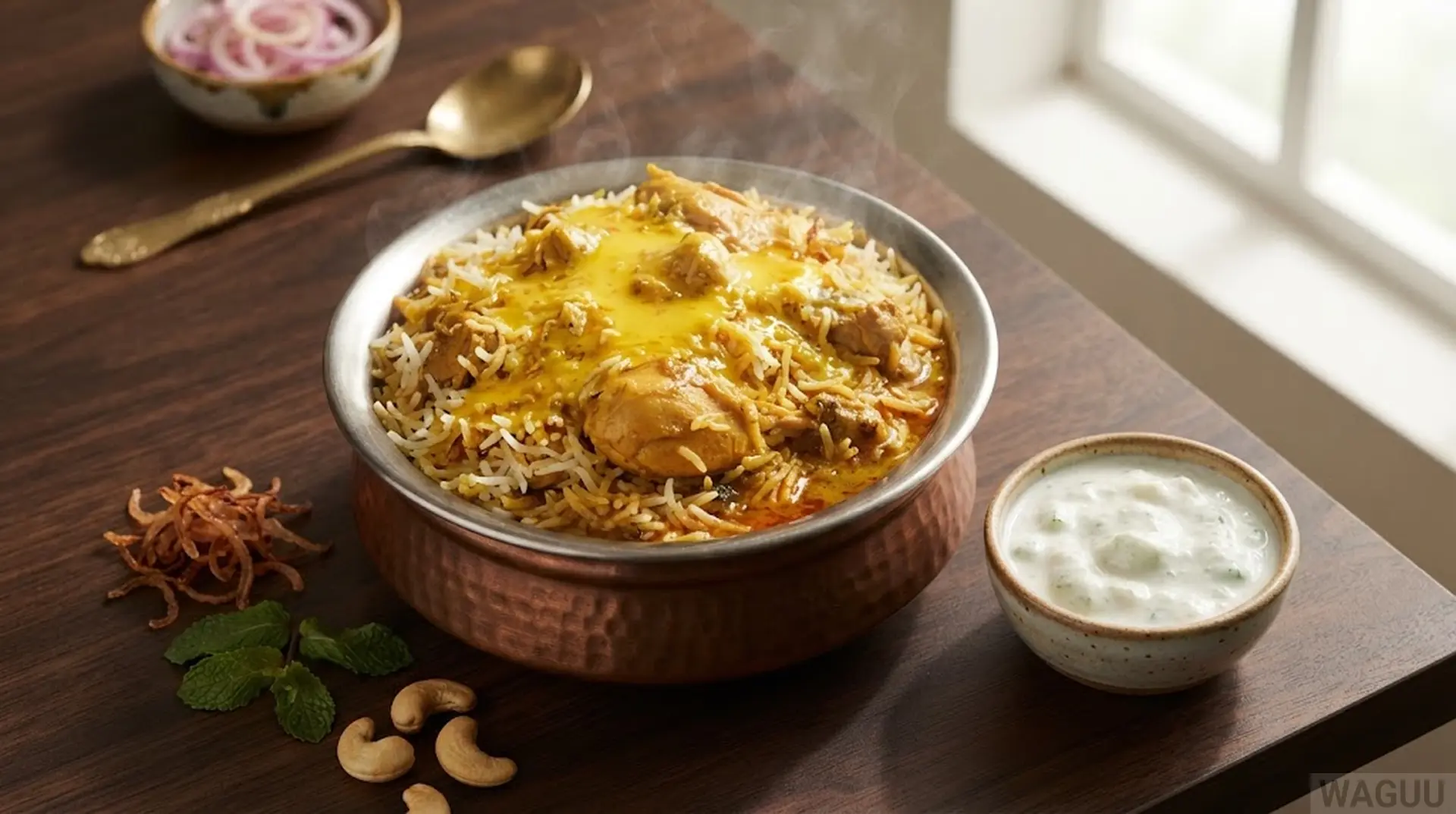
Summary: Basmati rice is parboiled until half-cooked, the meat is simmered in a spiced yogurt base, and both are layered with fried onions, mint, and saffron milk. The pot is sealed and the biryani steams to finish. Total time 105 minutes, base 6 servings.
Did you cook this recipe? Share your result with the community.
Category: Rice and grains · Indian Cuisine
Success rate: not rated yet% of users nailed this recipe
Quick overview
- Dish: Biryani – aromatic layered rice with meat, saffron, and a blend of spices
- Category: rice-and-grains, indian-cuisine
- Cuisine: Indian
- Main ingredient: Basmati rice, 21 oz (washed, soaked) (quality specification)
- Guide: 12 most famous Indian dishes: traditional recipes from Indian cuisine
- Total time: 105 minutes (35 min prep + 70 min cooking)
- Difficulty: Challenging
- Servings: 6 (Serving size: 18.3 oz)
- Key technique: Partially sealed layered cooking of rice with meat and saffron milk
- Preparation types: Layering, steaming in a sealed pot
- Dietary info & allergens: gluten (all-purpose flour); milk (plain yogurt, ghee, milk)
- Great for: Family dinner, dinner with friends, festive multi-course table, and meal prep for several days ahead.
- Nutrition facts (per serving): 818 calories, Protein: 46.8 g, Fat: 25.2 g, Carbs: 101.1 g
- Storage: 3 days in the fridge, 1 month in the freezer
- Pairing: Indian light lager, dry Riesling, salted lassi
- In short: Basmati rice is parboiled until half-cooked, the meat is simmered in a spiced yogurt base, and both are layered with fried onions, mint, and saffron milk. Total time 105 minutes, 6 servings.
WAGUU says: “Biryani is not stirred. The layers come together on their own through steam.”
Key facts
| Prep time: | 35 |
| Cook time: | 70 |
| Temperature: | Parboiling rice 203°F, steaming in sealed pot 320°F in the oven, saffron milk 140°F |
| Servings: | 6 |
At a glance
Biryani is judged by the grain: the rice must be fluffy, each grain separate yet coated with the meaty flavor base. The partially sealed pot and dough seal that traps steam are crucial. Anyone who stirs biryani with a spoon during steaming ends up with rice porridge with meat.
Ingredients
Base servings: 6 servings • Serving size: 18.3 oz
| Ingredient | Amount | Quality |
|---|---|---|
| basmati rice | 21 oz | long-grain, aged |
| boneless chicken | 32 oz | skinless thigh, cut into 1.5-inch pieces |
| plain yogurt | 11 oz | whole-milk, thick |
| onion | 4 pcs | two for the base, two for frying until crisp |
| ghee | 3.0 oz | clarified butter, for frying onions |
| ginger | 0.9 oz | fresh, finely grated |
| garlic | 6 pcs | fresh, finely minced |
| canned tomatoes | 14 oz | peeled, no added salt |
| milk | 1/2 cups | whole milk, warm for steeping saffron |
| fennel seeds | 1 tsp | whole, for saffron milk |
| garam masala | 2 tsp | freshly ground blend |
| ground cumin | 2 tsp | ground, toasted |
| ground coriander | 2 tsp | ground, toasted |
| turmeric | 1 tsp | ground |
| ground cinnamon | 1 tsp | ground |
| ground cardamom | 1 tsp | ground |
| bay leaf | 3 pcs | whole, for cooking rice |
| fresh mint | 1.0 oz | fresh, for layering |
| fresh cilantro | 1.0 oz | fresh, for layering |
| salt | 1 tsp | fine, for rice water |
| all-purpose flour | 3.5 oz | for sealing the pot, not consumed |
Why you’ll love this recipe
- Fluffy rice without fail: Parboiling and steam-finishing keep each grain separate. Biryani never sticks or turns to mush in the pot.
- Layers that come together on their own: Rice, meat, herbs, and saffron are not mixed but connected through steam. Every component is visible on the plate.
- A dish for a festive table: Biryani can be assembled in the pot ahead of time and steamed just before serving. It looks freshly made at the table.
Guaranteed success: Basmati rice is parboiled in plenty of water only until the grain at the edge softens while the center stays firm. The rest is done in the sealed pot, where steam from the meat and yogurt rises and cooks the rice through. The dough seal holds both pressure and moisture. Saffron is steeped in warm milk because its color is water-soluble and only slightly fat-soluble.
Recipe Overview
Prep: 35 min | Cook: 70 min | Difficulty: Advanced | Servings: 6 | Type: Main Course | Origin: Indian
Detailed Instructions
Total progress: 0 % done
Phase 1: Preparing Rice and Saffron – 35 min
Equipment: bowl, pot, colander, cup
1. Rinse the rice in several changes of water until the water runs clear, then leave it to soak. After that, drain it. Clear water means the grain is free of surface starch and won’t stick together after cooking.
2. In a large pot, bring water with bay leaf and salt to a boil. Add the rice and cook only until the grain softens at the edge but remains firm inside, then drain it.
3. Put the saffron in a cup with warm milk and let it steep. The color will release into yellow and the milk will gain a strong aroma.
VKB: The rice grain bends between your fingers and breaks, but doesn’t turn mushy. The drained water is clear. The saffron milk is deep yellow.
Before you move to the next step:
The rice must not be cooked until soft. In the sealed pot, it will finish cooking with steam. Overcooked grains stick together in layers and the biryani loses its separate grains.
Phase 2: Crispy Fried Onions – 15 min
Equipment: skillet, colander, paper towel
1. Slice two onions thinly and fry them in ghee over medium heat until dark golden. Stir so the slices don’t burn in one spot.
2. Remove the fried onions with a colander and let them drain on a paper towel. Set aside some of the ghee from the pan – it will be used for layering.
VKB: The onion slices are dark golden to brown, crispy, and dry. No oily spot remains on the paper towel from draining oil.
Before you move to the next step:
Light onions lack flavor, black ones are bitter. Fry in batches and watch the color – there are only seconds between golden and burnt.
Phase 3: Meat Base – 20 min
Equipment: pot, spoon
1. In the remaining ghee, sauté the remaining onion until golden brown, add ginger and garlic and sauté until fragrant. Sprinkle in ground coriander, cumin, turmeric, cinnamon, and cardamom.
2. Add the meat and sear it on all sides. Add the yogurt and stir until it blends with the spices. Then add the peeled tomatoes and simmer until the meat is tender and the sauce thickens.
VKB: The meat is tender and the sauce is thick, oil has separated on the surface. The flavor is spiced and slightly tangy from yogurt and tomatoes.
Before you move to the next step:
Yogurt curdles in boiling sauce. Lower the heat and add it by spoonfuls while stirring constantly.
Phase 4: Layering the Biryani – 12 min
Equipment: heavy-bottomed pot, spoon
1. Put half the meat with sauce in the bottom of the pot. Spread half the rice on top and sprinkle with fried onions, mint, and cilantro. Drizzle with saffron milk and a spoonful of ghee.
2. Repeat the layers in reverse order – remaining meat, remaining rice, herbs, onions, saffron milk, and ghee. The final layer must be rice.
VKB: The layers are visible on the side of the pot and remain separate. The rice doesn’t sink into the sauce and the surface is level.
Before you move to the next step:
The layers must not be mixed. If the rice mixes with the sauce, the biryani cooks like a risotto, not like layered rice.
Phase 5: Steaming in a Sealed Pot – 30 min
Equipment: lid, dough, oven
1. Brush the rim of the pot with water and cover with the lid. Seal it with a strip of dough made from flour and water so steam cannot escape.
2. Place the pot in an oven preheated to 325°F and steam the biryani until the rice absorbs all the moisture. Then remove the pot and let it rest for ten minutes.
VKB: The seal is puffed and firm, and fragrant steam rises when removed from the pot. The rice grains are separate and coated with sauce, but not sticky.
Before you move to the next step:
Opening the pot during steaming releases steam and the rice stays hard. Be patient and open the pot only after resting.
Phase 6: Opening and Serving – 8 min
Equipment: spoon, serving platter
1. Carefully peel off the seal with a knife and lift the lid in one motion so water from the lid doesn’t fall into the rice. Run a spoon through the layers from the edge to the center.
2. On a plate, place rice and meat side by side so the layers remain distinct. Serve with cucumber raita.
VKB: The rice grains are whole, separate, and multi-colored – white, yellow from saffron, and brown from onions. The meat holds its shape.
Required Equipment
| Item | Ideal Size | Alternative | Risk |
|---|---|---|---|
| heavy-bottomed pot with lid | 5 qt capacity | cast-iron pot or ceramic bowl with lid | a thin pot will burn the bottom layer of rice before the rest cooks through |
| large pot for parboiling rice | 6 qt capacity | wide saucepan | in a small pot, grains stick together because they have no room to move freely |
| fine-mesh colander | 9.5 in diameter | sieve lined with cloth | large holes let short grains through and they turn mushy in the pot |
| kitchen thermometer | up to 480°F | check by steam escaping from the edge | too high oven temperature will scorch the bottom layer of biryani |
Shopping List
Nutrition Facts
Values per 1 serving (without side dish). Calculated from average nutritional values of ingredients.
| Nutrient | Per 100 g | Per 1 serving | Per 6 servings |
|---|---|---|---|
| Energy | 661 kJ / 158 kcal | 3423 kJ / 818 kcal | 20535 kJ / 4908 kcal |
| Fat | 4.9 g | 25.2 g | 151.2 g |
| of which saturated | 2.3 g | 11.9 g | 71.6 g |
| Carbohydrates | 19.5 g | 101.1 g | 606.6 g |
| of which sugars | 2.2 g | 11.6 g | 69.6 g |
| Protein | 9.0 g | 46.8 g | 9.9 oz |
| Salt | 0.007 oz | 0.04 oz | 0.24 oz |
Reference intake of an average adult (8400 kJ / 2000 kcal).
WAGUU Pro level
- Pro standard: Verified recipe with precise ratios and visual checkpoints.
- Tip 1: Verified recipe with precise ratios and visual checkpoints.
- Tip 2: A grain of rice bends between your fingers and breaks, but doesn’t turn mushy. The water after draining is clear. The saffron milk is deep yellow. The rice must not be cooked until soft. In a sealed pot, it finishes with steam. Overcooked grains stick together in layers and the biryani loses its separate grains.
- Tip 3: The onion slices are dark golden to brown, crispy and dry. No oily stain remains on a paper towel from oil draining off them. Pale onion has no flavor, black is bitter. Fry in batches and watch the color – between golden and burnt there are only seconds.
- Tip 4: Prepare the ingredients on the table in small bowls beforehand. Indian cooking relies on spices added in precise order, and there’s no time to portion ingredients during cooking.
Scientific background
Saffron contains crocin and picrocrocin, which are released at around 140 °F – in boiling milk, some would be destroyed. Basmati rice has long grains with low amylose content, so it stays separate after cooking. Fried onions carry sugars that turn into brown aromatic compounds during frying, and these are washed into the rice by steam.
Fine Dining – Professional techniques
- Plate composition: Serve biryani in a small clay bowl so the guest can see the layers. Leave the top layer untouched so the colors remain separate.
- Texture contrasts: Add a crunchy element – toasted cashews or almonds. They give the delicate rice a contrast that holds the bite together.
- Temperature contrast: Top with a mint leaf and a few saffron threads. The mint aroma is released by the heat of the rice before the first bite.
- Aromatic additions: Serve cucumber yogurt raita chilled to 43 °F on the side. The temperature contrast between hot rice and cold yogurt is part of the experience.
Sensory radar
- Appearance: Rice grains are whole and multi-colored – white, yellow from saffron, and brown from fried onions. Pieces of meat peek through.
- Aroma: Saffron with warm milk, then fried onions, and finally mint with cilantro.
- Taste: Sweet onion, tangy yogurt, warm spices, and fresh herbs at the end. Each layer adds a different flavor.
- Texture: Rice grains separate and delicate, meat tender, fried onions crispy.
Pairings
- Indian light lager: A lager with higher carbonation cleanses the palate between bites of spiced rice and meat. Serve at 41–45 °F.
- dry Riesling: Riesling with acidity keeps up with the spices and doesn’t get lost next to saffron.
- salted lassi: Salted lassi with mint. It cools and binds capsaicin, so the heat doesn’t build with each bite.
Variations
- Lamb biryani:: Replace the meat with boneless lamb shoulder and simmer it twenty minutes longer. The flavor is deeper and the dish keeps for the next day.
- Vegetable biryani:: Omit the meat and use cauliflower, carrots, peas, and potatoes pre-roasted in the oven. The rice is layered the same way.
Allergens and dietary information
Contains: gluten (all-purpose flour); milk (plain yogurt, ghee, milk) • Gluten: no, the recipe is gluten-free (basmati rice, yogurt, spices) • Not suitable for: people with allergies to milk and dairy products
Suitable for
Family dinner, dinner with friends, a festive multi-course table, or meal prep for several days ahead.
Substitution guide
- basmati rice: jasmine rice (grains will be shorter and stickier)
FAQ
Which rice should I use for biryani?
Long-grain basmati, preferably from an older harvest. It contains less amylose, so it stays separate after cooking. Jasmine rice will clump.
What can I use to seal the pot if I don’t have dough?
A strip of dough made from flour and water, or two layers of aluminum foil pressed firmly against the rim. The seal must hold steam, not just cover the pot.
Why is the rice hard after steaming?
It was undercooked or steam escaped. Next time, parboil the rice two minutes longer and check the pot’s seal.
Do I have to use saffron?
No, but it makes the dish. You can substitute turmeric for color and a pinch of nutmeg for aroma. The flavor of saffron cannot be replaced.
Can biryani be made without meat?
Yes, sabz biryani is made with vegetables – cauliflower, carrots, peas, and potatoes. Pre-roast the vegetables so they don’t turn mushy in the steam.
How do I reheat biryani so the rice stays separate?
In the oven at 325 °F under foil with a spoonful of water. A microwave will steam the rice and the grains will stick together.
WAGUU Petr advises: Cooking for 6 or more people?
6–8 people: Make the masala (fried spice base) in double batch and store half in the fridge. When cooking for more people, use two pots, not one large one – spices don’t roast evenly in too thick a layer. • 10+ people: A grill or a cast-iron skillet heated in the oven to maximum can replace a tandoor. Prepare the naan dough and chicken marinade the day before and keep them in the fridge – both flavor and texture will be better.
Sides and serving
Serving: Serve biryani straight from the pot: run a spoon through the layers from the edge to the center and put both meat and rice on the plate at once. Cucumber yogurt raita and a small bowl of pickled vegetables go with it.
Storage and reheating
Fridge: 3 days • Freezer: 1 month • Reheating: Fridge: 3 days • Freezer: 1 month • Reheating: in the oven at 325 °F for fifteen minutes under foil, with a spoonful of water
Author: WAGUU Petr & Team • Published: 9 Oct 2026 • Updated: 10 Oct 2026
More recipes from the article
Guide: 12 most famous Indian dishes: traditional recipes from Indian cuisine
Butter Chicken – chicken in a mild creamy tomato sauce with butter and aromatic spices
Chicken Tikka Masala – pieces of marinated chicken in a spiced tomato-cream sauce
Tandoori Chicken – chicken marinated in yogurt and spices and baked at high heat
Rogan Josh – slow-cooked lamb in an aromatic sauce with Kashmiri spices
Chana Masala – chickpeas simmered in a spicy sauce of tomatoes, onions, and aromatic spices
Chana Masala – chickpeas simmered in a spicy sauce of tomatoes, onions, and aromatic spices
Dal Tadka – lentils flavored with fried spices, garlic, onion, and chili
Masala Dosa – thin crispy fermented rice and lentil crepe with spiced potatoes
Samosa – fried triangular pastries filled with potatoes, peas, and spices
Chole Bhature – spiced chickpeas with large fried leavened bhature breads
Naan – traditional Indian flatbread baked at high heat in a tandoor
More recipes you might like
Why WAGUU?
WAGUU recipes are checked for accuracy of ingredients, procedures, and nutritional values.
Photo gallery from the process
Photos from the community: Cook, take a photo, and share the result.
You can upload photos in the comments below or send them by email.
Did you film a video of the process for our recipe? Paste the link to YouTube, YouTube Shorts, TikTok, Instagram Reels, Facebook Reels, Pinterest, Vimeo, or X (Twitter) in the comments – we’ll be happy to publish it and help you and your content get noticed.
Most common mistakes
- Rice and saffron preparation – The rice must not be cooked until soft. In a sealed pot, it finishes with steam. Overcooked grains stick together in layers and the biryani loses its separate grains.
- Crispy fried onions – Pale onion has no flavor, black is bitter. Fry in batches and watch the color – between golden and burnt there are only seconds.
- Meat base – Yogurt will curdle in a boiling sauce. Lower the heat and add it by spoonfuls while stirring constantly.
- Layering biryani – The layers must not be mixed. If the rice is stirred into the sauce, the biryani cooks like a risotto, not like layered rice.