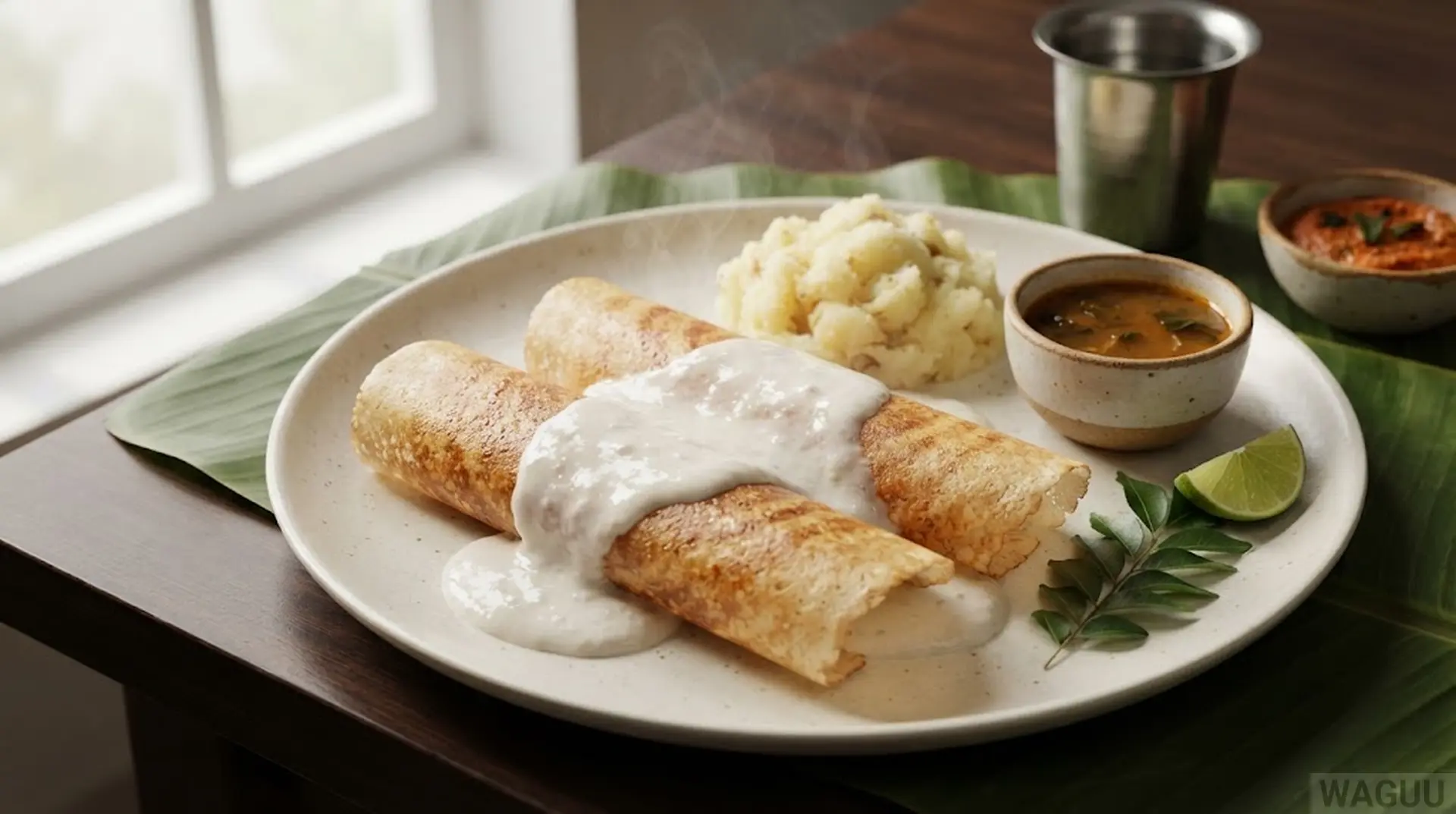
Summary: Rice and lentils are soaked, blended, and left to ferment overnight. The batter is then spread on a dry hot griddle into a thin crepe that cooks until crisp and is filled with spiced potatoes. Total time 620 minutes including fermentation, makes 6 servings.
Did you make this recipe? Share your result with the community.
Categories: appetizers, indian-cuisine
Success rate: not rated yet % of users mastered this recipe
Quick overview
- Dish: Masala Dosa – a thin crispy fermented rice and lentil crepe with spiced potatoes
- Categories: appetizers, indian-cuisine
- Cuisine: Indian
- Main ingredient: Basmati rice, 14 oz (for the batter) (quality specification)
- Guide: 12 most famous Indian dishes: traditional recipes from Indian cuisine
- Total time: 620 minutes (20 min prep + 600 min cooking)
- Difficulty: Advanced
- Servings: 6 (Serving weight: 12 oz)
- Key technique: Fermenting rice and lentil batter and cooking a thin crepe on a dry griddle
- Preparation types: Fermentation, griddle cooking
- Dietary info & allergens: mustard (black mustard seed)
- Great for: Family dinner, dinner with friends, a festive multi-course table, or meal prep for several days ahead.
- Nutrition (per 1 serving): 606, Protein: 16.7 g, Fat: 17.9 g, Carbohydrates: 94.5 g
- Storage: 3 days in the fridge, 1 month in the freezer
- Pairing: Indian light lager, dry Riesling, coconut water
- In short: Rice and lentils are soaked, blended, and left to ferment overnight. Total time 620 minutes, 6 servings.
WAGUU says: “”Dosa isn’t cooked by force. It’s cooked on a griddle that’s at the right temperature.””
Key facts
| Prep time: | 20 |
| Cook time: | 600 |
| Temperature: | Griddle 375–410 °F, batter fermentation 79–86 °F for 8–12 hours |
| Servings: | 6 |
The gist
Dosa is made from a batter that does the work itself – fermentation creates acid and bubbles that make the crepe crispy. Griddle temperature and batter thickness are what matter: batter that’s too thick makes a pancake, too thin and it tears. Skip the fermentation and you get a soft, bland crepe with no crisp crust.
Ingredients
Base servings: 6 servings • Serving weight: 12 oz
| Ingredient | Amount | Quality |
|---|---|---|
| basmati rice | 14 oz | for the batter, rinsed |
| urad dal | 5.5 oz | skinless split lentils, rinsed |
| potatoes | 32 oz | starchy, for the filling, boiled in their skins |
| onion | 3 pcs | medium, one for the batter, two for the filling |
| ginger | 0.7 oz | fresh, finely grated |
| green chile | 3 pcs | fresh, seeded |
| cumin seed | 1 tsp | whole, to season the filling |
| turmeric | 1 tsp | ground, for the filling |
| black mustard seed | 1 tsp | whole, for tempering |
| vegetable oil | 3.4 tbsp | neutral flavor, for the filling and the griddle |
| lime | 1 pcs | juicy, for juice in the filling |
| salt | 1 tsp | fine, for the batter and the filling |
| fresh cilantro | 0.9 oz | fresh, for garnish |
| shredded coconut | 3.0 oz | unsweetened, for coconut chutney |
Why you’ll love this recipe
- Crisp from fermentation: The batter works on its own overnight. The acid and bubbles from fermentation make the crepe crispy without baking powder.
- Gluten-free and egg-free: The base is rice and lentils. The batter contains no gluten, eggs, or milk, yet it holds together.
- Cheap and versatile: Rice and lentils make enough batter for twelve crepes. Fill them with potatoes, but also cheese, onion, or vegetables.
How it works: Fermentation produces carbon dioxide that puffs up the batter and lactic acid that gives it its characteristic tangy flavor. That’s why the batter must rest somewhere warm, but not hot – above 95 °F fermentation slows down. The griddle must be dry: fat on the surface keeps the batter from sticking and the crepe tears. The potato filling is made separately and spooned into the finished crepe right on the griddle.
Recipe overview
Prep: 20 min min | Cook: 600 min (including batter fermentation) min | Difficulty: Advanced | Servings: 6 | Type: Appetizer or main dish | Origin: Indian
Detailed instructions
Overall progress: 0 % done
Phase 1: Soaking the rice and lentils – 300 min
Equipment: two bowls, strainer
1. Rinse the rice and lentils separately until the water runs clear. Soak them separately in cold water until the grains soften when pressed.
2. Drain the soaking water and let the grains drip dry. Don’t use the soaking water – it’s cloudy and would make the batter heavy.
VKB: A rice grain breaks between your fingers and the lentils are soft when pressed. The drained water is clear and the grains don’t stick together.
Before you move on:
A short soak leaves the grains hard and the blender won’t grind them. If the batter stays gritty, the crepe tears on the griddle.
Phase 2: Grinding the batter and fermenting – 300 min
Equipment: blender, large bowl, kitchen towel
1. Blend the rice and lentils with a little water into a smooth paste. The batter should have the consistency of heavy cream and no grit should be detectable.
2.Cover the bowl with a towel and let the batter ferment in a warm place. During fermentation, the batter will rise, develop a tangy aroma, and show bubbles on the surface.
VKB:The batter is smooth, slightly tangy, and has small bubbles on the surface. When stirred, it coats the back of a spoon and falls off in a ribbon.
Before you move to the next step:
The batter will not ferment in the cold and will remain flavorless. In heat above 95°F, fermentation slows down and the batter turns sour. Keep it at room temperature.
Phase 3: Potato Filling – 20 min
Equipment: pot, skillet, wooden spoon
1. Boil the potatoes in their skins until tender, peel them, and mash them. Lightly salt them and let them cool so the filling does not fall apart.
2. Heat oil in a skillet and add the mustard seeds. When they pop, add the onion, ginger, and green chile. Stir in the turmeric and ground cumin.
3. Mix the mashed potatoes into the base and heat through. At the end, add the lime juice and cilantro and let the filling cool.
VKB: The filling is yellow, moist but crumbly, and holds its shape. The taste is tangy from lime and spicy from chile, with no raw onion flavor.
Before you move to the next step:
Overcooked potatoes will turn the filling into a mush that leaks through the crepe. Boil them in their skins and mash them dry, without milk or butter.
Phase 4: Cooking the Crepes – 15 min
Equipment: cast-iron griddle or nonstick skillet, ladle, spatula
1. Heat the griddle dry over medium-high heat. Ladle out some batter and spread it from the center outward into a circle, as thin as possible, in one stroke.
2. Brush the surface of the crepe with oil and let it cook until the edges start to lift from the griddle. Then flip it and cook until crisp.
VKB: The crepe is golden brown with darker spots, and the edges are crisp and dry. When folded, it holds its shape and does not break.
Before you move to the next step:
On a greasy griddle, the batter will tear because fat prevents it from sticking. Always wipe the griddle and cook dry.
Phase 5: Filling and Folding – 8 min
Equipment: spatula, spoon
1. Put a spoonful of potato filling on one half of the crepe and spread it into a thin layer. Fold the crepe over the filling and press lightly with the spatula.
2. Transfer the finished dosa to a warm plate and keep it warm until you cook the rest. Do not stack the crepes, or they will soften.
VKB: The crepe is crisp even after folding, and the filling does not fall out. The surface remains dry, without greasy spots.
Before you move to the next step:
The filling must be cool. Warm filling will steam the crepe from the inside and make it soggy even on the griddle.
Phase 6: Serving – 5 min
Equipment: serving plate, small bowls
1. Make coconut chutney by blending grated coconut, green chile, cilantro, and a little water. The taste should be fresh and mildly spicy.
2. Serve the dosa immediately, rolled into a cylinder, with chutney and a bowl of sambar. Put pickled vegetables and yogurt on the table.
VKB: The crepe is crisp, the chutney thick and green. No oil stain remains on the plate.
Required equipment
| Utensil | Ideal size | Alternative | Risk |
|---|---|---|---|
| cast-iron griddle or tava | 12 inches in diameter | nonstick skillet with a thick bottom | a thin skillet will warp and the crepe will cook only in the center |
| high-power blender | 2-quart jar | spice grinder and immersion blender | a weak blender will leave grains in the batter and the crepe will tear |
| thin flexible spatula | 4 inches wide | thin turner | a thick spatula will break the crepe when flipping |
| large fermentation bowl | 4-quart capacity | ceramic bowl with a towel | a small bowl will overflow during fermentation because the batter expands |
Shopping list
Nutrition profile
Values per 1 serving (without sides). Calculated from average nutrient values of ingredients.
| Nutrient | Per 100 g | Per 1 serving | Per 6 servings |
|---|---|---|---|
| Energy | 741 kJ / 177 kcal | 2536 kJ / 606 kcal | 15213 kJ / 3636 kcal |
| Fat | 5.2 g | 17.9 g | 107.4 g |
| of which saturated | 0.4 g | 1.4 g | 8.1 g |
| Carbohydrates | 27.6 g | 94.5 g | 567.0 g |
| of which sugars | 1.7 g | 5.9 g | 35.4 g |
| Protein | 4.9 g | 16.7 g | 100.2 g |
| Salt | 0.2 g | 0.8 g | 5.1 g |
Reference intake of an average adult (8400 kJ / 2000 kcal).
WAGUU Pro level
- Pro standard: Verified recipe with precise ratios and visual checkpoints.
- Tip 1: Verified recipe with precise ratios and visual checkpoints.
- Tip 2: The rice grains can be broken between your fingers and the lentils are soft when pressed. The water after draining is clear, and the grains do not stick together. Short soaking leaves the grains hard and the blender cannot grind them. If the batter remains grainy, the crepe will tear on the griddle.
- Tip 3: The batter is smooth, slightly tangy, and has small bubbles on the surface. When stirred, it coats the back of a spoon and falls off in a ribbon. The batter will not ferment in the cold and will remain flavorless. In heat above 95°F, fermentation slows down and the batter turns sour. Keep it at room temperature.
- Tip 4: Prepare the ingredients on the table in small bowls beforehand. Indian cooking relies on spices added in a precise order, and there is no time to measure during cooking.
Scientific background
The rice and lentils in the batter ferment through the action of natural lactic acid bacteria and wild yeasts. Lactic acid lowers the pH, which keeps the batter fresh longer and gives it flavor. The crispness of the crepe comes from rapid evaporation of water from the thin layer on the hot griddle – that is why the batter is spread as thin as possible and cooked dry.
Fine Dining – Professional techniques
- Plate composition: Roll the dosa into a cylinder and stand it upright on the plate. This keeps air inside and the crepe stays crisp.
- Texture contrasts: Add contrast – a spoonful of thick coconut chutney alongside and a thin streak of sambar on the edge of the plate.
- Temperature contrast: Place a cilantro leaf and a few drops of mustard seed oil on the roll. The aroma will be released by the heat of the crepe.
- Aromatic additions: Serve pickled vegetables chilled to 43 °F on the side. The cold and acid cleanse the palate between bites.
Sensory radar
- Appearance: The crepe is golden brown with darker spots, thin and crisp, with a yellow potato filling flecked with cilantro inside.
- Aroma: Tangy fermented batter, then toasted mustard seed, and finally fresh cilantro and lime.
- Taste: Sour from the fermented batter, sweet potato, and a finish of chili heat and bright lime.
- Texture: The crepe is crisp and dry, the filling soft and moist, the chutney smooth.
Pairings
- Indian light lager: A lager with higher carbonation cleanses the palate from the fried crepe. Serve at 41–45 °F.
- dry Riesling: Riesling with acidity keeps pace with the tangy batter and spicy chutney.
- coconut water: Coconut water is sweet and cooling. It pairs better with spicy chutney than sparkling water.
Variations
- Dosa with coconut chutney:: Coconut chutney with chili is served with the potato filling. The flavor is fresh and sweet, a contrast to the crisp crepe.
- Rava dosa from semolina:: The batter is made from semolina and yogurt and does not need to ferment. The crepe is ready within an hour, but it is more fragile and harder to fold.
Allergens and dietary information
Contains: mustard (black mustard seed) • Gluten: no, the recipe is gluten-free (rice, lentils, potatoes) • Not suitable for: people with legume sensitivity
Suitable for
Family dinner, dinner with friends, a festive multi-course table, and meal prep for several days ahead.
Substitution catalog
- basmati rice: jasmine rice (the grain will be shorter and stickier)
FAQ
Why does my dosa tear on the griddle?
The griddle was greasy or not hot enough, or the batter was too thin. Wipe the griddle dry and let the batter rest for an hour before cooking so it thickens.
How long should the batter ferment?
Eight to twelve hours at room temperature. Longer in winter, shorter in summer. The batter is ready when it is tangy and has bubbles on the surface.
Can I prepare the batter at night and cook in the morning?
Yes, that is the best approach. Put the batter in the refrigerator and take it out two hours before cooking so it loosens and warms up.
What can I use instead of urad dal?
Split moong dal or yellow split peas. The flavor will change slightly, but fermentation and crispness will remain.
Do I need a special griddle?
No, a cast-iron griddle or a heavy-bottomed nonstick pan works. The important thing is that it is dry and evenly heated.
What to serve with dosa?
Coconut chutney, sambar, and pickled vegetables. Yogurt also belongs on the table to tame the heat of the potato filling.
WAGUU Petr advises: Cooking for 6 or more?
6–8 people: Make the masala (fried spice base) in double batch and store half in the refrigerator. When cooking for more people, use two pots, not one large one – the spices will not roast evenly in too thick a layer. • 10+ people: A grill or a cast-iron pan heated in the oven to maximum can replace a tandoor. Prepare the naan dough and chicken marinade the day before and keep them in the refrigerator – both flavor and texture will be better.
Sides and serving
Serving: Serve the dosa immediately after cooking, rolled up, with coconut chutney and a bowl of sambar. Put pickled vegetables and yogurt on the table.
Storage and reheating
Refrigerator: 3 days • Freezer: 1 month • Reheating: Refrigerator: 3 days • Freezer: 1 month • Reheating: on a dry griddle for two minutes per side; in the microwave the crepe will soften
Author: WAGUU Petr & Team • Published: 9 Oct 2026 • Updated: 10 Oct 2026
More recipes from the article
Guide: 12 most famous Indian dishes: traditional recipes from Indian cuisine
Butter Chicken – chicken in a mild creamy tomato sauce with butter and aromatic spices
Chicken Tikka Masala – pieces of marinated chicken in a spiced tomato-cream sauce
Tandoori Chicken – chicken marinated in yogurt and spices and cooked at high heat
Biryani – aromatic layered rice with meat, saffron, and a blend of spices
Palak Paneer – Indian paneer cheese in a mildly spiced spinach base
Palak Paneer – Indian paneer cheese in a mildly spiced spinach base
Chana Masala – chickpeas simmered in a tangy sauce of tomatoes, onion, and aromatic spices
Dal Tadka – lentils seasoned with fried spices, garlic, onion, and chili
Samosa – fried triangular pastries filled with potatoes, peas, and spices
Chole Bhature – spiced chickpeas with large fried leavened flatbreads called bhature
Naan – traditional Indian flatbread baked at high heat in a tandoor
More recipes you might like
Why WAGUU?
Recipes on WAGUU are checked for accuracy of ingredients, procedures, and nutritional values.
Photo gallery from the process
Photos from the community: Cook, take a photo, and share your result.
You can upload photos in the comments below or send them by email.
Did you film a video of our recipe? Paste the link to YouTube, YouTube Shorts, TikTok, Instagram Reels, Facebook Reels, Pinterest, Vimeo, or X (Twitter) in the comments – we will be happy to publish it and help you and your content get noticed.
Most common mistakes
- Soaking rice and lentils – Short soaking leaves the grains hard and the blender cannot grind them. If the batter stays grainy, the crepe will tear on the griddle.
- Grinding the batter and fermentation – The batter will not ferment in the cold and will stay flavorless. In heat above 95 °F fermentation slows and the batter turns sour. Keep it at room temperature.
- Potato filling – Overcooked potatoes turn the filling into mush that leaks through the crepe. Boil them in their skins and mash them dry, without milk or butter.
- Cooking the crepes – On a greasy griddle the batter tears because fat prevents it from sticking. Always wipe the griddle and cook the dosa dry.