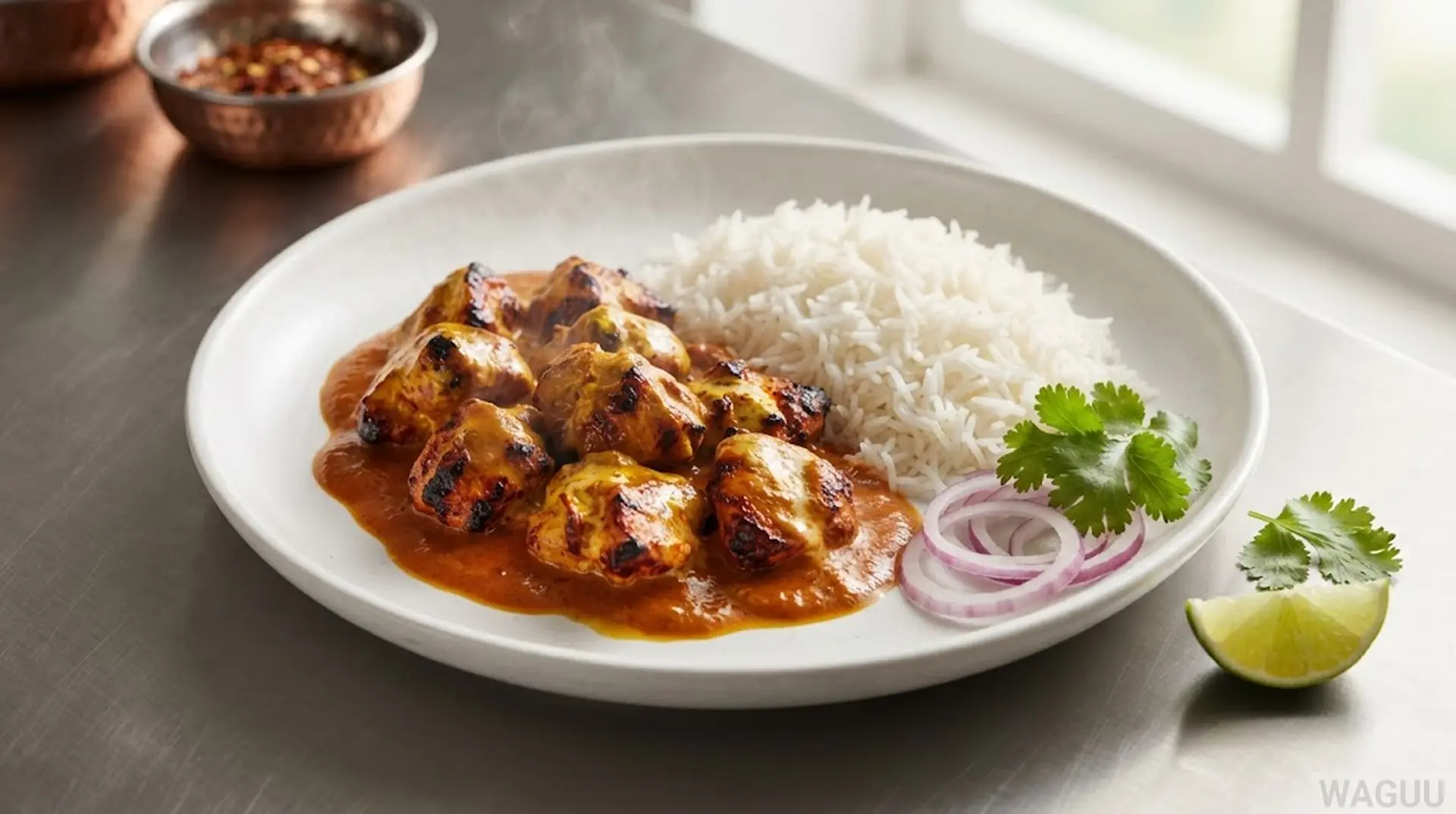
Summary: Chicken cubes are marinated in spiced yogurt, seared until charred, then simmered in a tomato-cream sauce with garam masala. The char from the grill is what sets this dish apart from ordinary curry. Total time 80 minutes, serves 6.
Did you make this recipe? Share your result with the community.
Category: Poultry · Indian Cuisine
Success rate: not rated yet % of users mastered this recipe
Quick overview
- Dish: Chicken Tikka Masala – pieces of marinated chicken in a spiced tomato-cream sauce
- Category: poultry, indian-cuisine
- Cuisine: Indian
- Main ingredient: Chicken thighs, 2.2 lb (boneless, skinless, cubed) (quality specification)
- Guide: 12 most famous Indian dishes: traditional recipes from Indian cuisine
- Total time: 80 minutes (30 min prep + 50 min cooking)
- Difficulty: Medium
- Servings: 6 (Serving size: 14.5 oz)
- Key technique: Searing marinated meat until charred and simmering tomato-cream sauce
- Preparation type: Grilling or broiling, simmering sauce
- Dietary info & allergens: milk (plain yogurt, cream, ghee)
- Suitable for: Family dinner, dinner with friends, festive multi-course table, and meal prep for several days ahead.
- Nutrition facts (per serving): 444, Protein: 39.8 g, Fat: 27.2 g, Carbs: 10.0 g
- Storage: 3 days in refrigerator, 1 month in freezer
- Pairing: Indian light lager, dry Riesling, salted lassi
- In short: Chicken cubes are marinated in spiced yogurt, seared until charred, then simmered in a tomato-cream sauce with garam masala. Total time 80 minutes, 6 servings.
WAGUU says: “Tikka masala is a sauce waiting for meat. Not meat drowning in sauce.”
Key facts
| Prep time: | 30 |
| Cook time: | 50 |
| Temperature: | Grill at 450–480 °F, sauce at 185–195 °F, cream added below 175 °F |
| Servings: | 6 |
In a nutshell
Tikka masala relies on two steps that cannot be combined: the meat must get a char from high heat, and the sauce must be made separately. The color of the char is key – dark spots carry flavor that the sauce alone never provides. If you put raw meat into the sauce, you get chicken in tomatoes, not tikka masala.
Ingredients
Base servings: 6 servings • Serving size: 14.5 oz
| Ingredient | Amount | Quality |
|---|---|---|
| boneless chicken meat | 2.2 lb | boneless skinless thighs, cut into 1.5-inch cubes |
| plain yogurt | 7.0 oz | full-fat, thick, room temperature |
| crushed tomatoes | 18 oz | peeled, no added salt |
| onion | 2 pcs | medium, finely chopped |
| ginger | 0.9 oz | fresh, finely grated |
| garlic | 6 pcs | fresh, finely minced |
| cream | 6.8 fl oz | heavy cream, 30% fat |
| ghee | 1.5 oz | clarified butter, for high heat |
| diced tomatoes | 7.0 oz | diced, unsweetened |
| garam masala | 2 tsp | freshly ground blend |
| ground coriander | 2 tsp | ground, toasted |
| ground cumin | 1 tsp | ground, toasted |
| turmeric | 1 tsp | ground |
| red chili flakes | 1 tsp | hot, to taste |
| salt | 1 tsp | fine, for marinade |
| fresh cilantro | 0.7 oz | fresh, for garnish |
Why you’ll love this recipe
- Char that the sauce alone can’t give: High heat creates a crust on the meat whose flavor washes into the sauce. The dish then tastes grilled, not stewed.
- Two stages, no rush: Meat and sauce are made separately and combined only at the end. Each part gets the temperature it needs.
- Dish for guests: You can prepare the sauce and meat ahead and combine before serving. It looks freshly cooked on the table.
Success guaranteed: At temperatures above 300 °F, browning occurs on the meat’s surface, creating hundreds of aromatic compounds. These then wash into the sauce and give it depth. That’s why the sauce is cooked separately and the meat is added only in the last ten minutes. The yogurt in the marinade keeps the meat moist because its protein coagulates on the surface before the meat fibers do.
Recipe overview
Prep: 30 min | Cook: 50 min | Difficulty: Medium | Servings: 6 | Type: Main dish | Origin: Indian
Detailed instructions
Total progress: 0 % done
Phase 1: Yogurt and spice marinade – 30 min
Equipment: bowl, plastic wrap, refrigerator
1. Mix yogurt with grated ginger, half the garlic, ground coriander, cumin, turmeric, red chili flakes, and salt. Whisk until smooth.
2. Add meat cubes to the marinade and massage with your hands. Cover the bowl and refrigerate. Twenty minutes before the next step, take the meat out so it’s not ice-cold.
VKB: The marinade is smooth, lump-free, and clings to the meat. The meat is firm to the touch and its surface has the color of the spices.
Before you move to the next step:
The salt marinade should not be too strong. Salt draws out water, and when there is too much, the meat dries out even before searing. Measure it precisely and let the marinade rest.
Phase 2: Sear to a crust – 12 min
Equipment: grill or cast-iron skillet, tongs, baking sheet
1. Heat the grill or cast-iron skillet to maximum. Remove the meat cubes from the marinade and let them drain so the marinade does not burn on the grate.
2. Spread the meat out with space between pieces and sear on each side to a dark golden crust. Do not flip too early, or the crust will tear.
Key checkpoints: The crust is dark golden to brown, with some black spots on the edges but not burnt. The meat inside remains juicy and does not release water when pressed with tongs.
Before you move to the next step:
Wet meat steams on the grill and no crust forms. Dry each piece with a paper towel and do not overload the grill – otherwise the temperature drops.
Phase 3: Tomato base – 20 min
Equipment: heavy-bottomed pot, wooden spoon
1. In the remaining ghee, sauté the onion until golden brown, add the remaining garlic and ginger and cook until fragrant. Sprinkle in the remaining garam masala and stir until it blooms.
2. Add the whole peeled and crushed tomatoes and crush them with a wooden spoon. Simmer over low heat until the sauce thickens and the oil separates on the surface.
Key checkpoints: The sauce is thick, dark red, and glossy, with a thin layer of oil on the surface. The flavor is sweet from the tomatoes, not raw.
Before you move to the next step:
Tomatoes drained too early leave the sauce sour and thin. Let it really cook down and stir along the bottom so it does not scorch.
Phase 4: Combine meat with sauce – 10 min
Equipment: pot, lid
1. Add the seared meat to the sauce and stir. Pour in a little water so the sauce stays thick and does not stick to the bottom, and simmer over low heat.
2. Stir the sauce and check how the meat is softening. The crust partially dissolves into the sauce and gives it depth – that is the sign of well-made tikka masala.
Key checkpoints: The sauce has darkened and taken on a meaty flavor, the meat is tender and the crust remains only as a hint. The sauce coats a spoon.
Before you move to the next step:
Leave the meat in the sauce only briefly. Long simmering completely dissolves the crust and the dish loses its character.
Phase 5: Finish with cream – 6 min
Equipment: cup, whisk
1. Warm the cream in a cup to room temperature, then pour it into the sauce in a thin stream while stirring constantly.
2. Remove the pot from the heat so the sauce stops boiling. The cream should just blend in the warmth, not boil.
Key checkpoints: The sauce is velvety and lighter, the color has turned orange-brown. The flavor is rounded and the heat is milder.
Before you move to the next step:
Cold or overcooked cream curdles into small flakes. Warm it and add it off the boil; a curdled sauce can only be strained.
Phase 6: Adjust and serve – 4 min
Equipment: serving bowl, spoon
1. Taste the sauce and adjust with salt, ground paprika, and the remaining garam masala. Add spices only to the finished sauce so the aroma does not fade.
2. Transfer the tikka masala to a warm bowl, top with a spoonful of cream, a slice of grilled onion, and cilantro.
Key checkpoints: On the plate, the sauce does not run but clings to the rice. The aroma is spicy with a hint of grill and cream.
Required equipment
| Utensil | Ideal size | Alternative | Risk |
|---|---|---|---|
| grill or grill pan | surface for six pieces of meat | cast-iron skillet heated in the oven to 480 °F | an overcrowded grill loses temperature and the meat steams instead of searing |
| sauce pot | 3-quart capacity | wide sauté pan with lid | a thin-walled pot will scorch the tomatoes at the bottom during reduction |
| kitchen thermometer | up to 570 °F | check by smoke and crust color | without measuring, the sauce goes above 195 °F and the cream curdles |
| meat tongs | 12-inch length | two forks | piercing with a fork squeezes juice out of the meat and tears the crust |
Shopping list
Nutrition profile
Values per 1 serving (without side dish). Calculated from average nutritional values of ingredients.
| Nutrient | Per 100 g | Per 1 serving | For 6 servings |
|---|---|---|---|
| Energy | 452 kJ / 108 kcal | 1858 kJ / 444 kcal | 11146 kJ / 2664 kcal |
| Fat | 6.6 g | 27.2 g | 163.2 g |
| of which saturated | 3.2 g | 13.0 g | 78.2 g |
| Carbohydrates | 2.4 g | 10.0 g | 60.0 g |
| of which sugars | 2.1 g | 8.8 g | 52.8 g |
| Protein | 9.7 g | 39.8 g | 238.8 g |
| Salt | 0.3 g | 1.2 g | 7.0 g |
Reference intake of an average adult (8400 kJ / 2000 kcal).
WAGUU Pro level
- Pro standard: Verified recipe with precise ratios and visual checkpoints.
- Tip 1: Verified recipe with precise ratios and visual checkpoints.
- Tip 2: The marinade is smooth, without lumps, and clings to the surface of the meat. The meat is firm to the touch and its surface has the color of the spices. The salt marinade should not be too strong. Salt draws out water, and when there is too much, the meat dries out even before searing. Measure it precisely and let the marinade rest.
- Tip 3: The crust is dark golden to brown, with some black spots on the edges but not burnt. The meat inside remains juicy and does not release water when pressed with tongs. Wet meat steams on the grill and no crust forms. Dry each piece with a paper towel and do not overload the grill – otherwise the temperature drops.
- Tip 4: Prepare the ingredients on the table in small bowls beforehand. Indian cooking relies on spices added in a precise order, and there is no time to portion ingredients during cooking.
Scientific background
Capsaicin from chili and curcumin from turmeric are fat-soluble, so the spices are first bloomed in ghee or oil. Tomato paste contains glutamate, which intensifies the meaty flavor of the crust. Cream is added off the heat so the milk fat does not separate and the sauce stays smooth.
Fine Dining – Professional techniques
- Plate composition: Spread the sauce in a circle on the bottom of the plate and place three pieces of meat on top, crust side up. The crust is the visual center of the dish.
- Texture contrasts: Add a crunchy element – a thin slice of naan dried in the oven or toasted almonds. The smoothness of the sauce needs contrast.
- Temperature contrast: Drizzle a few drops of ghee with paprika over the meat. The fat on the surface releases aroma that would otherwise be lost in the steam.
- Aromatic additions: Serve a small bowl of yogurt with mint and pickled onions on the side. Guests can refresh their portion to their own taste.
Sensory radar
- Appearance: The sauce is orange-brown and glossy, the meat pieces have dark grill marks, and a spoonful of cream floats on top.
- Aroma: Grill smoke, then sweet tomatoes with cream, and finally warm garam masala.
- Taste: First the meaty flavor of the crust, then the sweetness of tomatoes, and finally the heat that spreads slowly.
- Texture: The meat is firm but tender, the sauce velvety and thick, with small pieces of onion.
Pairings
- Indian light lager: A light lager with higher carbonation washes away the tomato acidity and heat from the palate. Serve at 41–45°F.
- Dry Riesling: A dry Riesling with acidity keeps up with the tomatoes and doesn’t succumb to the heat. An off-dry version would flatten the dish.
- Salted lassi: Salted lassi made from yogurt and cumin. The milk protein binds capsaicin and the heat quickly subsides.
Variations
- Paneer tikka masala: Replace the meat with cubes of paneer, which you sear in a dry pan until golden brown. The dish is meatless and ready in half the time.
- Lamb tikka masala: Use boneless lamb shoulder and marinate it overnight. The simmering time increases by twenty minutes.
Allergens and dietary information
Contains: milk (plain yogurt, cream, ghee) • Gluten: no, the recipe is gluten-free (yogurt, tomatoes, cream) • Not suitable for: people with an allergy to milk and dairy products
Suitable for
Family dinner, dinner with friends, a festive table with multiple courses, or meal prep for several days ahead.
Substitution catalog
- boneless chicken: boneless turkey thigh or firm tofu (marinate for the same amount of time)
FAQ
What is the difference between tikka masala and butter chicken?
Tikka masala has seared meat with a crust and more pronounced heat, while butter chicken is milder, with more butter and cream and no grilling. Both dishes have a tomato base.
Do I need a grill?
No, a cast-iron skillet heated to maximum or an oven with a broiler works. The important thing is that the meat surface is dry and the heat is high.
Why does my meat fall apart in the marinade?
The marinade was too acidic or the meat sat in it too long. Yogurt keeps meat fine for twelve hours; longer than that and it starts to break down the surface.
How can I make the sauce milder for kids?
Use only sweet paprika and omit the chili. Then adults can adjust the heat on their plate with chili flakes.
Can tikka masala be made ahead?
Yes. Make the sauce two days in advance and sear the meat on the day of serving. Reheat the sauce, then add the meat for five minutes.
What to do if the sauce is too spicy?
Add a spoonful of yogurt or cream and a pinch of sugar. A larger portion of rice or naan also tones down the heat.
WAGUU Petr advises: Cooking for 6 or more people?
6–8 people: Prepare the masala (fried spice base) in double batch and store half in the refrigerator. When cooking for more people, use two pots instead of one large one – spices don’t roast evenly in too thick a layer. • 10+ people: Replace the tandoor with a grill or a cast-iron skillet heated in the oven to maximum. Prepare the naan dough and chicken marinade the day before and keep them in the refrigerator – both flavor and texture will be better.
Sides and serving
Serving: Serve tikka masala in a deep bowl with basmati rice, spoon cream on top and add a slice of grilled onion. Naan and a small bowl of yogurt with mint go with the meal.
Storage and reheating
Refrigerator: 3 days • Freezer: 1 month • Reheating: Refrigerator: 3 days • Freezer: 1 month • Reheating: over medium heat to 165°F, with a spoonful of water; add cream only after reheating
Author: WAGUU Petr & Team • Published: 9 Oct 2026 • Updated: 10 Oct 2026
More recipes from the article
Guide: 12 most famous Indian dishes: traditional recipes from Indian cuisine
Butter Chicken – chicken in a mild creamy tomato sauce with butter and aromatic spices
Tandoori Chicken – chicken marinated in yogurt and spices and baked at high temperature
Biryani – aromatic layered rice with meat, saffron, and a blend of spices
Rogan Josh – slow-cooked lamb in an aromatic sauce with Kashmiri spices
Chana Masala – chickpeas simmered in a spicy sauce of tomatoes, onions, and aromatic spices
Chana Masala – chickpeas simmered in a spicy sauce of tomatoes, onions, and aromatic spices
Dal Tadka – lentils flavored with fried spices, garlic, onion, and chili
Masala Dosa – thin crispy fermented crepe made from rice and lentils with spiced potatoes
Samosa – fried triangular pastries filled with potatoes, peas, and spices
Chole Bhature – spiced chickpeas with large fried leavened flatbreads bhature
Naan – traditional Indian flatbread baked at high temperature in a tandoor
More recipes you might like
Why WAGUU?
Recipes on WAGUU are checked for accuracy of ingredients, procedures, and nutritional values.
Photo gallery from the process
Photos from the community: Cook, take a photo, and share the result.
You can upload photos in the comments below or send them by email.
Did you film a video of our recipe? Paste the link to YouTube, YouTube Shorts, TikTok, Instagram Reels, Facebook Reels, Pinterest, Vimeo, or X (Twitter) in the comment – we’ll be happy to publish it and help you and your content get noticed.
Most common mistakes
- Yogurt and spice marinade – The salty marinade must not be too strong. Salt draws out water, and when there’s too much, the meat dries out even before searing. Measure it precisely and let the marinade rest.
- Searing to form a crust – Wet meat steams on the grill and no crust forms. Dry each piece with a paper towel and don’t overcrowd the grill – otherwise the temperature drops.
- Tomato base – Tomatoes drained too early leave the sauce sour and thin. Let it really cook down and stir the bottom to prevent burning.
- Combining meat with sauce – Leave the meat in the sauce briefly. Long simmering completely dissolves the crust and the dish loses its character.