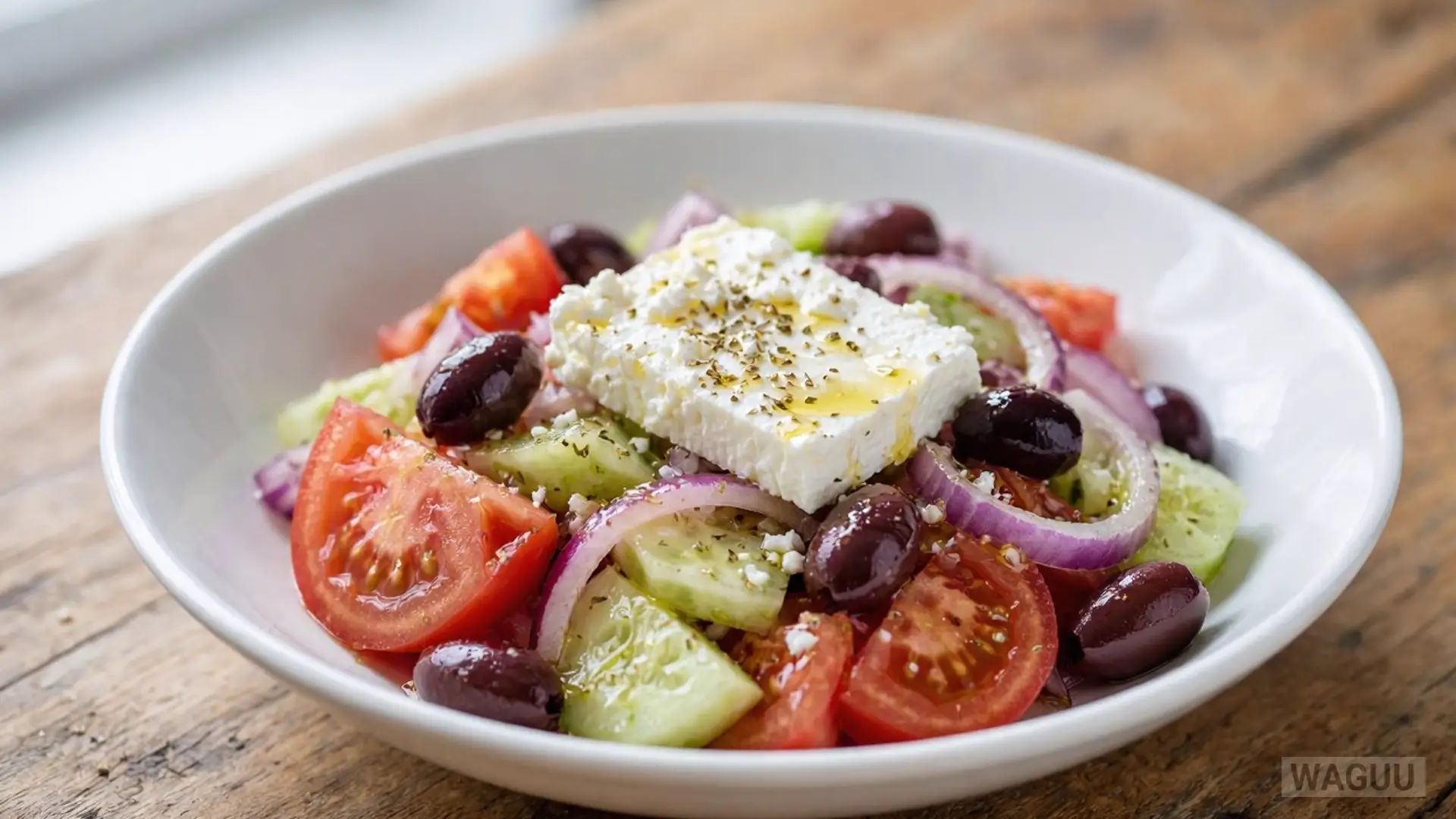
Summary: Greek Salad (Horiatiki) – Traditional authentic Greek salad made with ripe tomatoes, crisp cucumber, red onion, Kalamata olives, and creamy feta cheese, dressed simply with extra virgin olive oil and red wine vinegar, completely without lettuce in its classic form. Prep time 15 minutes, yields 4 servings.
Did you make this recipe? Share the result with the community.
Category: Salads, Mediterranean Cuisine
Success rate: not rated yet% of users successfully made this recipe
Quick overview
- Dish: Greek Salad (Horiatiki)
- Category: Salads, Mediterranean Cuisine
- Cuisine: Greek
- Main ingredient: Vine-ripened tomatoes, 1 lb (ripe, high quality)
- Guide: 12 Most Popular Mediterranean Dishes: Favorite Mediterranean Cuisine Recipes
- Total time: 15 minutes (15 min prep + 0 min cooking)
- Difficulty: Easy
- Servings: 4 servings (Serving weight: 250 g)
- Key technique: Rough chopping and layering without lettuce
- Preparation types: Raw assembly
- Dietary info & Allergens: Contains dairy (feta cheese), vegetarian, gluten-free
- Suitable for: Summer dining, light lunch, barbecue side dish
- Nutritional values (per 1 serving): 220 kcal, Protein: 7.0 g, Fat: 18.0 g, Carbs: 8.5 g
- Storage: 1 days in the fridge, 0 months in the freezer
- Pairing: Mythos beer, dry Greek Assyrtiko wine, iced sparkling water with lemon
- In a nutshell: A vibrant, crisp, sun-drenched classic celebrating pure Mediterranean flavors with zero lettuce.
- Last updated: October 24, 2023
WAGUU says: “The secret to an authentic Greek salad lies in the quality of the ingredients: sun-ripened tomatoes, authentic sheep’s milk feta, and bold extra virgin olive oil.”
Key facts
| Prep time: | 15 minutes |
| Cooking time: | 0 minutes |
| Temperature: | Chilled or room temperature |
| Number of servings: | 4 servings |
In a nutshell
Experience the authentic taste of the Greek taverna right in your kitchen with this traditional Horiatiki salad. Combining juicy tomatoes, crunchy cucumbers, pungent red onions, briny Kalamata olives, and a glorious block of feta cheese drizzled with extra virgin olive oil and oregano, this salad represents the pinnacle of Mediterranean simplicity and flavor.
Ingredients
Base servings: 4 servings • Serving weight: 250 g
| Ingredient | Quantity | Quality |
|---|---|---|
| Vine-ripened tomatoes | 1 lb | Ripe, room temperature, cut into wedges |
| English cucumber | 1 piece | Fresh, sliced into thick half-moons |
| Red onion | 0.5 cup | Thinly sliced |
| Kalamata olives | 0.5 cup | Pitted or whole, authentic Greek |
| Feta cheese | 7 oz | One thick block, sheep’s milk |
| Extra virgin olive oil | 4 tbsp | High-quality Greek extra virgin |
| Red wine vinegar | 1 tbsp | Traditional wine vinegar |
| Dried oregano | 1 tsp | Greek mountain oregano |
| Kosher salt | 0.5 tsp | To taste |
Why you’ll love this recipe
- Authentic tradition: Prepared strictly according to Greek culinary tradition without any lettuce or leafy greens.
- Lightning fast: Ready to serve in just 15 minutes using fresh, raw ingredients.
- Bold flavors: Perfectly balances acidic tomatoes, salty feta, briny olives, and fragrant oregano.
Success guaranteed: Follow our expert slicing techniques and use authentic Greek ingredients for a restaurant-quality result every single time.
Recipe overview
Prep: 15 min | Cooking: 0 min | Difficulty: Easy | Servings: 4 | Type: Salad | Origin: Greece
Detailed instructions
Overall progress: 0% completed
Phase 1: Preparing the Vegetables – 5 min
Appliances: Cutting board, chef’s knife
1. Wash the 1 lb of vine-ripened tomatoes and 1 English cucumber thoroughly under cold running water. Pat them dry with a clean kitchen towel. Cut the tomatoes into generous wedges and slice the cucumber into thick half-moon pieces (about 1/4 inch thick) to maintain a satisfying crunch.
CP: Tomatoes should be chunky wedges and cucumber slices thick and uniform.
Before moving to the next step:
Ensure tomatoes are at room temperature, as refrigeration dulls their natural flavor.
Phase 2: Slicing Onion and Mellowing – 4 min
Appliances: Cutting board, knife, small bowl
2. Peel the red onion and slice 0.5 cup into very thin half-rings. If the onion is exceptionally sharp, soak the slices in a small bowl of cold water for 5 minutes to mellow their bite, then drain and pat dry before adding to the salad.
CP: Onion slices should be paper-thin and translucent.
Before moving to the next step:
Check that onions are well drained so excess water does not dilute the dressing.
Phase 3: Combining Vegetables and Olives – 3 min
Appliances: Wide serving bowl, mixing spoon
3. In a wide, shallow serving bowl, combine the prepared tomato wedges, cucumber slices, and thinly sliced red onion. Add 0.5 cup of Kalamata olives. Toss gently to distribute the vegetables evenly without bruising the tomatoes.
CP: Colors should be vibrant red, green, and dark purple.
Before moving to the next step:
Verify that olives are pitted if serving to guests for ease of eating.
Phase 4: Adding the Feta Cheese – 1 min
Appliances: Knife
4. Take the 7 oz block of feta cheese and place it directly on top of the mixed vegetables in the center of the bowl, maintaining the traditional slab presentation rather than crumbling it.
CP: The feta block rests proudly on top of the salad ingredients.
Before moving to the next step:
Do not break up the feta yet; breaking it happens at the dining table.
Phase 5: Dressing and Seasoning – 1 min
Appliances: Measuring spoons
5. Drizzle 4 tbsp of extra virgin olive oil and 1 tbsp of red wine vinegar evenly over the entire salad and directly over the feta block. Sprinkle 0.5 tsp of kosher salt and 1 tsp of dried oregano generously over the top.
CP: Oregano is rubbed between palms slightly to release essential oils before sprinkling.
Before moving to the next step:
Use caution with salt since feta cheese and Kalamata olives are naturally quite salty.
Phase 6: Final Resting and Serving – 1 min
Appliances: None
6. Let the salad rest at room temperature for 5 minutes before serving to allow the olive oil and juices to mingle into a delicious bottom dressing. Serve immediately with crusty bread to soak up the juices.
CP: Salad is glossy, aromatic, and ready to be enjoyed.
Required equipment
| Utensil | Ideal size | Alternative | Risk |
|---|---|---|---|
| Chef’s knife | 8-inch blade | Santoku knife | Dull blade crushing tomatoes |
| Cutting board | Medium wooden | Plastic cutting board | Juice overflow |
| Serving bowl | Wide, shallow 10-inch | Large dinner platter | Spilling during tossing |
Shopping list
Nutrition profile
Values per 1 serving (excluding side dishes). Calculated from average ingredient nutrition values.
| Nutrient | Per 100 g | Per 1 serving | Per 4 servings |
|---|---|---|---|
| Energy | 88.0 kcal | 220.0 kcal | 880.0 kcal |
| Fat | 7.2 g | 18.0 g | 72.0 g |
| of which saturates | 3.2 g | 8.0 g | 32.0 g |
| Carbohydrates | 3.4 g | 8.5 g | 34.0 g |
| of which sugars | 2.5 g | 6.2 g | 24.8 g |
| Protein | 2.8 g | 7.0 g | 28.0 g |
| Salt | 0.9 g | 2.3 g | 9.2 g |
Reference intake of an average adult (8400 kJ / 2000 kcal).
WAGUU Pro level
- Pro standard: Verified recipe with precise ratios and authentic Greek preparation techniques.
- Tip 1: Always use room temperature tomatoes; refrigeration destroys their cellular structure and mutes flavor.
- Tip 2: Buy authentic sheep’s or goat’s milk Greek feta for a creamier, tangier texture compared to cow’s milk alternatives.
- Tip 3: Never chop the feta into small cubes; a solid block on top is the hallmark of a true Horiatiki.
- Tip 4: Rub dried oregano between your palms before sprinkling to awaken the volatile aromatic oils.
Scientific background
Tomatoes contain high levels of glutamic acid, which enhances savory flavors when combined with the sodium and lipids found in feta cheese and extra virgin olive oil. The absence of lettuce ensures that the high water content of cucumbers and tomatoes remains unmitigated by absorbent leafy greens, creating a flavorful liquid base at the bottom of the bowl known in Greece as ‘ladolemono’ or vegetable juices mixed with olive oil.
Fine Dining – Professional techniques
- Plate composition: Present in a shallow wide ceramic bowl with the feta block centered and crowned with Kalamata olives and oregano.
- Texture contrasts: Juiciness of ripe tomatoes paired with crisp cucumber bite and crumbly, rich feta cheese.
- Temperature contrast: Best served at cool ambient temperature with chilled fresh cucumbers and tomatoes.
- Aromatic garnishes: Crushed Greek mountain oregano and unrefined extra virgin olive oil drizzles.
Sensory radar
- Appearance: A brilliant mosaic of ruby red tomatoes, crisp white-green cucumbers, dark purple olives, and pristine white feta.
- Aroma: Herbaceous oregano, fruity olive oil, and fresh garden vegetables.
- Taste: Bright acidity, savory saltiness from feta and olives, rounded out by sweet ripe tomatoes.
- Texture: Tender tomato flesh, crisp cucumber crunch, and creamy, dense feta.
Pairing
- BEER: Chilled Greek Mythos lager
- WINE: Crisp, mineral-driven Assyrtiko from Santorini
- NON-ALCOHOLIC: Sparkling mineral water with a fresh lemon wedge
Various preparation methods
- Cretan Dakos Style: Serve over dried barley rusks (paximadia) soaked in the salad juices.
- Caper Addition: Add 1 tbsp of salted Greek capers rinsed for a briny flavor boost.
Allergens and dietary information
Contains: Dairy (Feta cheese) • Gluten: Naturally gluten-free • Not suitable for: Vegan diets due to dairy feta
Suitable for
Summer dining, light lunches, outdoor barbecues, and Mediterranean-themed dinners.
Substitution guide
- Red onion: Shallots or sweet Vidalia onion
- Kalamata olives: Black Niçoise or Gaiza olives
FAQ
Why is there no lettuce in authentic Greek salad?
Traditional Horiatiki relies entirely on sun-ripened summer vegetables like tomatoes and cucumbers. Lettuce is considered an Americanization and is absent in Greek tavernas.
Should I crumble the feta or leave it as a block?
Authentic Greek salad features a thick slab or block of feta resting on top, allowing diners to break off as much as they prefer with their own fork.
Can I make this salad ahead of time?
It is best consumed immediately after preparation. Letting it sit too long causes tomatoes to release excess water, diluting the dressing.
What kind of olives should I use?
Authentic Kalamata olives with pits provide the best rich, fruity flavor, though pitted versions can be used for convenience.
WAGUU Petr advises: Cooking for 12 or more people?
12–16 people: Scale ingredients by multiplying by 3 or 4. Chop vegetables in batches and keep dressing separate until just before serving to prevent sogginess. • 20+ people: Prepare in two large separate bowls and dress right before placing on the buffet table.
Sides and serving
- Crusty artisan bread – Perfect for soaking up the olive oil and tomato juices (not included in the recipe)
- Grilled souvlaki skewers – Excellent protein pairing for a complete Mediterranean feast (not included in the recipe)
Serving: Serve family-style in a wide ceramic bowl with a wooden serving spoon and warm bread on the side.
Storage and reheating
Fridge: 1 days • Freezer: 0 months • Reheating: Do not reheat; serve chilled or at room temperature.
Author: WAGUU Petr & Team • Published: 26 Aug 2026 • Updated: 31 Oct 2026
More Recipes in This Article
Other recipes you might enjoy
Why WAGUU?
Recipes on WAGUU undergo checks for ingredient accuracy, procedures, and nutritional values.
Process photo gallery
Community photos: Cook, take a picture, and share your results.
You can upload photos in the comments below or send them via email.
Did you record a video of your process for our recipe? Paste a link to YouTube, YouTube Shorts, TikTok, Instagram Reels, Facebook Reels, Pinterest, Vimeo, or X (Twitter) in the comments – we’d love to share it and help give you and your content more visibility.
Common mistakes
- Adding lettuce: Traditional Greek salad never contains lettuce or leafy greens.
- Crumbling the feta: Feta should be served as a solid block on top, not crumbled throughout the salad.
- Refrigerating tomatoes: Storing tomatoes in the fridge ruins their texture and strips away their flavor.
- Skipping the oregano: Authentic Greek oregano is essential for achieving the signature Mediterranean aroma and taste.