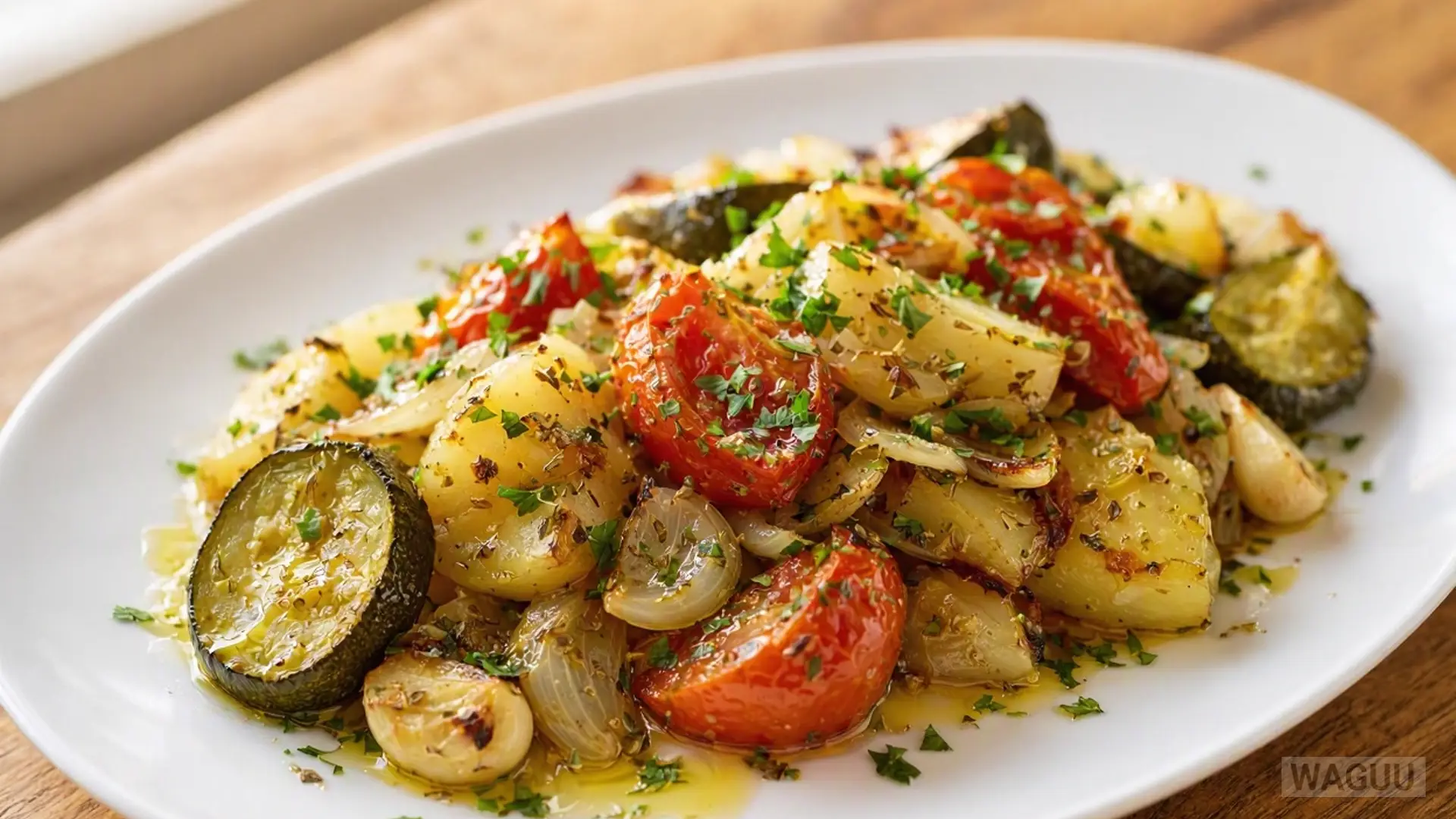
Summary: Briam – Greek roasted vegetables with tomatoes, zucchini, potatoes, and oregano, baked in olive oil until tender. Main vegetable dish, slow-roasted oven technique, 1 hour 30 minutes total preparation and cooking time, servings for 6.
Did you make this recipe? Share the result with the community.
Category: Main Dishes, Mediterranean Cuisine
Success rate: not rated yet% of users successfully made this recipe
Quick overview
- Dish: Briam
- Category: Main Dishes, Mediterranean Cuisine
- Cuisine: Greek
- Main ingredient: Zucchini and potatoes, 2 lb (fresh, firm and evenly sliced)
- Guide: 12 Most Popular Mediterranean Dishes: Favorite Mediterranean Cuisine Recipes
- Total time: 90 minutes (30 min prep + 60 min cooking)
- Difficulty: Easy
- Servings: 6 servings (Serving weight: 350 g)
- Key technique: Slow-roasting
- Preparation types: Slicing, layering, baking
- Dietary info & Allergens: Vegan, vegetarian, gluten-free, dairy-free
- Suitable for: Family dinners, vegetarian feasts, summer lunches
- Nutritional values (per 1 serving): 280 kcal, Protein: 5 g, Fat: 16 g, Carbs: 32 g
- Storage: 3 days in the fridge, 2 months in the freezer
- Pairing: Amber Lager, Assyrtiko, Lemon Water
- In a nutshell: Traditional Greek oven-roasted vegetables bathed in extra virgin olive oil and aromatic herbs until fork-tender and caramelized.
- Last updated: June 6, 2024
WAGUU says: “The secret to an exceptional Briam lies in allowing the high-quality extra virgin olive oil to thoroughly meld with the natural juices of the zucchini and tomatoes during a long, slow bake.”
Key facts
| Prep time: | 30 minutes |
| Cooking time: | 60 minutes |
| Temperature: | 400 °F (200 °C) |
| Number of servings: | 6 servings |
In a nutshell
Briam is a quintessential Greek comfort food dish that transforms humble garden vegetables into a magnificent centerpiece. Thinly sliced potatoes, zucchini, red onions, and ripe tomatoes are layered in a baking dish, generously drizzled with authentic Greek extra virgin olive oil, seasoned with garlic and dried oregano, and slow-roasted until the vegetables become meltingly tender and develop a rich, concentrated flavor profile.
Ingredients
Base servings: 6 servings • Serving weight: 350 g
| Ingredient | Quantity | Quality |
|---|---|---|
| Yellow Potatoes | 1.5 lb | Waxy, peeled and sliced ¼ inch thick |
| Zucchini | 1.25 lb | Fresh, firm, sliced ¼ inch thick |
| Ripe Tomatoes | 1.25 lb | Juicy, firm, sliced ¼ inch thick |
| Red Onions | 0.75 lb | Sliced into thin half-moons |
| Garlic Cloves | 4 cloves | Minced finely |
| Extra Virgin Olive Oil | 0.75 cup | High-quality Greek olive oil |
| Dried Oregano | 1.5 tbsp | Greek mountain oregano |
| Tomato Paste | 2 tbsp | Concentrated |
| Water | 0.5 cup | Warm |
| Sea Salt | 1.25 tsp | Fine grain |
| Black Pepper | 0.75 tsp | Freshly ground |
| Fresh Parsley | 0.25 cup | Chopped for garnish |
Why you’ll love this recipe
- Authentic Greek Flavors: Features classic Mediterranean ingredients like Greek olive oil, mountain oregano, and ripe summer tomatoes.
- Naturally Plant-Based: Completely vegan and vegetarian-friendly without sacrificing richness or satisfaction.
- One-Pan Simplicity: Assembles easily in a single roasting dish for minimal cleanup and maximum flavor mingling.
Success guaranteed: Follow the slicing thickness and baking times closely to achieve perfectly tender potatoes paired with caramelized edges.
Recipe overview
Prep: 30 min | Cooking: 60 min | Difficulty: Easy | Servings: 6 | Type: Main Dish | Origin: Greek
Detailed instructions
Overall progress: 0% completed
Phase 1: Preparing and Slicing the Vegetables – 15 min
Appliances: Chef’s knife, cutting board
1. Wash all vegetables thoroughly under cold running water and pat them completely dry with paper towels. Peel the yellow potatoes and red onions. Using a sharp chef’s knife, slice the potatoes, zucchini, tomatoes, and red onions into uniform rounds approximately ¼ inch thick. Keep the slices consistent to ensure even cooking throughout the baking process.
CP: Uniform ¼-inch thickness achieved across all vegetable slices.
Before moving to the next step:
Ensure the oven is preheated properly before assembling to maintain consistent thermal conditions.
Phase 2: Mixing the Flavor Base – 5 min
Appliances: Mixing bowl, whisk
2. In a medium mixing bowl, whisk together the 0.75 cup extra virgin olive oil, 2 tbsp tomato paste, 0.5 cup warm water, minced garlic cloves, 1.5 tbsp dried oregano, 1.25 tsp sea salt, and 0.75 tsp freshly ground black pepper until the tomato paste is fully dissolved and the liquid emulsifies into a fragrant dressing.
CP: Smooth, emulsified oil and tomato mixture.
Before moving to the next step:
Check that the dressing is well-combined with no clumps of tomato paste remaining.
Phase 3: Layering the Baking Dish – 10 min
Appliances: 9×13 inch baking pan
3. Arrange the sliced vegetables in a large 9×13 inch baking pan. You can either intersperse them in an alternating pattern (potato, zucchini, tomato, onion repeated in rows) or toss them gently with half the dressing directly in the pan and arrange them neatly. Pour the remaining olive oil and tomato dressing evenly over the top of the layered vegetables, ensuring every piece receives seasoning.
CP: Vegetables evenly arranged and coated with dressing.
Before moving to the next step:
Verify that the oven has reached 400 °F (200 °C) before placing the dish inside.
Phase 4: Initial Covered Baking – 30 min
Appliances: Oven, aluminum foil
4. Cover the baking pan tightly with aluminum foil to trap the steam, allowing the potatoes and zucchini to soften thoroughly. Place the pan into the preheated oven at 400 °F (200 °C) and bake for 30 minutes. This steaming phase ensures the dense root vegetables cook completely through without burning.
CP: Foil sealed tightly around the edges of the pan.
Before moving to the next step:
Carefully remove the foil, watching out for escaping hot steam.
Phase 5: Uncovered Roasting and Caramelization – 30 min
Appliances: Oven
5. Remove the aluminum foil carefully. Return the uncovered baking dish to the 400 °F (200 °C) oven for another 30 minutes. Bake until excess liquid reduces into a rich sauce, and the top vegetables develop gorgeous golden-brown caramelized edges.
CP: Golden-brown edges and reduced, bubbling juices.
Before moving to the next step:
Allow the dish to rest briefly so the olive oil and tomato juices settle.
Phase 6: Resting and Garnish – 10 min
Appliances: Serving spoon
6. Remove the Briam from the oven and let it rest at room temperature for 10 minutes. Scatter the freshly chopped parsley over the top. Serve warm or at room temperature alongside crusty artisanal bread and feta cheese if desired.
CP: Resting period complete, garnished and ready for plating.
Required equipment
| Utensil | Ideal size | Alternative | Risk |
|---|---|---|---|
| Baking Pan | 9×13 inches | Large roasting dish | Overcrowding if too small |
| Chef’s Knife | 8-inch blade | Santoku knife | Uneven vegetable slices |
| Mixing Bowl | 2-quart capacity | Large measuring cup | Spilling dressing when whisking |
Shopping list
Nutrition profile
Values per 1 serving (excluding side dishes). Calculated from average ingredient nutrition values.
| Nutrient | Per 100 g | Per 1 serving | Per 6 servings |
|---|---|---|---|
| Energy | 80.0 kcal | 280.0 kcal | 1680.0 kcal |
| Fat | 4.6 g | 16.0 g | 96.0 g |
| of which saturates | 0.7 g | 2.4 g | 14.4 g |
| Carbohydrates | 9.1 g | 32.0 g | 192.0 g |
| of which sugars | 3.4 g | 12.0 g | 72.0 g |
| Protein | 1.4 g | 5.0 g | 30.0 g |
| Salt | 0.3 g | 1.1 g | 6.6 g |
Reference intake of an average adult (8400 kJ / 2000 kcal).
WAGUU Pro level
- Pro standard: Verified recipe with precise ratios and visual checkpoints.
- Tip 1: Use ripe, in-season vine tomatoes for maximum natural sweetness and acidity.
- Tip 2: Do not skip the foil-covered baking phase; it guarantees tender potatoes without drying out the zucchini.
- Tip 3: Incorporate a handful of crumbled Greek feta cheese during the last 10 minutes of baking for a savory, creamy contrast.
- Tip 4: Let the dish rest after baking so the vegetable juices reabsorb and thicken into a luscious sauce.
Scientific background
Slow-roasting vegetables in high-quality extra virgin olive oil triggers the Maillard reaction and gentle caramelization of natural fruit sugars present in tomatoes and onions. As water evaporates from the zucchini and potatoes, cellular walls soften, allowing lipid-soluble aromatic compounds from the oregano and garlic to permeate every layer of the dish.
Fine Dining – Professional techniques
- Plate composition: Serve neat vertical stacks of layered vegetables ringed with reduced pan juices.
- Texture contrasts: Combine soft, melt-in-your-mouth potatoes with caramelized outer zucchini edges.
- Temperature contrast: Best served warm or at ambient room temperature to fully appreciate olive oil aromatics.
- Aromatic garnishes: Top with micro-greens or fresh wild oregano sprigs alongside flaky sea salt.
Sensory radar
- Appearance: Vibrant mosaic of golden potatoes, deep green zucchini, and rich red tomato slices.
- Aroma: Pungent roasted garlic combined with earthy Greek oregano and fruity olive oil.
- Taste: Deeply savory, naturally sweet from slow-cooked tomatoes, balanced by herbaceous warmth.
- Texture: Tender, velvety vegetable layers bathed in a rich, silky olive oil emulsion.
Pairing
- BEER: Crisp Amber Lager with mild malt sweetness.
- WINE: Chilled Greek Assyrtiko white wine with bright citrus acidity.
- NON-ALCOHOLIC: Sparkling lemon-infused spring water with fresh mint.
Various preparation methods
- Traditional Skillet Method: Prepare in a wide, heavy-bottomed Dutch oven on the stovetop before finishing in the oven.
- Mediterranean Cheese Infusion: Layer thick slices of authentic Greek feta or kefalotyri cheese between the vegetables halfway through baking.
Allergens and dietary information
Contains: None • Gluten: Naturally gluten-free • Not suitable for: None
Suitable for
Family dinners, vegetarian feasts, summer lunches, Mediterranean theme nights
Substitution guide
- Yellow Potatoes: Yukon Gold or russet potatoes
- Zucchini: Yellow summer squash or eggplant slices
- Red Onions: Sweet yellow onions or shallots
FAQ
Can I make Briam ahead of time?
Yes, Briam actually tastes even better the next day as the flavors continue to meld during refrigeration. Reheat gently before serving.
Do I need to peel the zucchini?
No, leave the skin on for beautiful color contrast, structural integrity, and added nutritional fiber.
Why is so much olive oil used?
Olive oil acts as the cooking medium and moisture source since water is only added sparingly. It creates a rich, emulsified sauce with the tomato juices.
Can I add bell peppers?
Sliced bell peppers are a popular regional variation in Greece and work wonderfully when layered alongside the zucchini and potatoes.
WAGUU Petr advises: Cooking for 12 or more people?
12–16 people: Double the recipe proportions and bake in two separate 9×13 inch roasting pans to ensure even heat circulation. • 20+ people: Prepare in hotel pans and rotate racks halfway through the baking cycle for uniform caramelization.
Sides and serving
- Crusty Artisan Bread – Perfect for soaking up flavorful olive oil and tomato juices (not included in the recipe)
- Authentic Feta Cheese – Adds a salty, creamy contrast to the tender baked vegetables (not included in the recipe)
Serving: Serve warm or at room temperature garnished with fresh chopped parsley.
Storage and reheating
Fridge: 3 days days • Freezer: 2 months months • Reheating: Reheat covered in an oven at 350 °F for 20 minutes until heated through.
Author: WAGUU Petr & Team • Published: 26 Aug 2026 • Updated: 31 Oct 2026
More Recipes in This Article
Other recipes you might enjoy
Why WAGUU?
Recipes on WAGUU undergo checks for ingredient accuracy, procedures, and nutritional values.
Process photo gallery
Community photos: Cook, take a picture, and share your results.
You can upload photos in the comments below or send them via email.
Did you record a video of your process for our recipe? Paste a link to YouTube, YouTube Shorts, TikTok, Instagram Reels, Facebook Reels, Pinterest, Vimeo, or X (Twitter) in the comments – we’d love to share it and help give you and your content more visibility.
Common mistakes
- Uneven Slicing – Cutting vegetables in varying thicknesses causes potatoes to remain raw while zucchini overcooks.
- Skimping on Olive Oil – Using insufficient oil prevents the vegetables from braising properly and developing rich caramelized flavors.
- Skipping the Covered Bake – Failing to cover the dish with foil initially leaves potatoes undercooked and hard in the center.
- Overcrowding the Pan – Piling vegetables too high restricts heat circulation and traps excess moisture, preventing proper roasting.