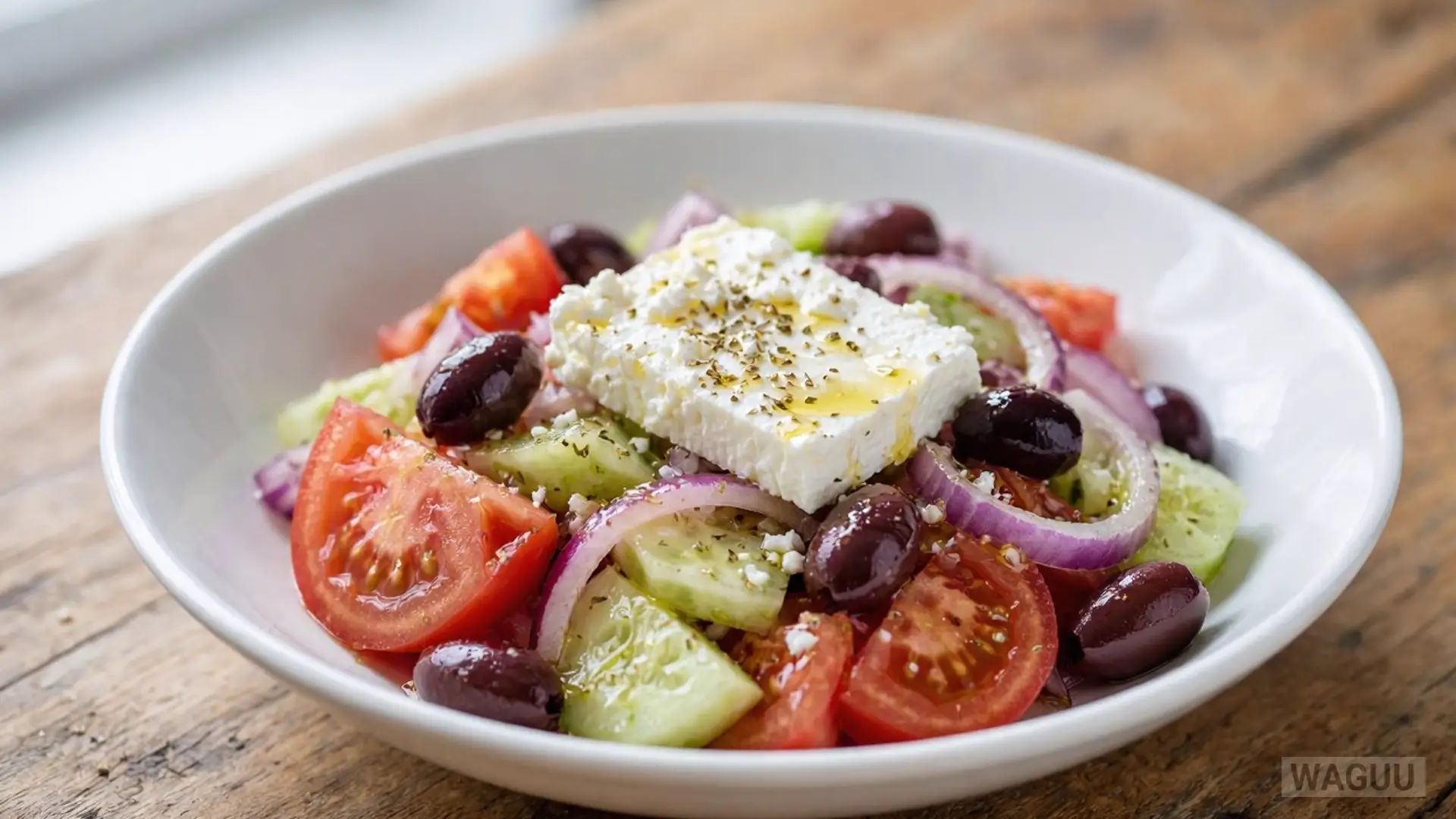
Summary: Authentic traditional Greek salad (Horiatiki) featuring ripe vine tomatoes, crisp cucumber, red onion, Kalamata olives, and a rich block of authentic feta cheese dressed with extra virgin olive oil and fragrant dried oregano, prepared without lettuce in 15 minutes for 4 portions.
Did you cook this recipe? Share the result with the community.
Category: salads-en, mediterranean-cuisine-en
Success rate: not rated yet% of users successfully made this recipe
Quick overview
- Dish: Greek Salad (Horiatiki)
- Category: salads-en, mediterranean-cuisine-en
- Cuisine: Greek
- Main ingredient: Vine tomatoes, 600 g (ripe, firm, premium greenhouse-grown or garden fresh)
- Guide: 12 most popular Mediterranean dishes: favourite recipes of Mediterranean cuisine
- Total time: 15 minutes (15 min prep + 0 min cooking)
- Difficulty: Easy
- Portions: 4 portions (Portion weight: 325 g)
- Key technique: Chopping, slicing, and layering without lettuce
- Preparation types: Raw mixing, dressing emulsion
- Dietary info & Allergens: Contains milk (feta cheese), vegetarian, gluten-free
- Suitable for: Summer lunch, dinner side dish, healthy snack, Mediterranean feast
- Nutritional values (per 1 portion): 340 kcal, Protein: 9.0 g, Fat: 28.0 g, Carbohydrates: 12.0 g
- Storage: 1 day in the fridge, 0 months in the freezer
- Pairing: Lager beer, Assyrtiko white wine, sparkling mineral water
- In short: An authentic, lettuce-free Mediterranean classic bursting with sun-ripened tomatoes, crisp cucumber, briny olives, and creamy feta.
- Last updated: October 24, 2023
WAGUU says: “Never include lettuce or leafy greens in a traditional Greek Horiatiki salad; true authenticity relies strictly on sun-kissed vegetables, genuine Greek feta, and top-tier extra virgin olive oil.”
Key facts
| Prep time: | 15 minutes |
| Cooking time: | 0 minutes |
| Temperature: | Chilled or ambient room temperature |
| Number of portions: | 4 portions |
In a nutshell
Experience the vibrant flavors of the Greek islands with this classic Horiatiki salad, combining thick wedges of juicy tomatoes, crunchy cucumber slices, sharp red onion rings, dark Kalamata olives, and a generous slab of sheep’s milk feta cheese drizzled with golden olive oil.
Ingredients
Base portions: 4 portions • Portion weight: 325 g
| Ingredient | Amount | Quality |
|---|---|---|
| Vine tomatoes | 600 g | Ripe, firm, room temperature |
| Cucumber | 300 g | Fresh, crisp, peeled in alternate stripes |
| Red onion | 100 g | Sweet, sliced into thin rings |
| Kalamata olives | 80 g | Authentic pitted or whole with pits |
| Feta cheese | 200 g | Genuine Greek sheep and goat milk block |
| Green bell pepper | 100 g | Crisp, sliced into thin strips |
| Extra virgin olive oil | 60 ml | High-quality cold-pressed Greek oil |
| Red wine vinegar | 15 ml | Traditional aromatic wine vinegar (optional) |
| Dried oregano | 3 g | Greek mountain oregano, fragrant |
| Sea salt | 4 g | Coarse sea salt flakes |
Why you will love this recipe
- Authentic Mediterranean Taste: Transports you straight to a Greek taverna by the Aegean Sea with pure, unmasked flavors.
- Lightning Fast Preparation: Ready in just 15 minutes with zero cooking required, perfect for busy weeknights or hot summer days.
- Nutrient-Dense and Healthy: Packed with antioxidants, healthy monounsaturated fats from olive oil, and essential vitamins.
Success guaranteed: Following these traditional slicing dimensions and ingredient ratios ensures the salad retains its structural integrity without becoming watery.
Recipe overview
Prep: 15 min | Cooking: 0 min | Difficulty: Easy | Portions: 4 | Type: Salad / Starter | Origin: Greece
Detailed instructions
Overall progress: 0% complete
Phase 1: Vegetable preparation and slicing – 5 min
Appliances: Chef’s knife, cutting board
1. Wash the 600 g of vine tomatoes and 300 g of cucumber thoroughly in cold water and dry them with a clean kitchen towel. Core the tomatoes and cut them into substantial wedges or chunky bite-sized pieces. Peel the cucumber in alternate lengthwise stripes using a vegetable peeler for a traditional rustic look, then slice it into thick half-moon rounds approximately 1 cm thick.
VKB: Visual control: tomatoes must retain their internal juices and not be overly mushy.
Before moving to the next step:
Ensure tomatoes are at room temperature; chilling tomatoes in the refrigerator dulls their natural sugars and aromatic compounds.
Phase 2: Onion and bell pepper slicing – 4 min
Appliances: Sharp paring knife
2. Peel the 100 g of red onion and slice it very thinly into delicate rings or half-moons. If the raw onion flavor is exceptionally sharp, submerge the slices in cold water for 5 minutes to mellow their bite, then drain thoroughly. Wash the 100 g of green bell pepper, remove the stem and core, and slice it into thin, elegant strips.
VKB: Onion slices should separate easily into individual rings for even distribution.
Before moving to the next step:
Check that bell pepper strips are thin enough to blend harmoniously with the soft texture of tomatoes.
Phase 3: Initial bowl assembly and seasoning – 3 min
Appliances: Wide serving bowl, wooden spoon
3. In a wide, shallow serving bowl, combine the tomato wedges, cucumber rounds, sliced red onion rings, and green bell pepper strips. Add the 80 g of Kalamata olives. Sprinkle 4 g of coarse sea salt evenly over the vegetables and drizzle with 15 ml of red wine vinegar if desired. Toss gently to combine without bruising the delicate tomato flesh.
VKB: Salt should dissolve slightly into the natural juices released by the tomatoes.
Before moving to the next step:
Do not overmix; the vegetables should look rustic and colorful rather than mashed together.
Phase 4: Adding authentic feta cheese slab – 2 min
Appliances: Butter knife
4. Take the 200 g block of genuine Greek feta cheese and place it proudly right on top of the mixed vegetables in the center of the bowl, rather than crumbling it into small pieces. Traditional Greek taverna style dictates serving feta as a whole rectangular slab resting atop the salad.
VKB: The feta block should remain structurally intact upon placement.
Before moving to the next step:
Ensure the feta is authentic sheep or goat milk cheese for optimal creaminess and tanginess.
Phase 5: Olive oil and oregano finishing touch – 1 min
Appliances: Measuring cup
5. Generously drizzle the 60 ml of extra virgin olive oil evenly over the feta block and the surrounding vegetables. Sprinkle 3 g of dried Greek oregano liberally across the entire surface of the salad. The olive oil will mingle with the tomato juices and salt at the bottom of the bowl, creating a delicious liquid base known in Greece as ‘ladolemono’ or the savory pot juices.
VKB: Oregano should be lightly rubbed between your palms before sprinkling to release aromatic oils.
Required equipment
| Utensil | Ideal size | Alternative | Risk |
|---|---|---|---|
| Chef’s knife | 20 cm blade | Utility knife | Dull blade squashing soft tomatoes |
| Cutting board | 30 x 40 cm | Plastic or wooden board | Juice overflow on countertop |
| Serving bowl | 25 cm diameter, wide rim | Deep ceramic dish | Spilling contents when tossing |
Shopping list
Nutritional profile
Values per 1 portion (excluding side dishes). Calculated from average nutritional values of ingredients.
| Nutrient | Per 100 g | Per 1 portion | Per 4 portions |
|---|---|---|---|
| Energy | 104.6 kcal | 340.0 kcal | 1360.0 kcal |
| Fat | 8.6 g | 28.0 g | 112.0 g |
| of which saturates | 3.7 g | 12.0 g | 48.0 g |
| Carbohydrates | 3.7 g | 12.0 g | 48.0 g |
| of which sugars | 2.8 g | 9.0 g | 36.0 g |
| Protein | 2.8 g | 9.0 g | 36.0 g |
| Salt | 1.2 g | 3.9 g | 15.6 g |
Reference intake of an average adult (8400 kJ / 2000 kcal).
WAGUU Pro Level
- Pro standard: Verified recipe with precise ratios and visual control points.
- Tip 1: Always use vine-ripened tomatoes stored at room temperature to maximize natural sweetness and lycopene development.
- Tip 2: Rub the dried oregano between your palms directly over the salad to release essential oils and volatile aromatics.
- Tip 3: Serve with crusty fresh bread or traditional paximadia rusks to soak up the delicious olive oil and tomato juices at the bottom of the bowl.
- Tip 4: Never store dressed salad in the fridge for more than a few hours, as salt draws out water from the vegetables and alters texture.
Scientific background
Tomatoes contain high levels of glutamic acid, which pairs exceptionally well with the sodium chloride and protein breakdown products found in aged feta cheese, creating a powerful umami synergy. Furthermore, extra virgin olive oil acts as a lipid carrier that significantly enhances the bioavailability of fat-soluble carotenoids such as lycopene and beta-carotene present in tomatoes and bell peppers.
Fine Dining – Professional techniques
- Plate composition: Arrange tomato wedges and cucumber rounds in an overlapping radial pattern, crowned with a pristine square slab of feta.
- Textural contrasts: Balance the crunch of fresh cucumbers and bell peppers with the melting, creamy texture of artisan feta cheese.
- Temperature contrast: Keep vegetables at ambient room temperature while using chilled olives for a sophisticated sensory mouthfeel.
- Aromatic garnishes: Crown with wild Greek oregano sprigs and a final drizzle of cold-pressed harvest olive oil.
Sensory radar
- Appearance: Vibrant crimson red, crisp white cucumber stripes, deep green peppers, dark Kalamata olives, and pristine white feta.
- Aroma: Fragrant mountain oregano, pungent extra virgin olive oil, and fresh garden tomato scent.
- Taste: Sweet acidity from ripe tomatoes, sharp onion bite, rich creaminess from feta, and briny olive saltiness.
- Texture: Succulent and juicy tomato wedges, crunchy cucumber, tender peppers, and creamy crumbly cheese.
Pairing
- BEER: Crisp Greek Mythos lager or a refreshing pilsner.
- WINE: Chilled Assyrtiko from Santorini or a crisp Athenian Retsina.
- NON-ALCOHOLIC: Sparkling mineral water with a fresh lemon wedge.
Various preparation variants
- Cretan Dakos Style: Add barley rusks (paximadia) soaked briefly in olive oil at the base of the bowl.
- Caper and Herb Variation: Incorporate pickled caper berries and fresh flat-leaf parsley for an extra herbaceous punch.
Allergens and dietary information
Contains: Milk (feta cheese) • Gluten: Gluten-free • Not suitable for: Vegan diets (contains dairy)
Suitable for
Summer lunch, barbecue side dish, vegetarian diets, healthy Mediterranean meal plans.
Substitution catalog
- Feta cheese: Authentic barrel-aged goat cheese or firm manouri cheese
- Kalamata olives: Black Amfissa olives or green Halkidiki olives
FAQ
Should I put lettuce in a Greek salad?
No, traditional Horiatiki salad never contains lettuce or leafy greens in its authentic form.
Should the feta be cubed or served as a slab?
In Greece, feta is traditionally placed on top as a whole block or thick slab rather than pre-cubed or crumbled.
Can I use vinegar in Horiatiki?
While some regions add a splash of red wine vinegar, many purists rely solely on lemon juice or vinegar as an optional touch.
Why are my tomatoes losing too much water?
Salting tomatoes draws out moisture via osmosis; add salt right before serving to maintain crisp vegetable textures.
WAGUU Petr advises: Cooking for 12 or more people?
12–16 people: Scale quantities proportionally and prepare vegetables in three separate large bowls to prevent bruising • 20+ people: Pre-chop vegetables and store in airtight containers in the cooler, assembling and dressing just 10 minutes before service.
Sides and Serving
- Crusty sourdough bread – Ideal for soaking up olive oil and tomato juices (not included in the recipe)
- Grilled souvlaki skewers – Perfect protein accompaniment for a complete Greek feast (not included in the recipe)
Serving: Serve immediately at ambient room temperature in a wide ceramic bowl alongside fresh bread.
Storage and reheating
Fridge: 1 day in an airtight container • Freezer: 0 months (freezing ruins raw vegetable structure) • Reheating: Serve chilled or at room temperature; do not reheat.
Author: WAGUU Petr & Team • Published: 26 Aug 2026 • Updated: 31 Oct 2026
More Recipes from This Article
Other recipes you might be interested in
Why WAGUU?
Recipes on WAGUU undergo checks for the accuracy of ingredients, procedures, and nutritional values.
Process photo gallery
Community photos: Cook, take a photo, and share the result.
You can upload photos in the comments below or send them via email.
Did you record a video guide for our recipe? Insert a link to YouTube, YouTube Shorts, TikTok, Instagram Reels, Facebook Reels, Pinterest, Vimeo, or X (Twitter) in the comment – we’d be happy to publish it and help promote you and your content.
Common mistakes
- Adding lettuce – Traditional Horiatiki salad never includes lettuce or leafy salad greens.
- Chilling tomatoes – Storing tomatoes in the refrigerator destroys their flavor compounds and makes them mealy.
- Pre-crumbling feta – Feta should be served as a whole slab on top rather than mixed into tiny pieces.
- Using low-quality oil – Substandard vegetable oil ruins the delicate dressing emulsion; always use extra virgin olive oil.