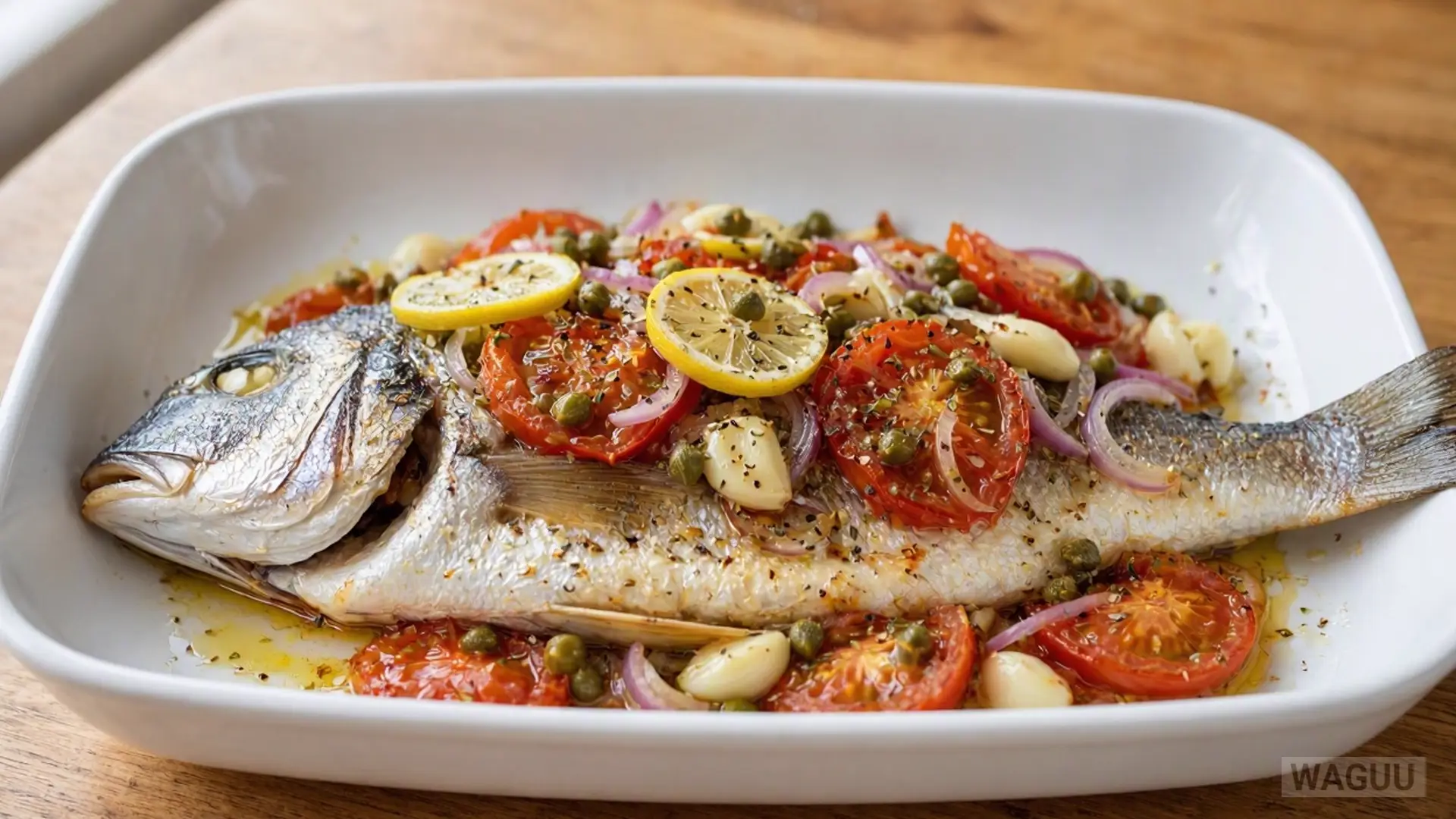
Summary: Psari Plaki is a traditional Greek baked fish dish featuring white fish fillets oven-roasted with ripe tomatoes, sweet onions, garlic, fresh herbs, and extra virgin olive oil. Preparation takes 20 minutes, cooking takes 40 minutes, and it yields 4 rich portions.
Did you cook this recipe? Share the result with the community.
Category: Fish and Seafood, Mediterranean Cuisine
Success rate: not rated yet% of users successfully made this recipe
Quick overview
- Dish: Psari Plaki
- Category: Fish and Seafood, Mediterranean Cuisine
- Cuisine: Greek Cuisine
- Main ingredient: White fish fillets, 800 g (fresh sea bass or cod)
- Guide: 12 most popular Mediterranean dishes: favourite recipes of Mediterranean cuisine
- Total time: 60 minutes (20 min prep + 40 min cooking)
- Difficulty: Easy
- Portions: 4 portions (Portion weight: 350 g)
- Key technique: Oven baking in olive oil
- Preparation types: Searing, chopping, baking, resting
- Dietary info & Allergens: Contains fish
- Suitable for: Lunch, dinner, healthy diet, pescatarian diet
- Nutritional values (per 1 portion): 420 kcal, Protein: 34 g, Fat: 22 g, Carbohydrates: 18 g
- Storage: 2 days in the fridge, 1 month in the freezer
- Pairing: Light lager beer, Assyrtiko white wine, sparkling water with lemon
- In short: Tender white fish baked in a rich tomato, garlic, and extra virgin olive oil sauce.
- Last updated: 2026-03-30
WAGUU says: “The secret to authentic Psari Plaki lies in slow-roasting the onions and garlic in copious amounts of high-quality extra virgin olive oil before introducing the tomatoes and fish.”
Key facts
| Prep time: | 20 minutes |
| Cooking time: | 40 minutes |
| Temperature: | 180 °C |
| Number of portions: | 4 portions |
In a nutshell
Psari Plaki brings the authentic warmth of the Greek seaside straight to your kitchen. Succulent white fish fillets bake atop a bed of caramelized onions, fragrant garlic, ripe tomatoes, and fresh herbs, creating a rich sauce that absorbs every drop of the finest olive oil. This classic Mediterranean comfort food is remarkably simple to prepare yet delivers extraordinary depth of flavor in every single bite.
Ingredients
Base portions: 4 portions • Portion weight: 350 g
| Ingredient | Amount | Quality |
|---|---|---|
| White fish fillets (sea bass, sea bream, or cod) | 800 g | fresh, skin-on, scaled and cleaned |
| Yellow onions | 300 g | sliced into thin half-moons |
| Garlic cloves | 20 g | minced or thinly sliced |
| Ripe tomatoes | 600 g | grated or finely chopped with juices |
| Tomato paste | 30 g | concentrated double tomato paste |
| Extra virgin olive oil | 100 ml | high-grade Greek extra virgin olive oil |
| Lemon juice | 40 ml | freshly squeezed from organic lemons |
| Fresh flat-leaf parsley | 15 g | finely chopped |
| Dried oregano | 5 g | fragrant Greek mountain oregano |
| Sea salt | 8 g | coarse sea salt crystals |
| Black pepper | 3 g | freshly cracked black pepper |
| Water or vegetable stock | 100 ml | warm water |
Why you will love this recipe
- Authentic Greek Flavor: Combines the quintessential Mediterranean trio of tomatoes, olive oil, and garlic for an unforgettable culinary experience.
- Nutritiously Balanced: High in lean protein, heart-healthy fats, and essential antioxidants without heavy cream or flour thickeners.
- One-Pan Simplicity: Assembles quickly in a single baking dish, minimizing cleanup while maximizing flavor development.
Success guaranteed: Follow the precise baking temperatures and sauce reduction steps to ensure the fish remains tender and flaky while the vegetable bed concentrates into a rich, savory glaze.
Recipe overview
Prep: 20 min | Cooking: 40 min | Difficulty: Easy | Portions: 4 portions | Type: Main dish | Origin: Greek Cuisine
Detailed instructions
Overall progress: 0% complete
Phase 1: Preparing and marinating the fish – 10 min
Appliances: Kitchen scale, cutting board, sharp knife
1. Rinse 800 g of white fish fillets under cold running water and pat them thoroughly dry using paper towels. Inspect the fillets for any remaining pin bones using tweezers and remove them. Cut the fish into 4 equal portions if required. Place the fillets in a shallow glass dish, drizzle with half of the lemon juice (20 ml) and a pinch of sea salt, and let them rest at room temperature while you prepare the vegetable base.
VKB: Visual control point (VKB): Fish surface must be completely dry before seasoning to ensure proper adhesion of flavors.
Before moving to the next step:
Ensure the fish fillets are fully patted dry so they absorb the lemon juice evenly without diluting the subsequent vegetable bed.
Phase 2: Slicing vegetables and creating the base – 10 min
Appliances: Chef’s knife, cutting board, box grater
2. Peel 300 g of yellow onions and slice them into thin half-moons. Peel and mince 20 g of garlic cloves. Grate 600 g of ripe tomatoes on a box grater, discarding the tough skin remnants. In a large mixing bowl, combine the sliced onions, minced garlic, grated tomatoes, 30 g of tomato paste, half of the extra virgin olive oil (50 ml), dried oregano, chopped parsley, and remaining sea salt and black pepper. Toss thoroughly until all ingredients are evenly distributed.
VKB: Visual control point (VKB): The onion slices must be uniform in thickness to cook at an identical rate in the oven.
Before moving to the next step:
Verify that the tomato paste is fully dissolved into the grated tomato mixture to prevent concentrated bitter spots.
Phase 3: Preheating and assembling the baking dish – 5 min
Appliances: Oven, ceramic baking dish (approx. 30×20 cm)
3. Preheat your oven to 180 °C on conventional top-and-bottom heat mode. Take a large ceramic or glass baking dish and pour the remaining 50 ml of extra virgin olive oil across the bottom, spreading it evenly. Spread the onion and tomato vegetable mixture uniformly across the base of the baking dish, creating a luscious bed for the fish.
VKB: Visual control point (VKB): The bottom of the baking dish should be completely coated with olive oil and a thick layer of vegetables.
Before moving to the next step:
Ensure the oven has reached a stable 180 °C before inserting the dish to guarantee even cooking.
Phase 4: Nesting the fish and adding liquid – 5 min
Appliances: Measuring cup, spoon
4. Arrange the marinated fish fillets gently on top of the tomato and onion bed, skin-side down if applicable. Pour 100 ml of warm water or vegetable stock around the edges of the dish. Drizzle the remaining 20 ml of lemon juice directly over the fish fillets. Dust the top lightly with an extra pinch of dried oregano and a drizzle of olive oil.
VKB: Visual control point (VKB): The liquid should reach about halfway up the vegetable layer without submerging the fish completely.
Before moving to the next step:
Check that the fish is resting securely on the vegetable bed so it steams and bakes without burning on the bottom of the dish.
Phase 5: Oven baking – 30 min
Appliances: Oven, oven mitts
5. Place the baking dish into the preheated oven at 180 °C. Bake uncovered for approximately 30 minutes. During baking, the onions will caramelize, the tomatoes will reduce into a rich sauce, and the fish will turn opaque and flake easily with a fork. Spoon some of the hot pan juices over the fish halfway through the baking time to keep the flesh moist.
VKB: Visual control point (VKB): The fish meat is fully cooked when its internal temperature reaches 60 °C and the flakes separate effortlessly.
Before moving to the next step:
Monitor the sauce consistency; if it thickens too quickly, cover the dish loosely with foil for the final 10 minutes.
Phase 6: Resting and final garnishing – 5 min
Appliances: Serving spoon
6. Remove the baking dish from the oven using protective oven mitts. Let the dish rest for 5 minutes at room temperature to allow the juices to settle and concentrate. Garnish generously with the remaining fresh chopped parsley and a final drizzle of raw extra virgin olive oil before serving warm.
VKB: Visual control point (VKB): The sauce should be glossy, thick, and aromatic with olive oil and herbs.
Required equipment
| Utensil | Ideal size | Alternative | Risk |
|---|---|---|---|
| Ceramic baking dish | 30×20 cm | Glass casserole dish or roasting pan | Dish too small causes overcrowding |
| Chef’s knife | 20 cm blade | Santoku knife | Dull blade crushes vegetables |
| Box grater | Standard 4-sided grater | Food processor | Accidental finger scraping on coarse blades |
Shopping list
Nutritional profile
Values per 1 portion (excluding side dishes). Calculated from average nutritional values of ingredients.
| Nutrient | Per 100 g | Per 1 portion | Per 4 portions |
|---|---|---|---|
| Energy | 120.0 kcal | 420.0 kcal | 1680.0 kcal |
| Fat | 6.3 g | 22.0 g | 88.0 g |
| of which saturates | 0.9 g | 3.1 g | 12.4 g |
| Carbohydrates | 5.1 g | 18.0 g | 72.0 g |
| of which sugars | 3.4 g | 12.0 g | 48.0 g |
| Protein | 9.7 g | 34.0 g | 136.0 g |
| Salt | 0.6 g | 2.1 g | 8.4 g |
Reference intake of an average adult (8400 kJ / 2000 kcal).
WAGUU Pro Level
- Pro standard: Verified recipe with precise ratios and visual control points.
- Tip 1: Use whole fresh fish instead of fillets if entertaining; scale back the cooking time slightly to avoid drying out the delicate flesh.
- Tip 2: Incorporate a splash of dry white wine into the vegetable base for extra aromatic complexity.
- Tip 3: Always use Greek extra virgin olive oil; its robust fruitiness defines the authentic flavor profile of traditional Plaki dishes.
- Tip 4: Let the baked dish rest for 5 minutes before serving so the sauce absorbs into the fish fibers.
Scientific background
Baking fish on a moisture-rich bed of tomatoes and onions creates an enclosed microclimate within the baking dish. The water content in the grated tomatoes and added stock vaporizes gently during the 180 °C bake, steaming the delicate white fish while simultaneously rendering the olive oil into the aromatics. This prevents the lean fish proteins from toughening, ensuring a moist texture paired with a concentrated umami-rich sauce.
Fine Dining – Professional techniques
- Plate composition: Carefully lift a single fish fillet onto warm shallow bowls, spooning the glossy tomato and onion ragout generously over and around the fish.
- Textural contrasts: Pair the tender, flaky fish with toasted crusty artisanal bread for dipping into the rich olive oil sauce.
- Temperature contrast: Serve piping hot directly from the oven alongside chilled crisp white wine.
- Aromatic garnishes: Top with freshly torn oregano leaves and micro-planed lemon zest for an elevated visual and olfactory finish.
Sensory radar
- Appearance: Vibrant crimson tomato sauce accented with golden onions and emerald green parsley over pristine white fish fillets.
- Aroma: Rich roasted garlic, sweet caramelized onions, earthy oregano, and bright lemon citrus notes.
- Taste: Harmonious balance of natural fish sweetness, savory tomato umami, and robust olive oil richness.
- Texture: Tender, flaky fish resting on a luscious, velvety vegetable ragout.
Pairing
- BEER: Crisp Greek yellow lager or refreshing pilsner.
- WINE: Chilled Assyrtiko or dry Sauvignon Blanc with high minerality.
- NON-ALCOHOLIC: Sparkling spring water with a fresh slice of lemon and mint.
Various preparation variants
- Potato Plaki variant: Add thin slices of waxy potatoes to the bottom layer for a hearty, complete one-pan meal.
- Feta cheese variant: Crumble authentic Greek feta cheese over the fish during the last 5 minutes of baking for a creamy, savory crust.
Allergens and dietary information
Contains: Fish • Gluten: Gluten-free • Not suitable for: Fish allergy sufferers
Suitable for
Lunch, dinner, healthy diet, pescatarian diet, Mediterranean diet enthusiasts.
Substitution catalog
- White fish fillets: Can be substituted with whole gutted sea bream, sea bass, or firm cod steaks.
- Extra virgin olive oil: Essential for authentic flavor, but high-grade avocado oil can serve as a neutral alternative.
FAQ
Can I use frozen fish fillets for Psari Plaki?
Yes, but ensure the frozen fish is fully thawed and patted completely dry before baking to prevent excess water from diluting the tomato sauce.
What type of fish works best for this recipe?
Firm white fish such as sea bass, cod, haddock, or sea bream hold their shape wonderfully during the baking process.
Do I need to peel the tomatoes?
Grating fresh ripe tomatoes on a box grater naturally leaves the tough skins behind on the grater, so you get smooth tomato flesh without peeling.
Can I prepare this dish in advance?
You can prep the vegetable base and assemble the dish ahead of time, then bake it fresh right before serving for the best texture.
WAGUU Petr advises: Cooking for 12 or more people?
12–16 people: Scale the ingredients by 3 and use multiple large roasting pans to avoid overcrowding the fish fillets. • 20+ people: Prepare the vegetable sauce in large pots on the stovetop first, transfer to several deep hotel pans, top with fish fillets, and bake in batches.
Sides and Serving
- Crusty artisanal bread – Perfect for soaking up the olive oil and tomato juices (not included in the recipe)
- Steamed wild rice – Adds a light, neutral grain element to balance the rich sauce (not included in the recipe)
Serving: Serve warm in shallow bowls with a drizzle of raw extra virgin olive oil and a sprinkle of fresh parsley.
Storage and reheating
Fridge: 2 days days • Freezer: 1 months months • Reheating: Reheat gently in a covered baking dish at 150 °C for 15 minutes or microwave on medium power until heated through.
Author: WAGUU Petr & Team • Published: 26 Aug 2026 • Updated: 31 Oct 2026
More Recipes from This Article
Other recipes you might be interested in
Why WAGUU?
Recipes on WAGUU undergo checks for the accuracy of ingredients, procedures, and nutritional values.
Process photo gallery
Community photos: Cook, take a photo, and share the result.
You can upload photos in the comments below or send them via email.
Did you record a video guide for our recipe? Insert a link to YouTube, YouTube Shorts, TikTok, Instagram Reels, Facebook Reels, Pinterest, Vimeo, or X (Twitter) in the comment – we’d be happy to publish it and help promote you and your content.
Common mistakes
- Overcooking the fish – Leaving the fish in the oven too long dries out the delicate flakes; remove promptly when internal temperature hits 60 °C.
- Skipping the pat-down step – Failing to dry the fish fillets causes excess surface moisture to water down the tomato and olive oil sauce.
- Skimping on olive oil – Psari Plaki relies heavily on good quality extra virgin olive oil to build the rich, velvety characteristic sauce.
- Crowding the baking dish – Piling fillets on top of one another prevents even heat distribution and steaming.