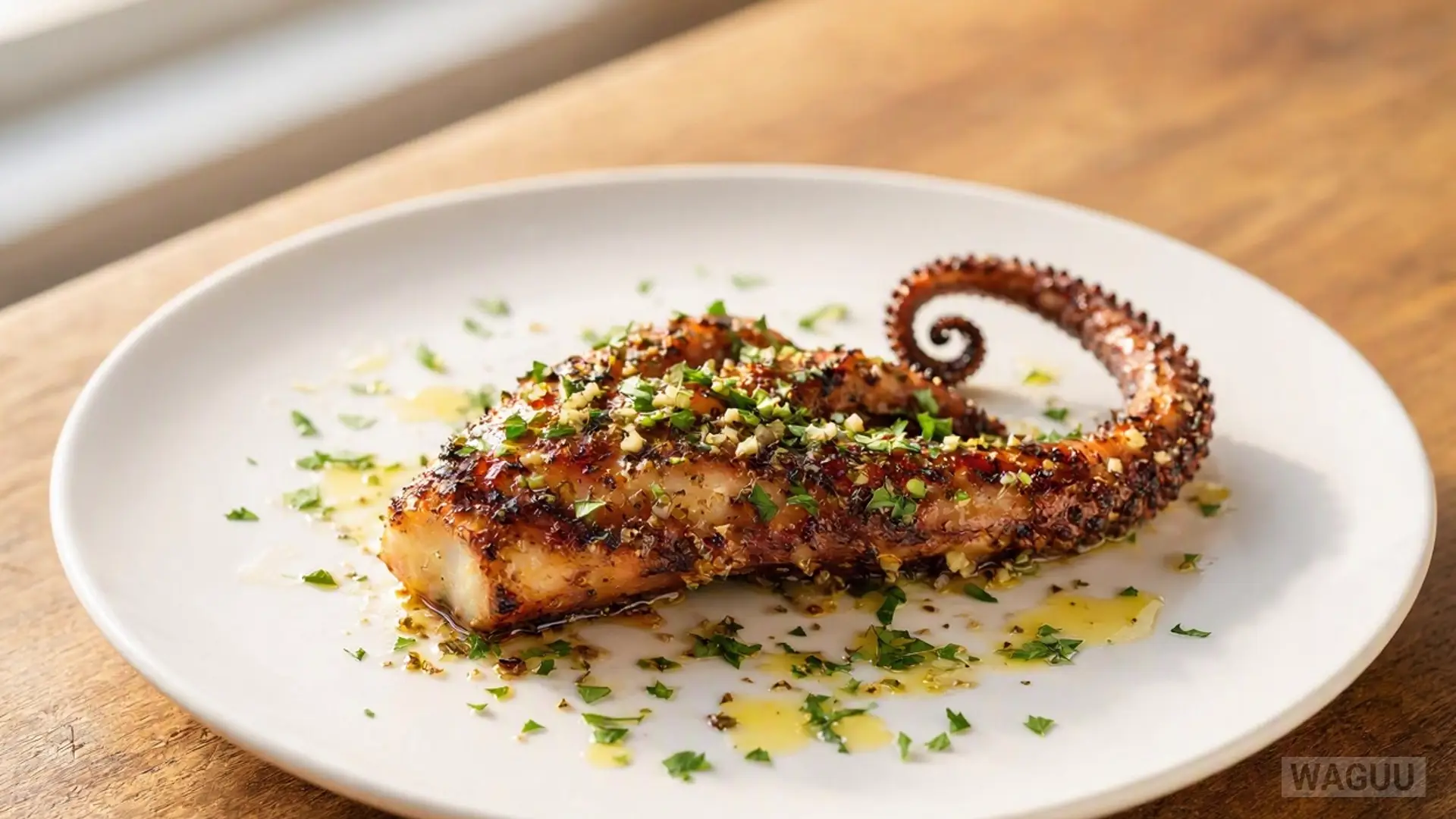
Summary: Grilled octopus with olive oil, lemon, garlic and herbs, particularly popular in Greek and other coastal cuisines – Whole Mediterranean octopus, charcoal grill method, 90 minutes preparation time, 6 portions.
Did you cook this recipe? Share the result with the community.
Category: Fish and Seafood, Mediterranean Cuisine
Success rate: not rated yet% of users successfully made this recipe
Quick overview
- Dish: Grilled Octopus
- Category: Fish and Seafood, Mediterranean Cuisine
- Cuisine: Greek and Mediterranean Coastal
- Main ingredient: Whole fresh octopus, 2000 g (premium coastal quality)
- Guide: 12 most popular Mediterranean dishes: favourite recipes of Mediterranean cuisine
- Total time: 90 minutes (60 min prep + 30 min cooking)
- Difficulty: Intermediate
- Portions: 6 portions (Portion weight: 280 g)
- Key technique: Slow simmering followed by high-heat charcoal grilling
- Preparation types: Boiling, Grilling
- Dietary info & Allergens: Molluscs, gluten-free, dairy-free
- Suitable for: Summer dinners, festive gatherings, seafood lovers
- Nutritional values (per 1 portion): 320 kcal, Protein: 34.5 g, Fat: 16.2 g, Carbohydrates: 3.8 g
- Storage: 2 days in the fridge, 3 months in the freezer
- Pairing: Crisp dry white wine (Assyrtiko), sparkling water with lemon
- In short: Tender, perfectly charred octopus tentacles infused with extra virgin olive oil, fresh garlic, lemon juice, and aromatic wild oregano.
- Last updated: 2025-05-15
WAGUU says: “The secret to an exceptionally tender grilled octopus is the initial gentle simmering in its own juices with a splash of red wine vinegar and bay leaves, ensuring zero toughness before it hits the roaring charcoal flames.”
Key facts
| Prep time: | 60 minutes |
| Cooking time: | 30 minutes |
| Temperature: | Medium simmer, then high direct charcoal grill heat (250 °C) |
| Number of portions: | 6 portions |
In a nutshell
Transport your senses directly to the sun-drenched Greek tavernas with this exquisite grilled octopus dish. Combining a melt-in-your-mouth tender interior with a smoky, charred exterior, every bite celebrates authentic coastal flavors enriched with cold-pressed olive oil, zesty lemon, and fragrant Mediterranean herbs.
Ingredients
Base portions: 6 portions • Portion weight: 280 g
| Ingredient | Amount | Quality |
|---|---|---|
| Fresh whole octopus | 2000 g | Cleaned, premium coastal quality |
| Extra virgin olive oil | 120 ml | Cold-pressed Greek extra virgin |
| Fresh lemons | 3 pcs | Juiced, plus wedges for serving |
| Garlic cloves | 4 pcs | Finely minced |
| Fresh oregano | 15 g | Chopped fresh leaves |
| Flat-leaf parsley | 15 g | Freshly chopped |
| Red wine vinegar | 60 ml | Traditional wine vinegar |
| Bay leaves | 3 pcs | Dried whole leaves |
| Sea salt | 18 g | Coarse sea salt crystals |
| Black peppercorns | 5 g | Whole black peppercorns |
Why you will love this recipe
- Authentic Mediterranean Taste: Captures the genuine culinary tradition of Greek coastal tavernas using simple, premium ingredients.
- Exceptional Texture: Dual preparation method ensures the meat is supremely tender on the inside while beautifully crisp and smoky on the outside.
- Healthful & Nutrient-Rich: Packed with lean protein, omega fatty acids, and wholesome extra virgin olive oil.
Success guaranteed: Follow our precise simmering time and high-heat charring technique for restaurant-quality results every single time.
Recipe overview
Prep: 60 min | Cooking: 30 min | Difficulty: Intermediate | Portions: 6 | Type: Main Dish | Origin: Greek Coastal Cuisine
Detailed instructions
Overall progress: 0% complete
Phase 1: Cleaning and Preparing the Octopus – 15 min
Appliances: Kitchen sink, sharp chef knife
1. Rinse the whole octopus (2000 g) thoroughly under cold running water. Inspect the cavity and remove any remaining internal organs if not pre-cleaned. Cut out the beak located in the center of the tentacles and squeeze out the eyes if intact. Pat the octopus dry with paper towels and separate the tentacles into manageable portions or keep the head intact depending on your preference.
VKB: Visual control: ensure all internal debris is removed and tentacles are clean.
Before moving to the next step:
Make sure the octopus is completely washed and free of grit before simmering.
Phase 2: Simmering for Tender Texture – 45 min
Appliances: Large heavy-bottomed pot, stove
2. Place the octopus into a large pot without adding water, as it will release its own natural juices. Pour in 60 ml of red wine vinegar, add 3 dried bay leaves, and 5 g of whole black peppercorns. Bring to a gentle simmer over medium heat, cover with a tight-fitting lid, and let it simmer on low heat for 45 minutes until a skewer easily pierces the thickest part of a tentacle.
VKB: Temperature: maintain a gentle simmer at 95 °C without vigorous boiling.
Before moving to the next step:
Verify tenderness with a metal skewer; if resistant, cook for an additional 10 minutes.
Phase 3: Cooling and Portioning – 15 min
Appliances: Cutting board, knife, cooling rack
3. Remove the cooked octopus from the pot and transfer it to a clean cutting board to cool for 15 minutes. Once safe to handle, separate each tentacle cleanly from the head. Cut the head into bite-sized pieces if desired, and pat all pieces completely dry with paper towels to ensure a superior crust on the grill.
VKB: Visual check: tentacles should hold their curl and firm up slightly as they cool.
Before moving to the next step:
Ensure the surface moisture is fully removed to prevent sticking on the grill grate.
Phase 4: Preparing the Herb and Olive Oil Marinade – 10 min
Appliances: Mixing bowl, whisk, garlic press
4. In a medium mixing bowl, combine 120 ml of extra virgin olive oil, freshly squeezed juice from 3 lemons, 4 finely minced garlic cloves, 15 g of chopped fresh oregano, 15 g of chopped flat-leaf parsley, and 18 g of coarse sea salt. Whisk the mixture vigorously until emulsified. Reserve half of the dressing for final plating and use the other half to lightly brush the octopus.
VKB: Taste test: seasoning should be bright, herbaceous, and well-balanced with acidity.
Before moving to the next step:
Separate the dressing into two bowls to avoid cross-contamination with cooked seafood.
Phase 5: Grilling over Charcoal – 15 min
Appliances: Charcoal grill, grill tongs, basting brush
5. Preheat your charcoal grill to high heat (250 °C) and ensure the grill grates are clean and lightly oiled. Place the octopus tentacles directly over the hottest part of the grill. Grill for 6 to 8 minutes, turning frequently and basting with the marinade, until dark grill marks form and the exterior develops a smoky, caramelized crust.
VKB: Temperature and visual check: watch for deep char lines without burning the herbs.
Before moving to the next step:
Remove the octopus promptly once charred to prevent the tender meat from drying out.
Phase 6: Final Dressing and Plating – 5 min
Appliances: Serving platter, sharp knife
6. Transfer the grilled octopus tentacles to a warm serving platter. Cut them diagonally into bite-sized pieces if desired or serve whole for dramatic presentation. Generously drizzle the remaining herb, garlic, and olive oil dressing over the top, garnish with extra fresh parsley and lemon wedges, and serve immediately while hot.
VKB: Visual check: glistening olive oil coating with vibrant green herbs and bright char.
Required equipment
| Utensil | Ideal size | Alternative | Risk |
|---|---|---|---|
| Heavy-bottomed pot | 8 litre capacity | Dutch oven | Burning if pot is too thin |
| Charcoal grill | 57 cm diameter | Gas grill with cast-iron grates | Flare-ups from oil |
| Chef knife | 20 cm blade | Santoku knife | Dull blade tearing flesh |
Shopping list
Nutritional profile
Values per 1 portion (excluding side dishes). Calculated from average nutritional values of ingredients.
| Nutrient | Per 100 g | Per 1 portion | Per 6 portions |
|---|---|---|---|
| Energy | 114.3 kcal | 320.0 kcal | 1920 kcal |
| Fat | 5.8 g | 16.2 g | 97.2 g |
| of which saturates | 0.8 g | 2.3 g | 13.8 g |
| Carbohydrates | 1.4 g | 3.8 g | 22.8 g |
| of which sugars | 0.5 g | 1.4 g | 8.4 g |
| Protein | 12.3 g | 34.5 g | 207.0 g |
| Salt | 1.1 g | 3.0 g | 18.0 g |
Reference intake of an average adult (8400 kJ / 2000 kcal).
WAGUU Pro Level
- Pro standard: Verified recipe with precise ratios and visual control points.
- Tip 1: Always simmer the octopus in its own juices without adding extra water to concentrate the natural seafood flavor.
- Tip 2: Ensure the cooked octopus is completely dry before placing it on a hot grill to achieve optimal caramelization.
- Tip 3: Use high-heat hardwood charcoal for grilling to impart an authentic Greek coastal smoke flavor.
- Tip 4: Apply half of the lemon-herb dressing immediately after grilling while the meat is still hot to lock in moisture.
Scientific background
Octopus muscle tissue is rich in tough collagen fibers. Gentle simmering at 95 °C breaks down these tough collagen networks into soft gelatin over a 45-minute period. Following this with high-heat charcoal grilling creates Maillard reactions on the surface proteins, producing savory complex flavor compounds while keeping the interior succulent.
Fine Dining – Professional techniques
- Plate composition: Arrange curled tentacles radially on a warm white ceramic plate with a brush of olive oil emulsion.
- Textural contrasts: Crispy charred exterior contrasting with exceptionally tender, velvety interior flesh.
- Temperature contrast: Piping hot freshly grilled octopus served with a cool, zesty herb dressing.
- Aromatic garnishes: Sprigs of fresh wild oregano, micro-greens, and delicate lemon zest curls.
Sensory radar
- Appearance: Deep reddish-purple curled tentacles with dark charcoal grill marks and glistening oil.
- Aroma: Smokey charcoal aroma combined with bright citrus, garlic, and wild oregano.
- Taste: Naturally sweet ocean flavor balanced by tart lemon, pungent garlic, and sea salt.
- Texture: Tender, melt-in-the-mouth bite with a contrasting crisp surface crust.
Pairing
- BEER: Crisp Greek lager or refreshing Pilsner with subtle hop bitterness.
- WINE: Chilled Greek Assyrtiko or dry Sauvignon Blanc with high mineral acidity.
- NON-ALCOHOLIC: Sparkling mineral water infused with fresh cucumber and lemon slices.
Various preparation variants
- Oven Broiler Variant: If a charcoal grill is unavailable, finish the boiled octopus under a high oven broiler for 5 minutes.
- Mediterranean Salad Variant: Toss sliced grilled octopus into a cold salad with cherry tomatoes, capers, and feta cheese.
Allergens and dietary information
Contains: Molluscs • Gluten: Gluten-Free • Not suitable for: Seafood allergy sufferers
Suitable for
Summer dinners, festive gatherings, outdoor barbecues, and romantic seafood evenings.
Substitution catalog
- Fresh oregano: Dried Greek oregano (use one-third the amount)
- Red wine vinegar: Fresh lemon juice or white wine vinegar
FAQ
Do I need to add water when simmering the octopus?
No, octopus naturally releases a large amount of moisture when heated, allowing it to simmer perfectly in its own rich juices.
How do I know when the octopus is tender enough for the grill?
Insert a metal skewer or the tip of a sharp knife into the thickest part of a tentacle; it should slide in with almost zero resistance.
Can I use frozen octopus for this recipe?
Yes, frozen octopus is actually ideal because the freezing process helps break down muscle fibers, making it even more tender when cooked.
How can I prevent the octopus from sticking to the grill?
Ensure the grill grates are thoroughly cleaned, preheated to high heat, and lightly brushed with oil before placing the octopus down.
WAGUU Petr advises: Cooking for 12 or more people?
12–16 people: Prepare two separate pots for simmering to ensure even cooking temperatures across all octopus tentacles. • 20+ people: Boil the octopus in advance, keep refrigerated, and grill in batches right before serving.
Sides and Serving
- Greek Salad (Horiatiki) – Crisp cucumbers, tomatoes, feta, and Kalamata olives (not included in the recipe)
- Grilled Pita Bread – Brushed with olive oil and oregano (not included in the recipe)
Serving: Serve hot on a large platter garnished with fresh lemon wedges and extra virgin olive oil.
Storage and reheating
Fridge: 2 days • Freezer: 3 months • Reheating: Gently warm in a pan over medium-low heat with a splash of olive oil.
Author: WAGUU Petr & Team • Published: 26 Aug 2026 • Updated: 31 Oct 2026
More Recipes from This Article
Other recipes you might be interested in
Why WAGUU?
Recipes on WAGUU undergo checks for the accuracy of ingredients, procedures, and nutritional values.
Process photo gallery
Community photos: Cook, take a photo, and share the result.
You can upload photos in the comments below or send them via email.
Did you record a video guide for our recipe? Insert a link to YouTube, YouTube Shorts, TikTok, Instagram Reels, Facebook Reels, Pinterest, Vimeo, or X (Twitter) in the comment – we’d be happy to publish it and help promote you and your content.
Common mistakes
- Adding water during simmering – Octopus releases plenty of natural juices; adding extra water dilutes flavor and makes the flesh mushy.
- Skipping the simmering step – Placing raw octopus directly on the grill results in tough, rubbery meat that is impossible to chew.
- Grilling wet tentacles – Surface moisture prevents proper caramelization and causes the octopus to stick stubbornly to the grill grates.
- Overcooking on the grill – Since the octopus is already tenderized by simmering, grilling should be brief and focused purely on achieving a smoky char.