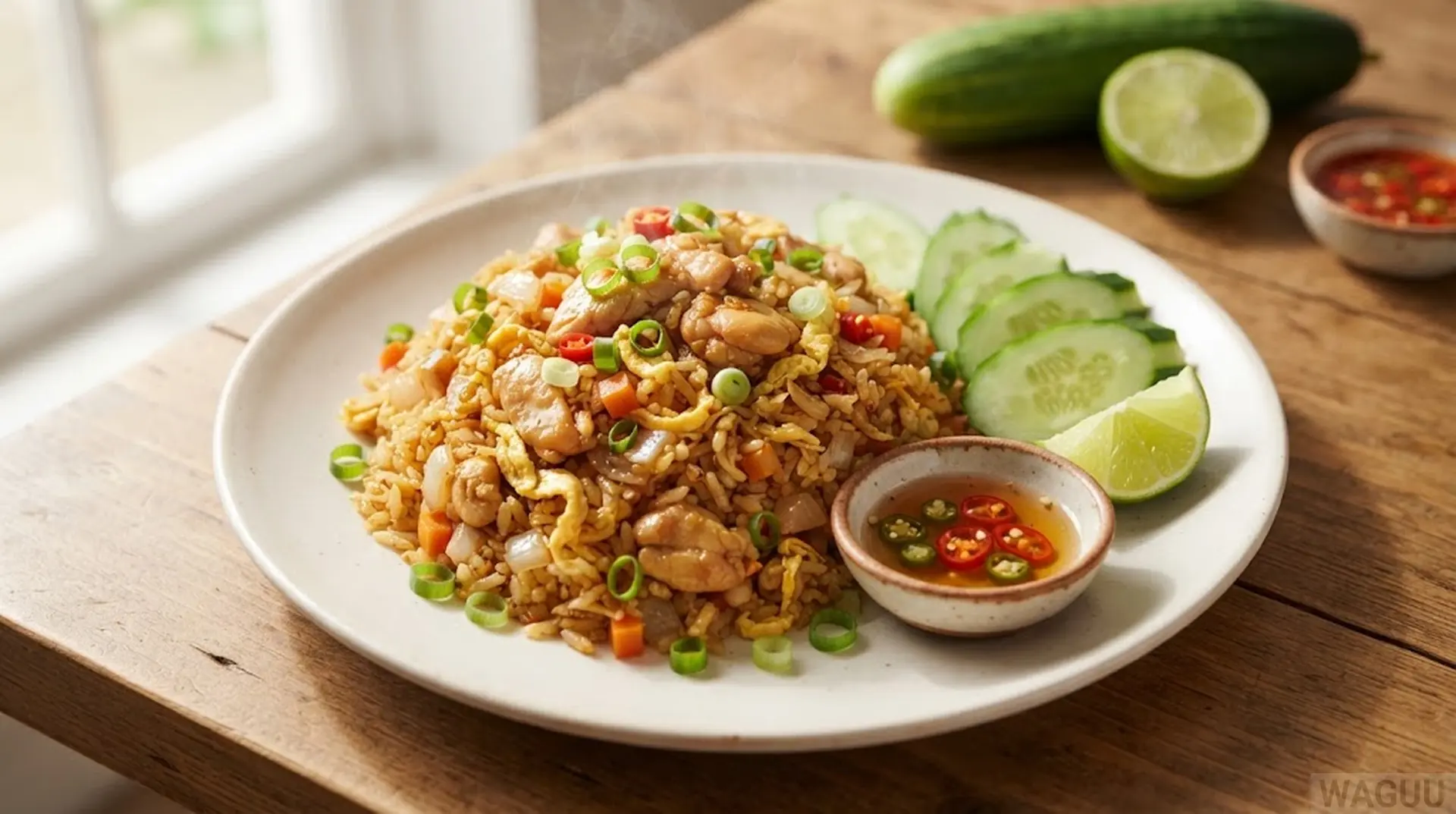
Summary: Khao Pad is the quintessential Thai fried rice dish, featuring jasmine rice stir-fried over extremely high heat with eggs, garlic, scallions, tomatoes, onions, and your choice of protein—such as chicken, prawns, or pork—expertly seasoned with fish sauce, soy sauce, and a pinch of white pepper, prepared in just 20 minutes for 6 generous portions.
Did you cook this recipe? Share the result with the community.
Category: Main Dishes, Thai Cuisine, Risotto and Grains
Success rate: 99% of users successfully made this recipe
Quick overview
- Dish: Khao Pad
- Category: Main Dishes, Thai Cuisine, Risotto and Grains
- Cuisine: Thai
- Main ingredient: Jasmine rice, 600 g (aged day-old cooked rice)
- Guide: 12 Most Popular Thai Dishes: Favourite Thai Cuisine Recipes
- Total time: 20 minutes (8 min prep + 12 min cooking)
- Difficulty: Easy
- Portions: 6 portions (Portion weight: 280 g)
- Key technique: High-heat wok frying with day-old dry rice
- Preparation types: Stir-frying, wok cooking
- Dietary info & Allergens: Contains soy, fish, and eggs. Gluten-free if using certified gluten-free soy sauce.
- Suitable for: Quick family dinners, street food lovers, Asian cuisine enthusiasts
- Nutritional values (per 1 portion): 420 kcal, Protein: 18 g, Fat: 14 g, Carbohydrates: 54 g
- Storage: 2 days in the fridge, 1 month in the freezer
- Pairing: Thai Singha beer, chilled Riesling, iced Thai lemon tea
- In short: Authentic Thai street food classic made with perfectly separated grains of day-old rice, aromatic garlic, crisp vegetables, and savory fish sauce seasoning.
- Last updated: May 20, 2024
WAGUU says: “The secret to restaurant-quality Khao Pad lies in using cold, day-old jasmine rice that has dried out slightly in the refrigerator, allowing every single grain to separate and crisp up without becoming mushy in the wok.”
Key facts
| Prep time: | 8 minutes |
| Cooking time: | 12 minutes |
| Temperature: | High heat (Wok cooking) |
| Number of portions: | 6 portions |
In a nutshell
Khao Pad is Thailand’s beloved national comfort food. Combining smoky wok hei flavor, tender grains of jasmine rice, savory umami seasonings, and fresh aromatic herbs, this dish transforms simple pantry staples into an extraordinary culinary masterpiece.
Ingredients
Base portions: 6 portions • Portion weight: 280 g
| Ingredient | Amount | Quality |
|---|---|---|
| Cooked jasmine rice (day-old, chilled) | 600 g | Aged, dry, separated grains |
| Chicken breast (or prawns/pork), diced | 300 g | Fresh, cut into bite-sized cubes |
| Eggs | 3 pcs | Free-range, lightly beaten |
| Garlic | 15 g | Freshly minced |
| Shallots or small onion | 80 g | Sliced thinly |
| Chinese kale (Gailan) or scallions | 100 g | Fresh, chopped stems and leaves |
| Tomato | 120 g | Ripe, seeded and diced |
| Fish sauce | 30 ml | Premium Thai brand |
| Light soy sauce | 20 ml | Standard fermented soy sauce |
| Sugar | 5 g | Palm sugar or white sugar |
| Ground white pepper | 2 g | Freshly ground |
| Vegetable oil for frying | 45 ml | High smoke point oil (canola or soybean) |
| Cilantro and lime wedges | 30 g | For garnish (not part of the recipe) |
Why you will love this recipe
- Lightning fast preparation: Comes together in just 20 minutes from start to finish, perfect for busy weeknights.
- Authentic street food taste: Recreates the signature smoky wok aroma and balanced savory-sweet flavor profile found in Bangkok food stalls.
- Endless versatility: Easily customizable with whatever leftover vegetables or proteins you have in your refrigerator.
Success guaranteed: Following our precise temperature guidelines and using chilled day-old rice guarantees fluffy, separate grains without any sogginess.
Recipe overview
Prep: 8 min | Cooking: 12 min | Difficulty: Easy | Portions: 6 | Type: Main Dish | Origin: Thailand
Detailed instructions
Overall progress: 0% complete
Phase 1: Ingredient Prep and Rice Aeration – 3 min
Appliances: Refrigerator, cutting board, chef’s knife
1. Take 600 g of chilled day-old jasmine rice out of the refrigerator. Using clean hands or a spatula, gently break apart any large clumps so that individual grains are loose and airy. Dice 300 g of chicken breast into 1.5 cm cubes, slice 80 g of shallots, mince 15 g of garlic, chop 100 g of Chinese kale, and dice 120 g of ripe tomatoes.
VKB: Visual Kitchen Benchmark (VKB): Rice grains must be fully separated with no large compressed blocks remaining.
Before moving to the next step:
Ensure your wok is completely clean and dry before heating, and have all measured sauces (30 ml fish sauce, 20 ml light soy sauce) placed within arm’s reach.
Phase 2: Searing Protein and Aromatics – 3 min
Appliances: Stove, carbon steel wok, spatula
2. Place your wok over high heat for 60 seconds until smoking hot. Add 30 ml of vegetable oil and swirl to coat the sides. Add the 300 g of diced chicken breast and stir-fry vigorously for 2 minutes until the meat turns opaque and develops light golden edges. Push the chicken to the sides of the wok, add the minced 15 g garlic and sliced 80 g shallots into the center well, and sauté for 30 seconds until intensely aromatic.
VKB: VKB: Garlic must be golden-brown and fragrant without any dark burnt spots.
Before moving to the next step:
Do not let the garlic burn; if it browns too quickly, lower the heat slightly before adding the eggs.
Phase 3: Incorporating Eggs – 2 min
Appliances: Stove, wok, spatula
3. Push the chicken and aromatics to one side of the wok, creating an open space in the middle. Pour an additional 15 ml of oil into the cleared space if needed, then crack 3 beaten free-range eggs directly into the center. Let the eggs sit undisturbed for 15 seconds until the edges begin to set, then gently scramble them with your spatula, breaking them into soft curds while mixing them slightly with the surrounding chicken and garlic.
VKB: VKB: Eggs should be soft-set and lightly scrambled, not overcooked or dry.
Before moving to the next step:
Keep the heat roaring high so that adding the cold rice in the next step does not drop the wok temperature too drastically.
Phase 4: Adding Rice and Stir-Frying – 2 min
Appliances: Stove, wok, spatula
4. Add the prepared 600 g of chilled day-old jasmine rice all at once into the wok over the chicken and eggs. Toss and fold continuously using a sweeping motion from the bottom of the wok upwards, pressing any remaining rice lumps against the hot surface with the back of your spatula for 90 seconds until every grain is heated through and coated with oil.
VKB: VKB: Rice temperature should be piping hot throughout with uniform color distribution.
Before moving to the next step:
Ensure seasonings are measured and ready nearby so you can add them immediately without burning the rice.
Phase 5: Seasoning and Vegetable Integration – 2 min
Appliances: Stove, wok, spatula
5. Drizzle 30 ml of fish sauce, 20 ml of light soy sauce, and 5 g of sugar around the inner perimeter of the hot wok so the liquids caramelize slightly before hitting the rice. Toss vigorously for 30 seconds. Add 100 g of chopped Chinese kale and 120 g of diced tomatoes, continuing to stir-fry over high heat for 90 seconds until the greens are vibrant green and tender-crisp.
VKB: VKB: Chinese kale must retain its bright green color and crisp texture.
Before moving to the next step:
Taste a small grain of rice to verify seasoning balance; adjust with a splash of fish sauce if needed before finishing.
Phase 6: Final Seasoning and Plating – 2 min
Appliances: Stove, wok, serving plates
6. Sprinkle 2 g of freshly ground white pepper over the fried rice and give everything one final vigorous toss for 30 seconds to distribute the aroma. Turn off the heat. Transfer the Khao Pad immediately onto warmed serving plates, garnish with fresh cilantro sprigs and lime wedges on the side, and serve piping hot.
VKB: VKB: Grains should be glossy, distinct, fragrant, and served immediately while steaming.
Required equipment
| Utensil | Ideal size | Alternative | Risk |
|---|---|---|---|
| Carbon steel wok | 32 cm diameter | Large heavy-bottom skillet | Overcrowding leading to steaming instead of frying |
| Wok spatula | Standard metal turner | Wooden spatula | Inability to scrape rice clumps effectively |
| Chef’s knife | 20 cm blade | Santoku knife | Uneven vegetable cutting |
Shopping list
Nutritional profile
Values per 1 portion (excluding side dishes). Calculated from average nutritional values of ingredients.
| Nutrient | Per 100 g | Per 1 portion | Per 6 portions |
|---|---|---|---|
| Energy | 150 kcal | 420 kcal | 2520 kcal |
| Fat | 5.0 g | 14.0 g | 84.0 g |
| of which saturates | 1.1 g | 3.0 g | 18.0 g |
| Carbohydrates | 19.3 g | 54.0 g | 324.0 g |
| of which sugars | 1.4 g | 4.0 g | 24.0 g |
| Protein | 6.4 g | 18.0 g | 108.0 g |
| Salt | 0.9 g | 2.5 g | 15.0 g |
Reference intake of an average adult (8400 kJ / 2000 kcal).
WAGUU Pro Level
- Pro standard: Verified recipe with precise ratios and visual control points.
- Tip 1: Always use cold rice straight from the refrigerator; warm or freshly cooked rice contains too much moisture and will turn gummy.
- Tip 2: Heat your wok until it smokes before adding oil to create a natural non-stick surface and achieve authentic wok hei.
- Tip 3: Drizzle liquid seasonings around the edge of the hot wok rather than directly onto the rice so they caramelize and concentrate.
- Tip 4: Cook in small batches if multiplying the recipe to prevent overcrowding the wok and lowering the cooking temperature.
Scientific background
Stir-frying relies on high-temperature convective and conductive heat transfer. When chilled, starchy jasmine rice loses surface moisture through retrogradation during refrigeration. Upon hitting the searing 250 °C+ wok surface, remaining surface water flashes into steam instantly while the oil coats each grain, preventing starch gelatinization and keeping individual grains perfectly separated while Maillard reactions create complex savory flavor compounds.
Fine Dining – Professional techniques
- Plate composition: Mold the fried rice tightly inside a cylindrical ring in the center of a warm matte black ceramic plate, topped with a delicate soft-poached quail egg.
- Textural contrasts: Contrast the fluffy, separate grains of rice with crispy fried garlic chips and tender-crisp Chinese kale stems.
- Temperature contrast: Serve piping hot directly from the wok alongside chilled fresh cucumber ribbons and lime wedges.
- Aromatic garnishes: Finish with micro-cilantro leaves and a light mist of freshly expressed lime oil over the plate.
Sensory radar
- Appearance: Golden-amber rice grains interspersed with vibrant green kale, bright red tomato pieces, and golden egg curds.
- Aroma: Fragrant toasted garlic, caramelized fish sauce, smoky wok hei, and subtle jasmine rice floral notes.
- Taste: Perfectly balanced umami, savory saltiness, mild sweetness, and a gentle kick of white pepper.
- Texture: Light, fluffy, and distinct grain separation with tender protein and crisp vegetable crunch.
Pairing
- BEER: Chilled Thai Singha or Chang lager to cut through the savory wok oils.
- WINE: Off-dry German Riesling or crisp Austrian Grüner Veltliner with vibrant acidity.
- NON-ALCOHOLIC: Traditional Thai iced tea with condensed milk or fresh lemongrass iced tea.
Various preparation variants
- Seafood Khao Pad: Substitute chicken with fresh tiger prawns, squid, and mussels for a coastal Thai variation.
- Vegetarian Khao Pad: Omit meat and fish sauce, substituting with premium vegetarian mushroom stir-fry sauce and firm tofu cubes.
Allergens and dietary information
Contains: Fish, Soy, Eggs • Gluten: Contains gluten in standard soy sauce (use gluten-free tamari variant to make it gluten-free) • Not suitable for: Vegan diets (unless modified with plant-based protein and sauces)
Suitable for
Quick family dinners, weeknight cooking, Asian street food lovers, and gathering with friends.
Substitution catalog
- Jasmine rice: Basmati rice or aged long-grain white rice
- Chicken breast: Firm tofu, pork loin, or peeled prawns
- Fish sauce: Light soy sauce combined with sea salt
- Chinese kale: Broccolini or regular chopped scallions
FAQ
Can I use freshly cooked warm rice for Khao Pad?
No, fresh warm rice contains too much moisture and will turn sticky and mushy when stir-fried. Always use chilled day-old rice.
What is wok hei and how do I achieve it at home?
Wok hei is the smoky breath of the wok achieved by cooking over extremely high heat in a seasoned carbon steel wok.
Can I freeze leftover Khao Pad?
Yes, store in airtight containers in the freezer for up to 1 month and reheat thoroughly in a hot skillet.
What condiment is traditionally served with Khao Pad in Thailand?
It is almost always served with Phrik Nam Pla (fish sauce with sliced bird’s eye chilies) and fresh lime wedges.
WAGUU Petr advises: Cooking for 12 or more people?
12–16 people: Cook in 3 separate batches of 4-5 portions each to maintain high wok temperature and prevent steaming • 20+ people: Prepare ingredients in advance and use multiple large woks or a commercial flat-top griddle.
Sides and Serving
- Phrik Nam Pla – Thai chili fish sauce condiment (not included in the recipe)
- Fresh cucumber slices and tomato wedges (not included in the recipe)
Serving: Serve piping hot on individual plates garnished with cilantro sprigs and a wedge of fresh lime.
Storage and reheating
Fridge: 2 days days • Freezer: 1 months months • Reheating: Reheat in a hot skillet with a splash of water over medium-high heat until piping hot.
Author: WAGUU Petr & Team • Published: 24 Aug 2026 • Updated: 31 Oct 2026
More Recipes from This Article
Other recipes you might be interested in
Why WAGUU?
Recipes on WAGUU undergo checks for the accuracy of ingredients, procedures, and nutritional values.
Process photo gallery
Community photos: Cook, take a photo, and share the result.
You can upload photos in the comments below or send them via email.
Did you record a video guide for our recipe? Insert a link to YouTube, YouTube Shorts, TikTok, Instagram Reels, Facebook Reels, Pinterest, Vimeo, or X (Twitter) in the comment – we’d be happy to publish it and help promote you and your content.
Common mistakes
- Using freshly cooked warm rice – Results in gummy, sticky fried rice due to excess moisture.
- Overcrowding the wok – Lowers the temperature and causes the ingredients to steam instead of fry.
- Adding sauces directly onto the rice – Prevents proper caramelization; sauces should hit the hot sides of the wok.
- Cooking over medium or low heat – Fails to produce the authentic smoky wok hei flavor characteristic of Thai street food.