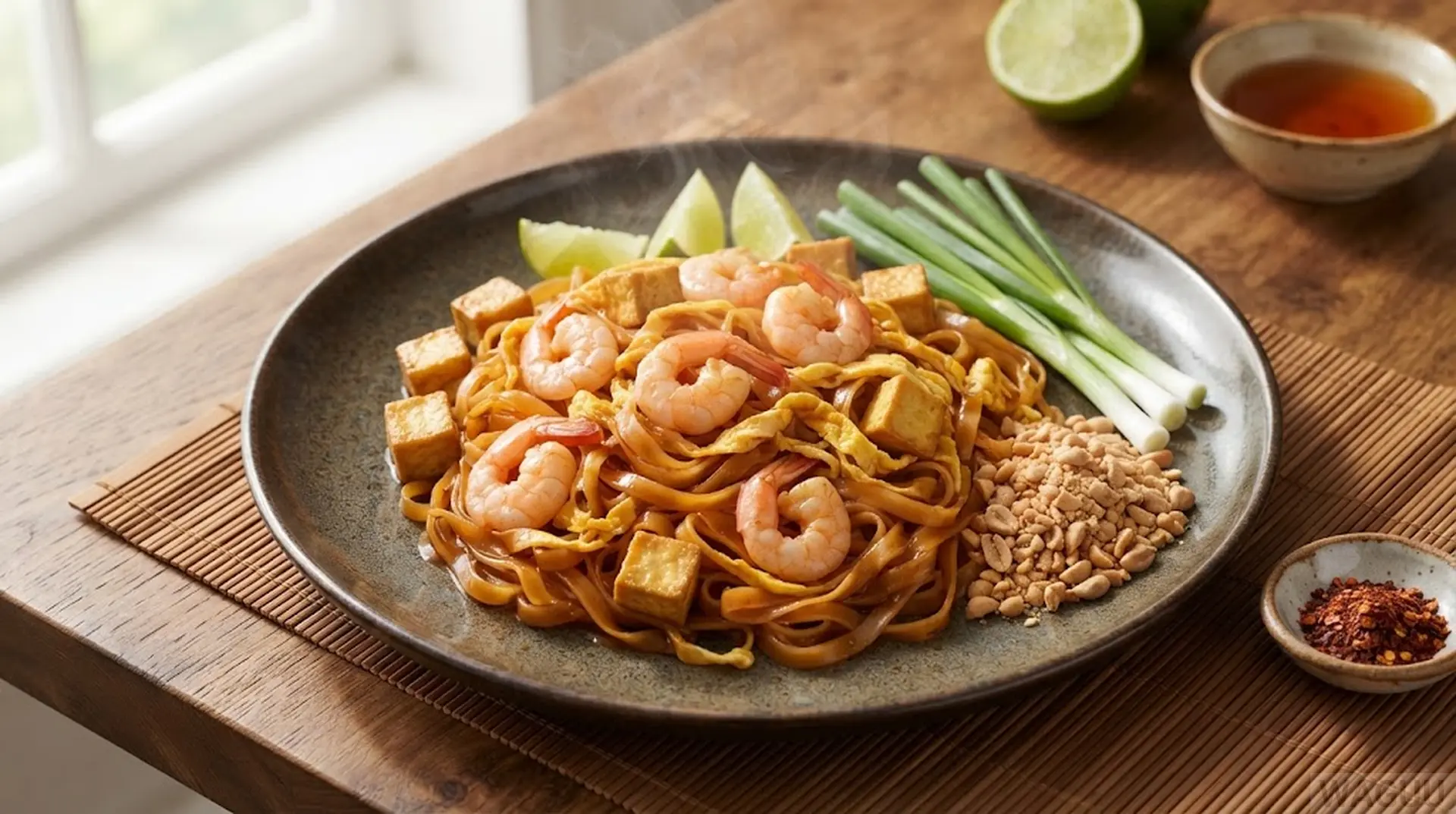
Summary: Pad Thai is the world-famous Thai stir-fried rice noodles featuring succulent prawns and tender chicken, scrambled egg, firm tofu, crunchy mung bean sprouts, and crushed peanuts, all tossed in a perfectly balanced sauce made of tangy tamarind paste, savoury fish sauce, and sweet palm sugar. Prepared using a high-heat wok technique, total preparation and cooking time is 35 minutes, perfectly scaled for 6 portions.
Did you cook this recipe? Share the result with the community.
Category: Thai Cuisine, Main Dishes
Success rate: 98.4% of users successfully made this recipe
Quick overview
- Dish: Pad Thai
- Category: Thai Cuisine, Main Dishes
- Cuisine: Thai
- Main ingredient: Dried rice noodles, 400 g (premium grade flat rice noodles)
- Guide: 12 Most Popular Thai Dishes: Favourite Thai Cuisine Recipes
- Total time: 35 minutes (15 min prep + 20 min cooking)
- Difficulty: Medium
- Portions: 6 portions (Portion weight: 350 g)
- Key technique: Wok stir-frying over intense heat with precise sauce emulsification
- Preparation types: Soaking, stir-frying, tossing
- Dietary info & Allergens: Crustaceans, peanuts, soy, eggs, fish
- Suitable for: Family dinner, festive weekend meal, Asian street food lovers
- Nutritional values (per 1 portion): 520 kcal, Protein: 26.5 g, Fat: 16.2 g, Carbohydrates: 65.8 g
- Storage: 2 days in the fridge, 0 months in the freezer
- Pairing: Thai Singha Beer, Riesling, Jasmine green tea
- In short: The ultimate balance of sweet, sour, and savoury notes wrapped around perfectly chewy rice noodles.
- Last updated: 15 June 2024
WAGUU says: “Never boil your rice noodles; soak them in warm water until pliable so they finish cooking absorbing the vibrant sauce directly in the wok.”
Key facts
| Prep time: | 15 minutes |
| Cooking time: | 20 minutes |
| Temperature: | High heat (wok cooking) |
| Number of portions: | 6 portions |
In a nutshell
Experience authentic Thai street food right in your kitchen with this foolproof Pad Thai recipe. Featuring succulent prawns, tender chicken strips, crispy fried tofu, and fresh bean sprouts coated in a signature tamarind-fish sauce reduction, every bite delivers an explosion of harmonious flavours and textures.
Ingredients
Base portions: 6 portions • Portion weight: 350 g
| Ingredient | Amount | Quality |
|---|---|---|
| Dried rice noodles (medium width) | 400 g | High-quality Thai brand |
| Prawns (shelled and deveined) | 300 g | Fresh or flash-frozen, size 16/20 |
| Chicken breast fillets (sliced thin) | 250 g | Free-range chicken |
| Firm tofu (cut into small batons) | 200 g | Traditional Asian soybean curd |
| Eggs | 3 pcs | Fresh farm eggs |
| Mung bean sprouts | 300 g | Crisp and fresh |
| Garlic (minced) | 4 cloves | Fresh cloves |
| Shallots (finely sliced) | 60 g | Sweet Asian shallots |
| Tamarind paste | 90 ml | Pure seedless concentrate |
| Fish sauce | 75 ml | First-press premium fish sauce |
| Palm sugar (grated) | 80 g | Authentic coconut palm sugar |
| Roasted peanuts (crushed) | 75 g | Unsalted dry-roasted peanuts |
| Garlic chives (cut into 4 cm lengths) | 60 g | Fresh Chinese chives |
| Vegetable oil | 60 ml | High smoke-point neutral oil |
| Limes (cut into wedges) | 2 pcs | Juicy fresh limes |
Why you will love this recipe
- Authentic Flavor Profile: Combines genuine tamarind, fish sauce, and palm sugar for a restaurant-quality taste.
- Protein Rich: Features a delightful combination of succulent prawns, tender chicken strips, and protein-packed tofu.
- Quick & Dynamic: Ready in just 35 minutes using high-heat wok techniques that lock in freshness.
Success guaranteed: Follow our precise soaking and temperature guidelines for perfectly chewy noodles that never stick or clump.
Recipe overview
Prep: 15 min | Cooking: 20 min | Difficulty: Medium | Portions: 6 portions | Type: Main Dish | Origin: Thailand
Detailed instructions
Overall progress: 0% complete
Phase 1: Noodle Soaking and Sauce Preparation – 10 min
Appliances: Stove burner, bowl
1. Place 400 g of dried rice noodles into a large bowl, cover with warm water (approx. 50 °C), and soak for 20 minutes until pliable but still firm to the bite. In a separate small saucepan, combine 90 ml of tamarind paste, 75 ml of fish sauce, and 80 g of grated palm sugar. Warm over low heat for 5 minutes, stirring constantly until the palm sugar completely dissolves into a uniform sauce.
VKB: Visual key: The sauce should be glossy and completely smooth without any solid sugar crystals.
Before moving to the next step:
Ensure the noodles are drained thoroughly so they do not water down the wok sauce.
Phase 2: Protein Searing and Tofu Frying – 5 min
Appliances: Carbon steel wok, stove
2. Heat 30 ml of vegetable oil in a carbon steel wok over high heat until shimmering. Add 250 g of sliced chicken breast and stir-fry for 2 minutes until white on all sides. Add 300 g of shelled prawns and 200 g of cubed firm tofu. Toss vigorously for 3 minutes until the prawns turn pink and opaque and the tofu develops a golden crust. Remove all proteins from the wok and set them aside on a clean plate.
VKB: Visual key: Prawns must be C-shaped and pink; do not overcook or they will become rubbery.
Before moving to the next step:
Keep the wok hot and clear of burnt residue before adding aromatics.
Phase 3: Aromatics and Noodle Stir-Frying – 4 min
Appliances: Carbon steel wok, spatula
3. Add the remaining 30 ml of vegetable oil to the same wok over medium-high heat. Sauté 4 minced garlic cloves and 60 g of sliced shallots for 60 seconds until fragrant and lightly golden. Drain the soaked rice noodles and add them directly into the wok. Pour in the prepared tamarind sauce. Toss and stir continuously for 3 minutes over high heat until the noodles absorb the liquid and soften completely.
VKB: Visual key: Noodles should turn evenly amber-brown and absorb all the sauce without pooling at the bottom.
Before moving to the next step:
Push the noodles to one side of the wok to create an open space for scrambling eggs.
Phase 4: Incorporating Eggs – 3 min
Appliances: Carbon steel wok
4. Push the noodles to one side of the wok, creating a clear well in the centre. Crack 3 fresh eggs directly into the empty space. Let them sit undisturbed for 30 seconds until the edges start to set, then break the yolks and gently scramble them with a spatula until soft curds form. Toss the scrambled eggs thoroughly into the noodle mixture.
VKB: Visual key: Soft yellow egg curds distributed evenly throughout the noodles.
Before moving to the next step:
Return the cooked prawns, chicken, and tofu to the wok before final tossing.
Phase 5: Recombining Proteins and Fresh Additions – 3 min
Appliances: Wok, spatula
5. Return the cooked prawns, chicken, and tofu along with their resting juices back into the wok. Add 300 g of fresh mung bean sprouts and 60 g of chopped garlic chives. Toss everything together vigorously over high heat for 2 minutes, allowing the bean sprouts to retain their crispness while heating through.
VKB: Visual key: Bean sprouts should remain bright white and crisp-tender, not wilted or soggy.
Before moving to the next step:
Turn off the heat immediately before plating to preserve texture.
Phase 6: Plating and Garnish – 2 min
Appliances: Serving plates
6. Transfer the Pad Thai immediately onto warm serving plates. Generously sprinkle 75 g of crushed dry-roasted peanuts over the top of each portion. Garnish with fresh lime wedges on the side for squeezing just before eating.
VKB: Visual key: Vibrant presentation with contrasting orange noodles, pink prawns, green chives, and golden peanuts.
Required equipment
| Utensil | Ideal size | Alternative | Risk |
|---|---|---|---|
| Carbon steel wok | 35 cm diameter | Large wide skillet | Overcrowding causing steaming instead of frying |
| Saucepan | 1 litre capacity | Small pot | Scorching sugar if heat is too high |
| Mixing bowl | 3 litres capacity | Large deep bowl | Water spilling during noodle soaking |
Shopping list
Nutritional profile
Values per 1 portion (excluding side dishes). Calculated from average nutritional values of ingredients.
| Nutrient | Per 100 g | Per 1 portion | Per 6 portions |
|---|---|---|---|
| Energy | 148.6 kcal | 520.0 kcal | 3120.0 kcal |
| Fat | 4.6 g | 16.2 g | 97.2 g |
| of which saturates | 0.9 g | 3.2 g | 19.2 g |
| Carbohydrates | 18.8 g | 65.8 g | 394.8 g |
| of which sugars | 5.1 g | 17.8 g | 106.8 g |
| Protein | 7.6 g | 26.5 g | 159.0 g |
| Salt | 1.1 g | 3.85 g | 23.1 g |
Reference intake of an average adult (8400 kJ / 2000 kcal).
WAGUU Pro Level
- Pro standard: Verified recipe with precise ratios and visual control points.
- Tip 1: Always soak rice noodles in warm water rather than boiling them to prevent them from becoming mushy in the wok.
- Tip 2: Cook proteins over intense heat and remove them before adding noodles to prevent overcooking.
- Tip 3: Balance the sauce tasting before pouring it over noodles; adjust tamarind for sourness or palm sugar for sweetness.
- Tip 4: Use a seasoned carbon steel wok to achieve the authentic smoky street-food aroma known as wok hei.
Scientific background
The chemistry of Pad Thai relies on the Maillard reaction achieved through high-heat wok frying, where amino acids and reducing sugars interact to create complex savory aromas. Tamarind provides organic tartaric and citric acids that balance the rich umami of fermented fish sauce and the caramel sweetness of palm sugar, creating the iconic Thai flavor equilibrium.
Fine Dining – Professional techniques
- Plate composition: Mound noodles neatly in the centre of a wide warm ceramic plate, crowned with whole grilled prawns and edible flowers.
- Textural contrasts: Pair chewy rice noodles with crunchy roasted peanuts and crisp raw bean sprouts.
- Temperature contrast: Serve piping hot stir-fried noodles alongside cool, crisp fresh lime wedges and fresh herb garnishes.
- Aromatic garnishes: Dust finely sliced banana blossom and fragrant toasted chili flakes around the rim.
Sensory radar
- Appearance: Glossy amber-coated noodles garnished with pink prawns, white sprouts, and golden peanuts.
- Aroma: Pungent fish sauce softened by sweet palm sugar, fragrant garlic, and tangy tamarind.
- Taste: Harmonious balance of sweet, sour, and salty with a mild chili kick.
- Texture: Chewy al dente noodles combined with tender meats and crunchy peanuts.
Pairing
- BEER: Chilled Thai Singha or Chang lager to cut through the rich umami flavors.
- WINE: Off-dry German Riesling or Gewürztraminer with subtle residual sweetness.
- NON-ALCOHOLIC: Fresh lemongrass iced tea with a squeeze of lime.
Various preparation variants
- Vegetarian Pad Thai: Replace prawns and chicken with extra firm tofu, shiitake mushrooms, and use soy sauce instead of fish sauce.
- Seafood Lover Variant: Add squid rings and sea scallops alongside the prawns for an ocean-rich feast.
Allergens and dietary information
Contains: Crustaceans, peanuts, soy, eggs, fish • Gluten: Naturally gluten-free when using pure rice noodles and certified gluten-free fish sauce • Not suitable for: Nut allergies, shellfish allergies
Suitable for
Family dinner, festive weekend meal, Asian street food lovers
Substitution catalog
- Tamarind paste: Lime juice mixed with a little brown sugar
- Palm sugar: Dark brown muscovado sugar
- Fish sauce: Light soy sauce combined with sea salt
FAQ
Why are my rice noodles sticking together?
Noodles stick if they are soaked in boiling water or over-soaked until mushy. Soak them only in warm water until just pliable, and toss with a little oil if resting.
Can I make Pad Thai without tamarind?
Tamarind provides the authentic signature sour note. While lime juice is a common substitute, true Pad Thai flavor relies on tamarind concentrate.
What is the best type of pan to use?
A traditional seasoned carbon steel wok is ideal because it retains high heat and allows quick tossing, but a large wide stainless steel skillet also works well.
Can I prepare the ingredients in advance?
Yes, you can chop all vegetables, soak the noodles, and mix the sauce beforehand. Stir-frying takes only minutes once the wok is hot.
WAGUU Petr advises: Cooking for 12 or more people?
12–16 people: Cook in two separate batches using two woks to prevent overcrowding and maintain high heat. • 20+ people: Pre-soak noodles in multiple batches and prepare all proteins and sauce in advance, stir-frying rapidly in rapid succession.
Sides and Serving
- Fresh Green Papaya Salad – Som Tam (not included in the recipe)
- Spicy Thai Beef Soup – Tom Yum Goong (not included in the recipe)
Serving: Serve immediately piping hot garnished with lime wedges, banana blossom slices, and extra crushed peanuts.
Storage and reheating
Fridge: 2 days days • Freezer: 0 months months • Reheating: Reheat gently in a hot wok with a splash of water until steaming.
Author: WAGUU Petr & Team • Published: 24 Aug 2026 • Updated: 31 Oct 2026
More Recipes from This Article
Other recipes you might be interested in
Why WAGUU?
Recipes on WAGUU undergo checks for the accuracy of ingredients, procedures, and nutritional values.
Process photo gallery
Community photos: Cook, take a photo, and share the result.
You can upload photos in the comments below or send them via email.
Did you record a video guide for our recipe? Insert a link to YouTube, YouTube Shorts, TikTok, Instagram Reels, Facebook Reels, Pinterest, Vimeo, or X (Twitter) in the comment – we’d be happy to publish it and help promote you and your content.
Common mistakes
- Boiling the noodles – Boiling rice noodles instead of soaking them makes them mushy and break apart in the wok.
- Overcrowding the wok – Adding too many ingredients at once lowers the cooking temperature and makes the noodles soggy.
- Skipping tamarind – Using only vinegar or lemon juice instead of tamarind paste alters the authentic sweet and sour balance.
- Overcooking the prawns – Leaving prawns in the wok too long turns them rubbery and dry.