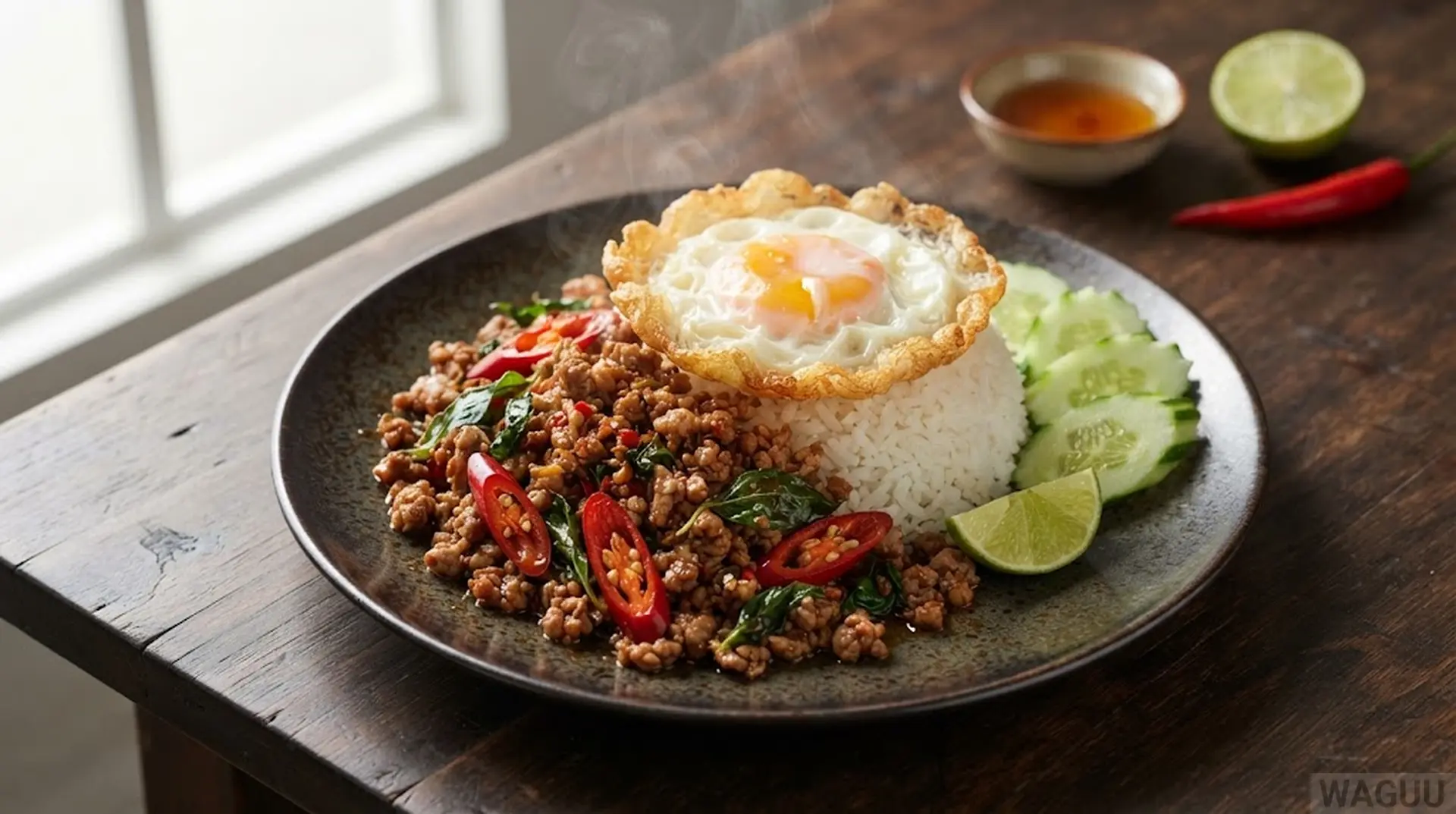
Summary: Pad Kra Pao – authentic Thai quick stir-fried minced pork or chicken with garlic, birds-eye chillies, and aromatic Thai holy basil, seasoned with savory fish sauce and oyster sauce, served over jasmine rice with a crispy-edged fried egg on top. Preparation time: 25 minutes. Number of portions: 4.
Did you cook this recipe? Share the result with the community.
Category: Main Dishes, Thai Cuisine
Success rate: 99% of users successfully made this recipe
Quick overview
- Dish: Pad Kra Pao
- Category: Main Dishes, Thai Cuisine
- Cuisine: Thai
- Main ingredient: Minced pork, 500 g (premium quality coarsely ground pork shoulder)
- Guide: 12 Most Popular Thai Dishes: Favourite Thai Cuisine Recipes
- Total time: 25 minutes (10 min prep + 15 min cooking)
- Difficulty: Easy
- Portions: 4 portions (Portion weight: 350 g)
- Key technique: High-heat wok stir-frying
- Preparation types: Stir-frying, frying
- Dietary info & Allergens: Contains soy, fish, and eggs. Gluten-free if using certified gluten-free soy sauce and oyster sauce.
- Suitable for: Quick weeknight dinners, spicy food lovers, authentic street food enthusiasts
- Nutritional values (per 1 portion): 540 kcal, Protein: 34 g, Fat: 24 g, Carbohydrates: 46 g
- Storage: 2 days in the fridge, 1 month in the freezer
- Pairing: Thai Singha beer, chilled Riesling, iced Thai milk tea
- In short: The ultimate fiery, fragrant Thai street food classic loaded with garlic, chilli, and holy basil over steamed jasmine rice.
- Last updated: 24. 8. 2026
WAGUU says: “The secret to an authentic Pad Kra Pao lies in pounding the garlic and chillies together in a granite mortar to release their essential oils, and using genuine Thai holy basil for its unique peppery, clove-like aroma.”
Key facts
| Prep time: | 10 minutes |
| Cooking time: | 15 minutes |
| Temperature: | High heat (wok burner) |
| Number of portions: | 4 portions |
In a nutshell
Pad Kra Pao is the undisputed king of Thai street food. With its bold collision of pungent garlic, scorching bird’s-eye chillies, and aromatic holy basil wrapped around savory minced meat, every single bite delivers an electrifying punch of authentic Thai flavors.
Ingredients
Base portions: 4 portions • Portion weight: 350 g
| Ingredient | Amount | Quality |
|---|---|---|
| Minced pork | 500 g | Coarsely ground pork shoulder (20% fat) |
| Garlic | 6 cloves | Fresh local garlic cloves |
| Bird’s eye chillies | 8 pieces | Fresh red and green Thai chillies |
| Thai holy basil leaves | 2 cups | Fresh holy basil (Kra Pao) picked off stems |
| Vegetable oil | 3 tbsp | High smoke point neutral cooking oil |
| Oyster sauce | 2 tbsp | Authentic thick oyster sauce |
| Fish sauce | 1 tbsp | First-press premium Thai fish sauce |
| Dark soy sauce | 1 tsp | Sweet dark soy sauce for caramelization |
| Light soy sauce | 1 tbsp | Standard Thai seasoning light soy sauce |
| Sugar | 1 tsp | Palm sugar or fine white sugar |
| Water or chicken stock | 3 tbsp | Clean lukewarm water |
| Eggs | 4 pieces | Fresh free-range chicken eggs |
| Jasmine rice | 300 g | Fragrant old crop Thai jasmine rice |
| Salt | 4 g | Fine sea salt for rice water |
Why you will love this recipe
- Blazing Speed: Ready from pantry to plate in under 25 minutes, making it the ultimate weeknight dinner solution.
- Authentic Street Food Flavor: Combines fiery chillies, pungent garlic, and fragrant holy basil for a true taste of Bangkok.
- Crispy Fried Egg Combo: Crowned with a glorious fried egg featuring lacy, crispy edges and a rich runny yolk that ties the spicy meat and rice together.
Success guaranteed: Follow our precise wok temperatures and pounding technique for restaurant-quality flavor every single time.
Recipe overview
Prep: 10 min | Cooking: 15 min | Difficulty: Easy | Portions: 4 | Type: Main dish | Origin: Thailand
Detailed instructions
Overall progress: 0% complete
Phase 1: Jasmine Rice Preparation – 15 min
Appliances: Stove, saucepan
1. Rinse 300 g of jasmine rice in cold water until the water runs completely clear. Drain well in a fine-mesh sieve. Transfer the rinsed rice to a medium saucepan and add 450 ml of clean water along with 4 g of fine sea salt. Bring the water to a rolling boil over medium-high heat uncovered for 3 minutes.
VKB: Visual key: Water level should sit approximately one knuckle above the surface of the rice before boiling.
Before moving to the next step:
Reduce the heat to the lowest setting immediately once water bubbles down to the rice surface to prevent burning.
Phase 2: Steaming the Rice – 12 min
Appliances: Stove
2. Cover the saucepan tightly with a well-fitting lid, turn the heat down to the lowest setting, and let the rice steam gently undisturbed for 12 minutes. Remove the saucepan from the heat source and let it rest covered for an additional 5 minutes before fluffing gently with a wooden fork or rice paddle.
VKB: Visual key: Grains should be fluffy, separate, and tender without any wet starchy residue.
Before moving to the next step:
Keep the lid closed during the resting period to allow steam to evenly distribute through every grain.
Phase 3: Aromatic Paste Preparation – 5 min
Appliances: Granite mortar and pestle
3. Peel 6 cloves of fresh garlic and place them into a granite mortar along with 8 bird’s eye chillies. Pound vigorously with the pestle until coarsely crushed into a fragrant, chunky paste where the cell walls of the garlic and chillies are fully broken down to release their volatile aromatic compounds.
VKB: Visual key: A coarse, pulpy mash with visible flecks of red chilli skin and crushed garlic pulp.
Before moving to the next step:
Avoid turning the paste into a smooth liquid puree; texture is essential for even distribution in the wok.
Phase 4: Sauce Mixing – 3 min
Appliances: Small mixing bowl, whisk
4. In a small mixing bowl, combine 2 tbsp of oyster sauce, 1 tbsp of first-press fish sauce, 1 tsp of dark soy sauce, 1 tbsp of light soy sauce, 1 tsp of sugar, and 3 tbsp of water. Stir thoroughly with a small spoon until the sugar crystals dissolve completely into the savory liquid blend.
VKB: Visual key: A uniform, glossy dark amber sauce mixture with a balanced salty-sweet aroma.
Before moving to the next step:
Premixing the sauce prevents burning in the scorching hot wok while measuring individual ingredients.
Phase 5: Wok Stir-Frying Meat and Aromatics – 6 min
Appliances: Carbon steel wok, spatula, stove burner
5. Place a carbon steel wok over high heat until smoking hot. Add 3 tbsp of vegetable oil and swirl to coat the sides. Add the garlic and chilli paste and stir-fry vigorously for 30 seconds until intensely aromatic, taking care not to burn the garlic. Add 500 g of minced pork, breaking it apart with the edge of your spatula, and stir-fry for 4 minutes until the meat is fully cooked through and slightly browned.
VKB: Visual key: Meat is crumbly, golden-brown in spots, and surrounded by aromatic sizzling oils.
Before moving to the next step:
Ensure adequate kitchen ventilation as cooking bird’s eye chillies at high heat releases pungent fumes.
Phase 6: Finishing with Sauce and Basil – 3 min
Appliances: Carbon steel wok, spatula
6. Pour the premixed sauce into the wok over the cooked pork. Toss continuously over high heat for 1 minute until the liquid reduces and clings to the meat. Turn off the heat completely, immediately add 2 cups of fresh Thai holy basil leaves, and fold them into the hot pork until they wilt instantly from residual heat. Serve hot over jasmine rice with a crispy fried egg.
VKB: Visual key: Basil leaves are bright green, wilted down by half, and enveloped in a glossy caramelized glaze.
Required equipment
| Utensil | Ideal size | Alternative | Risk |
|---|---|---|---|
| Carbon steel wok | 32 cm diameter | Heavy cast-iron skillet | Overcrowding causes steaming instead of frying |
| Granite mortar and pestle | 16 cm bowl | Mini food processor (coarse pulse) | Processor purees instead of crushing fibers |
| Saucepan | 2 litre capacity | Rice cooker | Rice scorching if heat is too high |
Shopping list
Nutritional profile
Values per 1 portion (including rice). Calculated from average nutritional values of ingredients.
| Nutrient | Per 100 g | Per 1 portion | Per 4 portions |
|---|---|---|---|
| Energy | 154.3 kcal | 540.0 kcal | 2160.0 kcal |
| Fat | 6.9 g | 24.0 g | 96.0 g |
| of which saturates | 2.3 g | 8.0 g | 32.0 g |
| Carbohydrates | 13.1 g | 46.0 g | 184.0 g |
| of which sugars | 1.1 g | 4.0 g | 16.0 g |
| Protein | 9.7 g | 34.0 g | 136.0 g |
| Salt | 0.8 g | 2.8 g | 11.2 g |
Reference intake of an average adult (8400 kJ / 2000 kcal).
WAGUU Pro Level
- Pro standard: Verified recipe with precise ratios and visual control points.
- Tip 1: Use coarsely hand-minced pork belly and shoulder combined instead of supermarket fine ground pork for authentic street food texture.
- Tip 2: Never substitute Italian sweet basil or Thai sweet basil (Horapha) for holy basil (Kra Pao); holy basil possesses a distinct clove-like pepperiness that defines the dish.
- Tip 3: Fry the egg in abundant hot oil at high heat so the whites bubble into lacy, crispy edges while the yolk remains soft and liquid.
- Tip 4: Prepare your mise en place completely before turning on the stove, as the stir-frying process takes less than two minutes.
Scientific background
Pounding garlic and bird’s eye chillies in a granite mortar ruptures plant cell walls mechanically, releasing the enzyme alliinase and capsaicin-carrying oils much more effectively than slicing with a knife. When these crushed aromatics hit screaming-hot oil in a carbon steel wok, Maillard reactions and thermal oil vaporization release potent aromatic sulfur compounds that give Pad Kra Pao its unmistakable street-side aroma.
Fine Dining – Professional techniques
- Plate composition: Mold the jasmine rice using a small round ramekin in the center of the plate, crown with the glossy dark pork, and top majestically with the lacy fried egg.
- Textural contrasts: Contrast the tender, juicy minced pork against the crispy, bubbled egg whites and fluffy, separate grains of jasmine rice.
- Temperature contrast: Serve the piping hot wok-fried pork alongside a freshly fried egg with a warm, velvety liquid yolk.
- Aromatic garnishes: Garnish with a few crisp fried holy basil leaves and a small side dish of fish sauce with sliced bird’s eye chillies (Prik Nam Pla).
Sensory radar
- Appearance: Glossy amber-brown minced pork topped with a vibrant golden fried egg and emerald green basil leaves over snowy white rice.
- Aroma: Pungent garlic, explosive spicy chilli notes, and herbal peppery holy basil fragrance.
- Taste: Intensely savory, umami-rich, harmoniously salty and sweet with a sharp, lingering chilli heat.
- Texture: Coarse, tender minced meat with crisp wok-charred edges, fluffy rice, and a silky egg yolk.
Pairing
- BEER: Chilled Thai Singha or Chang lager to cut through the intense chilli heat.
- WINE: Off-dry German Riesling or Gewürztraminer with subtle residual sweetness to balance the spice.
- NON-ALCOHOLIC: Traditional iced Thai milk tea (Cha Yen) or fresh young coconut water.
Various preparation variants
- Chicken Pad Kra Pao: Replace minced pork with coarsely chopped chicken thigh meat for a lighter alternative.
- Seafood Pad Kra Pao: Use a combination of peeled prawns and squid instead of minced meat for an upscale coastal variation.
Allergens and dietary information
Contains: Soy, fish, eggs • Gluten: Contains gluten in standard soy and oyster sauces (can be made gluten-free with certified tamari) • Not suitable for: Vegetarians and vegans unless substituted with plant-based mince and soy sauce.
Suitable for
Quick weeknight dinners, spicy food lovers, authentic street food enthusiasts, Asian cuisine fans.
Substitution catalog
- Minced pork: Minced chicken, beef, or finely textured textured vegetable protein
- Thai holy basil: Italian sweet basil (though flavor profile will differ significantly)
- Oyster sauce: Vegetarian mushroom stir-fry sauce
FAQ
Can I use standard sweet basil if holy basil is unavailable?
While sweet basil works in a pinch, holy basil possesses a unique peppery, clove-like spice that is essential for authentic Pad Kra Pao flavor.
Why must the wok be smoking hot?
Extreme heat ensures moisture evaporates instantly, allowing the meat to sear and caramelize rather than boil in its own juices.
Is the fried egg mandatory?
In Thailand, Pad Kra Pao is almost never served without a crispy fried egg (Kai Dao); the runny yolk mellows the fierce chilli heat.
How can I adjust the spice level?
Simply reduce the number of bird’s eye chillies or remove their seeds before pounding in the mortar.
WAGUU Petr advises: Cooking for 12 or more people?
12–16 people: Cook the minced pork base in two separate batches in your wok to maintain high heat and prevent overcrowding • 20+ people: Prepare the aromatic pork base in a large restaurant-grade tilting skillet and fry eggs in batches ahead of time.
Sides and Serving
- Prik Nam Pla – Thai fish sauce with sliced chillies and lime (not included in the recipe)
- Cucumber slices and lime wedges – refreshing palate cleansers (not included in the recipe)
Serving: Serve immediately piping hot over freshly steamed jasmine rice, crowned with the crispy fried egg.
Storage and reheating
Fridge: 2 days days • Freezer: 1 months months • Reheating: Reheat thoroughly in a hot wok or skillet with a splash of water until steaming hot.
Author: WAGUU Petr & Team • Published: 24 Aug 2026 • Updated: 31 Oct 2026
More Recipes from This Article
Other recipes you might be interested in
Why WAGUU?
Recipes on WAGUU undergo checks for the accuracy of ingredients, procedures, and nutritional values.
Process photo gallery
Community photos: Cook, take a photo, and share the result.
You can upload photos in the comments below or send them via email.
Did you record a video guide for our recipe? Insert a link to YouTube, YouTube Shorts, TikTok, Instagram Reels, Facebook Reels, Pinterest, Vimeo, or X (Twitter) in the comment – we’d be happy to publish it and help promote you and your content.
Common mistakes
- Using sweet basil instead of holy basil – Results in a completely different flavor profile lacking the authentic peppery bite.
- Overcrowding the wok – Causes the minced meat to steam and release water instead of searing and caramelizing.
- Chopping garlic and chillies with a knife – Fails to rupture cell walls sufficiently compared to pounding in a mortar.
- Skipping the crispy fried egg – Misses out on the traditional textural and flavor balance that ties the dish together.