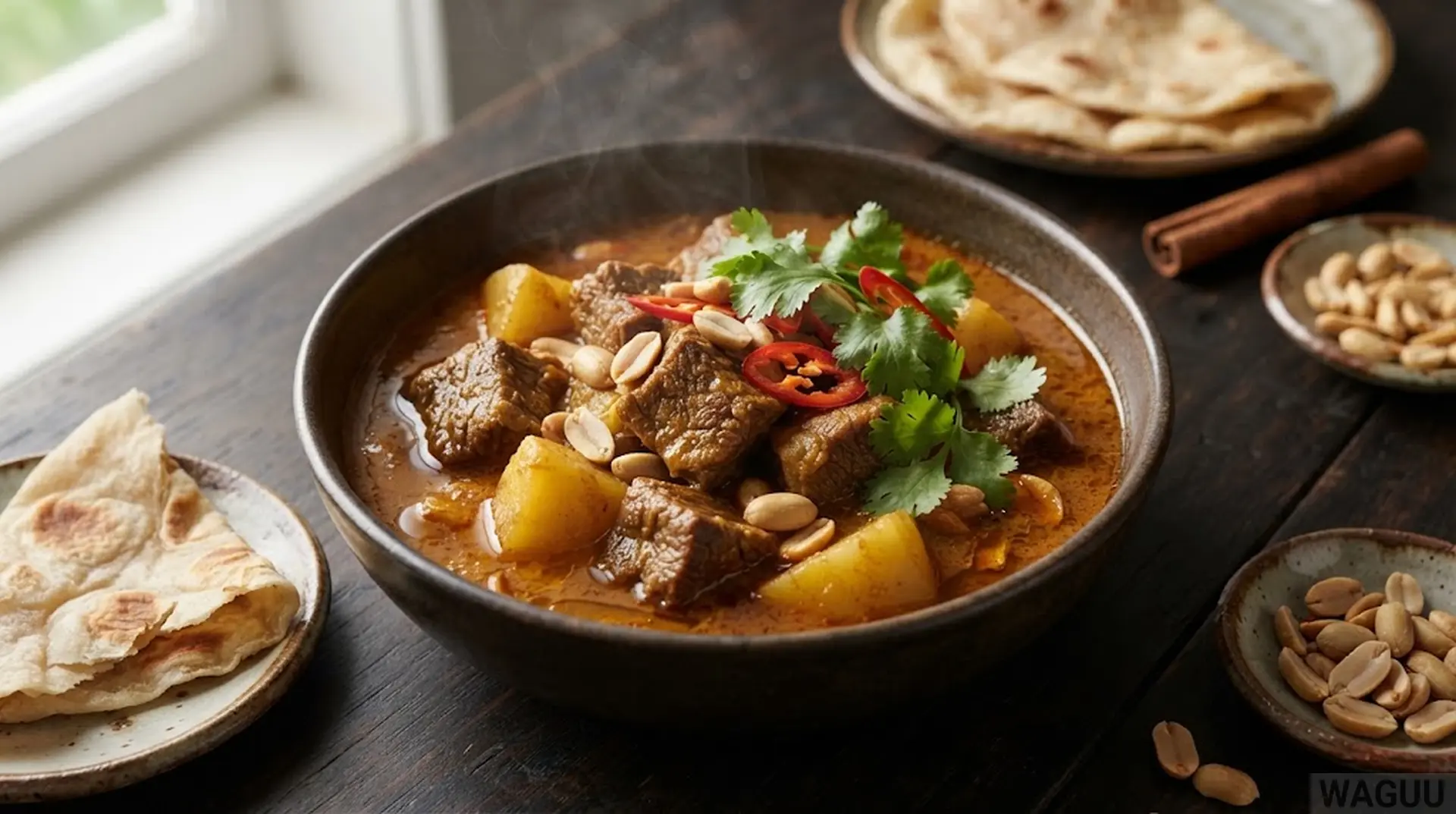
Summary: Massaman Curry – a milder, rich curry with coconut milk, potatoes, meat, peanuts, and a spice blend with Indian and Malay culinary influences, prepared using a traditional simmering technique, taking 100 minutes total, yielding 6 portions.
Did you cook this recipe? Share the result with the community.
Category: Thai Cuisine, Main Dishes
Success rate: 96% of users successfully made this recipe
Quick overview
- Dish: Massaman Curry
- Category: Thai Cuisine, Main Dishes
- Cuisine: Thai
- Main ingredient: beef chuck, 800 g (high quality, well-marbled)
- Guide: 12 Most Popular Thai Dishes: Favourite Thai Cuisine Recipes
- Total time: 100 minutes (30 min prep + 70 min cooking)
- Difficulty: Medium
- Portions: 6 portions (Portion weight: 450 g)
- Key technique: Simmering coconut milk and spices
- Preparation types: Braising and simmering
- Dietary info & Allergens: Contains peanuts, fish sauce, soy
- Suitable for: Lunch or dinner parties
- Nutritional values (per 1 portion): 540 kcal, Protein: 38.0 g, Fat: 28.5 g, Carbohydrates: 34.0 g
- Storage: 3 days in the fridge, 3 months in the freezer
- Pairing: Singha beer, Riesling wine, sparkling water with lime
- In short: A wonderfully fragrant, warming Thai curry combining tender beef, potatoes, and peanuts in a rich, spiced coconut sauce.
- Last updated: 2026-03-30
WAGUU says: “Massaman curry is unique in Thai cuisine due to its heavy reliance on dried spices introduced by traders from India and the Malay Peninsula.”
Key facts
| Prep time: | 30 minutes |
| Cooking time: | 70 minutes |
| Temperature: | Medium heat (160–180 °C) |
| Number of portions: | 6 portions |
In a nutshell
Massaman Curry is a masterpiece of Thai culinary art, blending sweet, savory, and nutty notes into an unforgettable dining experience.
Ingredients
Base portions: 6 portions • Portion weight: 450 g
| Ingredient | Amount | Quality |
|---|---|---|
| Beef chuck | 800 g | Well-marbled, cubed |
| Coconut milk | 400 ml | Full fat |
| Massaman curry paste | 50 g | Authentic Thai |
| Potatoes | 500 g | Waxy, peeled and cubed |
| Yellow onion | 200 g | Sliced into wedges |
| Roasted peanuts | 80 g | Unsalted |
| Tamarind paste | 30 g | Seedless |
| Palm sugar | 40 g | Soft |
| Fish sauce | 45 ml | First pressing |
| Cardamom pods | 4 pcs | Whole green |
| Cinnamon stick | 1 pcs | Ceylon |
| Water or beef stock | 300 ml | Warm |
| Salt | 6 g | Fine sea salt |
Why you will love this recipe
- Rich flavor profile: A harmonious blend of sweet, sour, and savory tastes.
- Tender meat: Slow-simmered beef chuck melts in your mouth.
- Comforting texture: Creamy coconut sauce paired with soft potatoes and crunchy peanuts.
Success guaranteed: Follow the precise simmering instructions to achieve restaurant-quality results at home.
Recipe overview
Prep: 30 min | Cooking: 70 min | Difficulty: Medium | Portions: 6 | Type: Main dish | Origin: Thailand
Detailed instructions
Overall progress: 0% complete
Phase 1: Preparation and Spices – 15 min
Appliances: Knife, cutting board, measuring spoons
1. Cut 800 g of beef chuck into uniform 3 cm cubes. Peel 500 g of waxy potatoes and cut them into large bite-sized chunks. Slice 200 g of yellow onion into wedges. Measure out 50 g of Massaman curry paste, 400 ml of full-fat coconut milk, 300 ml of warm water or beef stock, 80 g of roasted peanuts, 30 g of tamarind paste, 40 g of soft palm sugar, 45 ml of fish sauce, 6 g of salt, 4 green cardamom pods, and 1 cinnamon stick.
VKB: Visual Knife Board (ensuring even cuts for uniform cooking).
Before moving to the next step:
Ensure all ingredients are measured and prepped before turning on the heat.
Phase 2: Cracking Coconut Milk and Frying Paste – 15 min
Appliances: Heavy-bottomed pot or Dutch oven, wooden spatula
2. Pour 150 ml of the coconut milk into a heavy-bottomed pot over medium heat (170 °C). Cook, stirring constantly, until the coconut oil separates and begins to “crack” (about 5 minutes). Add 50 g of Massaman curry paste, the cracked green cardamom pods, and the 1 cinnamon stick. Fry the paste in the separated coconut oil for 3 to 4 minutes until deeply fragrant and aromatic.
VKB: Watch for the coconut cream to split, revealing glistening oil pockets.
Before moving to the next step:
Do not let the curry paste burn; reduce heat if it splatters too aggressively.
Phase 3: Searing the Beef – 10 min
Appliances: Heavy-bottomed pot, wooden spoon
3. Add the 800 g of cubed beef chuck into the pot with the fried curry paste. Toss the beef continuously for 6 to 8 minutes so that every piece is thoroughly coated and lightly seared on the outside, absorbing the rich spice flavors.
VKB: Ensure the meat changes color on all sides before adding liquids.
Before moving to the next step:
Scrape any browned bits from the bottom of the pot to incorporate into the sauce.
Phase 4: Simmering the Beef – 35 min
Appliances: Pot with lid, stovetop
4. Pour in the remaining 250 ml of coconut milk, 300 ml of warm water or beef stock, and 6 g of salt. Bring the mixture to a gentle simmer (100 °C), then cover with a lid, reduce heat to low (150 °C), and let it braise for 35 minutes until the beef begins to tenderize.
VKB: Maintain a gentle, steady bubble; vigorous boiling will curdle the coconut milk.
Before moving to the next step:
Check liquid levels; add a splash of water if the sauce reduces too quickly.
Phase 5: Adding Potatoes, Onions, and Peanuts – 15 min
Appliances: Pot with lid
5. Uncover the pot and add 500 g of cubed potatoes, 200 g of sliced yellow onion wedges, and 80 g of roasted peanuts. Stir well, cover again, and simmer on low heat for 15 minutes until the potatoes are fork-tender and the beef is completely soft.
VKB: Pierce a potato piece with a fork to test doneness.
Before moving to the next step:
Ensure potatoes do not overcook and turn to mush.
Phase 6: Seasoning and Final Balance – 10 min
Appliances: Ladle, tasting spoon
6. Stir in 30 g of tamarind paste, 40 g of soft palm sugar, and 45 ml of fish sauce. Simmer uncovered for 5 to 10 minutes, allowing the sauce to thicken slightly and the sweet, sour, and salty flavors to meld perfectly. Remove from heat and serve hot.
VKB: Taste the sauce and adjust sweetness or acidity if needed.
Required equipment
| Utensil | Ideal size | Alternative | Risk |
|---|---|---|---|
| Heavy-bottomed pot | 4-liter capacity | Dutch oven | Burning if heat is too high |
| Chef’s knife | 20 cm blade | Santoku knife | Cut hazard if dull |
| Wooden spatula | Standard size | Heat-resistant silicone spoon | None |
Shopping list
Nutritional profile
Values per 1 portion (excluding side dishes). Calculated from average nutritional values of ingredients.
| Nutrient | Per 100 g | Per 1 portion | Per 6 portions |
|---|---|---|---|
| Energy | 120.0 kcal | 540.0 kcal | 3240.0 kcal |
| Fat | 6.3 g | 28.5 g | 171.0 g |
| of which saturates | 4.5 g | 20.2 g | 121.2 g |
| Carbohydrates | 7.5 g | 34.0 g | 204.0 g |
| of which sugars | 2.5 g | 11.2 g | 67.2 g |
| Protein | 8.4 g | 38.0 g | 228.0 g |
| Salt | 0.4 g | 1.8 g | 10.8 g |
Reference intake of an average adult (8400 kJ / 2000 kcal).
WAGUU Pro Level
- Pro standard: Verified recipe with precise ratios and visual control points.
- Tip 1: Always let the coconut milk crack properly to release its natural oils for authentic flavor.
- Tip 2: Toast whole spices like cardamom and cinnamon gently to elevate their aromatic depth.
- Tip 3: Use chuck steak for the best balance of tenderness and collagen release during braising.
- Tip 4: Let the curry rest for 15 minutes off the heat before serving to allow flavors to deepen.
Scientific background
The unique character of Massaman curry stems from the Maillard reaction between amino acids and reducing sugars when frying the curry paste in separated coconut fat, combined with the slow breakdown of collagen in beef chuck into gelatin.
Fine Dining – Professional techniques
- Plate composition: Serve in a deep ceramic bowl with a neat mound of jasmine rice.
- Textural contrasts: Combine melt-in-the-mouth beef with crunchy roasted peanuts.
- Temperature contrast: Serve steaming hot curry alongside freshly steamed cool jasmine rice.
- Aromatic garnishes: Garnish with finely sliced crispy shallots and fresh cilantro leaves.
Sensory radar
- Appearance: Rich amber-brown sauce with glistening red oil droplets and tender chunks.
- Aroma: Warm notes of cinnamon, cardamom, toasted peanuts, and aromatic coconut.
- Taste: Mildly spicy, deeply savory, balanced with tamarind sourness and palm sugar sweetness.
- Texture: Velvety smooth sauce, tender beef, soft potatoes, and crunchy peanuts.
Pairing
- BEER: Chilled Thai Singha or crisp lager
- WINE: Off-dry German Riesling or Gewürztraminer
- NON-ALCOHOLIC: Sparkling water with fresh lime and mint
Various preparation variants
- Chicken Massaman: Substitute beef chuck with diced chicken thighs for a quicker cooking time.
- Vegetarian Massaman: Replace beef with firm tofu and chickpeas, using vegetable stock.
Allergens and dietary information
Contains: Peanuts, fish sauce, soy • Gluten: Naturally gluten-free (check paste label) • Not suitable for: Nut allergy sufferers
Suitable for
Lunch or dinner parties, cozy weekend meals, and lovers of Asian cuisine.
Substitution catalog
- Palm sugar: Substitute with light brown sugar or dark muscovado sugar.
- Fish sauce: Substitute with light soy sauce or tamari for vegetarian diets.
FAQ
Is Massaman curry very spicy?
No, Massaman is known as one of the mildest Thai curries, focusing more on aromatic warm spices than chili heat.
Can I make this curry in advance?
Yes, like many stews, Massaman curry tastes even better the next day after the flavors have fully melded.
What cut of beef works best?
Beef chuck or brisket works wonderfully because the connective tissue breaks down during slow simmering.
Can I freeze Massaman curry?
Yes, it freezes well for up to 3 months, though potatoes may soften slightly upon thawing.
WAGUU Petr advises: Cooking for 12 or more people?
12–16 people: Double all ingredient quantities and use a larger 10-liter stockpot. • 20+ people: Prepare the curry in two separate pots to ensure even heat distribution and simmering.
Sides and Serving
- Jasmine rice – Steamed fragrant white rice (not included in the recipe)
- Pickled cucumber relish – Fresh crunchy cucumber slices in vinegar (not included in the recipe)
Serving: Serve hot garnished with roasted peanuts, crispy shallots, and fresh cilantro.
Storage and reheating
Fridge: 3 days • Freezer: 3 months • Reheating: Reheat gently on the stovetop over medium-low heat, stirring occasionally with a splash of water if needed.
Author: WAGUU Petr & Team • Published: 24 Aug 2026 • Updated: 31 Oct 2026
More Recipes from This Article
Other recipes you might be interested in
Why WAGUU?
Recipes on WAGUU undergo checks for the accuracy of ingredients, procedures, and nutritional values.
Process photo gallery
Community photos: Cook, take a photo, and share the result.
You can upload photos in the comments below or send them via email.
Did you record a video guide for our recipe? Insert a link to YouTube, YouTube Shorts, TikTok, Instagram Reels, Facebook Reels, Pinterest, Vimeo, or X (Twitter) in the comment – we’d be happy to publish it and help promote you and your content.
Common mistakes
- Not cracking the coconut milk – Failing to separate the coconut oil before adding the paste leads to a flat, watery flavor.
- Overcooking the potatoes – Adding potatoes too early causes them to disintegrate completely into the sauce.
- Using high heat – Boiling coconut milk vigorously causes it to curdle and separate incorrectly.
- Skipping the resting time – Serving immediately without letting the curry rest prevents the flavors from fully harmonizing.