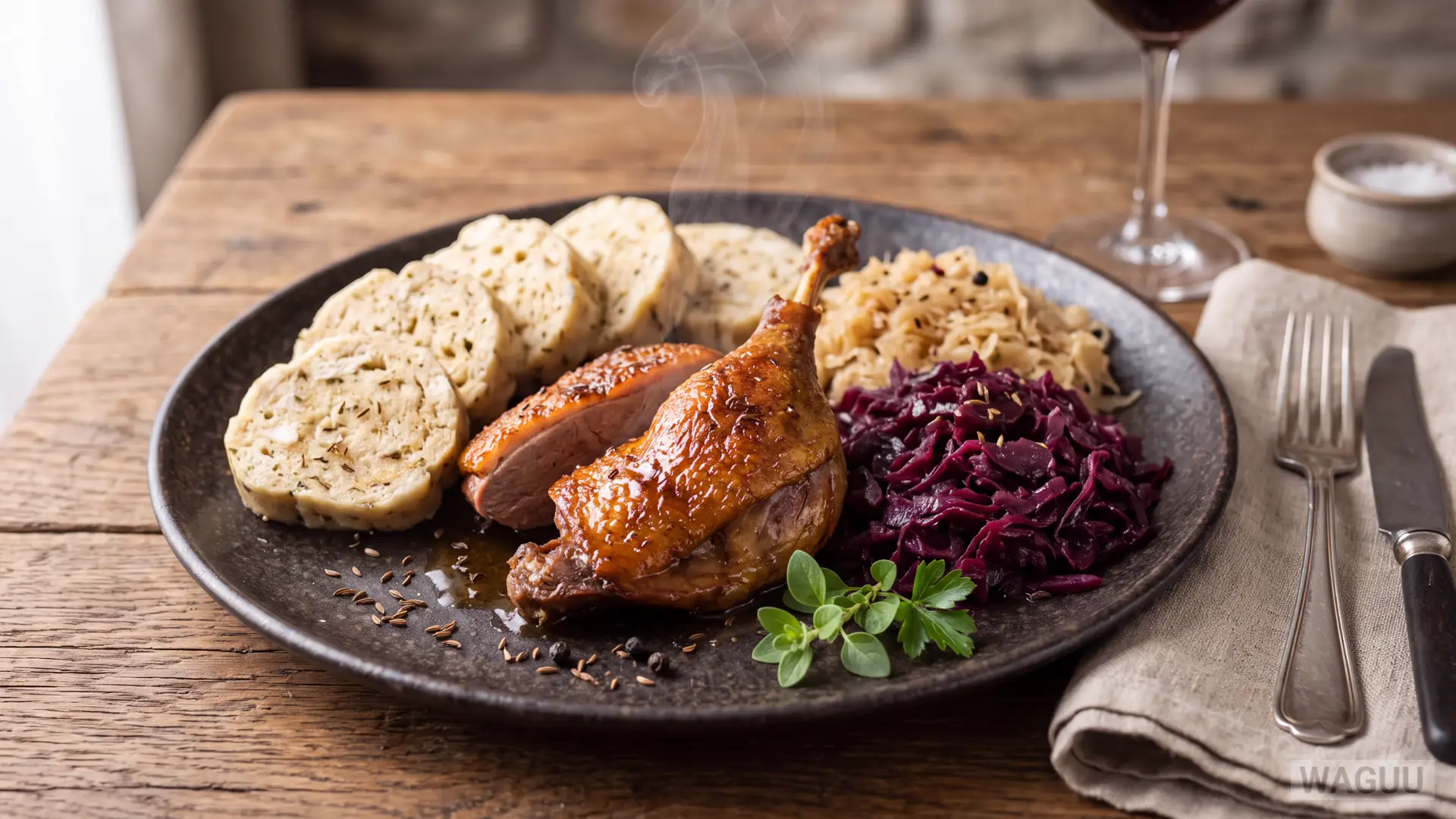
Summary: A classic festive centrepiece featuring slow-roasted duck with crispy skin, paired with sweet-and-sour braised cabbage and airy bread dumplings. This traditional technique relies on gentle oven roasting and precise temperature control. Preparation takes 30 minutes, followed by 3.5 hours of cooking, designed for 6 hearty portions.
Did you cook this recipe? Share the result with the community.
Category: Poultry, Czech Cuisine
Success rate: 98% of users successfully made this recipe
Quick overview
- Dish: Roast duck with cabbage and dumplings
- Category: Poultry, Czech Cuisine
- Cuisine: Czech
- Main ingredient: Whole duck, 2.5 kg (quality: free-range)
- Guide: The 12 most popular Czech dishes: the favourite recipes of Czech cuisine
- Total time: 240 minutes (30 min prep + 210 min cooking)
- Difficulty: Intermediate
- Portions: 6 (Portion weight: 450 g)
- Key technique: Slow roasting with moisture management
- Preparation types: Roasting, steaming, boiling
- Dietary info & Allergens: Contains: gluten, eggs
- Suitable for: Family gatherings, festive dinners
- Nutritional values (per 1 portion): 840 kcal, Protein: 38.0 g, Fat: 52.0 g, Carbohydrates: 48.0 g
- Storage: 3 days in the fridge, 3 months in the freezer
- Pairing: Lager beer, St. Laurent red wine, Sparkling mineral water
- In short: A masterclass in achieving crisp skin and succulent meat.
- Last updated: 21 September 2026
WAGUU says: “The secret to this dish is the slow rendering of the duck fat, which keeps the meat moist while the high-heat finish ensures a glass-like skin.”
How to take it further: Add caraway seeds to the duck skin before roasting for extra aromatic depth, or finish the cabbage with a spoonful of redcurrant jelly.
Key facts
| Prep time: | 30 min |
| Cooking time: | 210 min |
| Temperature: | 140–180 °C |
| Number of portions: | 6 |
In a nutshell
This iconic dish defines comfort food. By roasting the duck slowly at a lower temperature, we ensure the fat renders completely, leaving the meat tender and the skin perfectly golden and crisp. Served with sweet-and-sour braised cabbage and pillowy bread dumplings, it is a balanced, hearty, and deeply flavourful feast.
Ingredients
Base portions: 6 portions • Portion weight: 450 g
| Ingredient | Amount | Quality |
|---|---|---|
| Whole duck | 2.5 kg | Free-range |
| Salt | 30 g | Sea salt |
| Caraway seeds | 10 g | Whole |
| White cabbage | 800 g | Fresh |
| Bread dumplings | 6 pieces | Homemade |
| Water | 200 ml | Filtered |
Why you will love this recipe
- Perfect Texture: The slow rendering process ensures the skin becomes incredibly crispy while the meat remains juicy.
- Depth of Flavour: The combination of caraway seeds and rendered duck fat creates a uniquely aromatic profile.
- Balanced Sides: The sweet-and-sour cabbage provides a necessary acid contrast to the richness of the duck.
Success guaranteed: By following the strict temperature stages, you eliminate the risk of dry meat or soggy skin.
Recipe overview
Prep: 30 min | Cooking: 210 min | Difficulty: Intermediate | Portions: 6 | Type: Main Course | Origin: Czech Republic
Detailed instructions
Overall progress: 0% complete
Phase 1: Preparation – 30 min
Appliances: Oven
1. Clean the duck, remove excess fat from the cavity, and season thoroughly inside and out with salt and caraway seeds. Preheat the oven to 140 °C.
VKB: Visual check point (VKB): The skin should be evenly salted and the cavity cleared of large fat deposits.
Before moving to the next step:
Ensure the oven has reached 140 °C to start the slow rendering process.
Phase 2: Slow Roasting – 150 min
Appliances: Oven
2. Place the duck in a roasting tin, breast side up. Add 200 ml of water to the pan and cover. Roast for 150 minutes at 140 °C, basting occasionally with the rendered fat.
VKB: VKB: The meat should begin to pull away from the bone ends.
Before moving to the next step:
Check that the liquid in the pan has not evaporated completely.
Phase 3: Cabbage Preparation – 30 min
Appliances: Hob
3. Shred the white cabbage finely. Sauté in a saucepan until softened, then add a splash of water and cook until tender.
VKB: VKB: The cabbage should be soft but retain a slight bite.
Before moving to the next step:
Ensure the cabbage is seasoned to balance sweet and sour notes.
Phase 4: Crisp Skin – 30 min
Appliances: Oven
4. Remove the cover from the roasting tin. Increase the oven temperature to 180 °C and roast for another 30 minutes until the skin is deep golden and crisp.
VKB: VKB: The skin must be crispy to the touch.
Before moving to the next step:
Watch closely during the last 10 minutes to prevent burning.
Phase 5: Dumpling Heating – 10 min
Appliances: Hob
5. Steam the bread dumplings for 10 minutes until warmed through and fluffy.
VKB: VKB: Dumplings should be elastic to the touch.
Before moving to the next step:
Ensure the steamer is not too crowded to allow even heating.
Phase 6: Resting – 10 min
Appliances: None
6. Remove the duck from the oven and let it rest on a carving board for 10 minutes before serving.
VKB: VKB: Juices should redistribute, keeping the meat succulent.
Required equipment
| Utensil | Ideal size | Alternative | Risk |
|---|---|---|---|
| Roasting tin | 30×40 cm | Deep baking tray | Splashing fat |
| Saucepan | 2 litre | Casserole dish | Burning cabbage |
| Steamer | Standard | Colander over pot | Soggy dumplings |
Shopping list
Nutritional profile
Values per 1 portion (excluding side dishes). Calculated from average nutritional values of ingredients.
| Nutrient | Per 100 g | Per 1 portion | Per 6 portions |
|---|---|---|---|
| Energy | 186.7 kcal | 840.0 kcal | 5040.0 kcal |
| Fat | 11.5 g | 52.0 g | 312.0 g |
| of which saturates | 3.5 g | 15.8 g | 94.8 g |
| Carbohydrates | 10.6 g | 48.0 g | 288.0 g |
| of which sugars | 1.5 g | 6.8 g | 40.8 g |
| Protein | 8.4 g | 38.0 g | 228.0 g |
| Salt | 0.2 g | 1.0 g | 6.0 g |
Reference intake of an average adult (8400 kJ / 2000 kcal).
WAGUU Pro Level
- Pro standard: Verified recipe with precise ratios and visual control points.
- Tip 1: Score the duck skin in a diamond pattern to help fat render more efficiently.
- Tip 2: Use a meat thermometer to ensure the duck reaches an internal temperature of 75 °C.
- Tip 3: Keep the rendered duck fat; it is excellent for roasting potatoes.
- Tip 4: Let the duck rest uncovered for the last 5 minutes of resting to preserve the skin’s crispness.
Scientific background
The Maillard reaction, occurring during the high-temperature finishing phase, transforms the skin’s amino acids and reducing sugars into complex flavour compounds. Slow roasting at 140 °C facilitates the hydrolysis of collagen in the duck’s connective tissues, resulting in tender meat. Osmosis between the seasoned skin and the surrounding air contributes to the dehydration of the surface, which is crucial for achieving a glass-like crispness.
Fine Dining – Professional techniques
- Plate composition: Fan-cut slices of duck breast arranged against a mound of braised cabbage.
- Textural contrasts: The juxtaposition of the brittle, crispy skin against the soft, yielding dumpling.
- Temperature contrast: Serve the duck and cabbage hot, while the dumplings provide a warm, neutral temperature buffer.
- Aromatic garnishes: A light dusting of finely chopped fresh parsley adds a vibrant pop of colour.
Sensory radar
- Appearance: Deep mahogany skin, succulent pink meat, vibrant green parsley garnish.
- Aroma: Rich, roasted poultry notes with a distinct earthy undertone from the caraway seeds.
- Taste: A balance of savoury duck fat and sweet-and-sour cabbage.
- Texture: Brittle skin, tender meat, and airy dumplings.
Pairing
- BEER: A crisp, medium-bodied Czech pilsner to cut through the fat.
- WINE: A medium-bodied St. Laurent or Pinot Noir with good acidity.
- NON-ALCOHOLIC: Sparkling water with a twist of lemon.
Various preparation variants
- Herbed Duck: Rub the duck with a mixture of dried thyme and marjoram for a more aromatic skin.
- Apple Infusion: Stuff the cavity with quartered apples to add a subtle fruity sweetness to the meat.
Allergens and dietary information
Contains: Gluten, eggs • Gluten: Present in bread dumplings • Not suitable for: Vegetarians, vegans.
Suitable for
Family celebrations, festive Sunday lunches, and traditional holiday dinners.
Substitution catalog
- White cabbage: Red cabbage can be used for a sweeter, richer flavour.
- Bread dumplings: Potato dumplings are a suitable alternative for those preferring a different texture.
FAQ
How do I know the duck is done?
The duck is done when the juices run clear and the internal temperature at the thickest part of the thigh reaches 75 °C.
Can I roast the duck ahead of time?
Yes, you can roast the duck until 80% done, then finish the crisping process just before serving.
What if my skin is not crispy?
Increase the oven temperature for the final 15 minutes and ensure the duck is not sitting in too much liquid.
Is the fat reuseable?
Absolutely. Strain the rendered fat, store it in the fridge, and use it for roasting or sautéing vegetables.
WAGUU Petr advises: Cooking for 12 or more people?
12–16 people: Use two separate roasting tins and roast simultaneously, switching their positions in the oven halfway through. • 20+ people: Consider using two ovens to maintain consistent temperature and avoid overcrowding.
Sides and Serving
- Apple and horseradish salad – adds a refreshing crunch (not included in the recipe).
- Cranberry sauce – provides a tart complement to the fatty duck (not included in the recipe).
Serving: Carve the duck into portions and serve with two slices of dumpling and a generous helping of cabbage.
Storage and reheating
Fridge: 3 days • Freezer: 3 months • Reheating: Reheat in a moderate oven until hot through; do not refreeze after reheating.
Author: WAGUU Petr & Team • Published: 21 Sep 2026 • Updated: 29 Oct 2026
Other recipes you might be interested in
Why WAGUU?
Recipes on WAGUU undergo checks for the accuracy of ingredients, procedures, and nutritional values.
Process photo gallery
Community photos: Cook, take a photo, and share the result.
You can upload photos in the comments below or send them via email.
Did you record a video guide for our recipe? Insert a link to YouTube, YouTube Shorts, TikTok, Instagram Reels, Facebook Reels, Pinterest, Vimeo, or X (Twitter) in the comment – we’d be happy to publish it and help promote you and your content.
Common mistakes
- Overcrowding the oven: Prevents heat circulation, leading to uneven roasting.
- Not resting the meat: Results in loss of juices and tougher texture.
- High initial heat: Causes the skin to burn before the fat has rendered.
- Overcooking cabbage: Turns the cabbage into an unappealing mush.