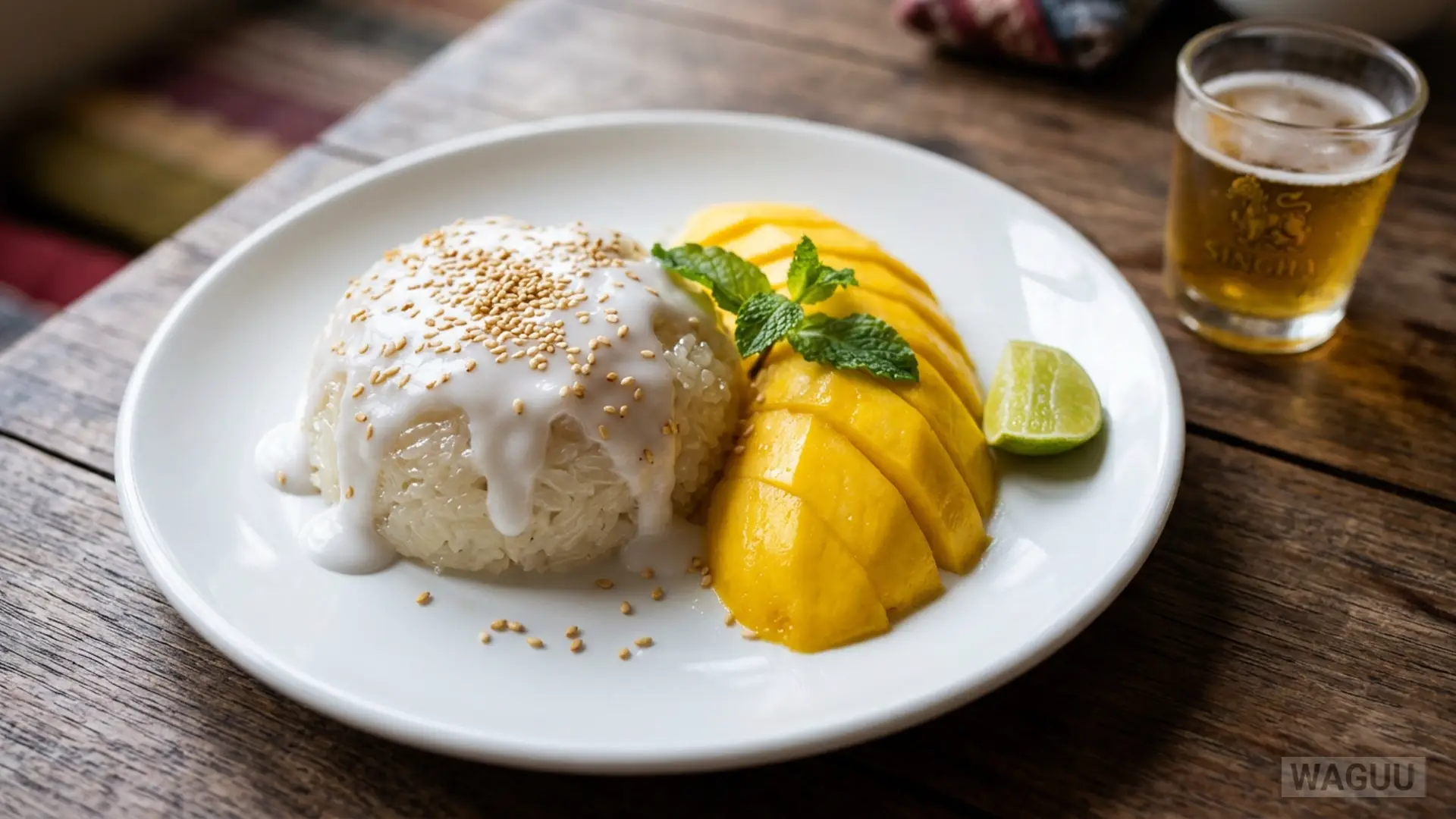
Summary: Mango Sticky Rice (Khao Niao Mamuang) – Authentic Thai sweet sticky rice prepared with rich coconut milk, infused with pandan leaves, served with perfectly ripe yellow mangoes and a subtly salted coconut sauce. Preparation time: 45 minutes of active work plus soaking time, designed for 6 portions.
Did you cook this recipe? Share the result with the community.
Category: Desserts, Thai Cuisine
Success rate: 96% of users successfully made this recipe
Quick overview
- Dish: Mango Sticky Rice (Khao Niao Mamuang)
- Category: Desserts, Thai Cuisine
- Cuisine: Thai
- Main ingredient: Glutinous rice, 500 g (premium grade long-grain glutinous rice)
- Guide: 12 Most Popular Thai Dishes: Favourite Thai Cuisine Recipes
- Total time: 480 minutes (30 min prep + 450 min soaking and cooking)
- Difficulty: Medium
- Portions: 6 (Portion weight: 280 g)
- Key technique: Bamboo steamer steaming and coconut milk absorption
- Preparation types: Soaking, steaming, simmering
- Dietary info & Allergens: Gluten-free, vegan
- Suitable for: Celebrations, summer dessert, Asian dinners
- Nutritional values (per 1 portion): 420 kcal, Protein: 6.5 g, Fat: 12.0 g, Carbohydrates: 72.0 g
- Storage: 2 days in the fridge, 0 months in the freezer
- Pairing: Jasmine tea, iced Thai milk tea, coconut water
- In short: The ultimate iconic Thai dessert balancing warm sweetened glutinous rice, creamy coconut sauce, and fresh ripe mango.
- Last updated: 24. 8. 2026
WAGUU says: “The secret to authentic Mango Sticky Rice lies in soaking the glutinous rice for at least 6 hours and steaming it in a traditional bamboo steamer rather than boiling it in water.”
Key facts
| Prep time: | 30 minutes |
| Cooking time: | 30 minutes |
| Temperature: | 100 °C steam |
| Number of portions: | 6 portions |
In a nutshell
Mango Sticky Rice (Khao Niao Mamuang) is Thailand’s most celebrated sweet masterpiece. Experience the harmonious contrast of piping hot, sweet coconut-infused sticky rice paired with chilled, buttery-soft slices of ripe yellow mango and crowned with a luscious, subtly salted coconut cream sauce.
Ingredients
Base portions: 6 portions • Portion weight: 280 g
| Ingredient | Amount | Quality |
|---|---|---|
| Glutinous rice | 500 g | Thai sweet rice / sticky rice |
| Full-fat coconut milk | 400 ml | High quality, thick |
| Granulated sugar | 150 g | White cane sugar |
| Fine sea salt | 5 g | Pure sea salt |
| Ripe yellow mangoes | 3 pcs | Nam Dok Mai or Alphonso variety |
| Pandan leaves | 3 pcs | Fresh or frozen, knotted |
| Roasted mung beans | 20 g | Split yellow mung beans (optional garnish) |
| Water | 1000 ml | For soaking and steaming |
Why you will love this recipe
- Authentic taste: Recreates the exact street-food flavor found in the bustling markets of Bangkok using traditional steaming techniques.
- Perfect texture: Explains how to achieve glossy, tender grains of sticky rice that absorb rich coconut milk without turning mushy.
- Versatile elegance: Serves as a stunning, naturally gluten-free and vegan dessert that impresses guests at any dinner party.
Success guaranteed: Following the exact soaking times and coconut milk absorption ratios guarantees professional results every single time.
Recipe overview
Prep: 30 min | Cooking: 30 min | Difficulty: Medium | Portions: 6 | Type: Dessert | Origin: Thai
Detailed instructions
Overall progress: 0% complete
Phase 1: Rice Soaking – 360 min
Appliances: Bowl, measuring cup
1. Measure 500 g of Thai glutinous rice into a large mixing bowl. Rinse the rice under cold tap water 3 to 4 times until the water runs clear, washing away excess surface starch. Pour 1000 ml of cold water over the rinsed rice, ensuring the water level sits at least 5 cm above the rice grains. Let the rice soak undisturbed at room temperature for 6 to 8 hours, or ideally overnight, to allow the hard grain cores to soften completely.
VKB: Visual check: Rice grains should appear slightly opaque and expand in size.
Before moving to the next step:
Ensure the rice has soaked for a minimum of 6 hours; insufficient soaking will result in hard, uncooked grain centers after steaming.
Phase 2: Steaming the Rice – 25 min
Appliances: Bamboo steamer, wok or pot, cheesecloth
2. Drain the soaked glutinous rice thoroughly in a fine-mesh colander. Fill a wok or wide pot with water and bring it to a rolling boil over high heat, ensuring the water level stays just below the bottom of the bamboo steamer basket. Line the bamboo steamer with a clean dampened cheesecloth or muslin cloth. Transfer the drained rice onto the cloth, spreading it evenly across the basket. Cover the steamer with its tight-fitting lid, reduce the heat to medium-high, and steam the rice for 20 minutes. After 20 minutes, carefully lift the cloth edges to flip or stir the rice gently, recover, and steam for an additional 5 minutes until tender and translucent.
VKB: Steam temperature: 100 °C. The rice grains should be glossy, soft, and completely translucent with no white chalky centers.
Before moving to the next step:
Check that the steaming water level does not touch the bottom of the rice basket to prevent waterlogging.
Phase 3: Preparing the Sweet Coconut Syrup – 10 min
Appliances: Saucepan, whisk
3. While the rice is steaming, prepare the sweet coconut infusion. In a medium saucepan, combine 300 ml of full-fat coconut milk, 120 g of granulated sugar, and 3 g of fine sea salt. Take 3 fresh pandan leaves, tie them into a single knot to release their natural aromatic oils, and drop them into the saucepan. Place the saucepan over medium-low heat, stirring constantly with a whisk until the sugar and salt dissolve completely. Heat the mixture until it is steaming hot (around 80 °C), but do not let it come to a boil, as boiling can cause the coconut milk to curdle or separate.
VKB: Temperature: 80 °C. The mixture should be smooth, aromatic, and free of undissolved sugar crystals.
Before moving to the next step:
Remove the pandan leaves from the coconut syrup before mixing them into the hot cooked rice.
Phase 4: Combining Rice and Coconut Syrup – 20 min
Appliances: Mixing bowl, silicone spatula
4. Immediately after the sticky rice finishes steaming, transfer the hot rice into a large heatproof mixing bowl. Remove and discard the pandan leaves from the hot coconut syrup. Pour the warm coconut syrup evenly over the steaming hot rice. Using a silicone spatula, gently fold and mix the rice to ensure every grain is coated with the liquid. Cover the bowl tightly with a lid or plastic wrap and let it rest undisturbed for 20 minutes. During this resting period, the rice will absorb all the sweet coconut milk, becoming plump, glossy, and sticky.
VKB: Visual check: After 20 minutes, all liquid should be completely absorbed, leaving the rice rich, shiny, and cohesive.
Before moving to the next step:
Stir the resting rice halfway through the 20-minute absorption period to ensure even distribution of the coconut syrup.
Phase 5: Preparing the Salted Coconut Sauce – 5 min
Appliances: Small saucepan, whisk
5. In a separate small saucepan, combine the remaining 100 ml of full-fat coconut milk, 30 g of granulated sugar, and 2 g of fine sea salt. Heat the mixture over low heat, stirring gently for 3 to 4 minutes until the sugar dissolves and the sauce thickens slightly into a rich, pourable topping. This subtly salted coconut sauce provides a delicious savory contrast to the sweet rice and mango.
VKB: Temperature: 70 °C. The sauce should taste distinctly creamy with a balanced sweet-and-salty profile.
Before moving to the next step:
Keep the salted coconut sauce warm until ready to plate, preventing a skin from forming on top.
Phase 6: Slicing Mangoes and Plating – 10 min
Appliances: Chef’s knife, cutting board, serving plates
6. Take 3 ripe yellow mangoes (such as Nam Dok Mai). Slice the flesh away from the flat central pit on both sides. Score the mango halves in a grid pattern without cutting through the skin, then invert them to create beautiful fan-shaped mango chunks, or slice them into neat longitudinal strips. To serve, portion the warm coconut sticky rice onto individual serving plates. Arrange the fresh mango slices neatly alongside the rice. Generously drizzle the warm salted coconut sauce over the rice and garnish with a small sprinkle of roasted yellow mung beans for authentic crunch.
VKB: Visual check: Vibrant yellow mangoes contrasting with glossy white sticky rice, drizzled with rich coconut sauce.
Required equipment
| Utensil | Ideal size | Alternative | Risk |
|---|---|---|---|
| Bamboo steamer | 28 cm diameter | Metal steamer basket | Rice sticking to metal |
| Mixing bowl | 3-litre capacity | Glass or ceramic bowl | Spilling during mixing |
| Saucepan | 1.5-litre capacity | Small pot | Scorching coconut milk |
Shopping list
Nutritional profile
Values per 1 portion (excluding side dishes). Calculated from average nutritional values of ingredients.
| Nutrient | Per 100 g | Per 1 portion | Per 6 portions |
|---|---|---|---|
| Energy | 150.0 kcal | 420.0 kcal | 2520.0 kcal |
| Fat | 4.3 g | 12.0 g | 72.0 g |
| of which saturates | 3.6 g | 10.0 g | 60.0 g |
| Carbohydrates | 25.7 g | 72.0 g | 432.0 g |
| of which sugars | 10.7 g | 30.0 g | 180.0 g |
| Protein | 2.3 g | 6.5 g | 39.0 g |
| Salt | 0.4 g | 1.1 g | 6.6 g |
Reference intake of an average adult (8400 kJ / 2000 kcal).
WAGUU Pro Level
- Pro standard: Verified recipe with precise ratios and visual control points.
- Tip 1: Always use genuine Thai glutinous rice (also known as sweet rice); jasmine rice or standard white rice will not achieve the desired sticky, chewy texture.
- Tip 2: Fresh pandan leaves impart an unmistakable vanilla-floral aroma; if fresh or frozen leaves are unavailable, use a few drops of high-quality pandan extract.
- Tip 3: Choose fully ripe, fragrant yellow mangoes such as Nam Dok Mai or Alphonso. Unripe mangoes will be too sour and firm for this dessert.
- Tip 4: Serve the sticky rice warm or at lukewarm temperature alongside chilled mango slices for the ultimate sensory contrast.
Scientific background
Glutinous rice contains virtually no amylose and high amounts of amylopectin, a branched-chain starch molecule that gives the cooked grains their sticky, cohesive, and gelatinous quality. Steaming allows the starch to gelatinize evenly in hot water vapor without leaching out into boiling water, preserving the structural integrity of each grain while absorbing rich coconut lipids and sucrose.
Fine Dining – Professional techniques
- Plate composition: Mold the warm sticky rice into a neat cylinder using a ring mold in the center of the plate, flanked by fan-cut yellow mango slices.
- Textural contrasts: Combine soft chewy rice, buttery smooth mango flesh, and crunchy toasted mung bean garnish.
- Temperature contrast: Serve warm, syrup-infused sticky rice next to freshly chilled mango slices straight from the refrigerator.
- Aromatic garnishes: Finish with micro-mint leaves or toasted sesame seeds for an elevated visual presentation.
Sensory radar
- Appearance: Glossy translucent white rice paired with vibrant golden-yellow mango slices and creamy white sauce.
- Aroma: Rich coconut milk, sweet tropical mango fruit, and subtle floral pandan fragrance.
- Taste: Sweet, creamy, and subtly salted with refreshing tropical fruit acidity.
- Texture: Sticky, chewy, velvety, and tender.
Pairing
- BEER: Light rice lager or crisp fruit-infused cider.
- WINE: Sweet Riesling or aromatic Gewürztraminer.
- NON-ALCOHOLIC: Iced Thai milk tea, fresh young coconut water, or jasmine green tea.
Various preparation variants
- Black Glutinous Rice Variant: Substitute half or all of the white sticky rice with black glutinous rice for a nutty flavor and striking purple color.
- Salty-Sweet Sesame Topping: Add toasted black and white sesame seeds to the coconut sauce topping for an extra layer of nutty crunch.
Allergens and dietary information
Contains: None • Gluten: Naturally gluten-free • Not suitable for: Individuals with coconut allergies
Suitable for
Celebrations, summer dessert, Asian dinners, vegetarian and vegan diet plans
Substitution catalog
- Glutinous rice: Use Thai sweet rice only; do not substitute with jasmine or basmati rice.
- Pandan leaves: Substitute with a few drops of pandan extract or vanilla extract.
FAQ
Can I use normal jasmine rice instead of glutinous rice?
No, jasmine rice lacks the high amylopectin starch content required to achieve the characteristic sticky texture of this traditional dessert.
How long do I need to soak the rice?
Soaking for at least 6 hours, or ideally overnight, is essential to soften the hard grains so they steam evenly without raw centers.
What kind of mango should I buy?
Look for sweet, ripe yellow mangoes such as Nam Dok Mai or Alphonso. Avoid firm or green unripe mangoes.
Can I reheat leftover sticky rice?
Yes, reheat leftover sticky rice gently in a steamer for 5 minutes to restore its soft, tender texture.
WAGUU Petr advises: Cooking for 12 or more people?
12–16 people: Double all ingredient quantities and steam the rice in two separate batches to ensure even steam circulation. • 20+ people: Prepare the coconut syrup and sticky rice in large commercial batches, keeping the cooked rice covered in warm insulated containers.
Sides and Serving
- Roasted mung beans – Adds a pleasant nutty crunch (not included in the recipe)
- Toasted sesame seeds – Enhances visual appeal and aroma (not included in the recipe)
Serving: Serve warm sweet sticky rice with chilled fresh mango slices, generously drizzled with salted coconut sauce.
Storage and reheating
Fridge: 2 days days • Freezer: 0 months months • Reheating: Reheat gently in a bamboo steamer over boiling water for 5 minutes.
Author: WAGUU Petr & Team • Published: 24 Aug 2026 • Updated: 31 Oct 2026
More Recipes from This Article
Other recipes you might be interested in
Why WAGUU?
Recipes on WAGUU undergo checks for the accuracy of ingredients, procedures, and nutritional values.
Process photo gallery
Community photos: Cook, take a photo, and share the result.
You can upload photos in the comments below or send them via email.
Did you record a video guide for our recipe? Insert a link to YouTube, YouTube Shorts, TikTok, Instagram Reels, Facebook Reels, Pinterest, Vimeo, or X (Twitter) in the comment – we’d be happy to publish it and help promote you and your content.
Common mistakes
- Skipping the soaking step: Failing to soak the rice leads to hard, uncooked centers.
- Using jasmine rice: Jasmine rice lacks the amylopectin needed for stickiness.
- Boiling coconut milk: Boiling coconut milk too vigorously causes it to curdle and separate.
- Using unripe mangoes: Sour and firm mangoes ruin the flavor profile of the dessert.