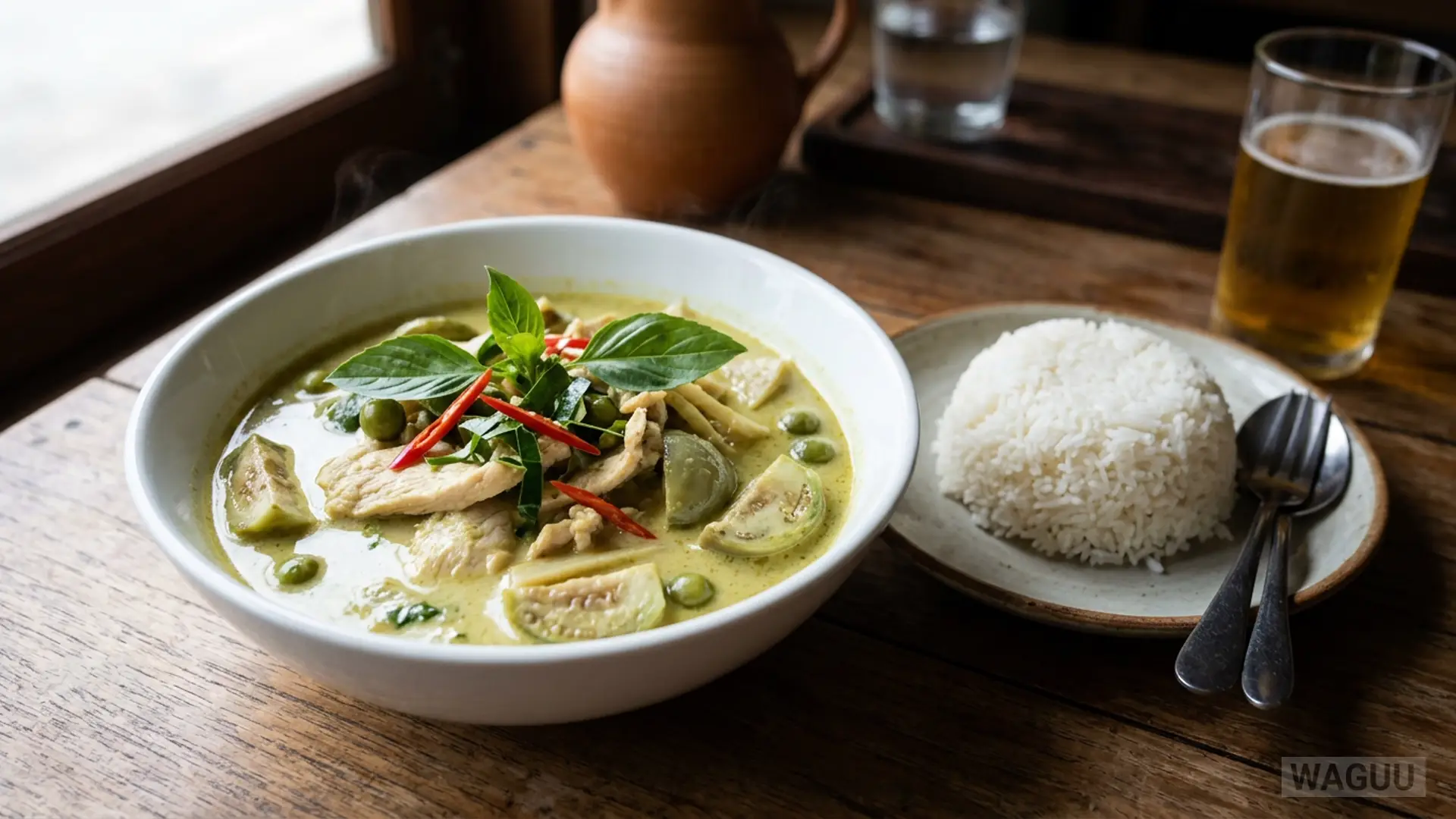
Summary: Green Curry (Gaeng Keow Wan) – authentic Thai green curry with coconut milk, fragrant green curry paste, tender chicken breast, aromatic Thai aubergine, and fresh sweet basil leaves, prepared in 35 minutes for 6 portions.
Did you cook this recipe? Share the result with the community.
Category: Thai Cuisine, Main Dishes, Poultry
Success rate: 99% of users successfully made this recipe
Quick overview
- Dish: Green Curry (Gaeng Keow Wan)
- Category: Thai Cuisine, Main Dishes, Poultry
- Cuisine: Thai
- Main ingredient: Chicken breast, 600 g (premium quality farm-raised poultry)
- Guide: 12 Most Popular Thai Dishes: Favourite Thai Cuisine Recipes
- Total time: 35 minutes (15 min prep + 20 min cooking)
- Difficulty: Medium
- Portions: 6 portions (Portion weight: 380 g)
- Key technique: Simmering and milk reduction
- Preparation types: Sautéing, simmering
- Dietary info & Allergens: Contains fish sauce, soy derivatives, coconut
- Suitable for: Lunch, dinner, lovers of authentic Asian cuisine
- Nutritional values (per 1 portion): 420 kcal, Protein: 32.5 g, Fat: 26.8 g, Carbohydrates: 12.4 g
- Storage: 3 days in the fridge, 3 months in the freezer
- Pairing: Jasmine rice, Singha beer, Thai iced tea
- In short: An aromatic, creamy, and spicy masterpiece of Thai culinary art combining fresh green chillies, galangal, lemongrass, tender chicken, and crisp Thai aubergines.
- Last updated: May 20, 2024
WAGUU says: “Never boil coconut milk too aggressively when first breaking the curry paste; let the natural oils separate gently to build the authentic restaurant-quality depth.”
Key facts
| Prep time: | 15 minutes |
| Cooking time: | 20 minutes |
| Temperature: | Medium to high heat |
| Number of portions: | 6 portions |
In a nutshell
Green Curry (Gaeng Keow Wan) stands as one of the most vibrant pillars of Thai gastronomy. Characterized by its brilliant emerald hue, rich coconut base, and complex interplay of sweet, salty, spicy, and herbaceous notes, this dish transforms simple ingredients into an unforgettable sensory experience.
Ingredients
Base portions: 6 portions • Portion weight: 380 g
| Ingredient | Amount | Quality |
|---|---|---|
| Chicken breast | 600 g | Fresh, sliced into bite-sized strips |
| Coconut milk | 800 ml | Full fat, high quality |
| Green curry paste | 90 g | Authentic Thai brand |
| Thai aubergine | 300 g | Small round eggplants, quartered |
| Fresh Thai sweet basil | 40 g | Freshly picked leaves |
| Fish sauce | 45 ml | First pressing |
| Palm sugar | 25 g | Finely grated |
| Kaffir lime leaves | 6 pieces | Fresh or frozen, torn |
| Red spur chilli | 30 g | Sliced diagonally for garnish |
| Bamboo shoots | 150 g | Sliced, drained |
| Vegetable oil | 30 ml | Neutral high-smoke oil |
Why you will love this recipe
- Authentic Flavours: DUVOD_1_POPIS: Replicates the exact balance of sweet, spicy, salty, and creamy notes found in traditional Thai kitchens.
- Quick Preparation: DUVOD_2_POPIS: Ready in just 35 minutes, making it ideal for both busy weeknight dinners and weekend feasts.
- Nutritional Balance: DUVOD_3_POPIS: Packed with lean protein, healthy fats from coconut, and antioxidant-rich herbs and vegetables.
Success guaranteed: Follow the precise reduction of the coconut cream and paste to ensure rich separation of aromatic oils without scorching.
Recipe overview
Prep: 15 min | Cooking: 20 min | Difficulty: Medium | Portions: 6 portions | Type: Main Dish | Origin: Thai
Detailed instructions
Overall progress: 0% complete
Phase 1: Preparation of Ingredients – 5 min
Appliances: Chef’s knife, cutting board
1. Slice the chicken breast into bite-sized strips of uniform thickness (approx. 1 cm). Quarter the Thai aubergines and immediately soak them in lightly salted water to prevent oxidation. Measure out the green curry paste, coconut milk, fish sauce, and palm sugar. Tear the kaffir lime leaves along the central stem to release their aromatic essential oils. Slice the red spur chilli and fresh bamboo shoots.
VKB: Visual Key of Browning / Breakdown: Uniform preparation ensures even cooking times across all protein and vegetable pieces.
Before moving to the next step:
Ensure the aubergines are fully submerged in salted water so they maintain their bright green and white color before hitting the wok.
Phase 2: Frying the Curry Paste – 5 min
Appliances: Wok or heavy-bottomed saucepan, wooden spatula
2. Place the wok over medium heat. Pour in 200 ml of the thick top layer of coconut milk. Let it simmer gently, stirring continuously until the coconut oil begins to separate from the cream (about 3 minutes). Add the 90 g of green curry paste into the separated oil. Stir-fry the paste vigorously for 2 minutes until deeply fragrant and slightly darkened, ensuring it does not burn.
VKB: Visual Key of Browning / Breakdown: The paste is ready when shiny green oil droplets shimmer across the surface of the fried mixture.
Before moving to the next step:
Do not skip oil separation; frying the paste in coconut fat unlocks the fat-soluble aromatic compounds of lemongrass, galangal, and kaffir lime.
Phase 3: Searing the Chicken – 4 min
Appliances: Wok, spatula
3. Add the 600 g of sliced chicken breast directly into the fried curry paste mixture. Toss vigorously so every piece of chicken is coated evenly with the emerald paste. Cook over medium-high heat for about 4 minutes, stirring constantly until the exterior of the chicken turns opaque and begins to absorb the rich flavours.
VKB: Visual Key of Browning / Breakdown: Chicken pieces should be surface-sealed and coated in thick green paste without being fully cooked through yet.
Before moving to the next step:
Ensure the chicken is stirred continuously to prevent sticking to the bottom of the wok.
Phase 4: Simmering with Coconut Milk – 6 min
Appliances: Wok, ladle
4. Pour in the remaining 600 ml of coconut milk and bring the mixture to a gentle simmer. Add the 6 torn kaffir lime leaves and the drained sliced bamboo shoots. Reduce the heat to medium-low and let the curry simmer gently for 6 minutes, allowing the chicken to become tender and the liquid to infuse deeply with herbal aromas.
VKB: Visual Key of Browning / Breakdown: A gentle bubbling simmer should be maintained; heavy boiling will curdle the coconut milk.
Before moving to the next step:
Keep the temperature controlled so the sauce reduces smoothly without breaking into oily chunks.
Phase 5: Adding Vegetables and Seasoning – 5 min
Appliances: Wok, tasting spoon
5. Drain the quartered Thai aubergines and add them into the simmering curry. Cook for 4 minutes until they soften and absorb the curry broth while retaining a slight crunch. Stir in the 45 ml of fish sauce and 25 g of grated palm sugar. Taste the curry and adjust the balance between salty (fish sauce) and sweet (palm sugar) according to personal preference.
VKB: Visual Key of Browning / Breakdown: Aubergines should turn tender-crisp and absorb the vibrant green tint of the sauce.
Before moving to the next step:
Do not overcook the aubergines or they will turn mushy; they should remain tender yet structurally firm.
Phase 6: Finishing with Fresh Herbs – 1 min
Appliances: Wok, serving ladle
6. Turn off the heat completely. Immediately fold in the 40 g of fresh Thai sweet basil leaves and the sliced red spur chillies. Stir gently for 30 seconds until the basil wilts slightly and releases its unmistakable aniseed aroma into the hot curry. Serve immediately piping hot.
VKB: Visual Key of Browning / Breakdown: Basil leaves should remain bright green and wilted rather than boiled brown.
Required equipment
| Utensil | Ideal size | Alternative | Risk |
|---|---|---|---|
| Wok pan | 32 cm diameter | Deep skillet or Dutch oven | Crowding ingredients causes steaming instead of frying |
| Chef’s knife | 20 cm blade | Santoku knife | Uneven vegetable cuts |
| Wooden spatula | Standard size | Heat-resistant silicone spoon | Scratched wok coating |
Shopping list
Nutritional profile
Values per 1 portion (excluding side dishes). Calculated from average nutritional values of ingredients.
| Nutrient | Per 100 g | Per 1 portion | Per 6 portions |
|---|---|---|---|
| Energy | 110.5 kcal | 420 kcal | 2520 kcal |
| Fat | 7.0 g | 26.8 g | 160.8 g |
| of which saturates | 5.8 g | 22.1 g | 132.6 g |
| Carbohydrates | 3.3 g | 12.4 g | 74.4 g |
| of which sugars | 1.8 g | 6.8 g | 40.8 g |
| Protein | 8.5 g | 32.5 g | 195.0 g |
| Salt | 0.9 g | 3.4 g | 20.4 g |
Reference intake of an average adult (8400 kJ / 2000 kcal).
WAGUU Pro Level
- Pro standard: Verified recipe with precise ratios and visual control points.
- Tip 1: PROFI_TIP_1: Always use coconut milk with a high coconut extract percentage (at least 75%) for authentic oil separation.
- Tip 2: PROFI_TIP_2: Fresh Thai basil leaves must be added off the heat to preserve their volatile aromatics and vibrant emerald colour.
- Tip 3: PROFI_TIP_3: Soak cut Thai aubergines in salted water immediately to prevent enzymatic browning and bitter off-flavours.
- Tip 4: PROFI_TIP_4: Adjust palm sugar and fish sauce progressively to achieve the classic Thai harmony of salty, sweet, and umami.
Scientific background
VEDECKE_POZADI: The distinct piquancy of green curry stems from capsaicin found in fresh green bird’s eye chillies, which stimulates thermoreceptors on the tongue. Frying the curry paste in coconut cream causes the emulsion to break, releasing lipophilic flavor molecules (such as aldehydes and terpenes from lemongrass and galangal) into the oil phase, significantly intensifying the aroma and flavor delivery upon consumption.
Fine Dining – Professional techniques
- Plate composition: FINE_DINING_1: Serve in warmed matte black ceramic bowls to accentuate the luminous green color of the sauce and herbs.
- Textural contrasts: FINE_DINING_2: Combine tender chicken strips, crisp-tender Thai aubergine quarters, and crunchy bamboo shoots.
- Temperature contrast: FINE_DINING_3: Contrast the piping hot curry with room temperature fragrant jasmine rice.
- Aromatic garnishes: FINE_DINING_4: Crown with finely julienned red spur chillies and micro Thai basil sprigs.
Sensory radar
- Appearance: VZHLED: Luminous emerald-green sauce dotted with vibrant red chilli slivers and fresh green herbs.
- Aroma: VUNE: Intensely aromatic, featuring lemongrass, kaffir lime, sweet basil, and rich coconut.
- Taste: CHUT: Harmonious balance of initial creamy sweetness followed by complex herbal heat and salty umami depth.
- Texture: TEXTURA: Velvety smooth coconut emulsion coating tender chicken and firm vegetables.
Pairing
- BEER: DOPORUCENI: Chilled crisp Asian lager (such as Singha or Chang) to temper the curry’s heat.
- WINE: DOPORUCENI: Off-dry Riesling or Gewürztraminer with subtle residual sweetness.
- NON-ALCOHOLIC: DOPORUCENI: Traditional iced Thai milk tea or fresh coconut water with lime.
Various preparation variants
- VARIANTA_1: POPIS_VARIANTY_1: Vegetarian version replacing chicken with firm fried tofu and vegetable stock.
- VARIANTA_2: POPIS_VARIANTY_2: Seafood variation utilizing succulent prawns and squid rings instead of poultry.
Allergens and dietary information
Contains: Fish, soy derivatives, coconut • Gluten: Naturally gluten-free (verify fish sauce label) • Not suitable for: Fish allergy, strict nut-free diets relying on coconut
Suitable for
Lunch, dinner, Asian dinner parties, gluten-free diets
Substitution catalog
- SUROVINA: Thai aubergine → NAHRADA: Regular small Italian eggplants or zucchini.
- SUROVINA: Palm sugar → NAHRADA: Light brown sugar or coconut sugar.
- SUROVINA: Fish sauce → NAHRADA: Light soy sauce or tamari for vegetarian adjustments.
FAQ
Why did my coconut milk curdle and separate into oily lumps?
ODPOVED_1: Coconut milk separates when boiled too vigorously. To prevent this, simmer gently and use full-fat canned coconut milk rather than carton light varieties.
Can I make green curry paste from scratch?
ODPOVED_2: Yes! Pound fresh green chillies, galangal, lemongrass, shallots, garlic, kaffir lime zest, shrimp paste, coriander roots, and spices in a granite mortar until smooth.
How can I make the curry less spicy?
ODPOVED_3: Reduce the amount of green curry paste or add a little extra coconut milk to dilute the capsaicin heat while maintaining creaminess.
What is the best rice to serve with Green Curry?
ODPOVED_4: Jasmine rice (Khao Hom Mali) is the traditional accompaniment, as its floral aroma and slight stickiness complement the rich curry sauce.
WAGUU Petr advises: Cooking for 12 or more people?
12–16 people: ADVICE_12_16: Scale ingredients linearly and cook in a wide stockpot rather than a standard wok to ensure even heat distribution and prevent overcrowding. • 20+ people: ADVICE_20: Prepare the curry base and chicken in two separate batches, combining them just before simmering with vegetables and herbs.
Sides and Serving
- Steamed Jasmine Rice – fragrant, fluffy long-grain rice (not included in the recipe)
- Cucumber Salad with Pickled Shallots – crisp refreshing palate cleanser (not included in the recipe)
Serving: Ladle the hot green curry into deep bowls alongside a separate mound of steaming jasmine rice. Garnish with fresh Thai basil leaves and red chilli slices.
Storage and reheating
Fridge: 3 days • Freezer: 3 months • Reheating: Reheat gently on the stove over medium-low heat, stirring occasionally. Avoid high heat to prevent the coconut milk from separating.
Author: WAGUU Petr & Team • Published: 24 Aug 2026 • Updated: 31 Oct 2026
More Recipes from This Article
Other recipes you might be interested in
Why WAGUU?
Recipes on WAGUU undergo checks for the accuracy of ingredients, procedures, and nutritional values.
Process photo gallery
Community photos: Cook, take a photo, and share the result.
You can upload photos in the comments below or send them via email.
Did you record a video guide for our recipe? Insert a link to YouTube, YouTube Shorts, TikTok, Instagram Reels, Facebook Reels, Pinterest, Vimeo, or X (Twitter) in the comment – we’d be happy to publish it and help promote you and your content.
Common mistakes
- Boiling coconut milk too fast – POPIS_CHYBY_1: Boiling coconut milk aggressively instead of simmering causes it to curdle and separate into unappealing oily chunks.
- Adding basil at the wrong time – POPIS_CHYBY_2: Adding fresh basil while boiling turns the leaves brown and destroys their delicate aniseed aromatics.
- Skipping paste frying – POPIS_CHYBY_3: Adding curry paste directly to watery broth without frying it in coconut fat prevents the release of essential aromatic oils.
- Overcooking aubergines – POPIS_CHYBY_4: Cooking Thai aubergines for too long turns them mushy rather than maintaining their tender-crisp texture.