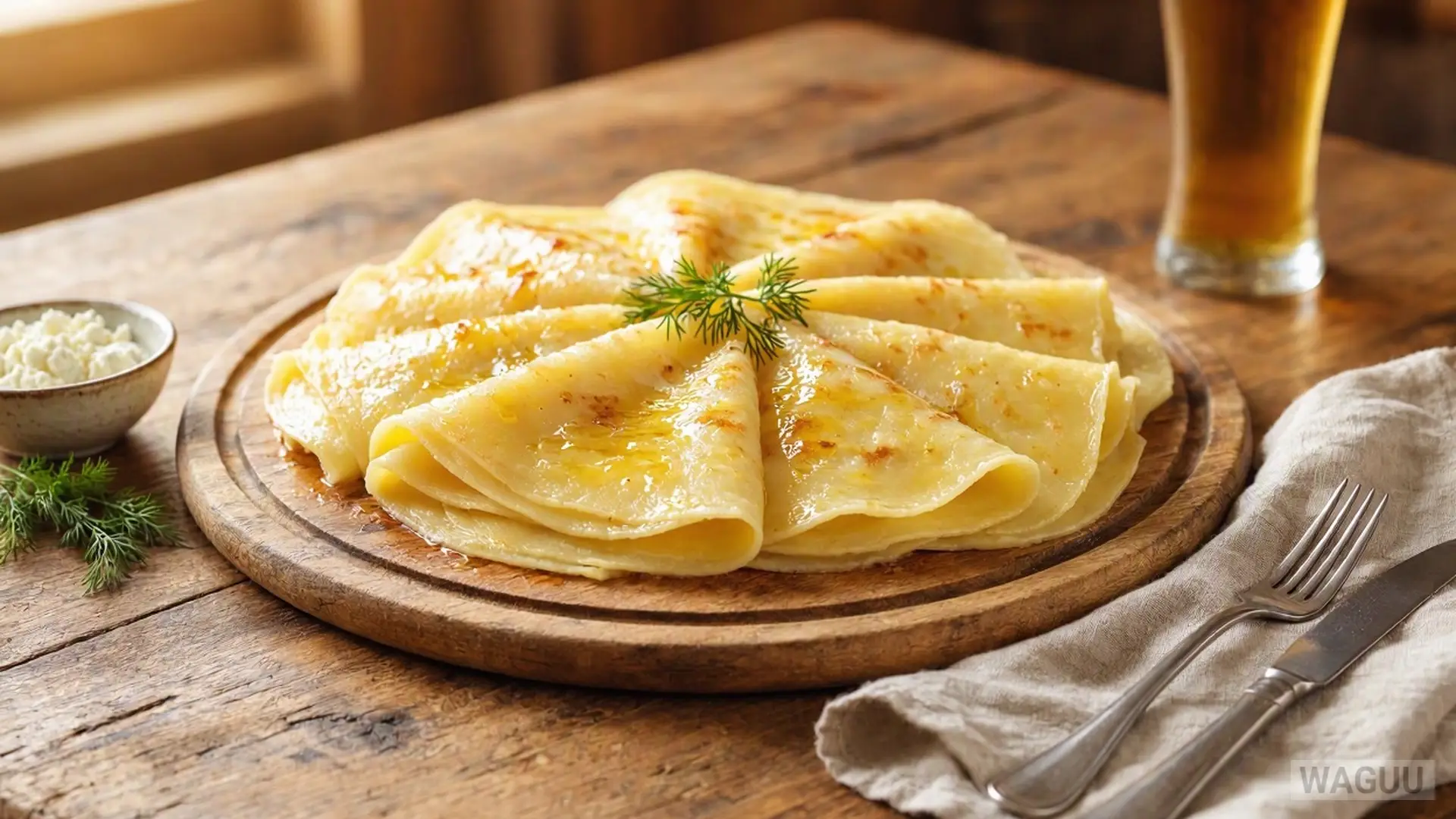
Summary: Traditional Slovak potato flatbreads made from leftover boiled potatoes, plain flour, and salt, cooked dry on a cast-iron griddle and generously brushed with melted lard or butter. This authentic home-style technique creates wonderfully soft, pliable flatbreads with characteristic golden-brown spots. Requiring only 30 minutes of preparation and 20 minutes of cooking across 6 portions, this comforting regional staple pairs with roast meats, stews, or simply enjoys a sweet or savoury filling.
Did you cook this recipe? Share the result with the community.
Category: Bread and pastry, Slovak cuisine
Success rate: 98% of users successfully made this recipe
Quick overview
- Dish: Potato flatbreads
- Category: Bread and pastry, Slovak cuisine
- Cuisine: Slovak
- Main ingredient: Floury potatoes, 1.2 kg (high starch content for smooth dough binding)
- Guide: 12 most popular Slovak dishes: favourite recipes of Slovak cuisine
- Total time: 50 minutes (30 min prep + 20 min cooking)
- Difficulty: Medium
- Portions: 6 portions (Portion weight: 180 g)
- Key technique: Dry pan-griddling on cast iron
- Preparation types: Kneading, rolling, dry-frying
- Dietary info & Allergens: Contains gluten, dairy (optional lard/butter brushing)
- Suitable for: Vegetarians, family gatherings, traditional dinners
- Nutritional values (per 1 portion): 320.4 kcal, Protein: 7.2 g, Fat: 8.5 g, Carbohydrates: 54.6 g
- Storage: 3 days in the fridge, 3 months in the freezer
- Pairing: Traditional lager beer, cold buttermilk, apple cider
- In short: Soft, pliable potato flatbreads griddled to perfection and finished with melted rendered lard.
- Last updated: 21 September 2026
WAGUU says: “Potato flatbreads represent the pinnacle of rustic resourcefulness, turning humble tubers into an ethereal, supple bread that elevates any festive roast or comforting stew.”
How to take it further: Brush the freshly baked flatbreads with garlic-infused butter, or fold them around a filling of seasoned stewed cabbage.
Key facts
| Prep time: | 30 min |
| Cooking time: | 20 min |
| Temperature: | 200–220 °C (griddle surface) |
| Number of portions: | 6 portions |
In a nutshell
Experience the authentic taste of Central European countryside baking with these traditional potato flatbreads. Made from freshly boiled floury potatoes and plain flour, rolled thin, and cooked on a dry cast-iron skillet, they achieve an irresistible softness with delicate blistered spots. Finished with a generous brushing of melted lard, they make an unforgettable accompaniment to festive roasts.
Ingredients
Base portions: 6 portions • Portion weight: 180 g
| Ingredient | Amount | Quality |
|---|---|---|
| Floury potatoes (peeled weight) | 1.2 kg | High starch variety (e.g. Maris Piper) |
| Plain flour | 400 g | Soft wheat flour, plus extra for dusting |
| Fine sea salt | 12 g | Pure sea salt |
| Rendered pork lard | 60 g | High quality, melted for brushing |
| Cold water (for boiling potatoes) | 1.5 l | Clean tap water |
Why you will love this recipe
- Authentic heritage taste: Recreates the genuine rustic flavours of traditional Slovak home baking without modern shortcuts.
- Incomparable texture: Combines a pillowy soft interior with delightful crisp charred blisters from dry cast-iron cooking.
- Incredible versatility: Serves as an exceptional accompaniment to roast meats, rich stews, or wrapped around savoury and sweet fillings.
Why it works: Using high-starch floury potatoes boiled in salted water and riced while warm creates a smooth, cohesive dough that requires minimal flour, keeping the flatbreads tender rather than tough.
Recipe overview
Prep: 30 min | Cooking: 20 min | Difficulty: Medium | Portions: 6 portions | Type: Bread and pastry | Origin: Slovak
Detailed instructions
Overall progress: 0% complete
Phase 1: Boiling and ricing the potatoes – 25 min
Appliances: Hob
1. Peel 1.2 kg of floury potatoes, cut them into uniform 3 cm cubes, and place them into a saucepan with 1.5 l of cold water and 12 g of fine sea salt. Bring to the boil over high heat, then reduce the heat to medium-low and simmer gently for 20 minutes until the potato cubes are completely tender when pierced with the tip of a sharp knife. Drain the potatoes thoroughly in a colander, shaking off any excess moisture, and immediately pass them through a potato ricer onto a clean kitchen worktop or into a wide mixing bowl to release steam and cool slightly for 5 minutes.
Visual check point (VKB): Potatoes must be thoroughly tender throughout with no hard lumps remaining after ricing.
Before moving to the next step:
Ensure the riced potatoes have cooled down to lukewarm temperature so they do not prematurely glutenise the flour during kneading.
Phase 2: Kneading the dough – 5 min
Appliances: None
2. Add 400 g of plain flour to the warm riced potatoes. Using your hands or a bench scraper, quickly work the flour into the potatoes by pressing and folding until a smooth, pliable dough forms. Do not over-knead, as excessive working will develop gluten and make the flatbreads chewy rather than tender. Shape the finished dough into a smooth cylinder on a lightly floured surface.
VKB: Dough should feel soft, cohesive, and slightly tacky without sticking excessively to your hands.
Before moving to the next step:
Divide the dough cylinder evenly into 12 equal portions to ensure uniform flatbread size and even cooking times.
Phase 3: Rolling out the flatbreads – 5 min
Appliances: None
3. Lightly dust your work surface and rolling pin with plain flour. Take one piece of dough and roll it out into a thin, round flatbread approximately 2 mm thick and 20 cm in diameter. Repeat the rolling process for the remaining dough portions, stacking them with small sheets of greaseproof paper between them if necessary to prevent sticking while you heat the griddle.
VKB: Each rolled flatbread should be translucent and evenly thick across its entire surface.
Before moving to the next step:
Preheat a heavy cast-iron griddle or ungreased frying pan over medium-high heat until hot before starting to cook.
Phase 4: Dry-griddling the flatbreads – 15 min
Appliances: Hob, cast-iron griddle
4. Place one rolled flatbread onto the dry, preheated cast-iron griddle heated to 200–220 °C. Cook for 1 to 2 minutes without oil until small dark blisters appear on the underside. Flip the flatbread carefully using a spatula and cook for another 1 to 2 minutes on the second side until golden brown spots appear across the surface. Remove from the griddle and repeat for all remaining flatbreads.
VKB: Flatbreads should feature characteristic dark golden-brown charred blisters while remaining soft and flexible.
Before moving to the next step:
Melt 60 g of rendered pork lard gently in a small saucepan over low heat until fully liquid and warm.
Phase 5: Finishing and greasing – 5 min
Appliances: None
5. Stack the freshly cooked flatbreads on a warm plate. Using a pastry brush, generously brush both sides of each hot flatbread with the melted rendered pork lard. Cover the stack with a clean cotton tea towel to trap the steam and keep the flatbreads soft and pliable until ready to serve.
VKB: Every flatbread should absorb the melted lard evenly, developing a rich sheen and luxurious aroma.
Required equipment
| Utensil | Ideal size | Alternative | Risk |
|---|---|---|---|
| Cast-iron griddle | 30 cm diameter | Heavy-bottomed frying pan | Uneven heat distribution if pan is too thin |
| Potato ricer | Standard kitchen press | Fine potato masher | Lumpy texture if mashing is incomplete |
| Rolling pin | 40 cm wooden pin | Glass bottle | Uneven dough thickness |
Shopping list
Nutritional profile
Values per 1 portion (excluding side dishes). Calculated from average nutritional values of ingredients.
| Nutrient | Per 100 g | Per 1 portion | Per 6 portions |
|---|---|---|---|
| Energy | 178.0 kcal | 320.4 kcal | 1,922.4 kcal |
| Fat | 4.7 g | 8.5 g | 51.0 g |
| of which saturates | 1.8 g | 3.2 g | 19.2 g |
| Carbohydrates | 30.3 g | 54.6 g | 327.6 g |
| of which sugars | 0.8 g | 1.4 g | 8.4 g |
| Protein | 4.0 g | 7.2 g | 43.2 g |
| Salt | 0.7 g | 1.3 g | 7.8 g |
Reference intake of an average adult (8400 kJ / 2000 kcal).
WAGUU Pro Level
- Pro standard: Verified recipe with precise ratios and visual control points.
- Tip 1: Always use floury, high-starch potatoes rather than waxy varieties to ensure the dough binds properly without requiring excessive flour.
- Tip 2: Rice the potatoes while they are still warm to eliminate lumps and achieve a silky, uniform texture.
- Tip 3: Cook the flatbreads on a completely dry cast-iron griddle; adding oil to the pan prevents proper blistering and makes the dough fry rather than toast.
- Tip 4: Stack the finished flatbreads under a damp cotton tea towel immediately after brushing with lard to steam and soften them.
Scientific background
Potato flatbread production relies on the gelatinisation of starches and gluten network formation. When potatoes are boiled, starch granules swell and absorb water. Ricing disperses these gelatinised starches evenly. Upon kneading with plain flour, wheat gluten proteins hydrate and form an elastic matrix that encapsulates the potato starch. Dry-griddling at high heat causes surface moisture to flash-evaporate, creating steam pockets that puff the dough and produce characteristic charred blisters via the Maillard reaction between amino acids and reducing sugars.
Fine Dining – Professional techniques
- Plate composition: Fold the warm flatbread into neat triangles and fan them across the center of a warm ceramic plate next to braised meats.
- Textural contrasts: Balance the pliable, soft interior of the flatbread with crispy crackling dust sprinkled over the top.
- Temperature contrast: Serve the hot, lard-brushed flatbread alongside a chilled cultured dairy dip.
- Aromatic garnishes: Finish with finely minced fresh chives and freshly cracked black pepper just before presenting at the table.
Sensory radar
- Appearance: Golden-brown round flatbreads featuring dark blistered spots and a glossy finish from rendered lard.
- Aroma: Comforting fragrance of toasted potato starch, rich rendered pork fat, and subtle earthy undertones.
- Taste: Savoury, clean potato flavor enhanced by sea salt and rich animal fat without heaviness.
- Texture: Supremely soft, pliable, and tender with a slight chew from the toasted surface blisters.
Pairing
- BEER: Traditional Czech or Slovak pale lager with crisp bitterness to cut through the rich lard.
- WINE: Dry, high-acid Grüner Veltliner with herbal and white pepper notes.
- NON-ALCOHOLIC: Chilled traditional fermented buttermilk or naturally cloudy artisanal apple juice.
Various preparation variants
- Butter-brushed variant: Replace the rendered pork lard with clarified butter or melted salted butter for a vegetarian-friendly preparation with a rich dairy aroma.
- Sweet jam-filled variant: Skip the lard brushing, spread the hot flatbread with plum jam or poppy seed paste, roll it into a cylinder, and dust with icing sugar.
Allergens and dietary information
Contains: Gluten • Gluten: Contains wheat flour • Not suitable for: Coeliacs (unless gluten-free flour blend is used)
Suitable for
Vegetarians (if butter is used instead of lard), traditional dinners, festive gatherings, rustic feasts
Substitution catalog
- Rendered pork lard: Melted butter or duck fat
- Plain flour: Spelt flour (though texture will be denser)
FAQ
Why are my flatbreads turning out tough and chewy?
This usually happens due to over-working the dough or adding too much flour. Handle the dough gently and only add enough flour to bring it together.
Can I use leftover boiled potatoes from yesterday?
Yes, leftover boiled potatoes are traditional. Ensure they are cold and thoroughly riced or mashed without lumps before incorporating the flour.
Do I need to add oil to the frying pan?
No, traditional potato flatbreads are cooked on a completely dry cast-iron griddle. The fat is applied by brushing after cooking.
How do I keep the flatbreads soft after cooking?
Stack them immediately after brushing with lard and cover the stack tightly with a clean damp cotton tea towel to trap the steam.
WAGUU Petr advises: Cooking for 12 or more people?
12–16 people: Double the ingredient quantities proportionally. Divide the dough into 24 smaller portions and cook them in batches on two cast-iron griddles simultaneously to maintain a smooth workflow. • 20+ people: Prepare the potato dough in two separate batches to prevent the dough from becoming overworked and sticky. Enlist a helper to roll while someone else operates the griddles.
Sides and Serving
- Braised red cabbage – slow-cooked with caraway seeds and vinegar (not included in the recipe)
- Roast goose or duck – crispy roasted poultry with savory drippings (not included in the recipe)
Serving: Serve warm, stacked on a warmed ceramic platter, brushed with lard and folded into quarters for easy dining.
Storage and reheating
Fridge: 3 days • Freezer: 3 months • Reheating: Warm gently in a dry frying pan over medium heat for 30 seconds on each side, or microwave briefly covered with a damp paper towel.
Author: WAGUU Petr & Team • Published: 21 Sep 2026 • Updated: 30 Oct 2026
More Recipes from This Article
Guide: 12 most popular Slovak dishes: favourite recipes of Slovak cuisine
Potato dumplings with sheep’s milk cheese and bacon
Sauerkraut and smoked meat soup
Potato dumplings stuffed with sheep’s milk cheese
Potato dumplings with sauerkraut and bacon
Other recipes you might be interested in
Why WAGUU?
Recipes on WAGUU undergo checks for the accuracy of ingredients, procedures, and nutritional values.
Process photo gallery
Community photos: Cook, take a photo, and share the result.
You can upload photos in the comments below or send them via email.
Did you record a video guide for our recipe? Insert a link to YouTube, YouTube Shorts, TikTok, Instagram Reels, Facebook Reels, Pinterest, Vimeo, or X (Twitter) in the comment – we’d be happy to publish it and help promote you and your content.
Common mistakes
- Using waxy potatoes – Waxy varieties contain too much moisture and insufficient starch, resulting in a sticky, unmanageable dough.
- Adding oil to the griddle – Cooking flatbreads in oil causes them to fry rather than dry-griddle, preventing proper blistering.
- Over-kneading the dough – Excessive working develops too much gluten, making the flatbreads tough and rubbery rather than tender.
- Skipping the resting steam – Failing to cover the hot, lard-brushed flatbreads with a damp cloth leaves them dry and brittle.