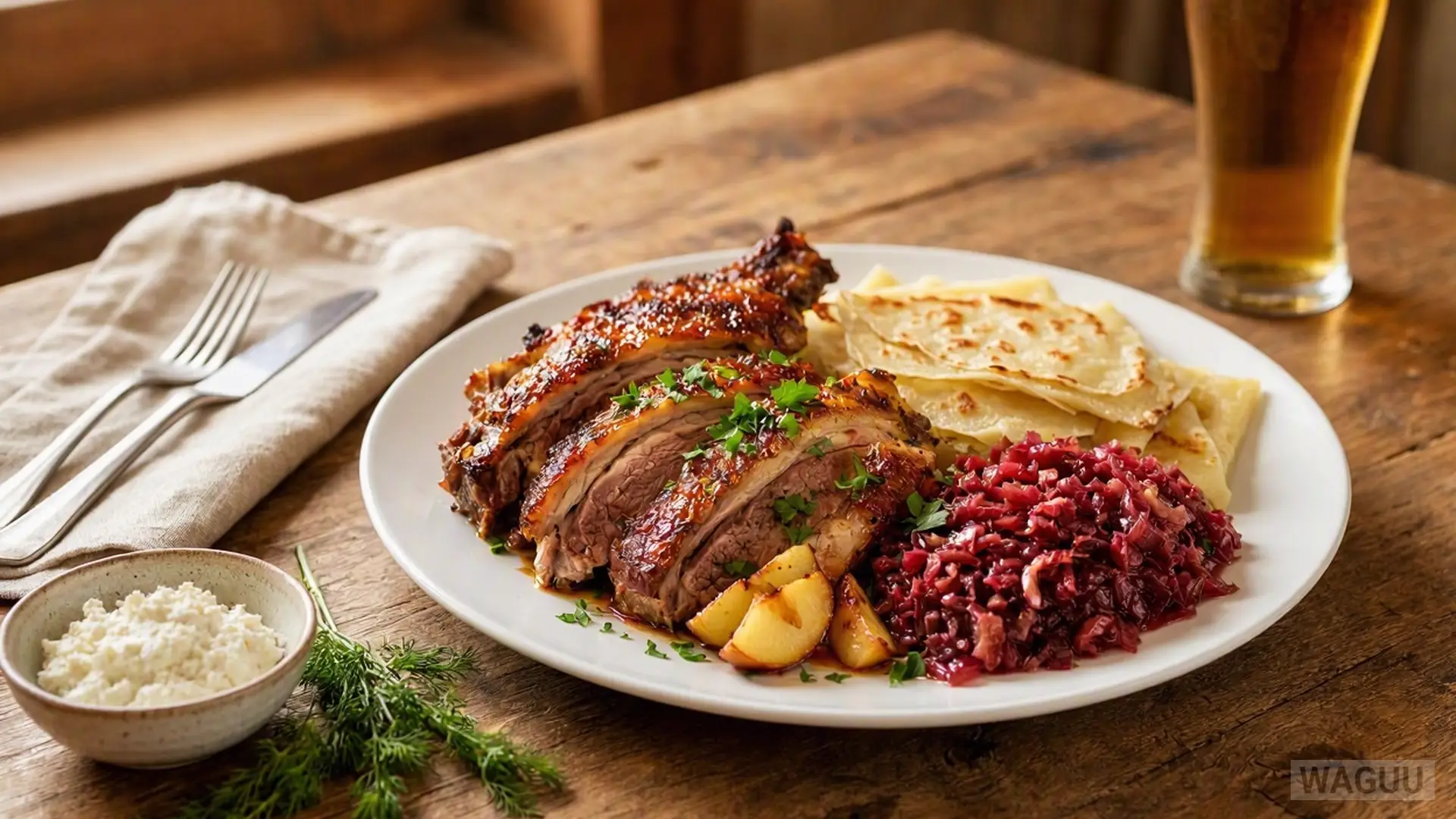
Summary: A magnificent traditional feast featuring a whole roasted goose with perfectly rendered crispy skin and tender meat, accompanied by braised red cabbage sweetened with apples and traditional homemade potato flatbreads. This classic celebration dish utilises slow-roasting techniques and careful basting to achieve optimal flavour, requiring 60 minutes of preparation and 3 hours and 30 minutes of cooking time for 6 hungry portions.
Did you cook this recipe? Share the result with the community.
Category: Poultry, Czech Cuisine
Success rate: 97% of users successfully made this recipe
Quick overview
- Dish: Roast goose with potato flatbreads and cabbage
- Category: Poultry, Czech Cuisine
- Cuisine: Czech
- Main ingredient: whole farm goose, 4,500 g (high quality, free-range)
- Guide: 12 most popular Slovak dishes: favourite recipes of Slovak cuisine
- Total time: 270 minutes (60 min prep + 210 min cooking)
- Difficulty: Advanced
- Portions: 6 portions (Portion weight: 650.0 g)
- Key technique: Slow roasting and fat rendering
- Preparation types: Roasting, braising, dough rolling
- Dietary info & Allergens: Gluten, milk, eggs, sulphites
- Suitable for: Festive lunches, Sunday family gatherings, autumn celebrations
- Nutritional values (per 1 portion): 945.2 kcal, Protein: 42.5 g, Fat: 68.3 g, Carbohydrates: 41.2 g
- Storage: 3 days in the fridge, 3 months in the freezer
- Pairing: Dark lager beer, full-bodied red wine like Frankovka, sparkling mineral water
- In short: The ultimate celebratory roast featuring crisp-skinned goose, sweet braised red cabbage, and pliable potato flatbreads.
- Last updated: 21 September 2026
WAGUU says: “A successful roast goose relies on patience: rendering out the heavy subcutaneous fat slowly at lower temperatures ensures the meat remains exceptionally succulent while the skin transforms into a glass-like crackling.”
How to take it further: Stuff the goose cavity with sour cooking apples and fresh marjoram sprigs; brush the potato flatbreads with rendered goose fat immediately upon removal from the hot dry skillet.
Key facts
| Prep time: | 60 minutes |
| Cooking time: | 210 minutes |
| Temperature: | 150 °C to 200 °C |
| Number of portions: | 6 portions |
In a nutshell
Experience the pinnacle of festive home dining by preparing a magnificent whole roasted goose. Paired with sweet-and-sour red cabbage and delicate potato flatbreads, this dish delivers an unforgettable symphony of rich textures and deep autumnal flavours.
Ingredients
Base portions: 6 portions • Portion weight: 650.0 g
| Ingredient | Amount | Quality |
|---|---|---|
| Whole farm goose | 4500 g | Free-range, cleaned |
| Fine sea salt | 35 g | Pure sea salt |
| Whole caraway seeds | 15 g | Aromatic dried seeds |
| Water for roasting | 500 ml | Clean tap water |
| Red cabbage | 1000 g | Fresh firm head |
| Yellow onion | 200 g | Finely chopped |
| Rendered goose fat | 60 g | Pure clarified fat |
| Granulated sugar | 40 g | White crystal sugar |
| Apple cider vinegar | 30 ml | Natural fermentation |
| Cooking apples | 300 g | Peeled and grated |
| Plain flour | 400 g | Wheat flour type 00 |
| Boiled potatoes | 300 g | Floury variety, cooled |
| Unsalted butter | 50 g | Melted for brushing |
Why you will love this recipe
- Exceptional skin crispiness: Slow rendering removes excess fat and transforms skin into golden crackling.
- Balanced flavour profile: Rich meat pairs harmoniously with tangy sweet-and-sour red cabbage.
- Authentic tradition: Hand-rolled potato flatbreads provide the ultimate accompaniment to soak up juices.
Why it works: Careful temperature management prevents protein over-coagulation while allowing collagen to break down completely.
Recipe overview
Prep: 60 min | Cooking: 210 min | Difficulty: Advanced | Portions: 6 | Type: Main course | Origin: Czech Republic
Detailed instructions
Overall progress: 0% complete
Phase 1: Goose preparation and initial seasoning – 20 min
Appliances: Kitchen scales
1. Rinse the whole farm goose (4,500 g) thoroughly under cold running water and pat completely dry with paper towels. Trim away any excess subcutaneous fat around the cavity opening. Rub the entire outer skin and internal cavity evenly with fine sea salt (35 g) and whole caraway seeds (15 g), ensuring the spices adhere well to the skin. Place the seasoned goose breast-side down on a clean wire rack set inside a large roasting tin. Visual check point (VKB): The entire surface of the bird must be uniformly coated with salt and caraway seeds without any bare patches.
VKB: The entire surface of the bird must be uniformly coated with salt and caraway seeds without any bare patches.
Before moving to the next step:
Ensure the goose is thoroughly dried before seasoning, as excess surface moisture prevents the salt from penetrating the skin effectively.
Phase 2: Slow roasting the goose – 150 min
Appliances: Oven
2. Pour water for roasting (500 ml) into the bottom of the roasting tin beneath the rack. Cover the roasting tin tightly with aluminium foil to create a sealed environment and place it into a preheated oven at 150 °C. Bake covered for 120 minutes to tenderise the dense muscle tissue and render out the heavy underlying fat. After 120 minutes, carefully remove the aluminium foil, flip the goose breast-side up, and continue roasting uncovered at 160 °C for an additional 30 minutes, basting every 10 minutes with the accumulated pan juices. VKB: The skin should begin to turn golden and release substantial fat into the base of the roasting tin.
VKB: The skin should begin to turn golden and release substantial fat into the base of the roasting tin.
Before moving to the next step:
Exercise extreme caution when removing the foil to avoid steam burns from the trapped hot moisture inside the roasting tin.
Phase 3: Crisping the skin – 30 min
Appliances: Oven
3. Increase the oven temperature to 200 °C. Roast the uncovered goose for 30 minutes, turning once halfway through, until the skin turns deep golden-brown and achieves a crisp, crackling texture. Spoon off excess liquid fat from the pan periodically if it threatens to submerge the lower parts of the bird. VKB: The skin must be uniformly crisp and blistered across the entire breast and thighs.
VKB: The skin must be uniformly crisp and blistered across the entire breast and thighs.
Before moving to the next step:
Monitor the skin closely during high-temperature roasting to prevent scorching, covering exposed tips with foil if necessary.
Phase 4: Braising the red cabbage – 40 min
Appliances: Hob
4. While the goose is roasting, prepare the cabbage. Core and finely shred the red cabbage (1,000 g). In a large saucepan over medium heat, melt rendered goose fat (60 g) and sauté finely chopped yellow onion (200 g) for 6 minutes until translucent and soft. Add granulated sugar (40 g) and let it caramelise lightly for 3 minutes. Stir in apple cider vinegar (30 ml), shredded red cabbage, and grated cooking apples (300 g). Cover and simmer over low heat for 31 minutes, stirring occasionally until tender. VKB: The cabbage should collapse into a rich, glossy, purple compote with a balanced sweet-and-sour taste.
VKB: The cabbage should collapse into a rich, glossy, purple compote with a balanced sweet-and-sour taste.
Before moving to the next step:
Ensure the sugar does not burn during caramelisation, as bitter notes will ruin the delicate flavour of the braised cabbage base.
Phase 5: Preparing the potato flatbread dough – 20 min
Appliances: Kitchen scales
5. Boil and cool floury potatoes beforehand. Finely grate the cooled boiled potatoes (300 g) onto a clean work surface. Combine with plain flour (400 g) and a pinch of salt. Knead vigorously for 10 minutes by hand until a smooth, pliable dough forms that does not stick to the fingers. Divide the dough into 12 equal portions. VKB: The dough must feel velvety and elastic without dry pockets of unmixed flour.
VKB: The dough must feel velvety and elastic without dry pockets of unmixed flour.
Before moving to the next step:
Allow the boiled potatoes to cool completely before grating to prevent excess moisture from breaking down the gluten network in the flour.
Phase 6: Rolling and dry-frying the flatbreads – 20 min
Appliances: Hob
6. Roll each dough portion on a lightly floured surface into a thin, round flatbread about 2 mm thick. Heat a heavy dry frying pan over medium-high heat without adding any oil. Cook each flatbread for 2 minutes on each side until blistered with characteristic dark brown spots. Brush each hot flatbread generously with melted unsalted butter (50 g) immediately upon removal from the pan. VKB: The flatbreads should be soft, pliable, and speckled with toasted spots.
VKB: The flatbreads should be soft, pliable, and speckled with toasted spots.
Required equipment
| Utensil | Ideal size | Alternative | Risk |
|---|---|---|---|
| Roasting tin | 40 x 30 cm | Deep baking tray | Spilling hot fat |
| Saucepan | 4 l capacity | Cast iron Dutch oven | Burning the cabbage |
| Heavy frying pan | 28 cm diameter | Cast iron griddle pan | Uneven browning |
Shopping list
Nutritional profile
Values per 1 portion (excluding side dishes). Calculated from average nutritional values of ingredients.
| Nutrient | Per 100 g | Per 1 portion | Per 6 portions |
|---|---|---|---|
| Energy | 145.4 kcal | 945.2 kcal | 5,671.2 kcal |
| Fat | 10.5 g | 68.3 g | 409.8 g |
| of which saturates | 3.4 g | 22.1 g | 132.6 g |
| Carbohydrates | 6.3 g | 41.2 g | 247.2 g |
| of which sugars | 2.8 g | 18.2 g | 109.2 g |
| Protein | 6.5 g | 42.5 g | 255.0 g |
| Salt | 0.9 g | 5.8 g | 34.8 g |
Reference intake of an average adult (8400 kJ / 2000 kcal).
WAGUU Pro Level
- Pro standard: Verified recipe with precise ratios and visual control points.
- Tip 1: Prick the skin gently with a thin fork before roasting to allow underlying fat to escape smoothly without tearing the flesh.
- Tip 2: Rest the roasted goose for at least 20 minutes in a warm spot before carving to allow muscle fibres to reabsorb juices.
- Tip 3: Save every drop of rendered goose fat in a sterilised glass jar in the fridge for roasting potatoes later.
- Tip 4: Use a combination of floury and waxy potatoes for the flatbread dough to achieve the ideal balance of elasticity and tenderness.
Scientific background
Waterfowl such as geese possess high levels of intermuscular and subcutaneous adipose tissue to provide buoyancy and thermal insulation. Slow thermal processing at moderate temperatures melts these fat depots gradually, while collagen within the connective tissue hydrolyses into gelatin, transforming tough connective matrices into a tender, succulent texture. Simultaneously, the Maillard reaction between amino acids and reducing sugars during the final high-temperature dry roasting creates complex aromatic pyrazines and deep amber pigmentation on the skin.
Fine Dining – Professional techniques
- Plate composition: Fan precise slices of roasted goose breast alongside folded potato flatbreads and a neat quenelle of braised red cabbage.
- Textural contrasts: Combine the shattering crispness of the skin with the velvety tenderness of the meat and soft chew of the flatbread.
- Temperature contrast: Serve the piping hot roasted meat and warm cabbage against room-temperature herb garnishes.
- Aromatic garnishes: Garnish with freshly microplaned orange zest and delicate sprigs of fresh marjoram.
Sensory radar
- Appearance: Deep golden-brown crackled skin with vibrant purple braised cabbage and golden buttered flatbreads.
- Aroma: Rich roasted poultry notes infused with warm caraway seeds, caramelized sugar, and earthy alliums.
- Taste: Deeply savory and rich goose meat balanced by the refreshing tartness and sweetness of red cabbage.
- Texture: Supremely crisp exterior giving way to melt-in-the-mouth tender meat and pliable, soft flatbreads.
Pairing
- BEER: Traditional Czech dark lager beer with caramel malt undertones.
- WINE: Structured, fruit-forward Frankovka (Blaufränkisch) with balancing acidity.
- NON-ALCOHOLIC: Chilled artisanal apple and blackcurrant craft cider.
Various preparation variants
- Stuffed Martinmas Goose: Fill the abdominal cavity with tart apples, dried plums, and fresh marjoram before sealing and roasting.
- White Cabbage Variation: Substitute red cabbage with shredded white cabbage braised with caraway seeds and smoked bacon lardons.
Allergens and dietary information
Contains: Gluten, milk, eggs, sulphites • Gluten: Contains wheat flour • Not suitable for: Vegan diets, lactose intolerance
Suitable for
Festive lunches, Sunday family gatherings, autumn celebrations
Substitution catalog
- Whole farm goose: Whole duck (adjust cooking time down by 60 minutes)
- Rendered goose fat: Clarified butter (ghee) or lard
- Plain flour: Spelt flour for a nuttier flatbread profile
FAQ
How do I prevent the goose meat from drying out during long roasting?
Covering the roasting tin tightly with aluminium foil during the initial two hours traps moisture, allowing the meat to steam gently in its own juices while rendering fat safely.
Can I prepare the potato flatbread dough in advance?
It is best to shape and cook the flatbreads immediately after kneading, as raw potato dough discolours and releases excess moisture if left standing.
What is the best way to store leftover rendered goose fat?
Strain the warm liquid fat through a fine mesh sieve into a clean glass jar, let it cool completely, and store it sealed in the refrigerator for up to 6 months.
Why did my flatbreads turn out tough instead of soft?
Overworking the dough or cooking them at too low a temperature in the pan dries out the moisture, resulting in a rubbery texture.
WAGUU Petr advises: Cooking for 12 or more people?
12–16 people: Roast two separate medium-sized geese simultaneously on different oven racks, rotating their positions halfway through cooking to ensure even browning. Prepare the red cabbage and flatbread dough in two separate batches to maintain optimal dough consistency.
20+ people: Consider outsourcing the baking of flatbreads or use catering convection ovens to manage multiple roasting tins. Batch-cook the braised red cabbage the day before and reheat gently before serving.
Sides and Serving
- Pickled gherkins – crunchy fermented cucumbers (not included in the recipe)
- Fresh horseradish – grated spicy root (not included in the recipe)
Serving: Serve carved portions of warm roast goose alongside generous spoonfuls of braised red cabbage and a stack of buttered potato flatbreads, garnished with fresh marjoram.
Storage and reheating
Fridge: 3 days • Freezer: 3 months • Reheating: Reheat sliced goose meat covered with a splash of water in an oven preheated to 160 °C for 20 minutes. Warm flatbreads briefly on a hot dry pan.
Author: WAGUU Petr & Team • Published: 21 Sep 2026 • Updated: 30 Oct 2026
More Recipes from This Article
Guide: 12 most popular Slovak dishes: favourite recipes of Slovak cuisine
Potato dumplings with sheep’s milk cheese and bacon
Sauerkraut and smoked meat soup
Potato dumplings stuffed with sheep’s milk cheese
Other recipes you might be interested in
Why WAGUU?
Recipes on WAGUU undergo checks for the accuracy of ingredients, procedures, and nutritional values.
Process photo gallery
Community photos: Cook, take a photo, and share the result.
You can upload photos in the comments below or send them via email.
Did you record a video guide for our recipe? Insert a link to YouTube, YouTube Shorts, TikTok, Instagram Reels, Facebook Reels, Pinterest, Vimeo, or X (Twitter) in the comment – we’d be happy to publish it and help promote you and your content.
roast-goose-with-potato-flatbreads-and-cabbage-en@waguu.online
Common mistakes
- Skipping the covered roasting phase – Results in tough, dry meat because the moisture escapes before the collagen has time to break down.
- Failing to prick the skin – Traps excessive subcutaneous fat beneath the skin, preventing proper rendering and resulting in rubbery crackling.
- Rushing the sugar caramelisation – Burning the sugar for the braised red cabbage imparts an unpleasant bitter taste that overpowers the dish.
- Overworking the flatbread dough – Develops too much gluten, making the flatbreads tough and rubbery rather than soft and pliable.