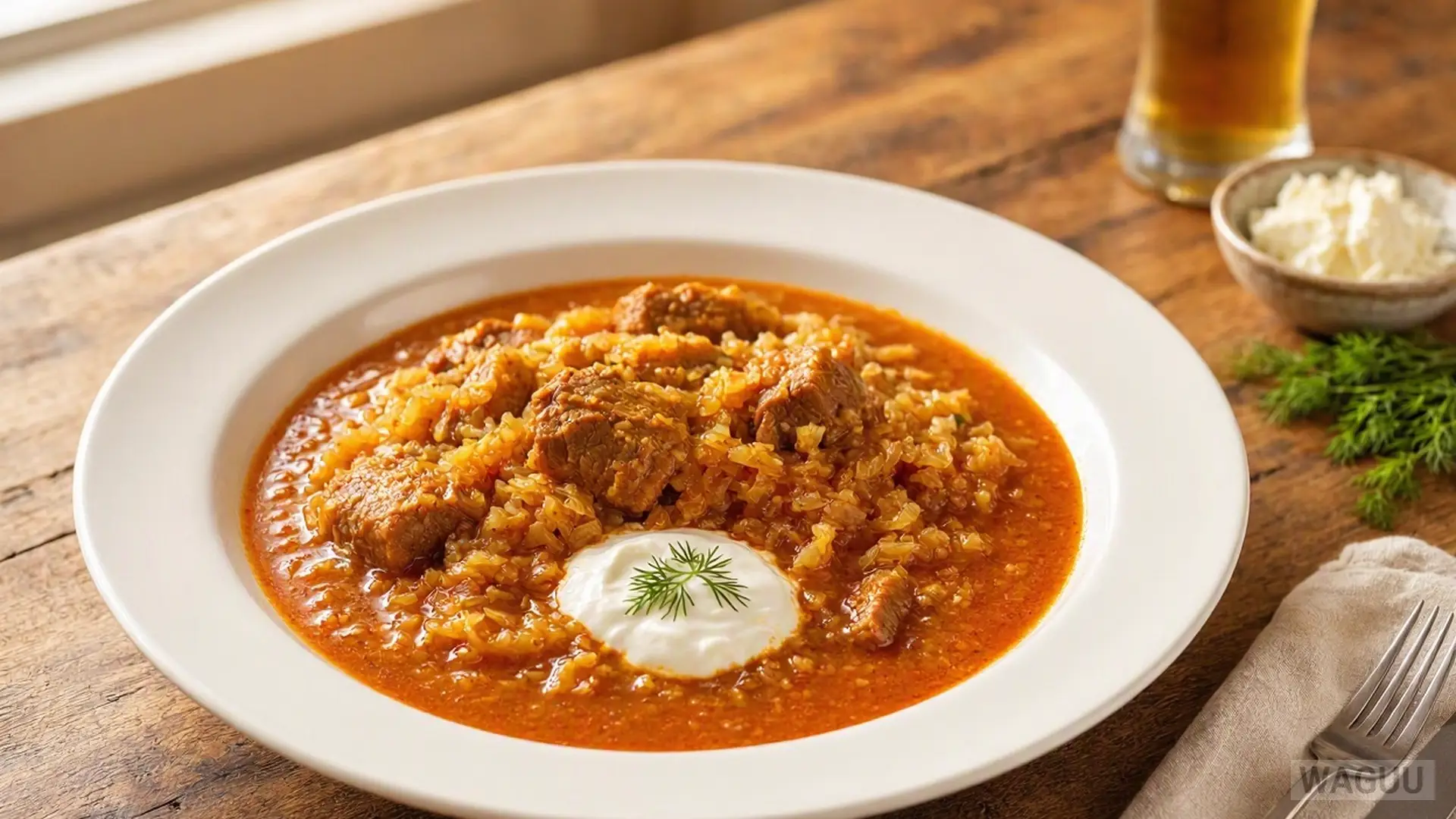
Summary: A classic Central European braised pork and sauerkraut stew enriched with rich soured cream, sweet smoked paprika, and onions, cooked slowly until melt-in-the-mouth tender, prepared in 120 minutes for 6 portions.
Did you cook this recipe? Share the result with the community.
Category: Pork, Slovak Cuisine
Success rate: 98.5% of users successfully made this recipe
Quick overview
- Dish: Szeged goulash
- Category: Pork, Slovak Cuisine
- Cuisine: Central European / Slovak
- Main ingredient: Pork shoulder, 1,200 g (high-fat marbling)
- Guide: 12 most popular Slovak dishes: favourite recipes of Slovak cuisine
- Total time: 120 minutes (30 min prep + 90 min cooking)
- Difficulty: Intermediate
- Portions: 6 portions (Portion weight: 420.0 g)
- Key technique: Braising with slow onion reduction and dairy emulsification
- Preparation types: Sautéing, braising, simmering
- Dietary info & Allergens: Contains milk, gluten-free
- Suitable for: Sunday lunch, family gatherings, cold weather dining
- Nutritional values (per 1 portion): 540.2 kcal, Protein: 38.4 g, Fat: 34.2 g, Carbohydrates: 21.5 g
- Storage: 3 days in the fridge, 3 months in the freezer
- Pairing: Lager beer, Grüner Veltliner, sparkling water with lemon
- In short: Tender pork shoulder stewed with tangy sauerkraut and sweet paprika, finished with rich soured cream.
- Last updated: 21 September 2026
WAGUU says: “The secret to a phenomenal Szeged goulash lies in browning the onions thoroughly and stewing the pork slowly alongside acidic sauerkraut until the fibers yield completely.”
How to take it further: Stir in a tablespoon of grated raw potato during the last 30 minutes to naturally thicken the sauce, or add freshly crushed caraway seeds for deeper herbal warmth.
Key facts
| Prep time: | 30 minutes |
| Cooking time: | 90 minutes |
| Temperature: | 160 °C oven or gentle simmer on hob |
| Number of portions: | 6 portions |
In a nutshell
Szeged goulash is a revered pillar of Central European gastronomy, combining succulent cuts of pork shoulder with finely shredded fermented cabbage. Unlike standard beef goulash, this variation relies on the interplay between pork fat, sweet Hungarian paprika, pungent onions, and cooling soured cream. It delivers a deeply satisfying balance of savory, sweet, and tangy notes that warms the soul.
Ingredients
Base portions: 6 portions • Portion weight: 420.0 g
| Ingredient | Amount | Quality |
|---|---|---|
| Pork shoulder | 1200 g | Well-marbled, cubed into 3 cm pieces |
| White onions | 600 g | Finely diced |
| Sauerkraut | 800 g | Fermented white cabbage, lightly rinsed if very sour |
| Lard | 60 g | Traditional rendered pork fat |
| Sweet paprika powder | 30 g | High-grade Hungarian paprika |
| Caraway seeds | 5 g | Whole dried seeds |
| Garlic | 15 g | Fresh cloves, minced |
| Plain flour | 30 g | Wheat flour for thickening |
| Soured cream | 250 g | Minimum 20% fat content |
| Beef stock | 800 ml | Clear, rich homemade stock |
| Salt | 15 g | Fine sea salt |
| Black pepper | 3 g | Freshly ground black pepper |
| Water for basting | 200 ml | Clean tap water |
Why you will love this recipe
- Unmatched depth of flavor: The slow reduction of onions combined with high-grade sweet paprika creates a velvety, aromatic base that hugs every morsel of meat.
- Perfect textural harmony: Tender, collagen-rich pork shoulder contrasts brilliantly with the pleasant crunch and vibrant acidity of fermented sauerkraut.
- Creamy velvety finish: Tempering rich soured cream into the stew gives the sauce a luxurious gloss without curdling.
Why it works: Slow braising breaks down tough connective tissue in the pork shoulder while allowing the natural lactic acid in the sauerkraut to tenderize the meat fibers to absolute perfection.
Recipe overview
Prep: 30 min | Cooking: 90 min | Difficulty: Intermediate | Portions: 6 | Type: Main dish | Origin: Slovak Cuisine
Detailed instructions
Overall progress: 0% complete
Phase 1: Onion base and pork searing – 25 min
Appliances: Hob
1. Melt 60 g of lard in a large heavy-bottomed casserole pot over medium heat (180 °C surface temperature). Add 600 g of finely diced white onions and sauté for 15 minutes, stirring frequently until deep golden-brown and caramelized. Add 15 g of minced garlic and 5 g of whole caraway seeds, stirring for 1 minute until fragrant. Trim 1,200 g of pork shoulder into 3 cm cubes, season with 5 g of salt and 3 g of black pepper, then add to the pot. Sear the pork on all sides for 9 minutes until lightly browned.
Visual check point (VKB): Onions are evenly golden-brown and caramelized, and meat cubes have a lightly seared exterior crust.
Before moving to the next step:
Ensure the onions are thoroughly browned without burning, as this forms the vital flavor foundation of the goulash sauce.
Phase 2: Paprika blooming and initial simmer – 35 min
Appliances: Hob
2. Remove the pot briefly from the heat source to prevent the spices from burning. Stir in 30 g of sweet paprika powder, coating the pork and onions evenly for 30 seconds. Pour in 200 ml of clean water for basting to deglaze the bottom of the pot. Return to medium heat, pour in 800 ml of rich beef stock, and bring the liquid to a gentle simmer. Cover with a lid and simmer gently for 34 minutes, stirring occasionally.
VKB: Liquid is maintaining a steady, gentle bubble and emits a rich, aromatic paprika fragrance.
Before moving to the next step:
Check that the paprika was bloomed off the direct flame so it does not turn bitter.
Phase 3: Adding sauerkraut and tender braising – 45 min
Appliances: Hob
3. Take 800 g of sauerkraut, chop it slightly if the strands are very long, and add it directly into the pot with the simmering pork. Stir thoroughly to combine all ingredients. Cover the pot with the lid and continue to braise on low heat for 45 minutes, ensuring the pork fibers begin to soften and tenderize completely.
VKB: Sauerkraut has integrated into the stew, and a pork cube easily yields when pressed with a wooden spoon.
Before moving to the next step:
Verify that the liquid level remains sufficient so the stew does not scorch on the bottom of the pot.
Phase 4: Thickening slurry preparation – 5 min
Appliances: None
4. In a small bowl, whisk 30 g of plain flour with 50 ml of cold water until completely smooth and free of lumps, ensuring a uniform liquid slurry is ready for thickening the goulash sauce.
VKB: Slurry mixture has a completely silky, lump-free consistency.
Before moving to the next step:
Ensure no dry flour pockets remain at the bottom of the mixing bowl.
Phase 5: Thickening and sour cream emulsion – 10 min
Appliances: Hob
5. Pour the flour slurry in a thin stream into the simmering goulash while stirring constantly. Simmer for 5 minutes to cook out the raw flour taste. In a separate bowl, whisk 250 g of soured cream with a ladleful of the hot goulash liquid to temper it. Pour the tempered soured cream back into the pot, stirring continuously. Simmer gently for 5 minutes without boiling to create a glossy, velvety sauce. Season with an additional 10 g of salt if required.
VKB: Sauce is rich, glossy, and thick, coating the back of a spoon smoothly without curdling.
Required equipment
| Utensil | Ideal size | Alternative | Risk |
|---|---|---|---|
| Casserole pot | 5-litre capacity | Dutch oven | Food burning if base is too thin |
| Chef’s knife | 20 cm blade | Santoku knife | Uneven meat cubes |
| Whisk | 25 cm wire whisk | Fork | Lumps in flour slurry or soured cream |
Shopping list
Nutritional profile
Values per 1 portion (excluding side dishes). Calculated from average nutritional values of ingredients.
| Nutrient | Per 100 g | Per 1 portion | Per 6 portions |
|---|---|---|---|
| Energy | 128.6 kcal | 540.2 kcal | 3,241.2 kcal |
| Fat | 8.1 g | 34.2 g | 205.2 g |
| of which saturates | 3.4 g | 14.3 g | 85.8 g |
| Carbohydrates | 5.1 g | 21.5 g | 129.0 g |
| of which sugars | 2.2 g | 9.2 g | 55.2 g |
| Protein | 9.1 g | 38.4 g | 230.4 g |
| Salt | 0.6 g | 2.5 g | 15.0 g |
Reference intake of an average adult (8400 kJ / 2000 kcal).
WAGUU Pro Level
- Pro standard: Verified recipe with precise ratios and visual control points.
- Tip 1: Use high-fat pork shoulder with visible marbling; lean cuts will dry out during long braising.
- Tip 2: Caramelise the onions slowly over medium heat until deep amber to establish a natural sweetness that balances the sourness of the cabbage.
- Tip 3: Always remove the pot from the direct heat source before adding paprika powder to prevent scorching, which turns the spice bitter.
- Tip 4: Temper the soured cream with hot goulash liquid before stirring it into the pot to prevent protein coagulation and curdling.
- Tip 5: Let the finished goulash rest off the heat for 15 minutes before serving so the sauce settles and coats the meat perfectly.
Scientific background
The culinary chemistry of Szeged goulash relies on collagen hydrolysis and acid tenderization. Pork shoulder contains abundant connective tissue made of collagen. When simmered gently for extended periods in the presence of lactic acid from the sauerkraut, this tough collagen converts into gelatin, yielding exceptionally tender meat while naturally thickening the cooking juices. Furthermore, sautéing onions triggers the Maillard reaction, producing complex savory flavor molecules that merge harmoniously with the fat-soluble capsaicin and carotenoids extracted from the sweet paprika powder.
Fine Dining – Professional techniques
- Plate composition: Serve a neat mound of tender pork and braised sauerkraut in the center of a warm shallow bowl, pooled generously with glossy paprika sauce.
- Textural contrasts: Balance the tender, yielding meat with the slight fibrous crunch of perfectly braised sauerkraut and crisp, toasted bread croutons.
- Temperature contrast: Ensure the stew is served piping hot, topped with a dollop of chilled, silky soured cream at the moment of plating.
- Aromatic garnishes: Finish with a light dusting of high-grade paprika and finely minced fresh dill to introduce vibrant herbaceous brightness.
Sensory radar
- Appearance: A rich, fiery amber-red sauce coating glossy pork cubes and strands of fermented cabbage, finished with a swirl of white cream.
- Aroma: Pungent sweet paprika, caramelized onion, earthy caraway seeds, and a pleasant lactic tang from the sauerkraut.
- Taste: Deeply savory and meaty with a balanced acidity from the cabbage and a rounded, creamy finish.
- Texture: Melt-in-the-mouth tender pork shoulder surrounded by a velvety, thick sauce and tender-crisp sauerkraut strands.
Pairing
- BEER: A crisp Czech or Slovak pale lager with pronounced hop bitterness to cut through the rich pork fat.
- WINE: A dry, medium-bodied Grüner Veltliner with vibrant acidity and white pepper notes.
- NON-ALCOHOLIC: Chilled sparkling mineral water infused with a slice of fresh lemon.
Various preparation variants
- Smoked pork belly twist: Dice 150 g of smoked pork belly and render it at the start along with the lard for an intense smoky depth.
- Mushroom enriched variation: Sauté 200 g of sliced wild porcini or chestnut mushrooms with the onions for an earthy woodland aroma.
Allergens and dietary information
Contains: Milk • Gluten: Contains wheat flour (can be omitted for gluten-free version) • Not suitable for: Vegetarians, vegans, dairy-allergic individuals
Suitable for
Sunday lunch, family gatherings, cold weather dining, traditional feasts
Substitution catalog
- Pork shoulder: Pork neck or lean pork leg
- Soured cream: Crème fraîche or high-fat Greek yoghurt
- Lard: Clarified butter or neutral vegetable oil
FAQ
Can I use beef instead of pork?
Traditional Szeged goulash is strictly made with pork shoulder. Beef requires a much longer cooking time and changes the classic flavor profile.
Why did my soured cream curdle in the sauce?
Curdling happens when cold soured cream meets boiling hot liquid. Always temper the cream by mixing it with a ladleful of warm stew before adding it to the pot.
Should I rinse the sauerkraut before cooking?
If your sauerkraut is extremely sour or salty, give it a quick rinse under cold water. Otherwise, retain the juices for an authentic tangy punch.
Can I freeze Szeged goulash?
Yes, it freezes remarkably well for up to 3 months. For best results, freeze the stew before adding the soured cream and stir the cream in after reheating.
WAGUU Petr advises: Cooking for 12 or more people?
12–16 people: Double all ingredient quantities and use a large 10-litre stockpot. Brown the meat in two separate batches to ensure proper searing rather than steaming.
20+ people: Divide the preparation across two large pots or utilize a professional catering braising pan. Maintain proportional ratios and simmer gently for an additional 15 minutes to ensure even tenderization.
Sides and Serving
- Bread dumplings – steamed bread rolls sliced into thick rounds (not included in the recipe)
- Potato flatbreads – griddled flatbreads brushed with animal fat (not included in the recipe)
Serving: Serve piping hot in deep ceramic bowls, accompanied by a generous dollop of extra soured cream and fresh crusty bread.
Storage and reheating
Fridge: 3 days • Freezer: 3 months • Reheating: Reheat slowly on the hob over medium-low heat, stirring occasionally and adding a splash of water or stock if the sauce has thickened too much.
Author: WAGUU Petr & Team • Published: 21 Sep 2026 • Updated: 30 Oct 2026
More Recipes from This Article
Guide: 12 most popular Slovak dishes: favourite recipes of Slovak cuisine
Potato dumplings with sheep’s milk cheese and bacon
Sauerkraut and smoked meat soup
Potato dumplings stuffed with sheep’s milk cheese
Potato dumplings with sauerkraut and bacon
Other recipes you might be interested in
Why WAGUU?
Recipes on WAGUU undergo checks for the accuracy of ingredients, procedures, and nutritional values.
Process photo gallery
Community photos: Cook, take a photo, and share the result.
You can upload photos in the comments below or send them via email.
Did you record a video guide for our recipe? Insert a link to YouTube, YouTube Shorts, TikTok, Instagram Reels, Facebook Reels, Pinterest, Vimeo, or X (Twitter) in the comment – we’d be happy to publish it and help promote you and your content.
Common mistakes
- Adding paprika to direct high heat – Scorching paprika turns it extremely bitter and ruins the sauce base. Always remove the pot from the heat before stirring in the paprika powder.
- Rinsing away all sauerkraut acidity – Over-rinsing fermented cabbage strips the goulash of its characteristic tangy punch. Only rinse if the sauerkraut is exceptionally sour.
- Adding cold soured cream directly – Pouring cold cream into boiling stew causes protein coagulation and curdling. Always temper the cream with warm liquid first.
- Using lean pork cuts – Extremely lean meat lacks the necessary collagen and intramuscular fat, resulting in dry, stringy pieces after braising. Always choose well-marbled pork shoulder.