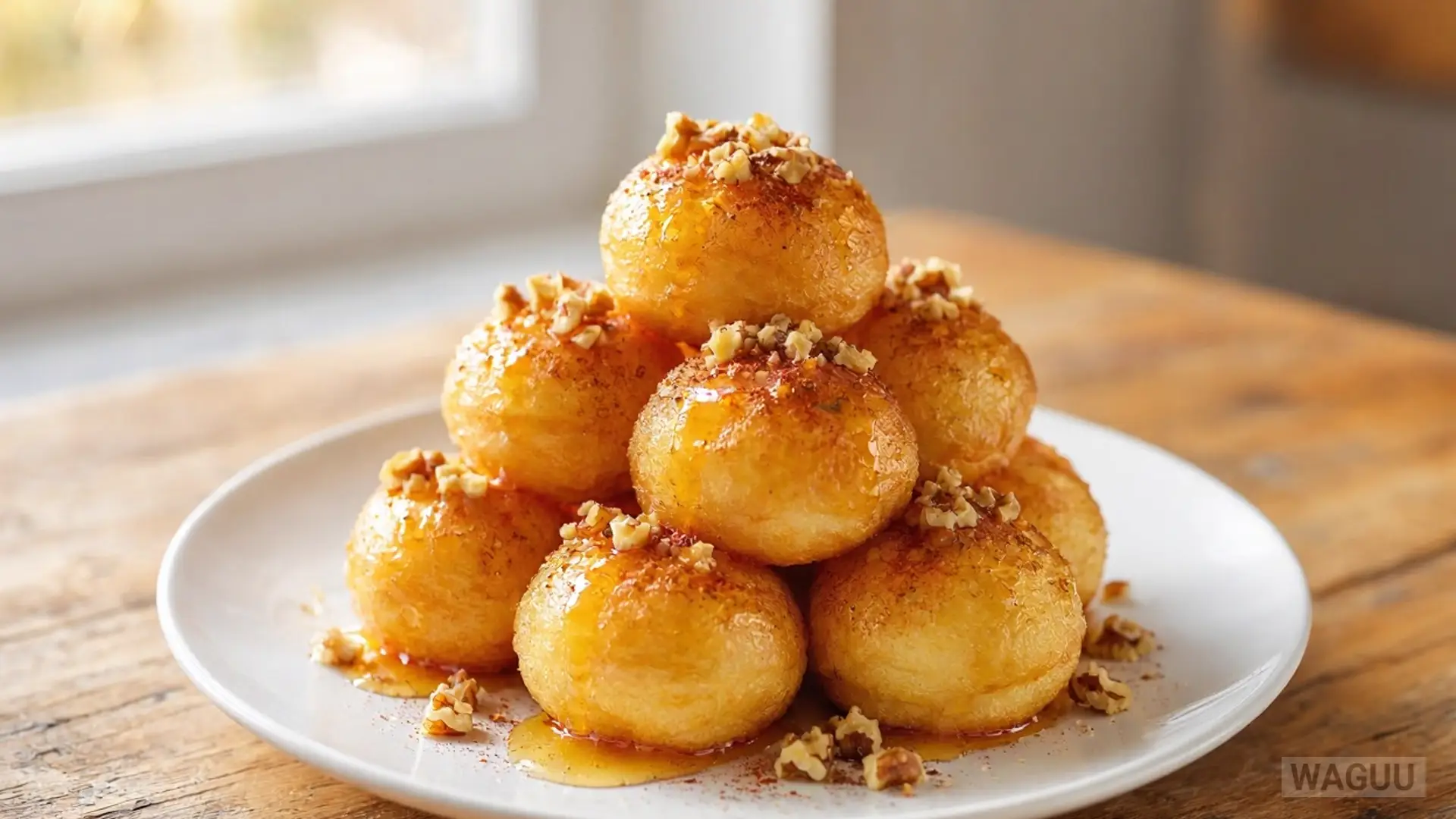
Summary: Loukoumades – Greek yeast-puffed doughnuts fried in oil, drizzled with honey and sprinkled with cinnamon and walnuts – Main ingredient: all-purpose flour, 500 g, technique: deep frying in hot vegetable oil with subsequent honey-syrup drenching, preparation time: 120 minutes including dough proving, number of portions: 6.
Did you cook this recipe? Share the result with the community.
Category: Desserts, Mediterranean Cuisine
Success rate: not rated yet% of users successfully made this recipe
Quick overview
- Dish: Loukoumades
- Category: Desserts, Mediterranean Cuisine
- Cuisine: Greek
- Main ingredient: All-purpose flour, 500 g (premium wheat quality)
- Guide: 12 most popular Mediterranean dishes: favourite recipes of Mediterranean cuisine
- Total time: 120 minutes (90 min prep + 30 min cooking)
- Difficulty: Medium
- Portions: 6 portions (Portion weight: 180 g)
- Key technique: Yeast dough fermentation and deep frying
- Preparation types: Mixing, proving, piping, frying, syrup drizzling
- Dietary info & Allergens: Contains gluten, nuts (walnuts), honey
- Suitable for: Vegetarians, festive gatherings, dessert lovers
- Nutritional values (per 1 portion): 485 kcal, Protein: 7.2 g, Fat: 18.5 g, Carbohydrates: 74.2 g
- Storage: 2 days in the fridge, 1 month in the freezer
- Pairing: Lager beer, Greek dessert wine, Greek mountain tea
- In short: Golden, crispy-on-the-outside, fluffy-on-the-inside Greek honey puffs dusted with fragrant cinnamon and crunchy walnuts.
- Last updated: 2025-01-15
WAGUU says: “Achieving the ultimate spherical shape without fancy machinery requires the classic hand-squeezing method through thumb and index finger, dropping dollops straight into preheated oil.”
Key facts
| Prep time: | 90 minutes |
| Cooking time: | 30 minutes |
| Temperature: | 175 °C frying oil |
| Number of portions: | 6 portions |
In a nutshell
Loukoumades represent the pinnacle of traditional Greek confectionery, tracing their roots back to ancient Olympic victors who were awarded these honey-soaked dough balls as prizes of honor. This recipe guides you through creating an airy, highly hydrated yeast batter that puffs up dramatically in hot oil, transforming into golden spheres ready to be drenched in warm thyme honey and garnished with toasted walnuts and aromatic cinnamon.
Ingredients
Base portions: 6 portions • Portion weight: 180 g
| Ingredient | Amount | Quality |
|---|---|---|
| All-purpose flour | 500 g | High protein wheat flour |
| Active dry yeast | 7 g | Standard dried yeast |
| Lukewarm water | 400 ml | Filtered, 37 °C |
| Granulated sugar | 15 g | Fine white sugar |
| Fine sea salt | 5 g | Pure sea salt |
| Olive oil (for dough) | 20 ml | Extra virgin olive oil |
| Sunflower oil (for frying) | 1000 ml | Neutral high-smoke-point oil |
| Greek honey | 200 g | Authentic thyme honey |
| Ground cinnamon | 5 g | Ceylon cinnamon powder |
| Walnuts | 80 g | Freshly shelled and chopped |
Why you will love this recipe
- Authentic taste: Brings genuine Greek confectionery tradition straight to your kitchen using classic Mediterranean flavor pairings.
- Unmatched texture: Features a delightful contrast between the crispy fried exterior and the spongy, airy crumb inside.
- Simple ingredients: Relies on everyday pantry staples transformed through precise biochemical technique into a gourmet dessert.
Success guaranteed: Follow the precise hydration and oil temperature guidelines to achieve flawless spherical puffs every single time.
Recipe overview
Prep: 90 min | Cooking: 30 min | Difficulty: Medium | Portions: 6 portions | Type: Dessert | Origin: Greece
Detailed instructions
Overall progress: 0% complete
Phase 1: Preparing and mixing the yeast batter – 20 min
Appliances: Mixing bowl, whisk, kitchen scale
1. In a large mixing bowl, combine 500 g of all-purpose flour, 7 g of active dry yeast, 15 g of granulated sugar, and 5 g of fine sea salt. Whisk the dry ingredients thoroughly until evenly distributed. Pour in 400 ml of lukewarm water (37 °C) and 20 ml of extra virgin olive oil. Using a wooden spoon or electric mixer with dough hooks, beat the mixture vigorously for 5 minutes until a smooth, very sticky, and elastic wet batter forms. Ensure no dry flour pockets remain.
VKB: Batter consistency must resemble a thick, stretchy dough rather than bread dough.
Before moving to the next step:
Verify that the water temperature does not exceed 40 °C, otherwise the yeast will be deactivated.
Phase 2: Fermenting and proving the dough – 60 min
Appliances: Clean kitchen towel, warm room
2. Cover the mixing bowl tightly with plastic wrap and a clean kitchen towel. Place the bowl in a warm, draft-free environment (around 25 °C) and let the batter ferment for 60 minutes. During this period, the yeast will consume sugars, producing carbon dioxide bubbles that expand the batter to double its original volume, creating the essential porous structure.
VKB: Look for numerous air bubbles breaking on the surface of the risen batter.
Before moving to the next step:
Do not deflate or knead the dough after proving; keep the trapped air bubbles intact.
Phase 3: Heating the frying oil – 10 min
Appliances: Deep saucepan, kitchen thermometer
3. Pour 1000 ml of sunflower oil into a deep, heavy-bottomed saucepan or Dutch oven, ensuring the oil depth reaches at least 5 cm. Heat the oil over medium-high heat until a reliable kitchen thermometer registers precisely 175 °C. Maintaining stable oil temperature is critical to prevent grease absorption or burning.
VKB: Test oil readiness by dropping a tiny spoonful of batter; it should sizzle and float immediately.
Before moving to the next step:
Ensure the working space near the stove is organized with a bowl of water for dipping spoons and a slotted spoon ready.
Phase 4: Shaping and frying the doughnuts – 20 min
Appliances: Teaspoon, slotted spoon, paper towels
4. Take a handful of the risen batter and squeeze it gently so a small ball oozes out between your thumb and index finger. Dip a teaspoon in water, scoop off the dough ball, and drop it carefully into the hot 175 °C oil. Repeat quickly to form 8 to 10 pieces per batch. Fry the loukoumades for 3 to 4 minutes, turning them frequently with a slotted spoon until uniformly golden brown on all sides. Remove with the slotted spoon and drain briefly on paper towels.
VKB: Do not overcrowd the pan, as cold batter drops lower the oil temperature rapidly.
Before moving to the next step:
Allow the oil temperature to recover to 175 °C between consecutive batches.
Phase 5: Preparing the honey syrup – 5 min
Appliances: Small saucepan, stove
5. In a small saucepan, gently warm 200 g of authentic Greek thyme honey over low heat for 2 to 3 minutes until it becomes fluid and runny. You can add 2 tablespoons of water and a thin strip of orange peel if desired to adjust viscosity, though pure warm honey provides the most authentic traditional flavor profile.
VKB: Warm honey penetrates the porous crust of the doughnuts much more effectively than cold honey.
Before moving to the next step:
Ensure the honey is warm but not boiling hot to avoid scorching.
Phase 6: Assembling, drizzling, and garnishing – 5 min
Appliances: Serving platter, knife, cutting board
6. Arrange the freshly fried warm loukoumades on a large serving platter. Generously drizzle the warm Greek honey all over the mounds of doughnuts. Sprinkle 5 g of ground cinnamon evenly across the top. Finish by scattering 80 g of freshly chopped walnuts over the dessert to add essential crunch and nutty depth. Serve immediately while warm and crispy.
VKB: Serve immediately; loukoumades lose their peak crispiness if left sitting too long before eating.
Required equipment
| Utensil | Ideal size | Alternative | Risk |
|---|---|---|---|
| Mixing bowl | 3-litre capacity | Large ceramic bowl | Too small for rising dough |
| Deep saucepan | 5-litre capacity | Dutch oven or wok | Oil overflow hazard |
| Kitchen thermometer | Digital probe | Candy thermometer | Inaccurate oil temperature |
Shopping list
Nutritional profile
Values per 1 portion (excluding side dishes). Calculated from average nutritional values of ingredients.
| Nutrient | Per 100 g | Per 1 portion | Per 6 portions |
|---|---|---|---|
| Energy | 269.4 kcal | 485.0 kcal | 2910.0 kcal |
| Fat | 10.3 g | 18.5 g | 111.0 g |
| of which saturates | 1.4 g | 2.5 g | 15.0 g |
| Carbohydrates | 41.2 g | 74.2 g | 445.2 g |
| of which sugars | 18.8 g | 33.8 g | 202.8 g |
| Protein | 4.0 g | 7.2 g | 43.2 g |
| Salt | 0.5 g | 0.9 g | 5.4 g |
Reference intake of an average adult (8400 kJ / 2000 kcal).
WAGUU Pro Level
- Pro standard: Verified recipe with precise ratios and visual control points.
- Tip 1: Add a tablespoon of ouzo or cognac into the batter mixture to inhibit excessive oil absorption during frying.
- Tip 2: Keep the oil temperature strictly between 170 °C and 180 °C to achieve an even golden crust without raw dough inside.
- Tip 3: Use genuine Greek thyme or pine honey for the most aromatic flavor profile characteristic of authentic tavernas.
- Tip 4: Toast the chopped walnuts lightly in a dry pan for 3 minutes before scattering them over the honeyed doughnuts.
Scientific background
Deep frying yeast dough relies on rapid thermal transfer where water molecules inside the batter flash into steam, creating internal air pockets that expand the gluten network. The high hydration level of loukoumades batter (around 80% baker’s percentage) ensures a very light crumb. When submerged in hot oil at 175 °C, the Maillard reaction between amino acids and reducing sugars on the surface produces the characteristic golden-brown crust and complex toasted aroma, while the honey coating acts as a humectant, locking in moisture and sealing the crispy exterior.
Fine Dining – Professional techniques
- Plate composition: Stack the golden spheres in a neat pyramid on a dark slate plate to highlight the amber honey glaze.
- Textural contrasts: Pair the ultra-crispy, syrup-soaked exterior with a velvety scoop of artisan mastic or vanilla bean gelato.
- Temperature contrast: Serve the hot, freshly fried loukoumades alongside ice-cold Greek yogurt or chilled ice cream.
- Aromatic garnishes: Garnish with edible dried rose petals and micro-planed orange zest for an elevated visual presentation.
Sensory radar
- Appearance: Golden-brown spherical puffs glistening with amber honey and speckled with dark walnuts and cinnamon.
- Aroma: Rich floral honey, warm sweet cinnamon, toasted nuts, and subtle yeast undertones.
- Taste: Decadently sweet honey balanced by earthy walnuts and spicy aromatic cinnamon.
- Texture: Crispy and crunchy on the outside, incredibly light, fluffy, and spongy on the inside.
Pairing
- BEER: Crisp Greek amber lager with malt-forward notes.
- WINE: Sweet fortified Greek Muscat of Samos or Mavrodafni.
- NON-ALCOHOLIC: Traditional Greek iced coffee (Frappé) or hot mountain herbal tea.
Various preparation variants
- Chocolate variation: Drizzle melted dark chocolate alongside honey and top with crushed hazelnuts.
- Stuffed variant: Fill fried loukoumades cavities with vanilla pastry cream or salted caramel using a piping bag.
Allergens and dietary information
Contains: Gluten, tree nuts (walnuts) • Gluten: Contains wheat flour (not suitable for celiac disease) • Not suitable for: Nut allergy sufferers, vegans (due to honey)
Suitable for
Vegetarians, festive dessert occasions, weekend baking projects, Mediterranean dinner parties.
Substitution catalog
- Walnuts: Substitute with toasted pistachios, slivered almonds, or sesame seeds.
- Greek honey: Substitute with maple syrup or agave nectar for a vegan alternative.
FAQ
Why are my loukoumades absorbing too much oil?
If the frying oil temperature drops below 165 °C, the dough absorbs excess fat instead of quickly forming a sealed crust. Always use a thermometer and fry in small batches.
Can I prepare the batter in advance and store it overnight?
It is not recommended to store yeast batter overnight in the fridge because over-fermentation weakens the gluten structure, resulting in dense, flat doughnuts.
How do I achieve perfectly round balls without a machine?
Squeeze a fistful of batter so a walnut-sized ball bulges out between your thumb and index finger, then scoop it off with a water-dipped teaspoon.
Can I use instant yeast instead of active dry yeast?
Yes, instant yeast can be mixed directly into the dry ingredients without prior activation in water, though the rising time remains similar.
WAGUU Petr advises: Cooking for 12 or more people?
12–16 people: Double all ingredient quantities and prepare two separate batches of batter to maintain optimal yeast activity. Use a larger wide-rimmed pot for frying. • 20+ people: Enlist an assistant to handle the shaping and dropping while you manage the fryer temperature and syrup drizzling to ensure everything is served warm and crisp.
Sides and Serving
- Vanilla bean gelato – creamy cold dairy contrast (not included in the recipe)
- Greek strained yogurt – tangy counterpoint to sweet honey (not included in the recipe)
Serving: Serve piled high on a decorative platter, liberally drenched in warm honey, and generously garnished with crushed walnuts and cinnamon right before serving.
Storage and reheating
Fridge: 2 days • Freezer: 1 month • Reheating: Reheat in a preheated oven at 180 °C for 5 minutes to restore crispiness; avoid microwaving.
Author: WAGUU Petr & Team • Published: 26 Aug 2026 • Updated: 31 Oct 2026
More Recipes from This Article
Other recipes you might be interested in
Why WAGUU?
Recipes on WAGUU undergo checks for the accuracy of ingredients, procedures, and nutritional values.
Process photo gallery
Community photos: Cook, take a photo, and share the result.
You can upload photos in the comments below or send them via email.
Did you record a video guide for our recipe? Insert a link to YouTube, YouTube Shorts, TikTok, Instagram Reels, Facebook Reels, Pinterest, Vimeo, or X (Twitter) in the comment – we’d be happy to publish it and help promote you and your content.
Common mistakes
- Oil temperature too low – Results in heavy, grease-soaked dough balls instead of crisp puffs.
- Over-kneading after proving – Deflates the trapped air bubbles essential for an airy, spongy crumb.
- Using cold honey – Fails to penetrate the crust and leaves the sweet topping pooled at the bottom of the plate.
- Overcrowding the pan – Drops the frying oil temperature abruptly and causes uneven cooking.