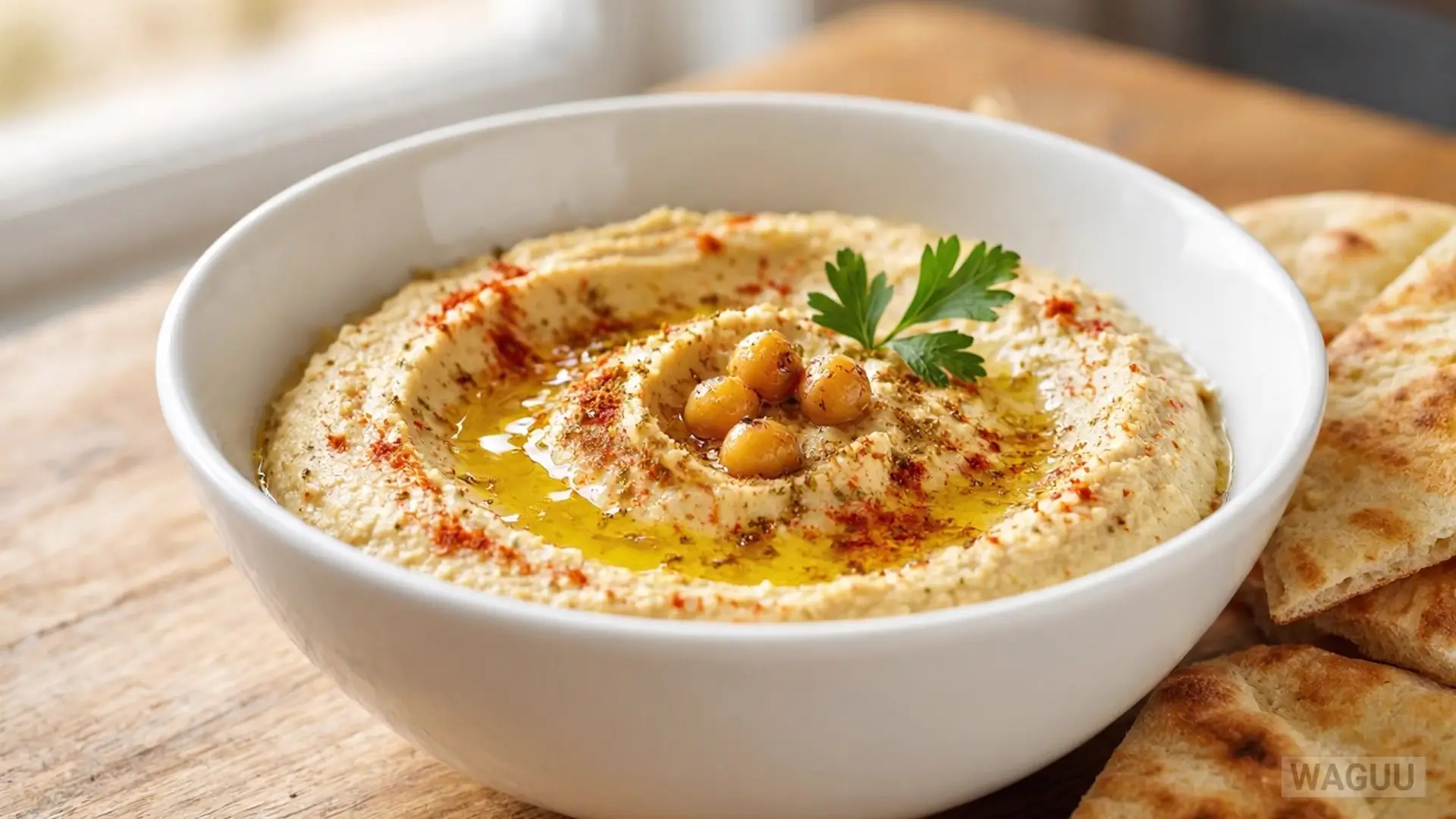
Summary: Hummus – A creamy dip made from chickpeas, tahini, lemon juice, garlic and olive oil, popular in Eastern Mediterranean cuisines. Preparation time: 15 minutes, 6 portions.
Did you cook this recipe? Share the result with the community.
Category: Sauces and Dips, Mediterranean Cuisine
Success rate: not rated yet% of users successfully made this recipe
Quick overview
- Dish: Hummus
- Category: Sauces and Dips, Mediterranean Cuisine
- Cuisine: Eastern Mediterranean
- Main ingredient: Chickpeas, 400 g (premium quality dried or canned)
- Guide: 12 most popular Mediterranean dishes: favourite recipes of Mediterranean cuisine
- Total time: 15 minutes (15 min prep + 0 min cooking)
- Difficulty: Easy
- Portions: 6 portions (Portion weight: 100 g)
- Key technique: Blending
- Preparation types: Cold preparation
- Dietary info & Allergens: Sesame (tahini), vegan, gluten-free
- Suitable for: Parties, appetizers, healthy snacking
- Nutritional values (per 1 portion): 180 kcal, Protein: 6.0 g, Fat: 10.0 g, Carbohydrates: 15.0 g
- Storage: 4 days in the fridge, 2 months in the freezer
- Pairing: Craft beer, dry white wine, minted lemonade
- In short: Silky smooth and rich Eastern Mediterranean dip made with whipped chickpeas, tahini, and fresh lemon juice.
- Last updated: 2026-03-30
WAGUU says: “The secret to restaurant-quality hummus is adding ice cubes or ice water while blending to whip air into the paste.”
Key facts
| Prep time: | 15 minutes |
| Cooking time: | 0 minutes |
| Temperature: | Room temperature / Chilled |
| Number of portions: | 6 portions |
In a nutshell
Hummus is an iconic Eastern Mediterranean dish cherished for its velvety texture and nutty, savory flavor profile.
Ingredients
Base portions: 6 portions • Portion weight: 100 g
| Ingredient | Amount | Quality |
|---|---|---|
| Chickpeas (cooked or canned) | 400 g | Rinsed and drained |
| Tahini (sesame paste) | 60 g | High-quality, stir-well |
| Lemon juice | 30 ml | Freshly squeezed |
| Garlic | 10 g | 2 cloves, peeled |
| Extra virgin olive oil | 45 ml | Fruity and cold-pressed |
| Ice water | 50 ml | Ice cold |
| Ground cumin | 3 g | Freshly ground |
| Salt | 5 g | Fine sea salt |
Why you will love this recipe
- Incredibly creamy: Whipping with ice water creates an ultra-smooth texture without heaviness.
- Quick and easy: Ready in just 15 minutes using simple pantry staples.
- Nutritiously rich: Packed with plant-based protein, healthy fats, and dietary fiber.
Success guaranteed: Following these precise ratios and blending techniques ensures restaurant-grade smoothness every single time.
Recipe overview
Prep: 15 min | Cooking: 0 min | Difficulty: Easy | Portions: 6 portions | Type: Dip / Appetizer | Origin: Eastern Mediterranean
Detailed instructions
Overall progress: 0% complete
Phase 1: Preparing and Whipping the Tahini – 5 min
Appliances: Food processor
1. Place 60 g of tahini and 30 ml of freshly squeezed lemon juice into the food processor bowl. Process on high speed for 2 minutes until the mixture turns pale, thick, and whipped.
VKB: Visual check: Tahini should expand and become fluffy.
Before moving to the next step:
Ensure the tahini is fully emulsified with the lemon juice before adding the garlic and spices.
Phase 2: Adding Aromatics and Seasoning – 4 min
Appliances: Food processor
2. Add 10 g of peeled garlic cloves, 5 g of fine sea salt, and 3 g of ground cumin into the whipped tahini mixture. Process for another 1 minute until completely smooth and fragrant.
VKB: Scrape down the sides of the bowl with a spatula to ensure uniform incorporation.
Before moving to the next step:
Check that no raw garlic chunks remain visible in the paste.
Phase 3: Incorporating Chickpeas – 3 min
Appliances: Food processor
3. Add half of the 400 g of rinsed and drained chickpeas into the processor bowl. Blend on high speed for 1 minute, then add the remaining chickpeas and process until a thick paste forms.
VKB: The mixture will look thick and somewhat grainy at this stage.
Before moving to the next step:
Ensure all chickpeas are thoroughly crushed before adding liquids.
Phase 4: Whipping with Ice Water – 3 min
Appliances: Food processor
4. With the food processor running continuously, slowly drizzle in 50 ml of ice water. Continue processing for 2 to 3 minutes until the hummus transforms into a silky, light, and exceptionally creamy texture.
VKB: Watch for the color to lighten significantly and the consistency to become velvety.
Required equipment
| Utensil | Ideal size | Alternative | Risk |
|---|---|---|---|
| Food processor | 1.5 l capacity | High-power blender | Motor overheating if overloaded |
| Rubber spatula | Standard size | Wooden spoon | None |
| Serving bowl | Deep shallow plate | Any shallow dish | None |
Shopping list
Nutritional profile
Values per 1 portion (excluding side dishes). Calculated from average nutritional values of ingredients.
| Nutrient | Per 100 g | Per 1 portion | Per 6 portions |
|---|---|---|---|
| Energy | 180.0 kcal | 180.0 kcal | 1080.0 kcal |
| Fat | 10.0 g | 10.0 g | 60.0 g |
| of which saturates | 1.5 g | 1.5 g | 9.0 g |
| Carbohydrates | 15.0 g | 15.0 g | 90.0 g |
| of which sugars | 1.2 g | 1.2 g | 7.2 g |
| Protein | 6.0 g | 6.0 g | 36.0 g |
| Salt | 0.8 g | 0.8 g | 4.8 g |
Reference intake of an average adult (8400 kJ / 2000 kcal).
WAGUU Pro Level
- Pro standard: Verified recipe with precise ratios and visual control points.
- Tip 1: Peel the chickpeas manually if you want an absolute, Michelin-star level of silkiness.
- Tip 2: Always whip the tahini with lemon juice first before introducing the chickpeas; this triggers a chemical aeration reaction.
- Tip 3: Use ice-cold water instead of room-temperature water to create a thermal shock that firms up the fats while trapping air.
- Tip 4: Serve at room temperature, never straight from a cold refrigerator, to fully appreciate the complex nutty aromas.
Scientific background
Hummus relies on the emulsification properties of sesame tahini combined with the starches and proteins of cooked chickpeas. When tahini is whipped vigorously with acidic lemon juice, the proteins denature and trap microscopic air bubbles. Introducing cold water lowers the temperature, stabilizing the oil-in-water emulsion and resulting in a lighter, foam-like yet rich cream.
Fine Dining – Professional techniques
- Plate composition: Swirl the hummus onto a wide shallow bowl using the back of a spoon to create deep wells for pooling olive oil.
- Textural contrasts: Garnish with whole cooked chickpeas, toasted pine nuts, or crispy spiced lamb.
- Temperature contrast: Serve cool hummus alongside warm freshly baked pita bread.
- Aromatic garnishes: Dust generously with vibrant sumac and chopped fresh flat-leaf parsley.
Sensory radar
- Appearance: Pale beige, glossy, artfully swirled with glistening olive oil and colorful toppings.
- Aroma: Rich nutty sesame, sharp fresh lemon, pungent garlic, and earthy cumin.
- Taste: Savory, mildly tangy, creamy, and deeply satisfying with a clean finish.
- Texture: Velvety smooth, whipped, airy, and entirely free of graininess.
Pairing
- BEER: Refreshing wheat beer or crisp pale ale.
- WINE: Dry, mineral-driven Sauvignon Blanc or Assyrtiko.
- NON-ALCOHOLIC: Fresh mint lemonade or iced herbal tea.
Various preparation variants
- Spicy Harissa Hummus: Swirl in a tablespoon of North African harissa paste for a fiery kick.
- Roasted Beetroot Hummus: Blend in one small roasted beet for a vibrant pink color and earthy sweetness.
Allergens and dietary information
Contains: Sesame (tahini) • Gluten: Naturally gluten-free • Not suitable for: Sesame allergy sufferers
Suitable for
Parties, festive gatherings, vegan diets, healthy snacks, and Mediterranean feasts.
Substitution catalog
- Tahini: Sunflower seed butter (for sesame allergies)
FAQ
Why do I need to whip tahini with lemon juice first?
Whipping tahini and lemon juice together before adding chickpeas aerates the sesame paste, creating a lighter and creamier final texture.
Should I use canned or dried chickpeas?
Canned chickpeas work wonderfully for a quick 15-minute preparation, provided they are thoroughly rinsed and drained.
Can I freeze hummus?
Yes, hummus can be frozen for up to 2 months in an airtight container with a thin layer of olive oil on top.
How do I make my hummus ultra-smooth?
Using ice-cold water while blending and processing for a full 3 to 5 minutes guarantees an exceptionally velvety texture.
WAGUU Petr advises: Cooking for 12 or more people?
12–16 people: Double all quantities and blend in two separate batches to avoid overloading your food processor motor. • 20+ people: Prepare in multiple batches and store in shallow containers in the refrigerator until ready to plate.
Sides and Serving
- Fresh Pita Bread – Warm, soft flatbread perfect for scooping (not included in the recipe)
- Crisp Crudités – Fresh cucumber, carrot, and bell pepper sticks (not included in the recipe)
Serving: Serve in a shallow bowl with a generous pool of extra virgin olive oil, a dusting of sumac, and fresh herbs.
Storage and reheating
Fridge: 4 days • Freezer: 2 months • Reheating: Serve chilled or at room temperature; reheating is not recommended.
Author: WAGUU Petr & Team • Published: 26 Aug 2026 • Updated: 31 Oct 2026
More Recipes from This Article
Other recipes you might be interested in
Why WAGUU?
Recipes on WAGUU undergo checks for the accuracy of ingredients, procedures, and nutritional values.
Process photo gallery
Community photos: Cook, take a photo, and share the result.
You can upload photos in the comments below or send them via email.
Did you record a video guide for our recipe? Insert a link to YouTube, YouTube Shorts, TikTok, Instagram Reels, Facebook Reels, Pinterest, Vimeo, or X (Twitter) in the comment – we’d be happy to publish it and help promote you and your content.
Common mistakes
- Skipping tahini whipping – Failing to whip tahini with lemon juice beforehand leaves the texture dense and heavy.
- Using room temperature or warm water – Ice water is essential for the thermal emulsion and achieving an airy consistency.
- Overprocessing garlic – Adding raw garlic too late or too early can result in an overpowering, sharp bite.
- Serving straight from the fridge – Cold temperature mutes the delicate aromas; always serve at room temperature.