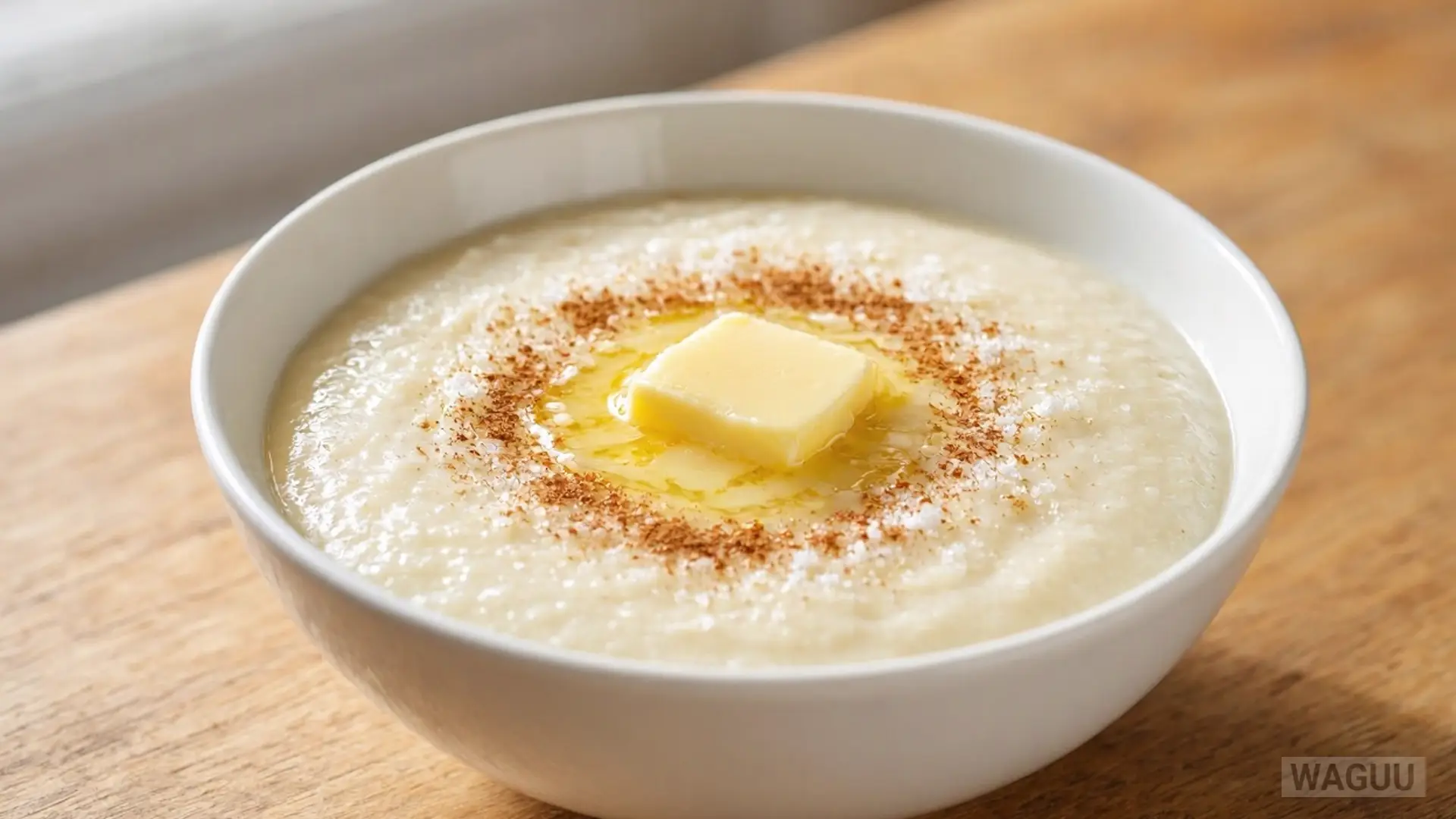
Summary: Norwegian thick porridge made from sour cream, flour, and milk, traditionally served with butter, cinnamon, and sugar – Rich sour cream base, simmered with flour and milk, 45 minutes total preparation time, yields 6 servings.
Did you make this recipe? Share the result with the community.
Category: Main Dishes, Scandinavian Cuisine
Success rate: not rated yet% of users successfully made this recipe
Quick overview
- Dish: Norwegian thick porridge made from sour cream, flour, and milk, traditionally served with butter, cinnamon, and sugar
- Category: Main Dishes, Scandinavian Cuisine
- Cuisine: Norwegian
- Main ingredient: Full-fat sour cream, 32 oz (heavy and rich culture)
- Guide: 12 Most Popular Scandinavian Dishes: Favorite Recipes of Scandinavian Cuisine
- Total time: 45 minutes (15 min prep + 30 min cooking)
- Difficulty: Intermediate
- Servings: 6 servings (Serving weight: 240 g)
- Key technique: Fat separation and gradual flour incorporation
- Preparation types: Simmering, whisking, butter separation
- Dietary info & Allergens: Contains dairy and gluten
- Suitable for: Festive occasions, traditional Norwegian dinners, winter gatherings
- Nutritional values (per 1 serving): 540 kcal, Protein: 8.5 g, Fat: 48.0 g, Carbs: 21.0 g
- Storage: 3 days in the fridge, 2 months in the freezer
- Pairing: Cold milk, aquavit, apple cider
- In a nutshell: An authentic Norwegian comfort dish featuring separated butter swimming over a velvety, rich sour cream and milk porridge, finished with aromatic cinnamon and sugar.
- Last updated: 2025-05-15
WAGUU says: “The secret to a traditional Norwegian thick porridge lies in letting the sour cream simmer long enough for the pure butterfat to separate completely before you even think about adding the flour.”
Key facts
| Prep time: | 15 minutes |
| Cooking time: | 30 minutes |
| Temperature: | Medium-low simmer (200 °F / 93 °C) |
| Number of servings: | 6 servings |
In a nutshell
Embrace the deep traditions of Norway with this classic, velvety porridge made from high-fat sour cream, gently simmered until golden butterfat beads on top, then thickened with flour and enriched with warm milk.
Ingredients
Base servings: 6 servings • Serving weight: 240 g
| Ingredient | Quantity | Quality |
|---|---|---|
| Full-fat sour cream | 32 oz | At least 30% butterfat content |
| All-purpose flour | 1.25 cups | Sifted for smoothness |
| Whole milk | 2 cups | Warmed slightly |
| Fine sea salt | 0.75 tsp | Pure mineral salt |
| Granulated sugar | 3 tbsp | For dusting and seasoning |
| Ground cinnamon | 1.5 tbsp | Freshly ground aromatic cinnamon |
| Unsalted butter | 3 tbsp | Melted for serving |
Why you’ll love this recipe
- Authentic heritage flavor: Experience a revered Norwegian masterpiece that has warmed Nordic homes for centuries.
- Luxurious texture: The combination of separated cream butterfat and velvety milk creates a uniquely rich mouthfeel.
- Simple yet rewarding technique: Master the traditional fat-separation method with clear, step-by-step guidance.
Success guaranteed: Follow the precise temperature cues and fat-skimming steps to achieve restaurant-quality results every single time.
Recipe overview
Prep: 15 min | Cooking: 30 min | Difficulty: Intermediate | Servings: 6 servings | Type: Main Dishes | Origin: Norwegian
Detailed instructions
Overall progress: 0% completed
Phase 1: Initial Sour Cream Simmering and Fat Separation – 15 min
Appliances: Heavy-bottomed saucepan, stove
1. Pour 32 oz of full-fat sour cream into a heavy-bottomed saucepan and set over medium-low heat. Bring the sour cream to a gentle simmer without scorching, stirring occasionally to maintain an even temperature.
CP: The sour cream is lightly bubbling and small pools of golden butterfat begin to form on the surface.
Before moving to the next step:
Ensure the heat is kept moderate so the dairy proteins do not burn at the bottom of the pan.
Phase 2: Skimming Excess Butterfat – 5 min
Appliances: Ladle, small heatproof bowl
2. Allow the sour cream to simmer undisturbed for about 8 to 10 minutes until a significant layer of golden butter separates on top. Carefully use a ladle to skim off most of this excess butterfat, transferring it to a small bowl to be used later for drizzling over the finished bowls.
CP: A clear layer of rich yellow butterfat has been successfully removed and reserved.
Before moving to the next step:
Leave a small amount of fat in the pan so the porridge maintains its rich texture when flour is whisked in.
Phase 3: Incorporating Flour and Whisking Smooth – 5 min
Appliances: Wire whisk, flour sifter
3. Sift 1.25 cups of all-purpose flour gradually over the simmering sour cream base while whisking vigorously to prevent any lumps from forming. Whisk continuously for 3 minutes until the mixture thickens into a heavy, glossy paste.
CP: The mixture is completely smooth, thick, and free of flour clumps.
Before moving to the next step:
Cook out the raw flour taste by stirring constantly over medium-low heat.
Phase 4: Adding Warm Milk and Seasoning – 10 min
Appliances: Whisk, measuring cup
4. Slowly pour in 2 cups of warmed whole milk in a thin stream while whisking briskly. Add 0.75 tsp of fine sea salt. Let the porridge simmer gently on low heat for another 5 minutes, stirring frequently with a wooden spoon until it achieves a thick, velvety consistency.
CP: The porridge coats the back of a spoon thickly and has a uniform, glossy appearance.
Before moving to the next step:
Ensure the milk is warm before adding it to prevent sudden temperature drops that can cause graininess.
Phase 5: Final Adjustments and Resting – 5 min
Appliances: Wooden spoon
5. Remove the saucepan from the heat source. Taste the porridge and adjust the seasoning with a tiny pinch of salt if needed. Cover the pot with a lid and let it rest for 3 minutes to allow the starches to fully settle and meld.
CP: The porridge holds its shape beautifully when scooped and has a smooth, rich aroma.
Before moving to the next step:
Do not skip the resting time, as it ensures the flour cooks completely and eliminates any raw taste.
Phase 6: Plating and Topping – 5 min
Appliances: Soup bowls, spoon, sifter
6. Ladle the hot porridge into warm individual bowls. Create a small depression in the center of each serving, pour in a spoonful of the reserved butterfat (or melted unsalted butter), and generously dust with ground cinnamon and granulated sugar.
CP: The butterpool floats attractively in the middle, surrounded by a vibrant dusting of cinnamon and sugar.
Required equipment
| Utensil | Ideal size | Alternative | Risk |
|---|---|---|---|
| Heavy-bottomed saucepan | 3-quart capacity | Enameled cast iron pot | Scorching if heat is too high |
| Wire whisk | 10-inch balloon whisk | Sturdy silicone spatula | Lumps forming if whisking is too slow |
| Soup bowls | 12-oz ceramic bowl | Deep dessert bowls | Quick cooling of the porridge |
Shopping list
Nutrition profile
Values per 1 serving (excluding side dishes). Calculated from average ingredient nutrition values.
| Nutrient | Per 100 g | Per 1 serving | Per 6 servings |
|---|---|---|---|
| Energy | 225.0 kcal | 540.0 kcal | 3240.0 kcal |
| Fat | 20.0 g | 48.0 g | 288.0 g |
| of which saturates | 12.5 g | 30.0 g | 180.0 g |
| Carbohydrates | 8.7 g | 21.0 g | 126.0 g |
| of which sugars | 3.3 g | 8.0 g | 48.0 g |
| Protein | 3.5 g | 8.5 g | 51.0 g |
| Salt | 0.3 g | 0.7 g | 4.2 g |
Reference intake of an average adult (8400 kJ / 2000 kcal).
WAGUU Pro level
- Pro standard: Verified recipe with precise ratios and visual checkpoints.
- Tip 1: Always use high-fat sour cream (at least 30%) to ensure proper fat separation. Low-fat varieties will curdle and fail.
- Tip 2: Whisk the flour in steadily while keeping the heat low to avoid lumps and achieve a silky paste.
- Tip 3: Warming the milk before adding it prevents thermal shock and keeps the porridge texture completely uniform.
- Tip 4: Serve immediately in warm bowls so the butter pool stays liquid and rich.
Scientific background
Heating cultured cream destabilizes the milk fat globule membranes, allowing free lipids to coalesce and separate as liquid butterfat. Adding wheat flour introduces starches that gelatinize in the remaining aqueous phase, creating a stable, high-viscosity suspension that holds its rich structure without breaking.
Fine Dining – Professional techniques
- Plate composition: Serve in matte white ceramic bowls to highlight the golden butter pool against the ivory porridge.
- Texture contrasts: Smooth velvety porridge contrasted with the gentle crunch of granulated sugar on top.
- Temperature contrast: Piping hot porridge topped with cool cinnamon and sparkling sugar crystals.
- Aromatic garnishes: Freshly grated Ceylon cinnamon dusted through a fine mesh sifter for an even halo.
Sensory radar
- Appearance: Rich ivory porridge with a glistening golden well of butterfat in the center, crowned with cinnamon and sugar.
- Aroma: Tangy fermented cream, sweet warm dairy, and fragrant woody cinnamon.
- Taste: Decadently rich, pleasantly tangy from the sour cream, balanced with sweet cinnamon notes.
- Texture: Thick, smooth, and velvety with a luxurious mouthcoating richness.
Pairing
- BEER: Traditional Norwegian farmhouse ale or dark stout
- WINE: Off-dry Riesling or sparkling cider
- NON-ALCOHOLIC: Cold fresh whole milk or spiced apple juice
Various preparation methods
- Festive style: Served with cured meats like fenalår on the side for a traditional Norwegian holiday meal.
- Modern sweet style: Garnished with fresh cloudberries or raspberry jam alongside the cinnamon and sugar.
Allergens and dietary information
Contains: Dairy, gluten • Gluten: Contains wheat flour • Not suitable for: Lactose-intolerant individuals, vegans
Suitable for
Festive occasions, winter brunches, traditional Scandinavian celebrations, and comforting family dinners.
Substitution guide
- All-purpose flour: Can be substituted with spelt flour for a nuttier flavor profile.
- Whole milk: Can be replaced with half-and-half for an even richer consistency.
FAQ
Can I use low-fat sour cream for this recipe?
No, low-fat sour cream lacks the necessary butterfat content to separate properly and will curdle when heated.
Why do I need to skim off the butterfat?
Skimming the fat ensures the porridge achieves the correct thickness and lets you pool the pure butter back on top when serving.
How should leftovers be stored?
Store covered in the refrigerator for up to 3 days and reheat gently with a splash of milk.
Can I freeze this porridge?
Freezing is not recommended as the dairy emulsion may separate and alter the smooth texture upon thawing.
WAGUU Petr advises: Cooking for 12 or more people?
12–16 people: Double all ingredient quantities and use a larger 6-quart heavy-bottomed pot • 20+ people: Prepare in two separate batches to maintain precise temperature control and prevent scorching.
Sides and serving
- Fenalår – Cured leg of lamb (not included in the recipe)
- Flatbrød – Traditional crisp flatbread (not included in the recipe)
Serving: Serve hot in individual bowls with a pool of butterfat, cinnamon, and sugar.
Storage and reheating
Fridge: 3 days • Freezer: 2 months • Reheating: Reheat slowly on the stovetop over low heat, whisking in a splash of milk to restore creaminess.
Recipe created by WAGUU culinary team • Published: 2025-05-15
More Recipes in This Article
Guide: 12 Most Popular Scandinavian Dishes: Favorite Recipes of Scandinavian Cuisine
Swedish open-faced sandwich with a rich layer of shrimp, egg, lettuce, lemon, and mayonnaise dressing.
Danish specialty of crispy fried pork belly, served with boiled potatoes and parsley sauce.
Swedish cinnamon rolls made from yeast dough with a buttery cinnamon filling, often sprinkled with pearl sugar and served with coffee.
Other recipes you might enjoy
Why WAGUU?
Recipes on WAGUU undergo checks for ingredient accuracy, procedures, and nutritional values.
Process photo gallery
Community photos: Cook, take a picture, and share your results.
You can upload photos in the comments below or send them via email.
Did you record a video of your process for our recipe? Paste a link to YouTube, YouTube Shorts, TikTok, Instagram Reels, Facebook Reels, Pinterest, Vimeo, or X (Twitter) in the comments – we’d love to share it and help give you and your content more visibility.
norwegian-thick-porridge-made-from-sour-cream-flour-and-milk-us@waguu.online
Common mistakes
- Using low-fat sour cream – Fails to separate butterfat correctly, resulting in a runny, curdled porridge.
- Adding flour too fast – Causes stubborn lumps that are difficult to whisk out smoothly.
- Using cold milk – Creates a thermal shock that breaks the smooth emulsion of the porridge.
- Skipping the resting time – Leaves a raw flour taste that detracts from the rich, traditional flavor.