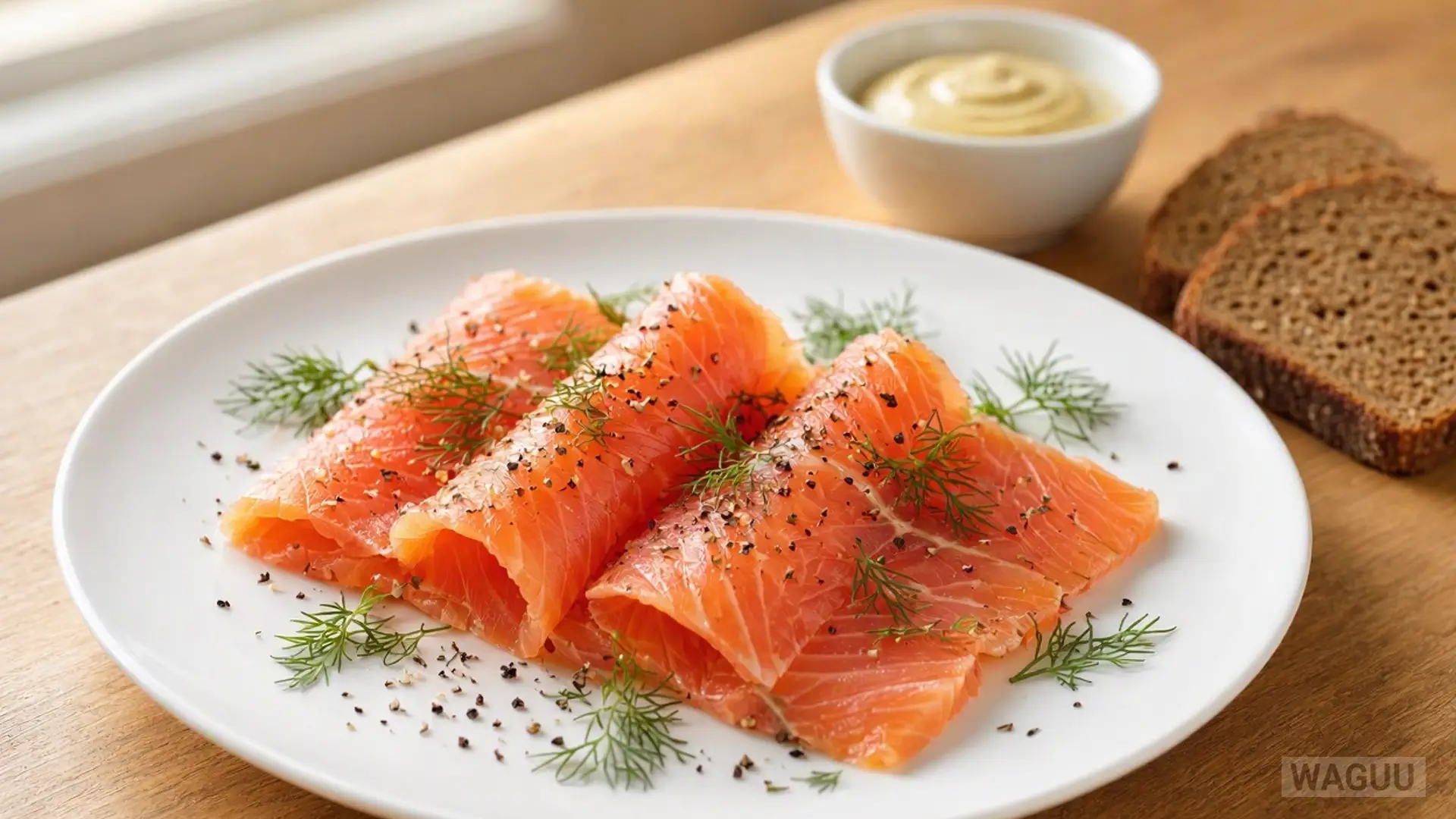
Summary: Scandinavian salmon cured in salt, sugar, and dill, sliced thin and served with mustard sauce and bread – Premium fresh salmon fillet cured with coarse sea salt, granulated sugar, fresh dill, and crushed white peppercorns, prepared in 30 minutes of active work plus 48 hours of curing, yielding 6 servings of exquisite Nordic delicacy.
Did you make this recipe? Share the result with the community.
Category: Main Dishes, Scandinavian Cuisine
Success rate: not rated yet% of users successfully made this recipe
Quick overview
- Dish: Scandinavian salmon cured in salt, sugar, and dill, sliced thin and served with mustard sauce and bread
- Category: Main Dishes, Scandinavian Cuisine
- Cuisine: Scandinavian
- Main ingredient: Fresh salmon fillet, 2.0 lb (sashimi-grade, skin-on)
- Guide: 12 Most Popular Scandinavian Dishes: Favorite Recipes of Scandinavian Cuisine
- Total time: 2910 minutes (30 min prep + 2880 min curing)
- Difficulty: Easy
- Servings: 6 servings (Serving weight: 220 g)
- Key technique: Dry curing and delicate slicing
- Preparation types: Curing, whisking, slicing
- Dietary info & Allergens: Contains fish, mustard, gluten (in bread), dairy (none)
- Suitable for: Festive dinners, holiday buffets, elegant appetizers
- Nutritional values (per 1 serving): 345 kcal, Protein: 28.5 g, Fat: 16.2 g, Carbs: 21.4 g
- Storage: 3 days in the fridge, 2 months in the freezer
- Pairing: Aquavit pale ale, dry crisp Riesling, iced sparkling water with lemon
- In a nutshell: Luxuriously silky cured salmon infused with fragrant fresh dill and sweet mustard sauce.
- Last updated: October 24, 2023
WAGUU says: “Mastering the art of dry-curing salmon transforms simple ingredients into an extraordinary culinary masterpiece of Nordic heritage.”
Key facts
| Prep time: | 30 minutes |
| Cooking time: | 48 hours (curing) |
| Temperature: | 38 °F (refrigerated) |
| Number of servings: | 6 servings |
In a nutshell
Experience the pure elegance of traditional Scandinavian gastronomy with this delicately cured salmon. Coated in a fragrant mixture of sea salt, sugar, crushed white peppercorns, and an abundance of fresh dill, the fish transforms over 48 hours into a buttery, melt-in-your-mouth delicacy. Paired with a zesty, sweet dill-mustard sauce and artisan dark rye bread, every bite delivers a harmonious balance of rich maritime flavor and aromatic herbs.
Ingredients
Base servings: 6 servings • Serving weight: 220 g
| Ingredient | Quantity | Quality |
|---|---|---|
| Fresh salmon fillet | 2.0 lb | Sashimi-grade, center-cut, skin-on, scaled and pin-bones removed |
| Coarse sea salt | 0.33 cup | High-grade coarse sea salt for proper osmotic draw |
| Granulated sugar | 0.33 cup | Pure white cane sugar to balance salinity |
| Fresh dill | 2.0 bunches | Vibrant green, freshly chopped with tender stems |
| Whole white peppercorns | 1.0 tbsp | Coarsely crushed in a mortar |
| Dijon mustard | 0.25 cup | Smooth, premium quality |
| Swedish yellow mustard | 2.0 tbsp | Slightly sweet traditional mustard |
| Granulated sugar (for sauce) | 2.0 tbsp | Fine white sugar |
| White wine vinegar | 1.5 tbsp | Crisp and clean acidity |
| Neutral vegetable oil | 0.5 cup | Canola or grapeseed oil for emulsification |
| Fresh dill (for sauce) | 0.33 cup | Finely minced fresh dill leaves |
| Salt | 0.5 tsp | Fine table salt for sauce seasoning |
| Artisan rye bread | 6.0 slices | Dense Scandinavian style dark rye bread |
| Unsalted butter | 3.0 tbsp | High-fat European style butter for spreading |
Why you’ll love this recipe
- Exquisite Nordic Flavor: Combines the rich, buttery texture of raw cured salmon with aromatic dill and bold white pepper.
- No Cooking Required: Relies entirely on traditional dry-curing techniques using salt and sugar to transform the fish safely.
- Homemade Mustard Sauce: Features an authentic sweet and tangy mustard-dill emulsion that perfectly complements the rich fish.
Success guaranteed: Follow the precise 48-hour refrigeration and weighting technique to achieve flawlessly firm yet silky cured salmon every single time.
Recipe overview
Prep: 30 min | Cooking: 2880 min | Difficulty: Easy | Servings: 6 | Type: Main course | Origin: Scandinavian
Detailed instructions
Overall progress: 0% completed
Phase 1: Salmon Inspection and Preparation – 10 min
Appliances: Cutting board, chef knife, tweezers
1. Inspect the 2.0 lb fresh salmon fillet for any remaining pin-bones using kitchen tweezers, running your fingers gently along the flesh to detect them. Rinse the fillet briefly under ice-cold running water and pat it completely dry with clean paper towels.
CP: Ensure the fillet is completely dry and free of all pin-bones before proceeding to the cure mixture.
Before moving to the next step:
Verify that the fish surface is entirely dry to allow the salt and sugar cure to adhere evenly without slipping off.
Phase 2: Mixing the Cure Blend – 10 min
Appliances: Mixing bowl, mortar and pestle
2. In a clean mixing bowl, combine 0.33 cup coarse sea salt, 0.33 cup granulated sugar, and 1.0 tbsp coarsely crushed whole white peppercorns. Stir the dry ingredients thoroughly until the mixture is uniform and evenly distributed.
CP: The salt-to-sugar ratio must be balanced equally to draw out moisture without overly dehydrating the fish flesh.
Before moving to the next step:
Ensure the white peppercorns are thoroughly crushed so their aromatic oils integrate smoothly into the cure.
Phase 3: Layering and Wrapping the Salmon – 10 min
Appliances: Plastic wrap, glass baking dish, weights
3. Lay out a large sheet of plastic wrap inside a glass baking dish. Place half of the 2.0 bunches of fresh dill across the plastic wrap. Set the salmon fillet skin-side down on top of the dill bed. Rub the salt and sugar mixture evenly over the flesh side of the salmon. Cover the top of the salmon with the remaining fresh dill. Wrap the plastic wrap tightly around the fish to create a secure, airtight package.
CP: The package must be tightly sealed to prevent liquid leakage during the refrigeration process.
Before moving to the next step:
Check that all surfaces of the salmon flesh are completely covered by the cure and dill before weighting down.
Phase 4: Refrigerated Curing Process – 2880 min
Appliances: Refrigerator, canned goods for weight
4. Place a small cutting board directly on top of the wrapped salmon package and place 2 canned goods or heavy weights on the board to press the fish evenly. Transfer the dish to the refrigerator maintained at 38 °F and let the salmon cure for 48 hours. Turn the package over every 12 hours to redistribute the curing juices evenly across the fillet.
CP: Regular turning ensures uniform salt penetration and firm texture throughout the entire fillet.
Before moving to the next step:
Do not shorten the curing time; 48 hours is essential for proper chemical transformation and safety.
Phase 5: Preparing the Mustard Sauce – 15 min
Appliances: Whisk, mixing bowl
5. While the salmon finishes curing, prepare the traditional mustard sauce. In a medium mixing bowl, whisk together 0.25 cup Dijon mustard, 2.0 tbsp Swedish yellow mustard, 2.0 tbsp granulated sugar, 1.5 tbsp white wine vinegar, and 0.5 tsp salt. While continuously whisking vigorously, slowly drizzle in 0.5 cup neutral vegetable oil until a thick, glossy emulsion forms. Stir in 0.33 cup finely minced fresh dill and refrigerate the sauce until serving time.
CP: Drizzle the oil in a slow, steady stream to prevent the emulsion from breaking.
Before moving to the next step:
Verify that the mustard sauce has achieved a smooth, mayonnaise-like consistency before chilling.
Phase 6: Unwrapping, Slicing, and Serving – 15 min
Appliances: Fillet knife, cutting board, serving platter
6. After 48 hours, unwrap the cured salmon and gently scrape away the excess salt, sugar, and wilted dill using a paper towel or the back of a knife. Rinse the salmon briefly under ice-cold water if desired, then pat completely dry. Using a long, flexible slicing knife held at a 45-degree angle, slice the salmon paper-thin away from the skin. Serve the sliced salmon immediately accompanied by the chilled mustard sauce, 6.0 slices of artisan rye bread, and 3.0 tbsp unsalted butter.
CP: Slice at a shallow angle to produce wide, translucent ribbons of cured salmon.
Required equipment
| Utensil | Ideal size | Alternative | Risk |
|---|---|---|---|
| Glass baking dish | 9×13 inches | Stainless steel tray | Corrosion if using reactive metals |
| Fillet knife | 10 inches flexible | Long carving knife | Ragged slices if dull |
| Kitchen tweezers | Standard size | Clean needle-nose pliers | Tearing the delicate fish flesh |
Shopping list
Nutrition profile
Values per 1 serving (excluding side dishes). Calculated from average ingredient nutrition values.
| Nutrient | Per 100 g | Per 1 serving | Per 6 servings |
|---|---|---|---|
| Energy | 156.8 kcal | 345.0 kcal | 2070.0 kcal |
| Fat | 7.4 g | 16.2 g | 97.2 g |
| of which saturates | 1.8 g | 3.9 g | 23.4 g |
| Carbohydrates | 9.7 g | 21.4 g | 128.4 g |
| of which sugars | 6.2 g | 13.6 g | 81.6 g |
| Protein | 13.0 g | 28.5 g | 171.0 g |
| Salt | 1.1 g | 2.4 g | 14.4 g |
Reference intake of an average adult (8400 kJ / 2000 kcal).
WAGUU Pro level
- Pro standard: Verified recipe with precise ratios and visual checkpoints.
- Tip 1: Always select the thickest center-cut portion of the salmon fillet for even curing and beautiful wide slices.
- Tip 2: Freeze the fresh salmon for 24 hours prior to curing if you have any concerns regarding wild parasites.
- Tip 3: Use a razor-sharp, long slicing knife and wipe the blade with a damp towel between every single cut.
- Tip 4: Let the mustard sauce rest in the refrigerator for at least 4 hours before serving to allow the flavors to meld.
Scientific background
Dry curing relies on the principle of osmosis. When salt and sugar are applied to raw fish muscle, the hypertonic environment draws out intracellular moisture through the cell membranes. This reduction in water activity inhibits bacterial proliferation while concentrating the natural proteins and fats of the fish. Simultaneously, the salt denatures the muscle proteins slightly, firming the texture into a silky, translucent delicacy.
Fine Dining – Professional techniques
- Plate composition: Fan translucent ribbons of gravlax over buttered dark rye bread, garnished with fresh dill sprigs and a quenelle of mustard sauce.
- Texture contrasts: The silky, tender mouthfeel of the cured fish contrasts brilliantly with the dense, chewy crumb of artisan rye bread.
- Temperature contrast: Serve the gravlax straight from refrigerator temperature while keeping the bread at room temperature.
- Aromatic garnishes: Finish with freshly cracked white peppercorns and finely minced dill just before presenting to the table.
Sensory radar
- Appearance: Translucent, deep coral-pink flesh with vibrant green dill specks and a glossy finish.
- Aroma: Clean oceanic freshness complemented by pungent dill and sweet mustard notes.
- Taste: Perfectly balanced salinity and sweetness with rich fish umami and herbal notes.
- Texture: Silky, dense, and luxuriously melting on the palate.
Pairing
- BEER: Aquavit-infused pale ale or traditional Scandinavian pilsner
- WINE: Dry, crisp German Riesling or Austrian Grüner Veltliner
- NON-ALCOHOLIC: Iced sparkling water infused with fresh cucumber and lemon slices
Various preparation methods
- Aquavit Gravlax: Add 2.0 tbsp of Scandinavian Aquavit spirit to the salt and sugar cure mixture for botanical depth.
- Beet-Stained Gravlax: Grate 1 cup of raw red beets into the cure mixture to impart a vibrant ruby-red exterior to the salmon.
Allergens and dietary information
Contains: Fish, mustard, gluten • Gluten: Contains gluten from rye bread (can be omitted) • Not suitable for: Fish allergies
Suitable for
Festive dinners, holiday buffets, elegant appetizers, cocktail parties
Substitution guide
- White peppercorns: Replace with freshly cracked black peppercorns if white pepper is unavailable.
- Rye bread: Substitute with pumpernickel or sourdough crackers.
FAQ
Do I need to cook the salmon before curing?
No, traditional gravlax is never heat-cooked. The combination of salt, sugar, and refrigeration cures the raw fish safely through osmotic pressure.
Can I use frozen salmon for this recipe?
Yes, as long as it has been thoroughly thawed and patted completely dry before applying the cure.
How long does cured salmon keep in the refrigerator?
Once cured and unwrapped, store it tightly wrapped in plastic wrap in the coldest part of the fridge for up to 3 days.
Why do I need to weight down the salmon while curing?
The weight helps press the cure into intimate contact with the flesh and accelerates the extraction of moisture.
WAGUU Petr advises: Cooking for 12 or more people?
12–16 people: Prepare two separate 2.0 lb salmon fillets in individual dishes to ensure even weight distribution and curing • 20+ people: Slice the salmon ahead of time and arrange neatly on platters lined with parchment paper, covering tightly with plastic wrap until service.
Sides and serving
- Boiled baby potatoes – Tossed with butter and fresh dill (not included in the recipe)
- Pickled cucumbers – Crisp sliced cucumbers with vinegar and dill (not included in the recipe)
Serving: Serve chilled on buttered artisan rye bread with mustard sauce drizzled over top.
Storage and reheating
Fridge: 3 days • Freezer: 2 months • Reheating: Do not heat; serve cold.
Author: WAGUU Petr & Team • Published: 26 Aug 2026 • Updated: 31 Oct 2026
More Recipes in This Article
Guide: 12 Most Popular Scandinavian Dishes: Favorite Recipes of Scandinavian Cuisine
Danish specialty of crispy fried pork belly, served with boiled potatoes and parsley sauce.
Other recipes you might enjoy
Why WAGUU?
Recipes on WAGUU undergo checks for ingredient accuracy, procedures, and nutritional values.
Process photo gallery
Community photos: Cook, take a picture, and share your results.
You can upload photos in the comments below or send them via email.
Did you record a video of your process for our recipe? Paste a link to YouTube, YouTube Shorts, TikTok, Instagram Reels, Facebook Reels, Pinterest, Vimeo, or X (Twitter) in the comments – we’d love to share it and help give you and your content more visibility.
scandinavian-salmon-cured-in-salt-sugar-and-dill-sliced-thin-us@waguu.online
Common mistakes
- Insufficient Curing Time – Removing the salmon from the refrigerator before the full 48 hours results in an under-cured, overly soft texture.
- Skipping Pin-Bone Removal – Leaving tiny bones in the fillet ruins the luxurious melt-in-your-mouth texture when slicing.
- Incorrect Slicing Angle – Cutting perpendicular to the skin instead of at a shallow 45-degree angle produces thick, clumsy chunks instead of delicate ribbons.
- Broken Mustard Emulsion – Pouring the vegetable oil too quickly into the mustard mixture causes the sauce to separate.