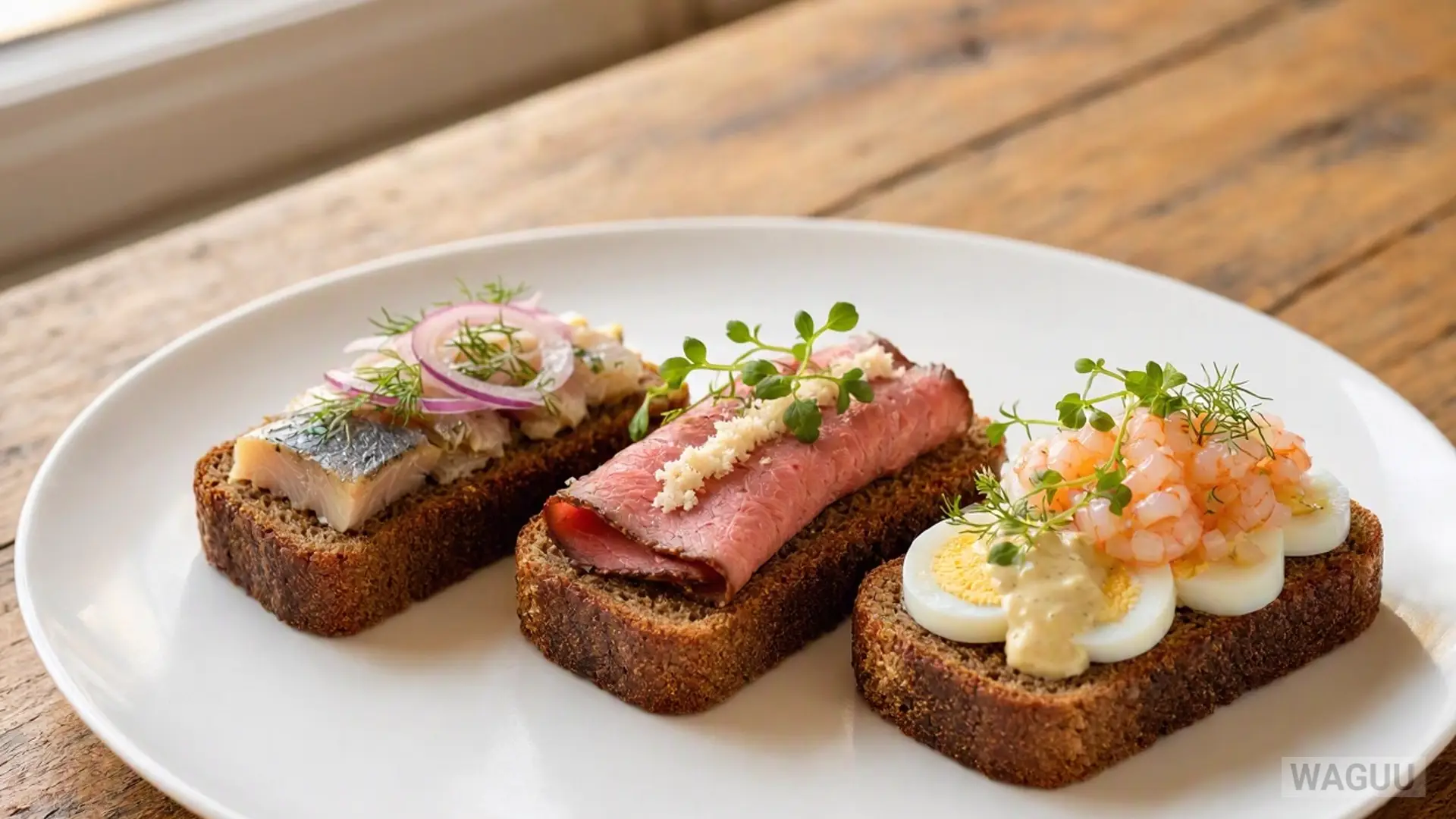
Summary: Authentic Danish open-faced rye sandwiches with various combinations of ingredients, such as pickled herring, roast beef, egg, shrimp, or remoulade – featuring dense dark rye bread, sliced meats, seafood, herbs, and condiments, prepared in 25 minutes plus assembly, yielding 6 servings.
Did you make this recipe? Share the result with the community.
Category: Appetizers, Scandinavian Cuisine
Success rate: not rated yet% of users successfully made this recipe
Quick overview
- Dish: Smørrebrød (Danish open-faced rye sandwiches with various combinations of ingredients, such as pickled herring, roast beef, egg, shrimp, or remoulade)
- Category: Appetizers, Scandinavian Cuisine
- Cuisine: Danish
- Main ingredient: dark rye bread, 12 oz (high-density sourdough)
- Guide: 12 Most Popular Scandinavian Dishes: Favorite Recipes of Scandinavian Cuisine
- Total time: 25 minutes (20 min prep + 5 min cooking)
- Difficulty: Easy
- Servings: 6 servings (Serving weight: 220 g)
- Key technique: Artisanal layering and curing
- Preparation types: Slicing, boiling, layering, pickling
- Dietary info & Allergens: Contains gluten, fish, crustaceans, eggs, mustard, dairy
- Suitable for: Lunch, festive gatherings, traditional gatherings, party food
- Nutritional values (per 1 serving): 340 kcal, Protein: 16.5 g, Fat: 18.2 g, Carbs: 28.4 g
- Storage: 2 days in the fridge, 0 months in the freezer
- Pairing: Aquavit, Danish pilsner beer, iced elderflower cordial
- In a nutshell: Iconic Danish open-faced rye sandwiches layered meticulously with pickled herring, roast beef, hard-boiled eggs, tender shrimp, and rich remoulade, offering a symphony of Nordic textures and flavors.
- Last updated: 2026-03-30
WAGUU says: “The secret to authentic Danish smørrebrød lies in the quality of the dark rye bread and the careful height balance of toppings.”
Key facts
| Prep time: | 20 minutes |
| Cooking time: | 5 minutes |
| Temperature: | Chilled and room temperature |
| Number of servings: | 6 servings |
In a nutshell
Experience the culinary heritage of Denmark with traditional open-faced sandwiches built on dense, nutrient-rich rye bread and crowned with classic toppings like cured herring, savory roast beef, delicate shrimp, and creamy remoulade.
Ingredients
Base servings: 6 servings • Serving weight: 220 g
| Ingredient | Quantity | Quality |
|---|---|---|
| dark rye bread (rugbrød) | 6 slices | dense, sourdough, seeded |
| unsalted butter | 3 tbsp | softened at room temperature |
| pickled herring fillets | 6 oz | marinated in spiced vinegar |
| roast beef | 6 oz | thinly sliced, medium-rare |
| large eggs | 3 whole | fresh, hard-boiled |
| small fjord shrimp | 6 oz | peeled, cooked |
| Danish remoulade | 4 tbsp | traditional yellow remoulade with pickles |
| fresh dill | ½ cup | freshly chopped |
| red onion | 1 medium | thinly sliced into rings |
| lemon | 1 whole | cut into wedges |
| capers | 2 tbsp | drained |
| salt | ½ tsp | fine sea salt |
| black pepper | ¼ tsp | freshly ground |
Why you’ll love this recipe
- Authentic Nordic Tradition: Experience the genuine taste of Denmark with traditional flavor pairings that have been perfected over centuries.
- Visual Masterpiece: Create stunning, colorful plates that look like they belong in a Copenhagen upscale restaurant.
- Nutritional Balance: Combine wholesome fiber-rich rye bread with lean proteins, healthy fats, and fresh herbs.
Success guaranteed: Follow our step-by-step assembly guide for perfectly balanced, restaurant-quality open-faced sandwiches every single time.
Recipe overview
Prep: 20 min | Cooking: 5 min | Difficulty: Easy | Servings: 6 | Type: Appetizer | Origin: Danish
Detailed instructions
Overall progress: 0% completed
Phase 1: Boiling the Eggs – 5 min
Appliances: Stove
1. Place 3 large eggs in a medium saucepan filled with boiling water. Cook for 9 minutes for hard-boiled eggs with creamy yolks. Transfer immediately to an ice water bath to stop the cooking process, then peel and slice them evenly.
CP: Eggs are fully cooked and cooled for clean slicing.
Before moving to the next step:
Ensure the eggs are completely chilled before slicing to prevent the yolks from crumbling.
Phase 2: Preparing the Bread Base – 5 min
Appliances: None
2. Lay out 6 slices of dense dark rye bread (rugbrød) on a clean cutting board. Spread 3 tablespoons of softened unsalted butter evenly across each slice to create a moisture barrier that prevents the bread from getting soggy.
CP: Bread slices are thoroughly and evenly buttered to the edges.
Before moving to the next step:
Verify that butter covers the entire surface of every slice.
Phase 3: Assembling the Herring Sandwich – 5 min
Appliances: None
3. Take two buttered rye slices. Arrange 6 oz of pickled herring fillets neatly on top. Garnish with thin red onion rings, 2 tablespoons of drained capers, and a generous sprinkle of chopped fresh dill.
CP: Herring is evenly distributed with vibrant garnishes on top.
Before moving to the next step:
Check that the herring pieces are securely seated on the buttered bread.
Phase 4: Assembling the Roast Beef Sandwich – 5 min
Appliances: None
4. Take another two buttered rye slices. Fold 6 oz of thinly sliced roast beef into elegant waves and place on the bread. Top with 4 tablespoons of Danish remoulade, a pinch of salt, and freshly ground black pepper.
CP: Roast beef has a voluminous, appealing fold with neat dollops of remoulade.
Before moving to the next step:
Ensure the remoulade is neatly portioned over the roast beef.
Phase 5: Assembling the Egg and Shrimp Sandwich – 5 min
Appliances: None
5. On the final two buttered rye slices, arrange the sliced hard-boiled eggs in an overlapping layer. Mound 6 oz of small fjord shrimp generously over the eggs. Garnish with remaining fresh dill and lemon wedges.
CP: Shrimp and egg layers are balanced and beautifully presented.
Before moving to the next step:
Confirm all three sandwich varieties are fully assembled and ready for final plating.
Phase 6: Final Plating and Serving – 5 min
Appliances: None
6. Arrange the completed smørrebrød varieties on a large serving platter. Serve immediately alongside chilled aquavit or Danish pilsner beer, ensuring guests have proper cutlery to enjoy the open-faced creations.
CP: Platter is garnished attractively and ready for presentation.
Required equipment
| Utensil | Ideal size | Alternative | Risk |
|---|---|---|---|
| Saucepan | 2-quart | Small pot | Boiling overflow |
| Chef’s knife | 8-inch | Utility knife | Uneven slices |
| Cutting board | 12×18 inches | Wooden board | Cross contamination |
Shopping list
Nutrition profile
Values per 1 serving (excluding side dishes). Calculated from average ingredient nutrition values.
| Nutrient | Per 100 g | Per 1 serving | Per 6 servings |
|---|---|---|---|
| Energy | 154.5 kcal | 340.0 kcal | 2040.0 kcal |
| Fat | 8.3 g | 18.2 g | 109.2 g |
| of which saturates | 4.1 g | 9.0 g | 54.0 g |
| Carbohydrates | 12.9 g | 28.4 g | 170.4 g |
| of which sugars | 2.1 g | 4.6 g | 27.6 g |
| Protein | 7.5 g | 16.5 g | 99.0 g |
| Salt | 1.1 g | 2.4 g | 14.4 g |
Reference intake of an average adult (8400 kJ / 2000 kcal).
WAGUU Pro level
- Pro standard: Verified recipe with precise ratios and visual checkpoints.
- Tip 1: Always butter the bread thoroughly all the way to the crust edges to form a moisture barrier against wet toppings.
- Tip 2: Use dense, authentic Danish rye bread (rugbrød) containing whole rye kernels for genuine texture and flavor.
- Tip 3: Layer ingredients thoughtfully so flavors complement rather than overpower one another.
- Tip 4: Serve immediately after assembly to maintain the crispness of the bread and freshness of the garnishes.
Scientific background
The tradition of smørrebrød relies on the fat barrier provided by butter, which prevents water-soluble compounds in pickled fish and meats from migrating into the dense rye crumb, preserving structural integrity and preventing sogginess.
Fine Dining – Professional techniques
- Plate composition: Asymmetric arrangement on slate or white porcelain highlighting vibrant natural colors.
- Texture contrasts: Combining dense chewy bread, creamy remoulade, crisp onions, and tender fish.
- Temperature contrast: Room temperature bread paired with chilled toppings and cold pickled herring.
- Aromatic garnishes: Precise placement of fresh dill fronds and capers for visual height and sharp aroma.
Sensory radar
- Appearance: Colorful, layered, and meticulously garnished open-faced presentation
- Aroma: Rich fermented rye, fresh dill, savory roast beef, and spiced pickled fish
- Taste: Complex blend of savory, tangy, briny, and subtly sweet flavor notes
- Texture: Dense crumb, tender meats, snappy shrimp, and creamy toppings
Pairing
- BEER: Chilled Danish pilsner or dark bock beer
- WINE: Crisp dry white wine such as Grüner Veltliner
- NON-ALCOHOLIC: Iced elderflower cordial or sparkling mineral water with lemon
Various preparation methods
- Vegetarian Smørrebrød: Replace meats and fish with sliced marinated beets, creamy goat cheese, walnuts, and watercress.
- Smoked Salmon Variation: Substitute pickled herring with cold-smoked salmon, horseradish cream, and cucumber ribbons.
Allergens and dietary information
Contains: Gluten, fish, crustaceans, eggs, mustard, dairy • Gluten: Contains rye gluten • Not suitable for: Celiac disease, vegan, lactose intolerance
Suitable for
Lunch, festive gatherings, traditional gatherings, party food
Substitution guide
- Dark rye bread: Pumpernickel or dense sourdough bread
- Danish remoulade: Tartar sauce mixed with a touch of Dijon mustard
FAQ
What is the purpose of buttering the rye bread?
Butter creates a moisture barrier that stops wet ingredients from making the dense rye bread soggy.
Can I make smørrebrød in advance?
It is best assembled just before serving to maintain bread texture and garnish freshness.
What kind of bread is traditional?
Traditional Danish rugbrød, a dark, dense sourdough rye bread packed with whole grains and seeds.
How do you properly eat smørrebrød?
They are eaten with a knife and fork rather than picked up by hand due to their rich toppings.
WAGUU Petr advises: Cooking for 12 or more people?
12–16 people: Double all ingredient quantities and set up a smørrebrød assembly station so guests can build their own. • 20+ people: Prepare pre-cut half-slice portions to allow guests to sample multiple varieties easily.
Sides and serving
- Chilled Aquavit – Traditional Nordic spirit (not included in the recipe)
- Pickled cucumber slices – Tangy crunchy garnish (not included in the recipe)
Serving: Serve plated on flat ceramic dishes with knife and fork provided.
Storage and reheating
Fridge: 2 days • Freezer: 0 months • Reheating: Serve cold or at room temperature; do not reheat.
Author: WAGUU Petr & Team • Published: 26 Aug 2026 • Updated: 31 Oct 2026
More Recipes in This Article
Guide: 12 Most Popular Scandinavian Dishes: Favorite Recipes of Scandinavian Cuisine
Danish specialty of crispy fried pork belly, served with boiled potatoes and parsley sauce.
Other recipes you might enjoy
Why WAGUU?
Recipes on WAGUU undergo checks for ingredient accuracy, procedures, and nutritional values.
Process photo gallery
Community photos: Cook, take a picture, and share your results.
You can upload photos in the comments below or send them via email.
Did you record a video of your process for our recipe? Paste a link to YouTube, YouTube Shorts, TikTok, Instagram Reels, Facebook Reels, Pinterest, Vimeo, or X (Twitter) in the comments – we’d love to share it and help give you and your content more visibility.
danish-open-faced-rye-sandwiches-with-various-combinations-o-us@waguu.online
Common mistakes
- Skipping the butter layer – Leads to soggy bread from wet toppings and dressings.
- Using soft white bread – Fails to provide the necessary sturdy foundation and dense flavor profile.
- Overcrowding the toppings – Results in unstable sandwiches that collapse upon cutting.
- Incorrect boiling time for eggs – Causes dry, chalky yolks instead of creamy textures.