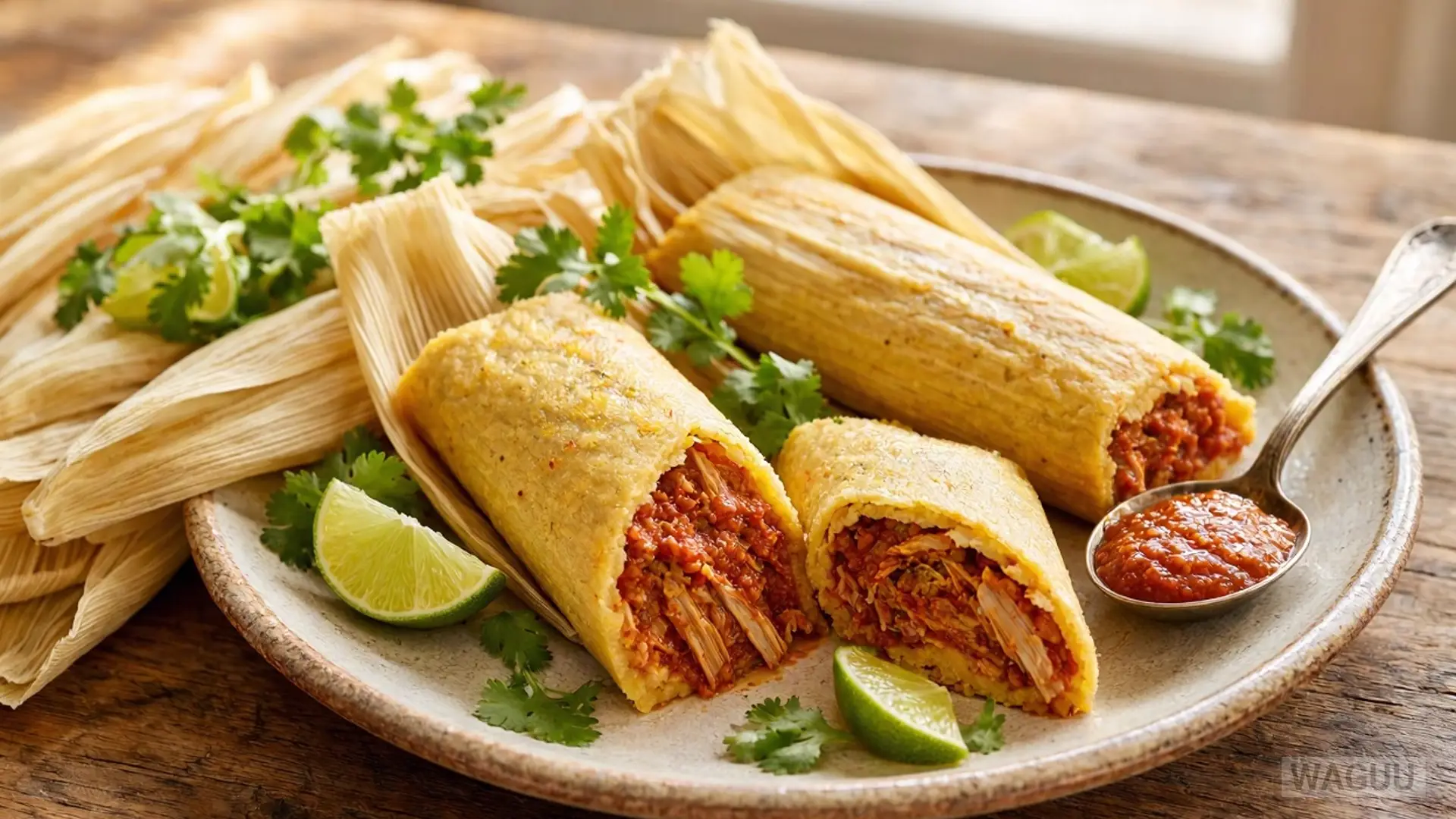
Summary: Authentic Mexican tamales made with freshly prepared nixtamalized corn masa dough, filled with tender shredded pork shoulder simmered in a rich, smoky guajillo and ancho chilli sauce, wrapped in softened corn husks, and gently steam-cooked until light and fluffy. Preparation time: 180 minutes. Number of portions: 6.
Did you cook this recipe? Share the result with the community.
Category: Mexican Cuisine, Main Dishes
Success rate: not rated yet% of users successfully made this recipe
Quick overview
- Dish: Tamales
- Category: Mexican Cuisine, Main Dishes
- Cuisine: Mexican
- Main ingredient: Masa harina, 800 g (premium finely ground corn flour)
- Guide: 12 most popular Mexican dishes: favourite Mexican cuisine recipes
- Total time: 180 minutes (120 min prep + 60 min cooking)
- Difficulty: Advanced
- Portions: 6 portions (Portion weight: 320 g)
- Key technique: Steaming in corn husks
- Preparation types: Simmering, whipping, wrapping, steaming
- Dietary info & Allergens: Gluten-free, lactose-free
- Suitable for: Festive occasions, traditional family dinners, weekend gatherings
- Nutritional values (per 1 portion): 620 kcal, Protein: 28 g, Fat: 22 g, Carbohydrates: 76 g
- Storage: 4 days in the fridge, 3 months in the freezer
- Pairing: Mexican amber lager, chilled hibiscus water (Agua de Jamaica), citrus soda
- In short: Classic Mexican comfort food featuring spiced pork wrapped in corn masa and husks.
- Last updated: 2025-01-15
WAGUU says: “Mastering tamales is a culinary milestone. Take your time whipping the lard and broth into the masa until it floats in water to guarantee light, pillow-soft results.”
How to take it further: Warm the 26 cm plate, plate the portion in the centre with a clean rim; put a glass of agua fresca, cutlery and a few herb leaves behind it.
Key facts
| Prep time: | 120 minutes |
| Cooking time: | 60 minutes |
| Temperature: | 100 °C steam |
| Number of portions: | 6 portions |
In a nutshell
Experience the rich heritage of Mexican cuisine with these handcrafted tamales. Filled with savory shredded pork and aromatic red chilli sauce, they offer an unforgettable sensory journey.
Ingredients
Base portions: 6 portions • Portion weight: 320 g
| Ingredient | Amount | Quality |
|---|---|---|
| Masa harina | 800 g | finely ground nixtamalized corn flour |
| Pork shoulder | 600 g | boneless, well-marbled |
| Lard | 250 g | rendered pork fat, chilled |
| Chicken broth | 600 ml | warm, rich homemade stock |
| Dried guajillo chillies | 40 g | stemmed and seeded |
| Dried ancho chillies | 30 g | plump and pliable |
| Garlic | 20 g | fresh cloves (approx. 5 cloves) |
| Cumin | 5 g | ground cumin seeds |
| Dried oregano | 4 g | Mexican oregano |
| Salt | 18 g | fine sea salt |
| Baking powder | 10 g | standard food grade |
| Corn husks | 30 pcs | dried, soaked in warm water |
Why you will love this recipe
- Authentic Flavors: Uses traditional dried Mexican chillies and nixtamalized masa for genuine taste.
- Texture Perfection: Whipped lard guarantees an extraordinarily fluffy and light corn dough.
- Make-Ahead Friendly: Tamales freeze and reheat exceptionally well without losing moisture.
Success guaranteed: Follow the floating test for your masa dough to ensure your tamales never turn out dense or heavy.
Recipe overview
Prep: 120 min | Cooking: 60 min | Difficulty: Advanced | Portions: 6 | Type: Main dish | Origin: Mexican
Detailed instructions
Overall progress: 0% complete
Phase 1: Husk Preparation and Chilli Rehydration – 25 min
Appliances: Bowl, saucepan
1. Immerse 30 dried corn husks in a large bowl filled with warm water, weighing them down with a heavy plate so they remain fully submerged for at least 30 minutes to soften. Meanwhile, remove the stems and seeds from 40 g of dried guajillo chillies and 30 g of dried ancho chillies. Place the flattened chillies into a medium saucepan, cover them with water, bring to a boil over medium-high heat for 10 minutes, then turn off the heat and let them steep for 15 minutes to soften thoroughly.
VKB: Visual check: Husks should be completely pliable and chillies soft and rehydrated.
Before moving to the next step:
Ensure the corn husks are completely soft before attempting to assemble the tamales to prevent tearing.
Phase 2: Pork Simmering and Shredding – 35 min
Appliances: Large pot
2. Place 600 g of boneless pork shoulder into a large pot, add 20 g of fresh peeled garlic cloves, half of the total 18 g of salt, and cover with water. Bring the water to a rolling boil over high heat, reduce the heat to low, cover with a lid, and simmer gently for 45 minutes until the pork is fork-tender. Once cooked, remove the pork from the liquid and let it cool slightly before shredding it finely using two forks. Reserve 200 ml of the pork cooking broth for the sauce.
VKB: Visual check: Pork must easily pull apart into tender shreds.
Before moving to the next step:
Do not discard all cooking liquid; reserve a portion for the chilli sauce base.
Phase 3: Chilli Sauce and Pork Filling Integration – 20 min
Appliances: Blender, skillet
3. Transfer the rehydrated guajillo and ancho chillies into a blender. Add 5 g of ground cumin, 4 g of dried Mexican oregano, a pinch of salt, and 150 ml of the reserved pork broth. Blend on high speed for 90 seconds until a completely smooth, vibrant red sauce is formed. Heat a skillet over medium heat, pour in the blended sauce, and simmer for 8 minutes, stirring continuously until thickened. Stir the shredded pork shoulder into the sauce, coating every strand evenly, and simmer for 5 minutes. Remove from heat and set aside.
VKB: Visual check: Sauce should coat the back of a spoon and thoroughly coat the pork.
Before moving to the next step:
Let the meat filling cool down before assembling the tamales so it doesn’t melt the corn dough.
Phase 4: Masa Dough Preparation – 25 min
Appliances: Stand mixer, mixing bowl
4. In a large mixing bowl or stand mixer fitted with the paddle attachment, beat 250 g of chilled rendered pork lard on medium-high speed for 5 minutes until light, fluffy, and pale. Gradually add 800 g of masa harina, 10 g of baking powder, and the remaining salt, alternating with 600 ml of warm chicken broth. Continue beating for another 10 minutes until a soft, spreadable, peanut-butter-like dough forms. Perform the float test by dropping a 5 g ball of masa into a glass of cold water; if it floats, the dough is properly aerated.
VKB: Visual/Float check: Masa must float in cold water.
Before moving to the next step:
If the masa sinks in water, whip for another 3 minutes until incorporated air makes it buoyant.
Phase 5: Tamale Assembly and Wrapping – 45 min
Appliances: Clean workstation
5. Drain the softened corn husks and pat them dry with a clean kitchen towel. Take one husk and place it flat on your palm with the wide end pointing up. Spread about 2 tablespoons of the prepared masa dough in a thin, even layer across the center and upper half of the husk, leaving a 1 cm border around the edges. Spoon 1 tablespoon of the seasoned shredded pork filling down the center of the masa. Fold the left and right sides of the corn husk inward to enclose the filling, then fold the bottom pointy tail upward, leaving the top open.
VKB: Visual check: Tamales should be neatly folded with open tops facing upward.
Before moving to the next step:
Ensure all tamales are securely wrapped so the filling does not leak out during steaming.
Phase 6: Steaming and Resting – 60 min
Appliances: Steamer pot
6. Fill a large steamer pot with water up to the fill line, making sure the water level sits just below the steamer insert rack. Line the bottom of the rack with leftover corn husks. Arrange the assembled tamales vertically inside the steamer with the open ends pointing upward, packing them snugly together so they stay upright. Cover the pot with a tight-fitting lid, bring the water to a rolling boil over high heat, then reduce the heat to medium-low and steam steadily for 60 minutes. Turn off the heat and let the tamales rest undisturbed in the covered pot for 15 minutes before serving.
VKB: Visual check: The corn husk should easily peel away from the cooked masa without sticking.
Required equipment
| Utensil | Ideal size | Alternative | Risk |
|---|---|---|---|
| Steamer pot | 8-litre capacity | Large stockpot with a metal colander insert | Water boiling dry |
| Stand mixer | 4.5-litre bowl | Electric hand mixer with paddle attachments | Motor overheating with stiff dough |
| Blender | 1.5-litre jar | Immersion blender in a deep container | Splattering hot chilli liquid |
Shopping list
Nutritional profile
Values per 1 portion (excluding side dishes). Calculated from average nutritional values of ingredients.
| Nutrient | Per 100 g | Per 1 portion | Per 6 portions |
|---|---|---|---|
| Energy | 193.8 kcal | 620.0 kcal | 3720.0 kcal |
| Fat | 6.9 g | 22.0 g | 132.0 g |
| of which saturates | 2.5 g | 8.0 g | 48.0 g |
| Carbohydrates | 23.8 g | 76.0 g | 456.0 g |
| of which sugars | 0.6 g | 2.0 g | 12.0 g |
| Protein | 8.8 g | 28.0 g | 168.0 g |
| Salt | 0.9 g | 3.0 g | 18.0 g |
Reference intake of an average adult (8400 kJ / 2000 kcal).
WAGUU Pro Level
- Pro standard: Verified recipe with precise ratios and visual control points.
- Tip 1: Always use nixtamalized masa harina (treated with lime) rather than standard cornmeal, as regular cornmeal will not yield the correct texture or flavor.
- Tip 2: Ensure your lard is properly chilled before beating to trap maximum air, creating fluffy tamales.
- Tip 3: Place a small coin or marble at the bottom of your steamer pot water; if you hear it rattling, there is still water. If the rattling stops, add boiling water immediately.
- Tip 4: Let cooked tamales rest for 15 minutes off the heat so the masa sets and firms up properly before unwrapping.
Scientific background
Nixtamalization is a traditional Mesoamerican process where field corn is cooked and soaked in an alkaline solution (typically water and slaked lime/calcium hydroxide). This chemical transformation softens the outer hull, unlocks niacin (vitamin B3), improves nutritional bioavailability, and releases starches and proteins that allow the ground corn flour (masa harina) to bind into a cohesive, pliable dough when mixed with fats and liquids.
Fine Dining – Professional techniques
- Plate composition: Unwrap the tamale partially and fan it out next to a pool of vibrant salsa verde and crema.
- Textural contrasts: Pair soft, pillowy masa with a crispy garnish of crumbled cotija cheese and toasted pumpkin seeds (pepitas).
- Temperature contrast: Serve piping hot tamales alongside a chilled, refreshing lime and avocado mousse.
- Aromatic garnishes: Finish with finely microplaned fresh cilantro leaves and edible marigold petals.
Sensory radar
- Appearance: Pale golden corn masa wrapped neatly in rustic natural corn husks.
- Aroma: Earthy sweet corn notes combined with smoky dried chillies and warm pork fat.
- Taste: Deeply savory, mildly spicy, with a rich, buttery corn sweetness balanced by robust pork.
- Texture: Incredibly light, spongy, and moist masa enveloping tender, juicy shredded meat.
Pairing
- BEER: Traditional Mexican amber lager (Vienna style) with caramel malt notes.
- WINE: Fruity and acidic dry Chenin Blanc or light-bodied Tempranillo.
- NON-ALCOHOLIC: Chilled Agua de Jamaica (hibiscus iced tea) with a hint of cinnamon.
Various preparation variants
- Vegetarian Tamales: Fill with black beans, roasted sweet potatoes, and crumbled cotija cheese.
- Sweet Tamales: Substitute fruit preserves or raisins into a sweetened cinnamon-scented vanilla masa dough.
Allergens and dietary information
Contains: Pork fat (lard) • Gluten: Naturally gluten-free • Not suitable for: Vegans and vegetarians due to lard and pork
Suitable for
Festive occasions, traditional family dinners, weekend gatherings, and Mexican cuisine enthusiasts
Substitution catalog
- Lard: Substitute with refined coconut oil or vegetable shortening for a vegetarian fat alternative.
FAQ
Why did my tamales turn out dry and crumbly?
Dry tamales usually happen when there is not enough fat or broth whipped into the masa dough, or if they were over-steamed.
Can I use parchment paper instead of corn husks?
Yes, parchment paper cut into rectangles works well if corn husks are unavailable, though husks impart a subtle traditional aroma.
How do I know when the tamales are fully done?
When a corn husk easily peels away from the cooked masa without sticking and the dough feels firm yet spongy, they are ready.
Can I freeze uncooked assembled tamales?
Yes, you can freeze raw assembled tamales for up to 3 months. Steam them straight from frozen, adding 15 extra minutes to the cooking time.
WAGUU Petr advises: Cooking for 12 or more people?
12–16 people: Double the ingredient quantities and use two large steamer pots simultaneously • 20+ people: Prepare the meat filling and masa dough in two separate batches to prevent kitchen equipment overload.
Sides and Serving
- Mexican Red Rice – fluffy tomato-infused grain side dish (not included in the recipe)
- Refried Black Beans – creamy seasoned bean puree (not included in the recipe)
Serving: Serve hot in their corn husks accompanied by fresh lime wedges, Mexican crema, and extra salsa.
Storage and reheating
Fridge: 4 days • Freezer: 3 months • Reheating: Steam for 15 minutes or microwave wrapped in a damp paper towel until heated through.
Author: WAGUU Petr & Team • Published: 26 Aug 2026 • Updated: 31 Oct 2026
More Recipes from This Article
Other recipes you might be interested in
Why WAGUU?
Recipes on WAGUU undergo checks for the accuracy of ingredients, procedures, and nutritional values.
Process photo gallery
Community photos: Cook, take a photo, and share the result.
You can upload photos in the comments below or send them via email.
Did you record a video guide for our recipe? Insert a link to YouTube, YouTube Shorts, TikTok, Instagram Reels, Facebook Reels, Pinterest, Vimeo, or X (Twitter) in the comment – we’d be happy to publish it and help promote you and your content.
Common mistakes
- Insufficient beating of the lard – Failing to whip the lard and masa adequately leads to dense, heavy tamales.
- Dry corn husks – Using unsoaked or insufficiently softened husks causes them to tear during folding.
- Overfilling – Putting too much filling or masa makes wrapping difficult and causes leaks during steaming.
- Letting the steamer run dry – Allowing the water in the pot to evaporate completely burns the bottom husks.